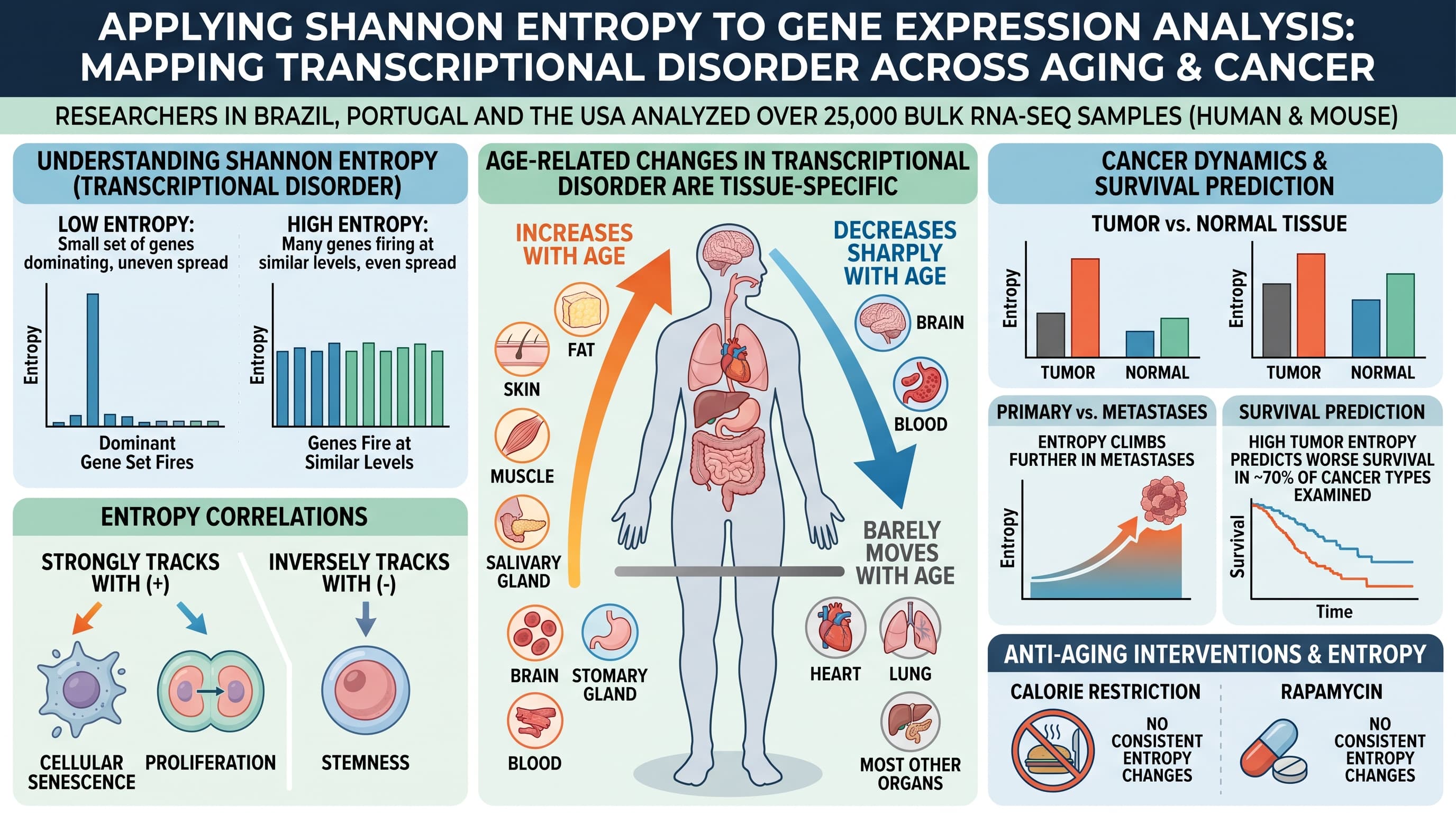
Researchers in Brazil, Portugal and the United States applied Shannon entropy, a measure borrowed from information theory, to more than 25,000 bulk RNA-sequencing samples from human and mouse tissues. Entropy here means how evenly gene expression is spread across the genome: high entropy indicates many genes firing at similar levels, low entropy indicates a smaller set of genes dominating. The headline result is that transcriptional disorder does not simply accumulate with age everywhere. It rises in skin, fat, muscle and salivary gland, falls sharply in brain, blood and stomach, and barely moves in heart, lung and most other organs. Entropy tracks strongly with cellular senescence and proliferation, and inversely with stemness. In cancer, tumours almost always show higher entropy than the tissue they arose from, entropy climbs further in metastases, and high tumour entropy predicts worse survival in roughly 70 percent of cancer types examined. Notably, neither calorie restriction nor rapamycin produced consistent entropy changes.
For two decades, aging biology has run on a tidy metaphor: the genome is a signal, and time is static. Cells accumulate noise, regulatory precision degrades, and identity blurs. The metaphor is satisfying, and it has driven work on epigenetic drift, transcriptional noise and loss of cell identity. This paper takes the metaphor seriously enough to measure it at scale, and the answer that comes back is more awkward than the story predicted.
The team calculated Shannon entropy for every sample in the GTEx healthy tissue atlas and the TCGA cancer atlas, then extended the analysis to mouse datasets, prenatal human tissue, single cell atlases and several disease cohorts. Entropy is a single number describing how expression is distributed across all expressed genes. A tissue running a narrow, specialised program has low entropy. A tissue running many genes at once has high entropy.
If aging were uniform decay, entropy would rise everywhere. It does not. Brain shows the strongest relationship of any tissue, and it goes the wrong way for the decay story: entropy falls with age, and does so more steeply than it rises anywhere else. Blood and stomach follow the same downward path. Meanwhile adipose tissue, salivary gland, skin, nerve and skeletal muscle drift upward. Most organs, including heart, lung, liver, kidney and colon, show essentially nothing. Aging, measured this way, is organ specific rather than systemic.
What entropy does track reliably is cellular state. Across tissues, higher entropy accompanies more proliferation and more senescence, and less stemness. That combination is odd, because proliferation and senescence are usually treated as opposites. The authors argue both increase transcriptional heterogeneity within a tissue, which bulk sequencing reads as disorder. Deconvolution supported this: high entropy skin contains more basal and fewer mature keratinocytes, and high entropy muscle contains more fibroblasts, fat and immune cells with fewer myocytes, a compositional signature that looks like sarcopenia and inflammaging.
Cancer is where the signal sharpens. Primary tumours carry higher entropy than matched adjacent normal tissue in nearly every cancer type tested. Melanoma shows a clean gradient from unexposed skin, to sun exposed skin, to primary tumour, to metastasis. In five of six melanoma patients, entropy rose after relapse on targeted therapy. Mice with mesothelioma that responded to checkpoint blockade showed falling entropy; non-responders did not. Chemotherapy, androgen blockade and steroids all reduced entropy, consistent with treatment acting as a selective filter.
There is a twist that complicates any simple reading. When the team applied the same measure to cells undergoing Yamanaka factor reprogramming, the rejuvenation technique that resets aged cells toward an embryonic state, entropy went up rather than down. Prenatal tissue also carries higher entropy than tissue after birth. Whatever this number is capturing, it is not damage. It looks closer to plasticity, the capacity of a cell to become something else, which is precisely why the same reading flags both a rejuvenated cell and a tumour.
The most sobering result sits in the supplement. Calorie restriction and rapamycin, the two best validated lifespan interventions in mammals, produced no consistent entropy change in mouse or human tissue. Across mammal species, baseline tissue entropy showed no relationship to maximum lifespan either. Entropy may describe aging without being a lever that aging interventions pull.
Actionable Insights
This paper is diagnostic, not prescriptive, and the honest bottom line is that it validates almost no intervention.
The one exception is photoprotection. Melanoma entropy climbs in a straight line from sun-protected skin, to sun-exposed skin, to primary tumour, to metastasis. Sun-exposed skin already sits partway toward the tumour state. That is correlational and cannot prove causation, but it aligns with everything known about ultraviolet mutagenesis, and sunscreen is close to free.
For the rest, here is what the numbers actually mean. The paper reports correlations (rho), which run from -1 to +1. Squaring rho gives the fraction of variation explained. The strongest aging correlation, brain entropy declining with age at rho = -0.40, explains 16 percent of the variation between people. Converted to a standardised effect size, that is Cohen’s d of about 0.87, which is a large effect. Fat tissue at rho = 0.26 explains 7 percent, d of about 0.54, a moderate effect. Muscle at rho = 0.17 explains 3 percent, d of about 0.35, a small effect.
Critically, calorie restriction and rapamycin, the two interventions with the strongest lifespan evidence in mammals, changed entropy inconsistently or not at all. So entropy is not currently a target you can act on, and no supplement, diet or drug in this paper was shown to move it in a beneficial direction. Treat it as a research metric.
Context and Source
- Open Access Paper: Tissue-Level Transcriptomic Entropy Reveals Organ-Specific Aging Patterns and Predicts Cancer Progression
- Institutions:
- Hospital Sírio-Libanês, São Paulo, Brazil (lead and corresponding institution)
- i3S, Instituto de Investigação e Inovação em Saúde, Universidade do Porto, Portugal
- Aging and Aneuploidy Laboratory, IBMC, Universidade do Porto, Portugal
- Instituto de Química, Universidade de São Paulo, Brazil
- University of Wisconsin-Madison, Wisconsin, USA
- Countries: Brazil, Portugal, United States
- Journal: Aging Cell (Wiley, on behalf of the Anatomical Society)
- Impact evaluation: The impact score of this journal is 7.7 (Journal Impact Factor), evaluated against a typical high-end range of 0 to 60+ for top general science, therefore this is a Medium impact journal.