YES! You can reduce your CAC score!

My father just had a CAC score test done after his first baseline one.

In the 2 years between the tests he started taking a statin (Atorvastatin 10 mg), Ezetemibe and Bempedoic Acid daily. His ApoB is between 38-48.

His CAC score 2 years ago was 323 in the 52% for his age (almost average)
His new CAC score 2 years later was 282 in the 44% for his age (15% decrease! and below average)

Also the measured calcified plaque went down in 3 of the major 4 arteries measured. His arterial age was 81 when he was 77. Now it is 80 when he is 79. So, yes, you can get rid of calcified plaque!!!

5 Likes

@Bicep Might be interested in this great result…

Does anyone know what are the error bars on CAC measurement? Depending on that, the reported decrease may not be significant. For instance if CAC is +/- 25 of the reported number, the reportedly changed CAC scores may just overlap.

Also, CAC numbers are suppossed to go up with age, and these went down. I think a 15% change is more than an error.

1 Like

You may be right, but… In my case I’ve had a series of CAC scans.
5/97 CAC zero
10/20 CAC 157
8/22 CAC 287
6/24 CAC 242,
Current age is 75, Levine bio age 64
So, looking at my last 2 scans, did I successfully reverse the CAC or is it just an overlap due to the error bars not being reported ?
To be fair, I did increase my Rosuvastatin to the max and added Ezetimibe after 8/22
However, my question is still… what are the error bars on the reported CAC numbers?
( I do plan to do another CAC or CTAngio in August to decide on whether or not to add inclisiran.)

1 Like

From Gemini. It could be statistical error. However…

Even though the 15% decrease could be a technical illusion, this test result is a massive clinical win for a 79-year-old male.

Zero Progression: In an untreated individual, coronary calcium scores typically increase by 20% to 25% every single year as a natural part of aging and progressive vascular disease. Over two years, a score of 323 would normally be expected to climb well over 450.

Disease Stoppage: The fact that his score dropped slightly means his plaque buildup has completely halted and stabilized. The disease is sleeping, not growing.

Either way, it’s a win. We will rescan in 2 years.

1 Like

The OpenEvidence AI comments:
" Coronary artery calcium (CAC) Agatston scores carry interscan variability of approximately 10–20% , with a standard deviation of roughly 10% on contemporary scanners. "
So for a CAC of 250 the error bars are +/- 25 for a contemporary scanner or as much as +/- 50 for an older scanner.
So, I don’t think we have any proof, in this thread, that CAC numbers are reversible.

2 Likes

I think being able to reduce your CAC score beyond 20% may be difficult. It’s similar to saying I’ll beleive in longevity if someone hits 150 (20% above Jean Calment’s record).

I guess you can either choose to beleive CAC regression or not. Even if you don’t beleive it decreased, it did not gain the 20-25% it should have in a typical man of his age. That is an achievement in and of itself.

I’ll post his updated score after his next scan in 2 years. Maybe it will go down further? Honestly, these results were better than I expected in any case so I am pleased.

Also, they are developing therapeutics which do actually regress calcified plaque. Maybe this will all be a moot point when those drugs are approved.

I asked Claude Opus 4.8 to summarize the clinical and scientific evidence of Low LDL lowering CAC scores. Here is what it said:

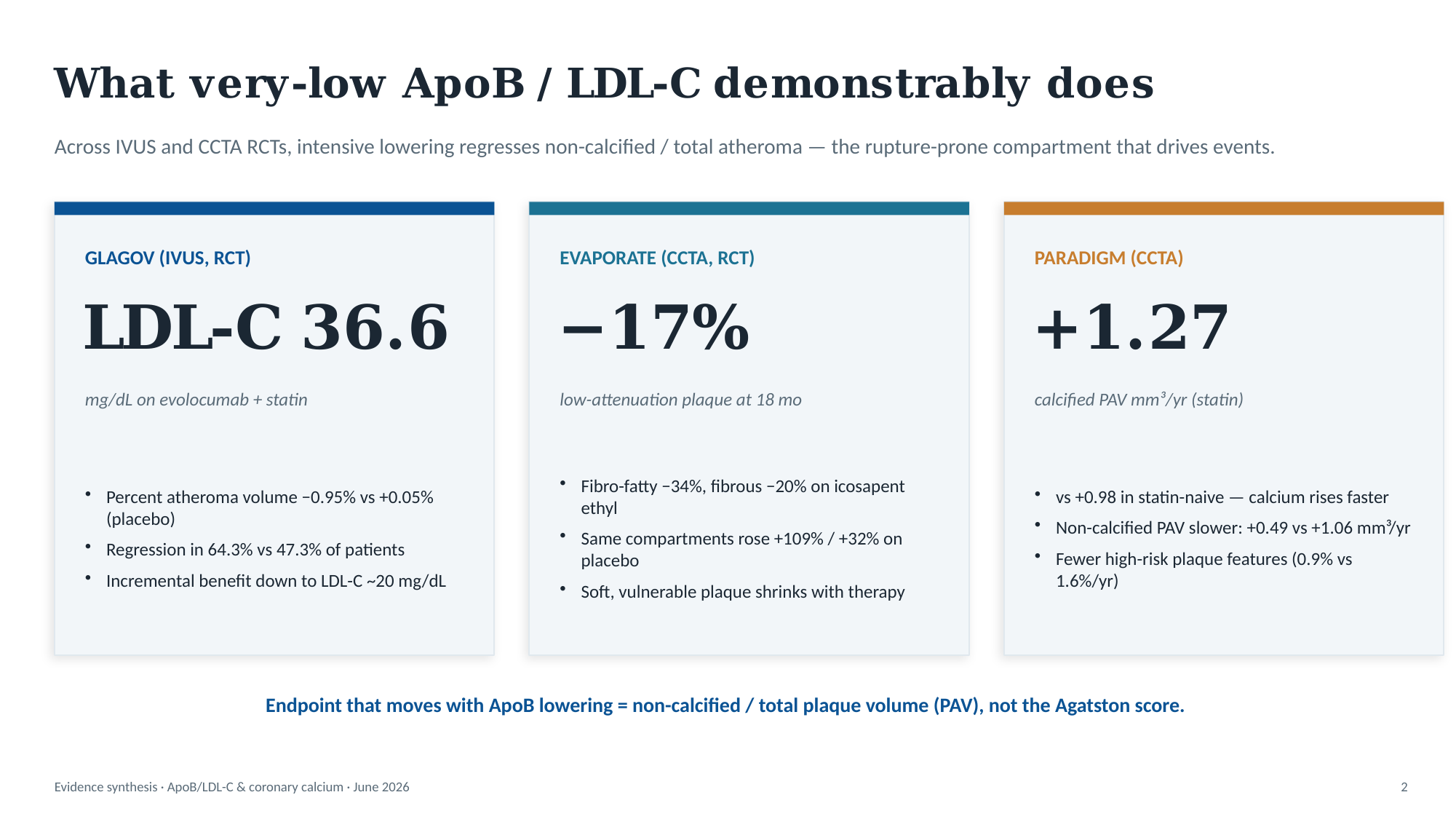
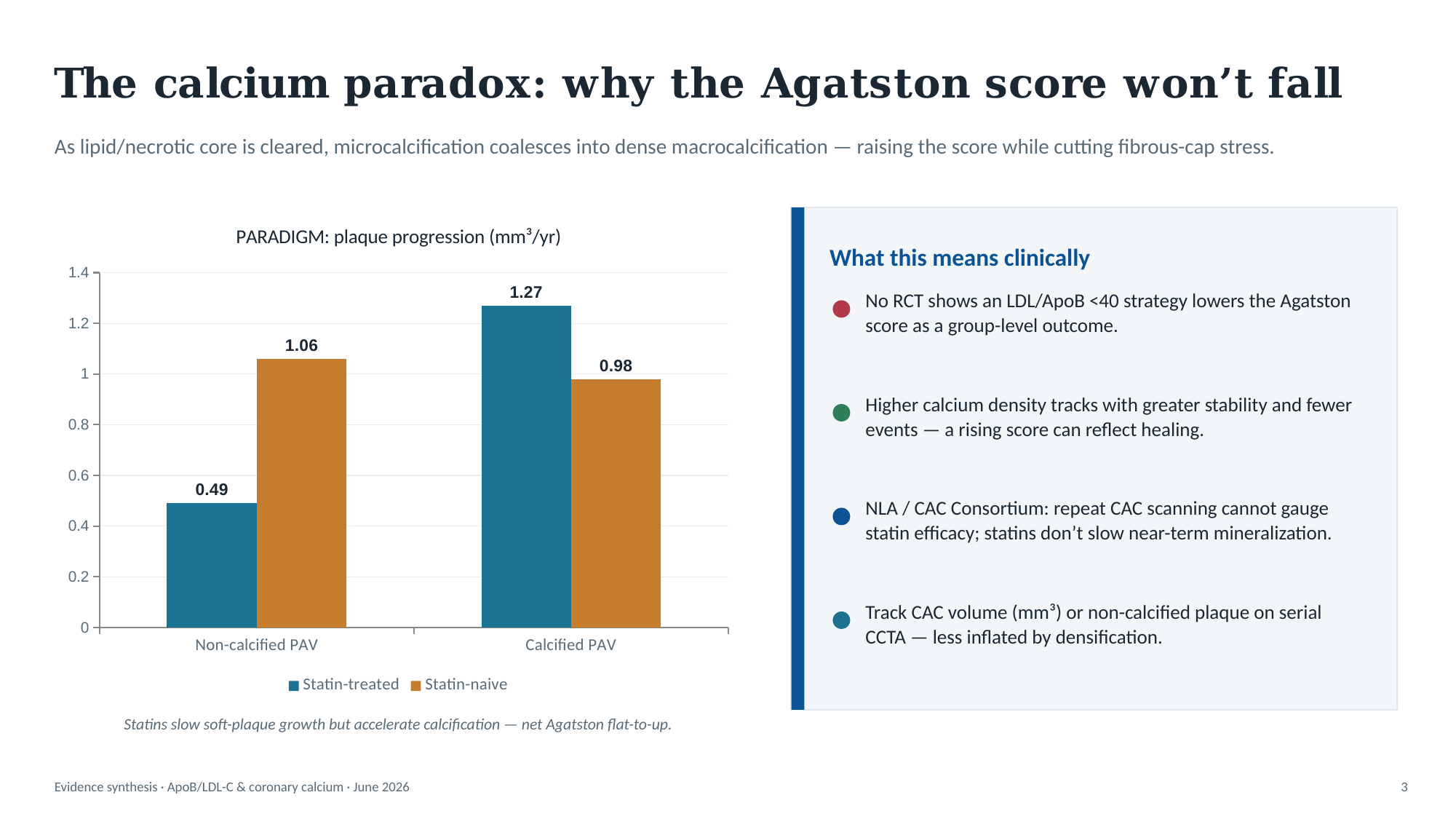
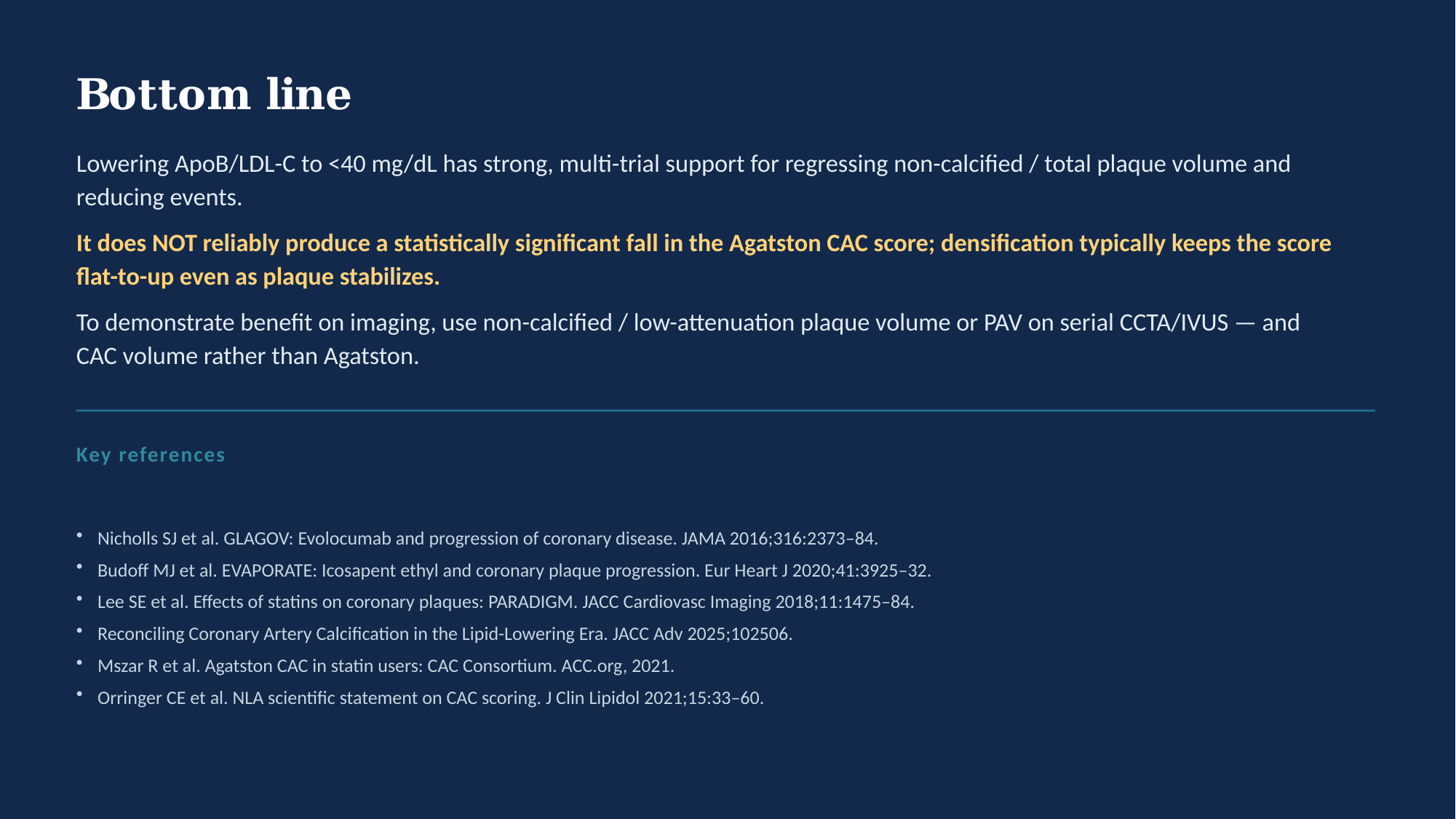
There is good, multi-trial evidence that lowering ApoB/LDL-C to very low levels (<40) regresses non-calcified plaque volume and reduces events. There is no high-quality evidence that it produces a statistically significant decrease in the Agatston CAC score; the densification effect generally pushes the Agatston number flat-to-up even as the plaque becomes more stable. If the goal is to demonstrate benefit on imaging, the defensible endpoints are non-calcified/low-attenuation plaque volume or PAV on serial CCTA/IVUS — and CAC volume rather than Agatston — not the calcium score itself.


2 Likes

This is odd then. If statins and cholesterol treatments are suppossed to increase the CAC, it’s doubly odd that the CAC score declined.

The Average Annual Increase [1]

  • Statin Monotherapy: Clinical trials published in journals like Nature and Atherosclerosis show that standard statin therapy typically causes an annual CAC score progression of roughly 25% to 30% per year. [1, 2]
  • The Non-Statin Baseline: For comparison, individuals not taking a statin but who already have plaque buildup naturally progress at a rate of about 15% to 18% per year. [1, 2]
  • The “Statin Premium”: This means the medication itself is responsible for an additional 7% to 12% absolute increase in the score each year beyond the natural progression of the disease

So, my father, taking a statin decreased by 15% when it was expected he should increase by 25-30% per year. Or 15-18% per year with no therapy. A 15% reduction over two years, is amazing. Even if you assume a statistical error, there’s some valuable reductions here. Maybe all calcified plaque is not equal?