Left anterior descending artery of heart is 25-49% occluded at 30 years old.
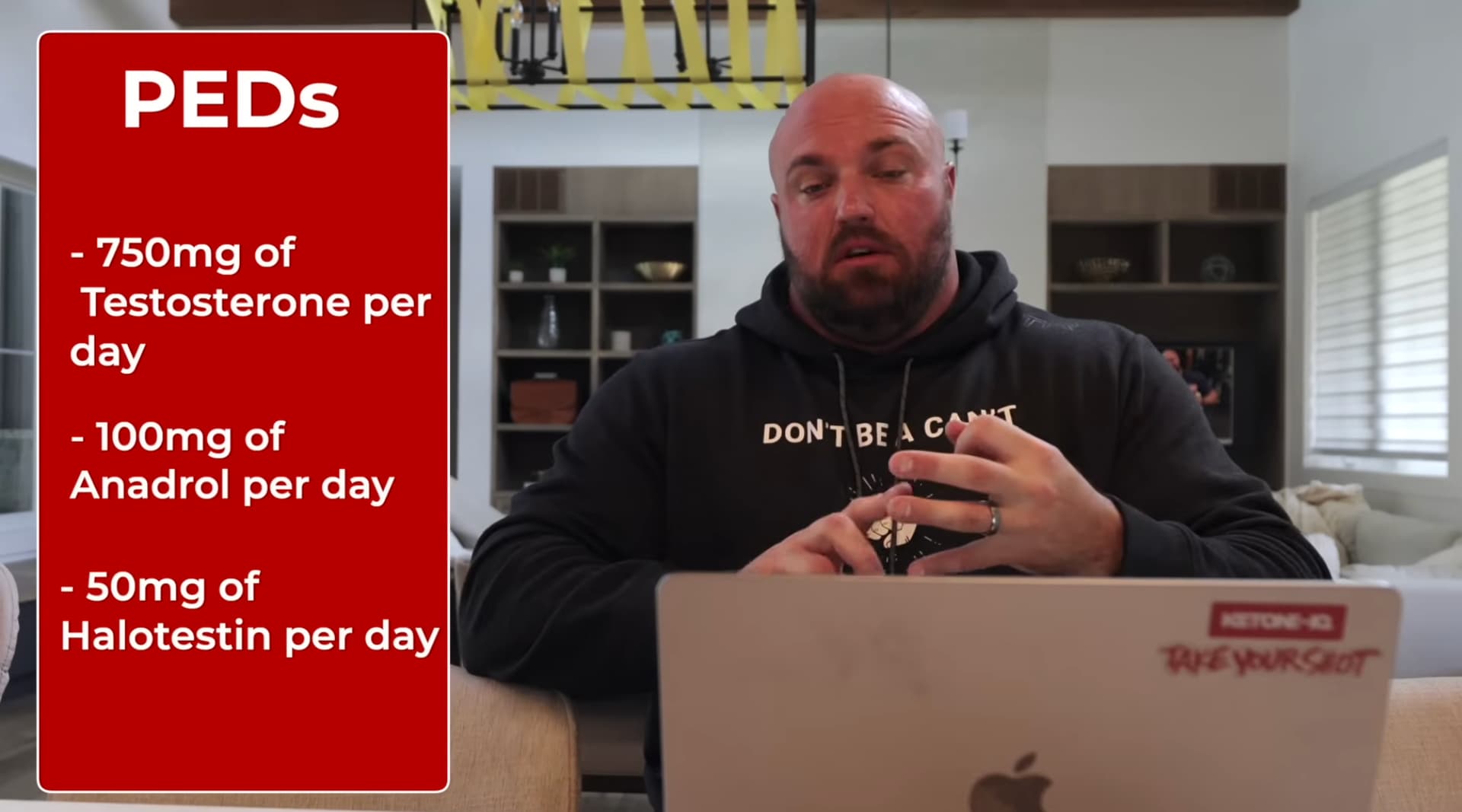
He did not mention if the drugs used were per day or per week as some can be either daily or weekly due to half life. Maybe someone can correct it if it’s wrong.
Base stack:
-testosterone: 750mg (weekly)
-npp: 300mg (weekly)
-masteron: 100mg (weekly or daily, not sure)
-adderall: 30mg day (is prescribed 60mg/day)
Total with masteron at 700mg/week (plus not adding the adderall dose) =1750mg/week
Add-on to the base stack for a short period only:
-anadrol: 100mg (probably per day)
-halo: 100mg (probably per day)
=3150mg
Not sure if the this guy is taking other medications or supplements.
There are some great posts & stacks people have posted here to help possibly avoid various issues like high LDL levels, high cholesterol, high blood pressure etc.
I guess people have different thought processes on what it means to “live a great life,” but I can’t help but think many strongmen, bodybuilders, powerlifters, and other athletes taking PED’s will regret their choices down the road.
I do give him a ton of credit for his transparency though, given that most people aren’t too keen to share about what their PED use looks like. He is also very quick to state that this is simply a bad idea from a health point of view.
Having his LAD partially blocked at such a young age is quite concerning. I wonder if he retires at age 35 and were to “turn things around” if he could reverse (or at least halt) the progression of heart disease and other health problems he faces.
At 6"3 and about 330 lbs he is certainly a huge individual and being that large puts major strain on pretty much every organ system in the body. Though he isn’t even close to the size of Hafthor Bjornsson at about 450 lbs or Brian Shaw at 415 lbs (though all of these “strongmen” have weights that fluctuate a lot).
I’m sure the massive amount of daily calories, saturated fat, etc., that come with life in the strongman world don’t do him any favours either. And while he’s clearly got great genetics to be strong, perhaps they aren’t so good when it comes to plaque accumulation in his arteries.
I watched another video from him from about 3 months ago and apparently that testosterone dose is per day… which equates to 5250mg/week (about 50x the amount given for TRT).
According to this video his cholesterol, LDL, and liver values are pretty high, while his glucose, HBA1C, and triglycerides are good.
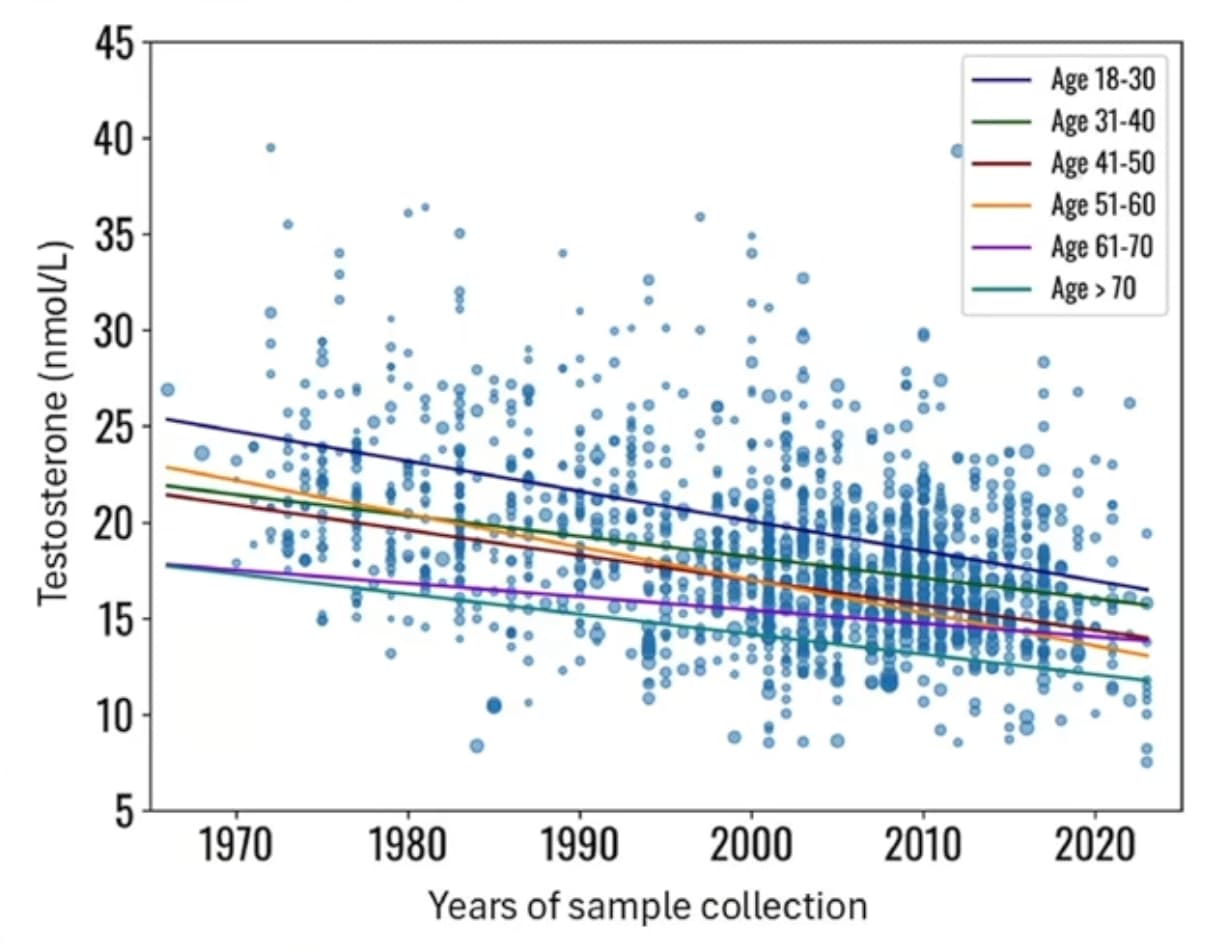
I’ve see similar charts before, but the apparent decline in testosterone over the years is interesting too. I wonder if the primary contributing factor is that humans are just living less healthily than they once were… granted things like endocrine disrupting chemicals in our environment aren’t doing us any favors either.
A summary of the first video in this thread, and analysis of factualness:
I. Executive Summary
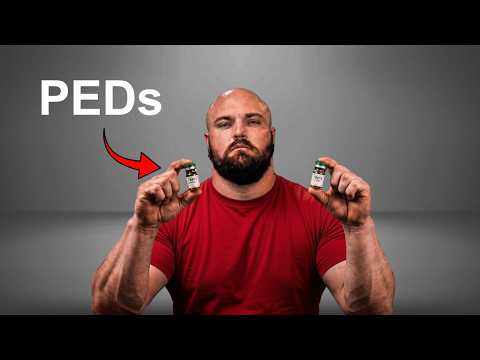
In this video disclosure, Mitchell Hooper, the reigning World’s Strongest Man (WSM) champion and clinical exercise physiologist, outlines his high-dose performance-enhancing drug (PED) regimens utilized during his competitive season (Arnold Classic, World’s Strongest Man, Enhanced Games) and his tapering/titration protocol leading into the upcoming Rogue Invitational. Hooper details the severe physiological ramifications of supraphysiologic polypharmacy involving anabolic-androgenic steroids (AAS), 17-alpha-alkylated oral compounds, and central nervous system (CNS) stimulants, explicitly acknowledging the presence of premature, clinically significant subclinical coronary artery disease (a 25% to 49% occlusion of his Left Anterior Descending [LAD] coronary artery diagnosed via coronary computed tomography angiography at age 30).
Hooper presents two distinct pharmacological stacks: a high-toxicity peak contest stack (750 mg/week Testosterone, 300 mg/week Nandrolone Phenylpropionate [NPP], 100 mg/week Masteron [Drostanolone], 30 mg/day prescription Adderall [mixed amphetamine salts], stacked acutely with 100 mg/day Anadrol [Oxymetholone] and 100 mg/day Halotestin [Fluoxymesterone]) and a moderated upcoming contest stack (500–750 mg/week Testosterone, 200–300 mg/week NPP, 50 mg/day Anadrol for the final 2 weeks, eliminating Halotestin and chronic daily Adderall). Hooper discusses complete hypothalamic-pituitary-gonadal (HPG) axis shutdown experienced following cold-turkey cessation when transitioning across borders without replacement therapy, emphasizing profound subjective physical and psychological exhaustion.
From a clinical and translational perspective, Hooper’s assertion that fertility is the primary risk of AAS abuse—relegating cardiovascular, hepatic, and renal pathology to secondary status—is contradicted by clinical cardiology and toxicological literature. Supraphysiologic androgens accelerate atherogenesis via severe dyslipidemia (near-total high-density lipoprotein [HDL] suppression, low-density lipoprotein [LDL] elevation, and hepatic lipase hyperactivation), induce concentric left ventricular hypertrophy (LVH) with diastolic impairment, trigger vascular endothelial dysfunction, and heighten acute thrombotic risk. Furthermore, co-administering sympathomimetic CNS stimulants (Adderall) alongside hepatotoxic and hypertensive 17-alpha-alkylated androgens creates an extreme cardiotoxic milieu, significantly increasing the probability of coronary vasospasm, arrhythmia, and plaque rupture in an already compromised LAD.
II. Insight Bullets
Mitchell Hooper provides an open disclosure of his anabolic-androgenic steroid and stimulant regimen utilized as reigning World’s Strongest Man heading into the Rogue Invitational.
Hooper states that elite strongman competition is untested, rendering performance-enhancing substance use ubiquitous and legally permissible within the private organizing federations.
High-dose exogenous androgens cause complete suppression of endogenous luteinizing hormone (LH) and follicle-stimulating hormone (FSH) release, leading to profound testicular hypofunction.
Abrupt androgen cessation following the 2026 Enhanced Games induced severe secondary hypogonadism, leaving Hooper with near-zero circulating serum testosterone and profound debilitating physical and mental fatigue.
The 2026 World’s Strongest Man peak preparatory regimen combined weekly injectables (750 mg Testosterone, 300 mg Nandrolone Phenylpropionate, 100 mg Masteron) with 30 mg daily Adderall.
For peak acute strength expression at WSM, Hooper stacked two oral 17-alpha-alkylated compounds: 100 mg daily of Anadrol (Oxymetholone) for three weeks and 100 mg daily of Halotestin (Fluoxymesterone) for the final week.
Hooper publicly credits exercise scientist Dr. Mike Israetel for advising him to cease stacking daily Adderall with high-dose androgens to avert sudden cardiac death.
Cardiovascular computed tomography angiography (CCTA) at age 30 revealed 25% to 49% stenosis in Hooper’s Left Anterior Descending (LAD) coronary artery.
Despite external clinical assertions attributing his premature LAD plaque to genetics, chronic supraphysiologic androgen exposure and heavy body mass (320–335 lbs) accelerate coronary atherosclerosis.
Hooper asserts that impaired fertility constitutes the primary concern of AAS use for young men, categorizing cardiovascular, renal, and hepatic damage as secondary issues.
For the upcoming contest, Hooper reduces overall toxicity by eliminating Halotestin and discontinuing chronic daily amphetamine salts.
The revised preparatory cycle starts at 500 mg Testosterone and 200 mg NPP per week, titrating at six weeks out to 750 mg Testosterone and 300 mg NPP.
Anadrol introduction is limited to 50 mg daily for the final two weeks prior to competition, halving the dose and duration utilized during WSM prep.
Acute CNS stimulation will be restricted to a single 30 mg dose of prescription Adderall taken solely on the day of competition.
Hooper notes that higher AAS dosages improve cosmetic muscularity and vascularity in bodybuilding, but often degrade overall functional athleticism, sleep quality, and systemic recovery in heavy strength athletes.
The speaker references historical cohort data showing a population-level, secular decline in male serum testosterone concentrations over the past 50 years.
Hooper promotes tele-health hormone clinic partner Enhance for diagnostic blood testing, endocrine optimization, and clinical testosterone replacement therapy (TRT).
Hooper advocates that recreational gym-goers and non-professional athletes avoid black-market polypharmacy and self-directed steroid cycles.
The competitive strength athlete body weight of 320 to 335 pounds imposes independent mechanical and hemodynamic burdens on the cardiovascular and renal systems.
Hooper argues that medical transparency concerning performance pharmacology is necessary to dispel false natural expectations among youth and amateur lifters.
III. Adversarial Claims & Evidence Table
Claim from Video
Speaker’s Evidence
Scientific Reality (Current Data)
Evidence Grade
Verdict
Fertility impairment is the primary clinical problem of AAS abuse; cardiac, renal, and hepatic damage are secondary.
Subjective clinical framing and observation of younger athletes seeking fertility recovery post-cycle.
Male infertility and azoospermia are largely reversible with hCG/SERMs upon cessation, whereas cardiovascular damage (concentric LVH, LAD plaque, myocardial fibrosis) and sudden cardiac death represent permanent, life-limiting pathologies (Kanayama et al., 2022).
Level A
Safety Warning
A 25% to 49% LAD coronary artery occlusion at age 30 is primarily driven by genetics rather than AAS exposure.
Personal physician/evaluator reassurance following cardiovascular screening at Enhanced Games.
AAS abuse directly drives premature atherogenesis via marked HDL suppression, severe LDL/ApoB elevation, vascular endothelin-1 upregulation, and coronary inflammation as quantified by pericoronary adipose attenuation (Ribeiro et al., 2022).
Level C
Unsupported
Combining high-dose 17-alpha-alkylated oral steroids (Anadrol/Halotestin) with prescription amphetamines (Adderall) creates an immediate lethal threat.
Personal discussion with exercise scientist Dr. Mike Israetel regarding extreme cardiovascular strain and lethality.
Amphetamines induce peripheral vasoconstriction, elevated heart rate, and coronary shear stress; combined with AAS-induced thrombophilia, altered platelet aggregation, and ventricular stiffness, this dramatically increases acute myocardial infarction and fatal arrhythmia risks (Niedfeldt, 2018).
Level C
Strong Support
Average 20-year-old men today exhibit the circulating testosterone levels of 60-year-old men from the 1970s.
Secular hormone charts and endocrine trends cited from historical population comparisons.
Multigenerational prospective cohort studies (e.g., Massachusetts Male Aging Study) confirm an age-independent secular decline in population testosterone (~1% annual reduction), strongly mediated by rising obesity rates, altered adiposity, metabolic disease, and endocrine disruptors, though exact chronological equivalencies vary (Travison et al., 2007).
Level C
Plausible
Dropping down to 500–750 mg Testosterone and 200–300 mg NPP per week represents a ‘moderate’ health-protective cycle.
Relative comparison to the extreme peak dosages commonly deployed in elite professional strongman and open bodybuilding.
Total weekly androgen intake of 700 to 1,050 mg represents 10 to 15 times normal physiological male production (~50–70 mg/week endogenous testosterone). It maintains complete gonadal suppression, sustains dyslipidemia, and perpetuates ongoing cardiac remodeling (Baggish et al., 2017).
I am almost certain that testosterone dose is a typo and the image meant to say per week. 750mg is a common weekly dose of testosterone among bodybuilders (1cc of a 250mg/ml vial 3x weekly). He sounds somewhat intelligent enough that he wouldn’t do something completely insane.
I don’t know what his labs look like or what his blood pressure is when he is “on” but I would be curious.