chatGPT(6.1):
Why Stars Are Aligning Between Science and Advocacy to Extend Health Span and Longevity
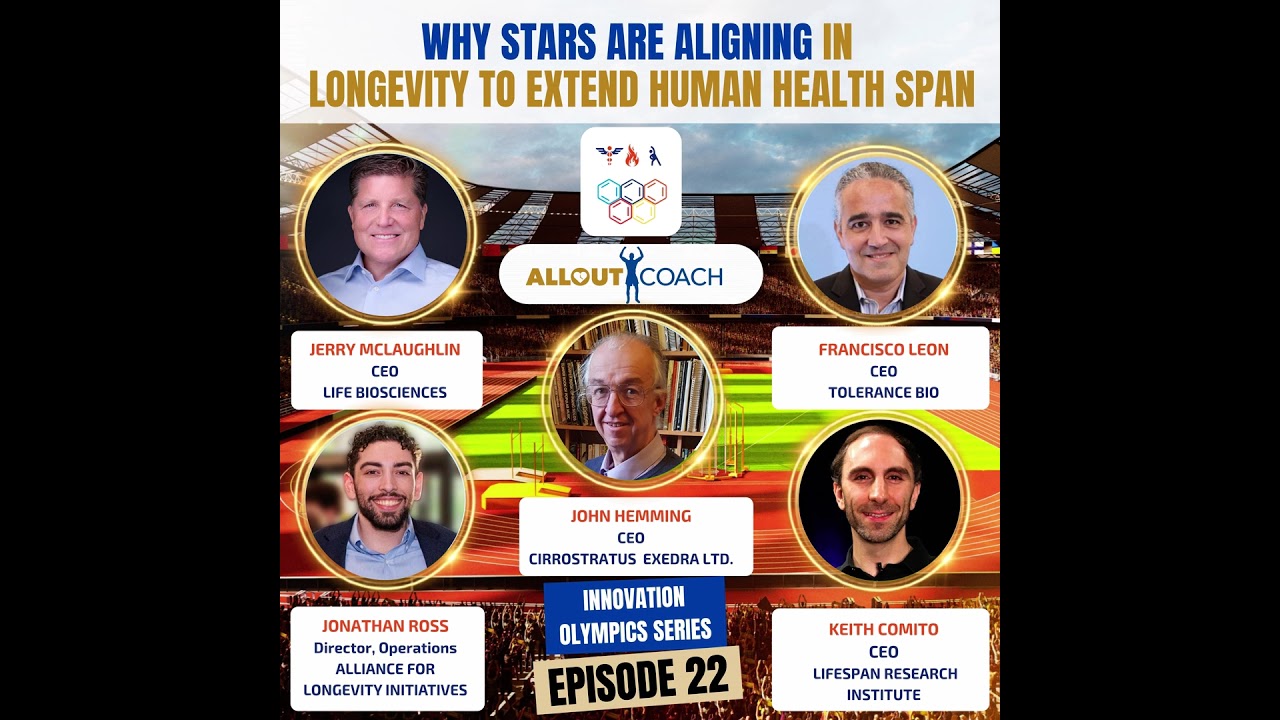
Closing panel of the 2026 Medical Innovation Olympics, held on 16 October 2026 at Rockefeller Center in New York. Tim Mikhelashvili moderated. Panelists were Keith Comito (Lifespan Research Institute), Jonathan Ross (Alliance for Longevity Initiatives), Francisco Leon (Tolerance Bio), Jerry McLaughlin (Life Biosciences), and John Hemming (Cirrostratus Exedra). Video | Organiser’s event report
Summary
The panel asked what it would take to turn ageing biology into better health and function. The speakers approached the question at three scales. Life Biosciences is testing whether partial epigenetic reprogramming can restore function in the eye. Tolerance Bio wants to preserve or rebuild thymic function and test whether vulnerable people experience fewer infections. John Hemming proposed a systemic mechanism involving mitochondrial citrate export, acetylation and gene expression, with kidney function and cataracts as examples of outcomes to investigate.
- 08:18 - ER-100. Jerry McLaughlin described an ongoing first-in-human trial in optic nerve disease, with glaucoma as his example. He asked whether a treatment could recover some lost vision. The company had already presented early safety and visual-field observations.
- 11:57 - The thymus. Francisco Leon described repurposing drugs to preserve or restore T-cell immunity. He proposed fewer infections, opportunistic infections or serious complications in older people and people living with HIV as the first meaningful clinical results.
- 14:44 - Systemic geroscience. John Hemming argued that an intervention affecting a shared process of ageing should show effects across tissues. He discussed mitochondrial citrate export, the two-carbon acetylation pathway and RNA splicing. He also described the difficulty of testing multiple interventions and the limits of individual health metrics.
- 16:21 - Patient advocacy and measurement. Jonathan Ross encouraged constituents to engage Congress through the Longevity Science Caucus. Keith Comito argued for measures of function people can recognise, including aerobic capacity, grip strength and chair-rise performance. The discussion also covered voice and gait as potential digital biomarkers.
- 24:18 - Policy and translation. Ross proposed a US national healthy-life-expectancy goal and, in the closing round, an FDA Multi-Disease Therapeutic Designation. Comito discussed ageing-research funding and a possible link between retirement-age changes and broadly shared gains in healthy years. Hemming raised personal medicine imports and the weak commercial incentive to test compounds with little patent protection. The biotech speakers favoured starting with specific disease indications.
- 31:42 - Audience questions and outlook. The questions covered cancer and immune surveillance, the food environment and glucose, and how FDA collaboration can affect trial design. The final round raised longevity escape velocity as a hypothetical future.
Critique
ER-100 is the most concrete clinical development
The important advance is that partial epigenetic reprogramming has reached human testing in the eye. Earlier work showed recovery of visual function in mouse models. ER-100 is a gene therapy designed to induce retinal cells to express three transcription factors, OCT4, SOX2 and KLF4. At the panel, McLaughlin described this loosely as delivering proteins. The company announced the first participant had received ER-100 on 9 June 2026 and released the first interim results on 8 October. The remarks at about 08:50 appear to run those milestones together. Mouse study | First-dosing announcement | October interim results
In the first three participants with open-angle glaucoma, the sponsor reported that treatment was well tolerated through day 56 and that visual-field sensitivity improved in two people. In each of those two, at least 28% of tested locations improved by more than 4 dB. The open-label study primarily assesses safety and tolerability. Without a comparison group, the apparent improvement could reflect test variability, familiarity with the test or a treatment effect. The next evidentiary step is a durable, prespecified difference against a suitable control, with repeated baseline testing and an outcome that captures how well people see in daily life. Any claim beyond the eye would need its own human evidence. Trial registration | October interim results | Visual-field learning effects in glaucoma
The thymus proposal has a testable clinical endpoint
Leon’s proposal to measure infections and their complications gives the thymus programme a practical early test. Thymic involution reduces the generation of naive T cells. Recent human observational work also associates better thymic health with lower risks of some diseases and death. A trial could measure new T-cell output and repertoire diversity alongside clinically defined infections, their severity and hospital admissions. That pairing would help tie a clinical effect to the proposed mechanism. The panel offered no clinical basis for the suggested ten extra healthy years, and offered the 30% winter nursing-home mortality figure without a defined population or source. Thymic involution review | Human observational study | Study of influenza and RSV mortality in nursing homes
The cancer discussion also has a relevant human study. In people receiving immune checkpoint inhibitors, better thymic health on imaging was associated with longer progression-free survival. That association gives a rationale for a treatment study. The causal question is whether improving thymic function changes the outcome for otherwise comparable patients. Thymic health and immunotherapy outcomes study
The acetylation hypothesis needs a causal test
There is experimental support for individual links in Hemming’s proposal. ATP-citrate lyase can convert citrate to acetyl-CoA for histone acetylation, and changes in histone acetylation can alter splice choices. The open question is whether limited citrate-derived acetyl-CoA drives the age-related changes at issue, in which cells, and whether restoring it improves function. An October 2026 preprint makes direction and cell context worth testing directly. The authors used neurons directly converted from the cells of people with Alzheimer’s disease and age-matched controls. They reported that excess nuclear acetyl-CoA and hyperacetylation of RNA-binding proteins contributed to splicing changes in the Alzheimer’s disease model. A direct test would ask whether restoring citrate-derived acetyl-CoA also restores acetylation and splice-junction use in the same cell type, and whether that rescue translates into a prespecified functional benefit. Citrate and histone acetylation study | Histone acetylation and splicing study | Alzheimer’s neuron preprint
Kidney function is a useful candidate outcome, especially if changes are corroborated by repeat measurements and assessed alongside another organ system. Creatinine and cystatin C each have influences beyond filtration. A stronger study would use repeated measurements with both markers, consider measured filtration where precision is central, and specify in advance what result would count as a systemic benefit. Likewise, records from self-experimentation can help generate hypotheses about combinations, while controlled comparisons are needed to estimate the effects of individual interventions and their interactions. KDIGO kidney function guidance | NIDDK on estimating filtration | Factorial trial design guidance
Clinical function gives the biomarkers a job to do
Comito’s examples of walking, getting out of a chair and maintaining independence are the clearest way the panel made healthspan tangible. Hemming’s Goodhart’s law point adds a test-design issue. Training for a grip or chair-rise test can improve that particular task, so a multi-system claim calls for a prespecified set of measures across domains. An epigenetic clock, a voice score or thymic output can help explain a result. Using one as a surrogate for clinical benefit requires evidence for that particular use. The discussion at 31:05 gave too broad an account of FDA reluctance. In June 2026, the FDA granted accelerated approval to teplizumab for certain children with recently diagnosed stage 3 type 1 diabetes based on a slower decline in C-peptide, a marker of endogenous insulin production. The FDA accepted it as reasonably likely to predict clinical benefit and required a follow-up study to verify that benefit. Validation of ageing biomarkers | FDA teplizumab decision
The policy proposals need explicit measures of success
Ross’s figure of about 12.5 years is close to the 12.4-year gap a 2024 JAMA Network Open analysis estimated for the US using 2019 WHO data, the largest among the 183 countries studied. The statistic is the gap between life expectancy and health-adjusted life expectancy. It represents an equivalent loss of years in full health across the population, with different weights for different health states. The national target would be more informative with both figures tracked together and results reported by income, geography and sex. A smaller gap on its own can result from a fall in life expectancy. Healthspan-lifespan gap study
Ross’s multi-disease proposal is a way to coordinate FDA review when one candidate is being developed across several conditions. Its practical test is whether developers can share evidence where it is applicable while still demonstrating clinically meaningful outcomes and acceptable safety for the intended uses. Composite outcomes can make a trial feasible, but results for the individual components matter if one frequent event accounts for most of the effect. Multi-Disease Therapeutic Designation proposal | TAME trial design example
Other claims worth checking
- 24:18 - US healthcare spending. The OECD’s 2025 country note put US health spending at 17.2% of GDP and prevention at 3.6% of current health spending. The second figure uses health spending as its denominator. The captions leave the moderator’s 1% figure and its denominator unclear. OECD US country note
- 27:22 - Personal imports. The contemporary US action was a customs compliance deadline extension to 20 January 2027 for certain international mail requirements. FDA rules and enforcement discretion for medicines are a separate issue. The panel’s broader question about funding evidence for off-patent drugs deserves to stand on its own. US Customs notice | FDA personal importation policy
- 34:45 - Glucose. The conversion of 8 mmol/L to roughly 144 mg/dL is correct. The panel offered no evidence for a universal switch in polyol-pathway activity at that concentration. Activity depends on glucose exposure and tissue context. There is more direct evidence for a narrower point made earlier. In a randomised crossover study of adults with type 2 diabetes, walking after meals lowered post-meal glucose more than advice to walk without specifying timing. Polyol pathway review | Walking crossover study
- 37:35 - Longevity escape velocity. Aubrey de Grey published the concept in 2004, and later used the full phrase “longevity escape velocity” in a published essay. Moving from an expected lifespan of 80 to 90 over a decade illustrates an average gain of one year per year over that interval. Escape velocity is the hypothesis that successive advances can keep raising the expected age at death for people already alive fast enough to offset the years they age in the meantime. No forecast or evidence for crossing that threshold was presented. De Grey’s 2004 article | De Grey’s later essay
Tidied transcript
Edited from the supplied captions. Timestamps indicate the approximate start of a speaking turn or passage. Filler, false starts and repeated caption fragments have been trimmed. Speaker labels follow the introductions, the organiser’s programme and the conversational handovers. Brackets indicate stage directions or unclear caption text. The speakers’ claims and chronology are retained from the captions. Some long sentences were recast for readability. Fact checks appear above.
00:00 - Opening excerpts
00:00 - Keith Comito
This has been a dream of humanity going back to the Epic of Gilgamesh, but for a long time it was completely out of reach. Now we’re entering a moment when attacking the root causes of ageing is becoming possible.
00:16 - Jonathan Ross
The best thing I’d like to see done is to introduce a national health expectancy goal. The one thing we’re not seeing right now is accountability. We are currently the nation with the biggest gap between lifespan and healthy life expectancy. It’s twelve and a half years. That’s a significant number. Twelve and a half years sick. That’s a sentence.
00:40 - Francisco Leon
Preventing infectious diseases has already more than doubled our healthspan through history. I still believe that we can do a bit more and add ten more years of healthspan by further improving our immune resilience by any of the mechanisms we’re working on.
01:00 - Jerry McLaughlin
Reversing ageing in cells to restore function where it’s been lost. We’re very excited that at this point we’ve entered human clinical trials. The first humans have received an epigenetic restoration therapy, and five years ago that was impossible. It was never going to happen.
01:13 - John Hemming
One of my key measures to look at is kidney function, because kidney function generally deteriorates. Although it’s hard to measure because you can’t rely on the biomarker alone, if you have a systemic improvement, it will improve kidney function.
01:38
[Intro music]
02:35 - Moderator’s opening and introductions
02:35 - Tim Mikhelashvili
All right. We’re ready for our next panel. It’s the final closing ceremony. It’s an emotional event, so I want to start with some emotions before we get into the science and the advocacy here.
Two years ago, when we talked about longevity, we showed pictures of children. You see eternity in the eyes of children, just as you see wisdom in older people. If you’re able to connect these generations with the medications that we have in the future, imagine the world that we can create.
Right now there’s a lot of excitement in ageing biology, and the stars are really aligning from the perspective of health systems, pharma and the industry. Eli Lilly recently said that it’s no longer a sick company. It’s a health company. We’re moving towards preventive medicine, and a lot of people are following this field.
This panel is therefore appropriately titled “Why Stars Are Aligning Between Science and Advocacy to Extend Health Span and Longevity.” Why don’t we introduce ourselves?
04:03 - Keith Comito
Hi, everyone. I’m Keith Comito, president and CEO of the Lifespan Research Institute. We’re a 501(c)(3) nonprofit focused on driving forward research aimed at extending healthy human lifespan through a variety of programmes. We spin out companies, do advocacy, run a news outlet at Lifespan.io and help build the ecosystem by connecting companies with investment.
To build on what Tim is saying, this has been a dream of humanity going back to the Epic of Gilgamesh. For a long time it was completely out of reach, and now we’re entering a moment when attacking the root causes of ageing is becoming possible. The question is how we use that power to inspire the public without overhyping it, and how we do it in a way that reaches the public and not just a few people. It’s an exciting time, and I’m looking forward to talking with the rest of the panel.
05:03 - Jonathan Ross
Hi, everyone. My name is Jonathan Ross. I’m director of operations for the Alliance for Longevity Initiatives. We are the first and only 501(c)(4) advocating on behalf of longevity science and for extended healthy human lifespan.
05:23 - Francisco Leon
Good morning. I’m Francisco Leon, CEO of Tolerance Bio. We’re a biotech company focused on the thymus. The thymus is not the thyroid. [Laughter] It’s an organ in the chest. For a long time everybody believed it disappeared in adults. The reality is that it’s the educator of the immune system, it keeps working throughout life, and it determines your longevity. The company is focused on how to preserve it, regenerate it and modulate it to extend health.
05:59 - Jerry McLaughlin
Thirty-six years ago I was looking for a job in banking and finance, and I took an interview on campus with Merck. They were America’s most admired company, and they had really good health benefits. My parents said that was important in my first job. Maybe someday I’ll make my way towards banking and finance, but 36 years later I couldn’t have imagined doing anything else.
All kidding aside, I’m Jerry McLaughlin with Life Biosciences. What we do in our industry is underrecognised. We do good things and help a lot of people, and that’s what it’s about for me. George W. Merck, who founded Merck, had a saying. If we focus on the patients, the profits will follow. That told me that as a business person it’s OK to do well if we’re doing well for others.
Life Biosciences is tapping into what I think is the next frontier. We’ve unlocked the underlying biology of ageing, and we have a chance to redefine what treating and managing disease looks like. We can move from managing decline towards being younger and healthier, and restoring function where it’s been lost.
07:11 - Tim Mikhelashvili
John?
07:11 - John Hemming
I’m John Hemming. I’ve done various things over time. I’ve run a computer technology business. I’ve been a member of the UK Parliament. I’m a musician from time to time as well. These days I’m working with the University of Birmingham and a team of biohackers.
The difficulty we face with interventions for longevity is that if we need more than one intervention, every time you add a new one the problem of testing it multiplies. There is an advantage to a process where you try multiple interventions and keep a lot of records about what impact there is from one intervention to another. We tend to focus on acetylation, which is a two-carbon pathway, rather than the one-carbon pathway. It’s linked to mitochondrial function and citrate export. That’s where my focus tends to be, along with splicing and things like that.
08:10 - ER-100, thymic function and systemic ageing
08:10 - Tim Mikhelashvili
Thank you, John. Jerry, you’ve done a lot of research recently and announced some breakthroughs. Can you give us a brief snapshot of the mechanism and the results you’re targeting at this stage to validate ER-100?
08:27 - Jerry McLaughlin
Basically, we target aged and injured cells and make them young again. Technically, we do that by delivering proteins to these cells specifically. The question comes up, are you reversing ageing? I say we’re reversing ageing in cells to restore function where it’s been lost.
We’re very excited that we’ve entered human clinical trials. Just last week, and you’ll hear more about this later, the first humans received an epigenetic restoration therapy. Five years ago that was deemed impossible. It was never going to happen. Here we are with an ongoing phase 1 clinical trial. We’re extremely excited about the ability to redefine how we think about medicine.
I’ll give you a specific case study in glaucoma. In my early days of work I was in ophthalmology, and I remember looking at the history. I’ve gone back and reaffirmed it. We’ve been treating glaucoma for 170 years. The gold standard today remains what it was in 1855, when in Germany an incision in the eye released the pressure [unclear]. To this day, and at the American Academy of Ophthalmology last week, the question was how much we can slow the worsening of vision over time.
Then this little company, Life Biosciences, shows up, and we presented early data last week. We’re asking whether, in very short order, we can restore vision where it’s been lost. I’m more on the business side, with great respect for the science. It’s scientifically on the frontier, but you also think about the patient population, reimbursement and the value you bring.
I’ll round down and say that there are roughly four million glaucoma patients in the United States today. The number is growing fast with the ageing population. Despite all these wonderful intraocular pressure-lowering treatments, implants and procedures, more than a million patients progress from mild to moderate glaucoma, and just under a million get to severe glaucoma. Once you’re at those stages, despite these treatments, your vision is going. In glaucoma you lose your vision from the outside in, so your world is collapsing visually.
It has a tremendous impact on quality of life. We know that visual impairment is associated with a 50% greater likelihood of dementia. Depression is three times as likely. Patients become socially isolated, and they’re more likely to fall or have hip fractures. It leads to an incredible loss of quality of life and a burden on the system.
We feel it’s our mission to create a new way to help these patients. In medicine we often say we have options already, so there’s no need. Then people working at the frontier redefine what the expectations should be. We’re at that point in ageing biology. We like to think we have a master key that can affect disease throughout the body. We’re starting in the eye, but you’ll hear later about the possibilities for this underlying biology of ageing. We’re not the only company. More are coming. I think in ten years we’ll look back and ask why we ever thought about it the way we did 30 years ago.
11:57 - Tim Mikhelashvili
Francisco, a lot of us in longevity medicine, or those who follow this field, think about preventing risk factors for ageing and mortality. You’re taking a different approach by trying to improve immune resilience. Can you share how Tolerance Bio approaches this?
12:22 - Francisco Leon
I think it’s exciting that we’re all working on complementary approaches. There are companies like Life Biosciences that are focused on fundamental molecular mechanisms of ageing that can work across multiple tissues and organs. Then there are companies like mine that are focused on one specific aspect of ageing and are trying to use it to increase healthspan. In our case it’s immunity, and our goal is to prevent the decay of the immune system.
Evolution only ensures we have a good immune system through reproductive age. After reproductive age it declines. In terms of the immunity we have, we’re just not ready to live 80 or 90 years. That’s why, for example, every winter in a nursing home something like 30% of people will die from complications of viral respiratory infections.
We’re trying to preserve immunity in healthy people and regenerate it for those who have already lost it. We’ve repositioned clinical-stage drugs that have been found to work in the thymus and to preserve T-cell immunity. We’re now studying them in a different way to show that we can restore immunity.
13:48 - Tim Mikhelashvili
What would be the first clinical proof point that thymus therapy can improve healthspan and not just alter biomarkers?
13:59 - Francisco Leon
Better defence against infections is probably the most reasonable one, because it’s readily measurable and acceptable to the FDA. You can look at a population that is immunologically vulnerable, older people or people living with HIV, for example. Those are our first two populations. You can show that by boosting their immunity, they have fewer infections, fewer opportunistic infections and fewer complications from infections. That’s tangible. It should result in increased healthspan, but that will come later. We have to go in steps.
14:44 - Tim Mikhelashvili
John, you’ve done a lot of research. What are you targeting? What are you excited about?
14:50 - John Hemming
There’s a thing called the geroscience hypothesis. There is a thing called ageing, which I think we all accept exists. If you target something that affects ageing, you will get benefits in a number of areas. If you have a systemic approach, it won’t just affect the thymus or the eye. It will affect the system as a whole.
One of my key measures is kidney function, because it generally deteriorates. It’s hard to measure, because there are various other factors and you can’t rely too much on individual biomarkers. If you have a systemic improvement, it will improve kidney function.
There are other things, like reversing cataracts, which is an area we look at. There’s a lot of debate about cataracts, but if you can reverse the actual damage to the lens, that’s a good process rather than having to replace the lens. That’s where the geroscience hypothesis comes in. We’re aiming to work on it via the acetylation route rather than methylation. We agree that it’s an epigenetic issue, including in the thymus, but I think it comes from the mitochondria. Mitochondria control gene expression through the acetylation pathway.
16:21 - Patient advocacy and ways to measure health
16:21 - Tim Mikhelashvili
We’re still years away from some of these treatments, though they’re advancing rapidly. There’s a spark in the eyes of the researchers and executives moving the research forward. What can patients do today, and how can they change the perception of extending healthspan? Jonathan Ross and Keith Comito, who would like to tackle that first?
16:51 - Jonathan Ross
I’ll take this on first. The best thing patients can do is advocate for themselves. My colleagues, sponsors and I work on Capitol Hill with congressional offices to get them more on board with the importance of longevity science. Very rarely do those directly affected speak up for themselves.
That’s especially important with local representatives, who want to listen and understand what matters to their voters. People can go to their representatives, talk to them and ask them to join the Longevity Science Caucus. I think that’s the best way they can advocate for themselves.
17:41 - Keith Comito
I completely agree. We’re better when we stand together. One of the things that has slowed down medical research is the siloed approach of doing things one disease at a time. As John was saying, if we can approach the root causes and realise that, in a sense, everything is an age-related disease, even car accidents, we can make much faster progress.
To build on Jonathan’s point, patient advocacy organisations can advocate for their own disease and also come together in consortia to address the root causes of diseases together. I think that’s an area where we can make a lot of progress. Tim, this might be the next topic, but it also crosses over into what we can measure that is visible and resonates with people.
18:52 - Tim Mikhelashvili
How do you quantify that? A VO2 max test, grip strength, a timed sit-to-stand test. What can patients do now?
19:00 - Keith Comito
To bring this into clinical relevance, one of the questions the field has wrestled with is what ageing is, how we quantify it, and whether we need to call it a disease. I don’t think we necessarily need to do that. We do need clearly defined functional endpoints for whatever you want to call it, whether that’s functional decline or something else.
One of the challenges everyone on this panel has probably encountered is that there are always ageing clocks popping up. They’re all interesting in their own way, but everyone wants to call that one thing ageing, whether it’s telomere length or an epigenetic clock. That’s a proxy for one part of ageing. The question is how clinically relevant it is.
We need a better way to quantify this. In my earlier life I did R&D projects for companies like Disney, where I invented technologies related to tracking physiological biomarkers, including voice. There was interesting work in the COVID pandemic on diagnosis based on voice. To go back to your question, my mum doesn’t necessarily care about her epigenetic clock score, but she cares whether she can move and function properly. Better metrics could help the public understand what they can do and how it will affect them.
Right now the best things you can do are still to sleep well, eat in moderation and avoid too much stress. To understand the clinical and functional relevance of forthcoming drugs and other approaches, we’ll need ways to measure whether people can function better. Things like VO2 max and a suite of those kinds of metrics are on the right track.
20:57 - Tim Mikhelashvili
How about Alzheimer’s? Keith, could you share something about the voice test?
21:02 - Keith Comito
When we were doing work on diagnosing COVID, that used transfer learning from earlier work on diagnosing Alzheimer’s disease. I think this is an untapped area and something I’m working on personally. If you’re interested, you can reach out to me at [website unclear].
There’s potential both as a market and in terms of clinical relevance. It makes sense on a human level. You can look at someone or hear their voice and think they don’t sound or look so good for their age, or that they’re in amazing health for their age. It stands to reason that advancing machine-learning models based on voice, face and walking gait might be able to do this too.
21:55 - Tim Mikhelashvili
At our first Medical Innovation Olympics in 2022, we had an executive who was a patient with an autoimmune disease and was able to biohack her own health. Mette Dyhrberg started a company called Mymee. She’s based in New York, and there have been clinical studies with Mount Sinai. John Hemming, what would you add, given your experience in biohacking?
22:24 - John Hemming
The first thing is to do what your mother told you to do. Make sure you get reasonable sleep. Don’t get drunk every day. [Laughter] I’m a biohacker who drinks. Many of our biohackers don’t drink, and I therefore know what the effects of alcohol are. My recommendation to people is to take a few days off every so often. Don’t keep going all the time.
Walking after dinner isn’t difficult. It manages glucose excursions. One of the key issues is glucose, and we can argue about why it’s an issue. I would argue it’s because of the damage it does to mitochondrial DNA and the knock-on effects of that. Those are some things people can do, along with getting some exercise.
There’s a thing called Goodhart’s law in economics. When you take a metric and turn it into a target, it loses its value as a metric. Grip strength and VO2 max are useful metrics. A marvellous VO2 max or grip strength doesn’t mean you’re going to live forever, or that your kidneys function well, but it is a good metric.
Do what your mother told you to do. Be reasonably healthy in your habits. Don’t eat or drink too much. If you do drink alcohol, take a few days off from time to time. Those basic things are important. I’m a rapamycin user, for instance, and I have a large number of interventions that I’m not going to go through now. I think rapamycin has its merits, but it’s a complicated thing to use. I’d happily go on at length, but I don’t think you’ve got the time.
24:18 - Policy, access and regulation
24:18 - Tim Mikhelashvili
Let’s turn to policy before we go to our final takeaways. The US spends about 17% of its GDP on healthcare. One percent of it is on preventable healthcare [wording unclear]. What is one government policy you’d like to see? There’s legislation in New Hampshire and Montana concerning access to experimental therapy, including for patients with chronic disease. Can you shed some light on policies you’d like to see and how to create financial incentives?
25:01 - Jonathan Ross
The best thing I’d like to see done is to introduce a national health expectancy goal. The one thing we’re not seeing right now is accountability. We are currently the nation with the biggest gap between lifespan and healthy life expectancy. It’s twelve and a half years. That’s a significant number. Twelve and a half years sick. That’s a lengthy prison sentence.
Until we have a number Congress can accept and say, “We need to mitigate that,” there’s no reason for them to act on it, because no one is going to hold them to it. That’s the number one change I’d like to see.
25:46 - Tim Mikhelashvili
Anyone else? Go ahead.
25:47 - Keith Comito
That’s great, Jonathan. Some of the broad things are obvious, like allocating more funding to the National Institute on Aging’s Division of Aging Biology to work on mechanisms. To build on Jonathan’s point, there are also policy measures that could interact with things like retirement age and help align incentives between governments and the public.
Governments want people to work more and be taxed longer. People might want to work less. What if there were a policy, maybe call it the Protection of Retirement Age Act, where the government couldn’t raise retirement age unless quality-adjusted life years had risen equitably across society by much more than the proposed increase in retirement age?
That’s just an example. Alongside funding, there could be policies that align healthspan with the goals of a country and the health of all its citizens. It’s one idea for how these things could come together.
27:22 - Tim Mikhelashvili
John, I think I saw your hand up.
27:22 - John Hemming
In the US there has been a big debate recently, particularly among rapamycin users, about the ability to import drugs for personal use. In the UK we are allowed to import prescription drugs for our own use, but not controlled substances. I think America might benefit from our system.
In America they were going to tighten this up. Over the last couple of days, after some senators or members of Congress wrote to the executive, I think that process has been delayed. On a practical basis it was going to cause, and still may cause, harm to people who are taking evidence-based actions to improve their own health by importing prescription medicines.
In the UK and globally there’s an imbalance between the absence of intellectual property and regulatory requirements. If you have a small molecule and you can’t get any intellectual property protection on it, you can’t fund the work needed to prove that it satisfies the regulatory requirements. That’s a particular problem in the UK, and I think it’s a problem in the States as well. The urgent thing is to avoid stopping people from importing medicines for their own use.
28:48 - Tim Mikhelashvili
Jerry and Francisco, how are you working with the current regulatory framework to advance your treatments?
28:57 - Jerry McLaughlin
We do need to make these long-term changes. They tend to move at a glacial pace, so we’re focusing on what we can do today to help people. I view extended healthspan as taking away the drivers of disability and age-related decline. I gave the example of the eye. What we’re asking is how we can apply our technology to cells and organs around the body to restore function where it’s been lost or prevent further loss.
It might be one or two decades before the big policies are in place. We know from Singapore that it took 20 or 30 years, but their healthy lifespan is amazing. It’s among the longest. It takes time. We look at what we can do to help the system today, and that’s by developing therapeutics that can restore function.
It’s a multifaceted approach. Francisco, I think you’re probably thinking the same thing about resilience in immunity. That’s our goal and that’s going to be our contribution. I look at it over five, ten or fifteen years. From an investor or entrepreneur’s perspective, there are things we can do in this time frame to make a big difference and have an impact on society.
30:16 - Tim Mikhelashvili
Francisco.
30:18 - Francisco Leon
Building on Jerry’s points, we have this grand vision, but we also have investors and the public to serve. We need near-term indications for approval, and we need to collect data on biomarkers that can help us build towards longevity. In my biased view, the biggest gap in the regulatory environment is a lack of flexibility to accept relatively robust biomarkers.
We’ve worked in type 1 diabetes, for example. The pancreas making insulin is not acceptable as a measure of efficacy for diabetes, right? Why not? The regulations say you need decades of data collection. We need to start those natural-history studies and collect the biomarkers. In the meantime, we also need some regulatory flexibility to accept biomarkers that have already been proven.
31:42 - Audience questions
31:42 - Tim Mikhelashvili
Thank you. Any questions from the audience before we go to the final takeaways? Eduardo, we haven’t heard from you today. One of our expert judges.
31:58 - Eduardo, audience member
Thank you. A question for the panel about the relationship between the two fields of ageing and cancer. We know there is a clear link between these health problems. As an example of what we’re doing at Einstein, we have a programme on ageing and cancer where we’re looking at clonal haematopoiesis and tumours awakening from dormancy. There’s a clear target, a [likely DNMT3A] mutation. From the ageing field, how do you see the two fields benefiting from working together?
32:42 - Francisco Leon
We age as a whole. All our systems age. With the molecular mechanisms that contribute to ageing, things eventually start to fail. Immunity against neoantigens is less robust. When a tumour wakes up, we don’t have the tools to recognise and fight it.
Our interventions will invariably result in better recognition of those new tumours. We need biomarkers in place to measure that and we need to collect data for long enough to make the link between resilience and better clinical outcomes.
There’s been work published this year about the thymus. If thymic function isn’t good, you don’t have enough T cells to recognise and fight new tumours in the context of checkpoint inhibitors. Hopefully, through Life Biosciences’ interventions, acetylation or the tools we’re developing, we can improve immunity and live longer with less cancer.
34:01 - Tim Mikhelashvili
Graham, I think you had a question.
34:07 - Graham, audience member
There’s a lot of evidence that chronically elevated cortisol and insulin lead to systemic inflammation and affect appetite. Many people are in a constant state of hunger, so trying to eat less is very difficult when your hunger hormones are through the roof, for example because of hidden maltodextrin and modified starches in processed food. What does the panel think about the impact on metabolic disease? Is this a diet problem or self-control?
34:45 - John Hemming
Definitely a diet problem. These are well-known things. Cortisol drives up glucose. Glucose is bad news. You get into the polyol pathway when the figure, in UK terms, is 8 mmol/L of serum glucose, and it goes into another pathway that creates further problems. In American terms that’s roughly 144 mg/dL. Once you get to that, that’s a problem.
It’s a dietary issue. Processed foods can be an issue, but it’s not just a dietary issue. GLP-1s are helpful.
35:28 - Tim Mikhelashvili
We have a comment from the audience.
35:28 - Audience member
It was fascinating. Thank you so much. I think one of the important things is sharing best practices. Francisco, this relates to your comment about stringent FDA pathways. We changed a clinical trial design in a way that had seemed beyond imagination. We identified a champion at the FDA. The superiority and non-inferiority approach wasn’t appealing to industry at the time. I work in industry now. We were able, within a year, to take a different approach to the clinical trial design itself.
Today there are two medications, lenacapavir and islatravir, on the market. One is from Merck. I know somebody here is from Merck. So it is possible. Another example is doing a consensus statement, which we’re working on now. You bring all the stakeholders together and advocate. It takes a village. Everything moves fast, but we have these stringent pathways, and there are mechanisms we need to understand better. Thank you for the work you all do.
36:57 - Keith Comito
To build on that, sometimes members of the biohacking community think organisations like the FDA are the enemy or are resistant to change. There have been announcements recently that I won’t go over now, but in my experience, and I think in Jonathan’s as well, these organisations are open to new approaches if there’s a concerted effort to find a champion and come up with a model. There’s a lot we can do together, with patients involved. We have reason for optimism.
37:35 - Longevity escape velocity and final remarks
37:35 - Tim Mikhelashvili
I want to give you a final minute and introduce the concept of longevity escape velocity. It was introduced by Google’s Ray Kurzweil, who’s very accurate in his predictions. Imagine that in ten years humans are expected to live to 90 instead of 80. They’d be gaining a year of life expectancy for each year they age [exact phrasing unclear], which is how he defines longevity escape velocity. Looking ahead ten years, what would an advance like that be attributable to?
38:18 - John Hemming
Sort out acetylation. That’ll make quite a big difference, I think.
38:24 - Tim Mikhelashvili
Thank you, John. Anyone else? Very quickly, please.
38:29 - Keith Comito
It’s not going to be one silver bullet. It will be a range of things, and it’s a bootstrapping process. We should be optimistic that the goal is achievable and work on it. Some people might say we’re never going to live for a thousand years, so why work on it, or ask what’s going to happen to society.
There may be unknowns in the future, but right now something like 150,000 people die every day, many painfully from age-related diseases. I’d much rather solve that problem, and we can address future challenges when we get there.
39:12 - Jonathan Ross
If I had to attribute it to one potential change, it would be government agencies backing the research and perhaps adjusting their language to accommodate it better. As I understand it, drugs that are trying to treat multiple diseases can get stuck having to do separate trials for each thing they treat, on different timelines.
One of the policies we’re trying to enact is a Multi-Disease Therapeutic Designation. It would allow companies to do this research in parallel, and the FDA would be there each step of the way. That’s what I think would help lead to it.
40:02 - Francisco Leon
My bias is that preventing infectious diseases has already more than doubled our healthspan through history. I still believe we can do a bit more and add ten more years of healthspan by improving immune resilience through any of the mechanisms we’re all working on.
40:22 - Jerry McLaughlin
I agree. Selfishly, I think restoring resilience through epigenetic restoration is a big idea. It’s why I’ve dedicated the rest of my career to it. The evidence we’re seeing shows potential down the road. I’ll say potential. We’re going to start with individual diseases. That’s what we have to do in the framework we have. Someday, with advances in evidence and technology, we may be able to expand beyond that.
40:49 - Tim Mikhelashvili
Thank you for your dedication, for challenging the health system globally, and for giving people hope across generations. Let’s give all our speakers a round of applause. Thank you.
40:57
[Applause]
41:13
[Outro music]