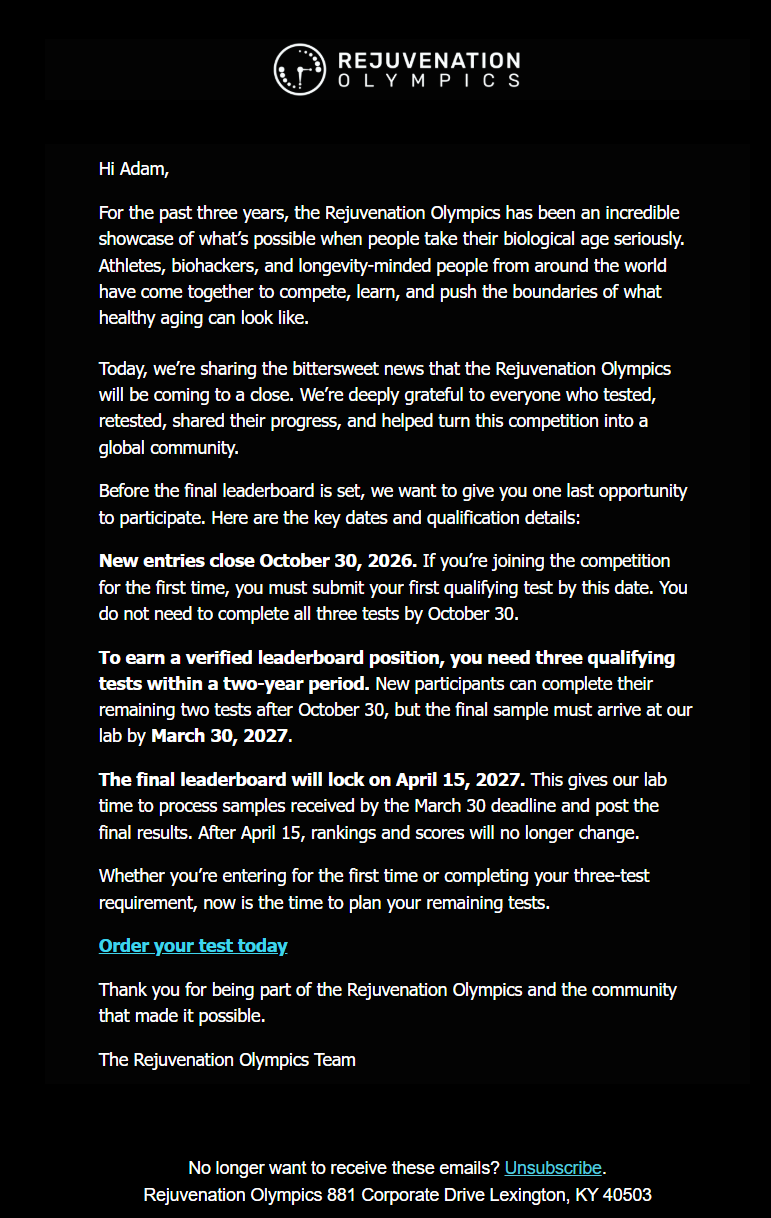
Anyone knows anything about this?
(RO is not to be confused with Longevity World Cup, that’s still going strong.)
Anyone knows anything about this?
(RO is not to be confused with Longevity World Cup, that’s still going strong.)
I think it was primarily a marketing tool for Bryan Johnson, set up by Oliver Zolman… and they no longer see value in it.
And it seemed that they split a year or more ago, and Oliver has gone on to focus on Longevity medicine in the UK in private practice:
and his “Longevity School”
and his insta:
An update from Oliver. Interestingly, unlike Bryan Johnson, Oliver is still bullish (appropriately so) about rapamycin.
In this clinical interview on the Soberhead Podcast, Dr. Esra Çavuşoğlu interviews Dr. Oliver Zolman, MD, the physician responsible for establishing the organ-quantification protocols underpinning Bryan Johnson’s Project Blueprint. Zolman articulates a structured, three-tiered clinical hierarchy designed to counter biological aging: Level 1 encompasses foundational lifestyle and risk factor management backed by international consensus; Level 2 aggregates non-age-related clinical domains and precision health navigation; and Level 3 targets organ-specific biological rejuvenation therapies and advanced geroprotective pharmacology.
Zolman’s central thesis asserts that biological aging cannot be treated as an amorphous, single-metric phenotype. Instead, it must be decomposed into 81 discrete organ types, as systemic aging progresses asynchronously across distinct tissues. He aggressively deflates longevity hype, labeling commercial direct-to-consumer “biological age tests” largely unscientific and vulnerable to statistical noise and selective reporting. According to Zolman, fully executing Level 1 lifestyle modifications can extend human life expectancy by approximately 10 years, which corresponds to a maximum biological age deceleration or reversal of roughly 10% to 20% relative to chronological trajectories. Achieving further rejuvenation or approaching theoretical “Longevity Escape Velocity” necessitates invasive Level 3 therapeutic interventions, including organ replacement (e.g., xenotransplantation), targeted senolytics, peptide therapeutics, and viral or non-viral gene therapy (e.g., telomerase reverse transcriptase [TERT], follistatin, and Klotho).
Addressing specific pharmacotherapies, Zolman cautions against anti-aging human growth hormone (HGH) supplementation, emphasizing that animal knockouts (e.g., Ames dwarf models) demonstrate extended lifespans under suppressed somatotropic signaling, whereas exogenous HGH in humans drives insulin resistance, dyslipidemia, and accelerated epigenetic aging markers. Conversely, he frames GLP-1/GIP receptor agonists (e.g., semaglutide, tirzepatide) as pragmatic caloric restriction mimetics that require precise, low-dose titration to limit rare pancreatic risks. He further analyzes rapamycin protocols, emphasizing blood concentration monitoring at maximum concentration time (Tmax) rather than arbitrary dosing, and defends energy-based aesthetic dermatology (radiofrequency, micro-needling, lasers) as authentic cellular rejuvenation rather than superficial damage, citing localized reductions in senescent cell burden and extracellular matrix remodeling.
FTR Oliver has left the competition in 2025 March, not under the best circumstances. He asked me to add this to the “history of longevity as a sport document”:
In a private exchange, Dr. Zolman revealed his departure from the Rejuvenation Olympics. He attributed his choice to step away to concerns over the leaderboard’s scientific integrity, stating, “Bryan and TruDiagnostic made the leaderboards unscientific and clinically meaningless.”
Methylation clocks have lots of problems.
anything that can’t be fixed tho?
I am not sure it is “fixable” simply because methylation is downstream from the ageing process and all a bit random and also influenced by other factors (football matches, pregnancy, time of day etc).
Rejuvation Olympics is a joke. It’s something made by Bryan Johnson to put him on top and promote himself as he calls him “the most healthy person on earth” to sell you more crap.
I knew a few people that had better testing than him, submitted their testings and never got a reply back. (this like 1-2 years ago)
Yes, most of the leaders were spending a small fraction of what he was spending, and getting better results.
Hannah Went is a key founding team member of TruDiagnostic,
As I wrote… not impressed by this person… or her company.
I’m not getting grifter energy from Hannah at all
Based on this lagging Rejuvenation Olympics program… a money grab, and my negative consult… I disagree. My N=1.
Most ppl who take Rapa for longevity have no idea what their Tmax is and how it affects them. Most rely only on dose. The same dose however produces different Tmax and trough levels in different ppl. Tmax and trough are the most important, not the dose. Fully agree with Zolman.
She may not have that information and I don’t actually have rapamycin measurements, but I can see the WBC which moves with rapamycin levels (as well as the other movements such as platelets). Because neutrophils have a really short half life you can see the impact very quickly. I took rapamycin on Friday morning and am doing a blood test tomorrow when I expect to see a substantial drop in neurophil count. In fact I am expecting the lab to phone me in a week or so to warn me that my WBC is low.
Where do platelets move with rapa? Up or down? I’ve just fall off the fine line I was walking between omega3 index and low platelet count.
mTOR inhibition reduces the production of new cells. I expect to see this first in neutrophils because their half life is under a day.
I think I am no longer unique in having rapamycin at a frequency of about 6 weeks, but I think I am still unique in also doing blood tests weekly.
received a new letter, nothing new, but i thought I’ll put it here for reference
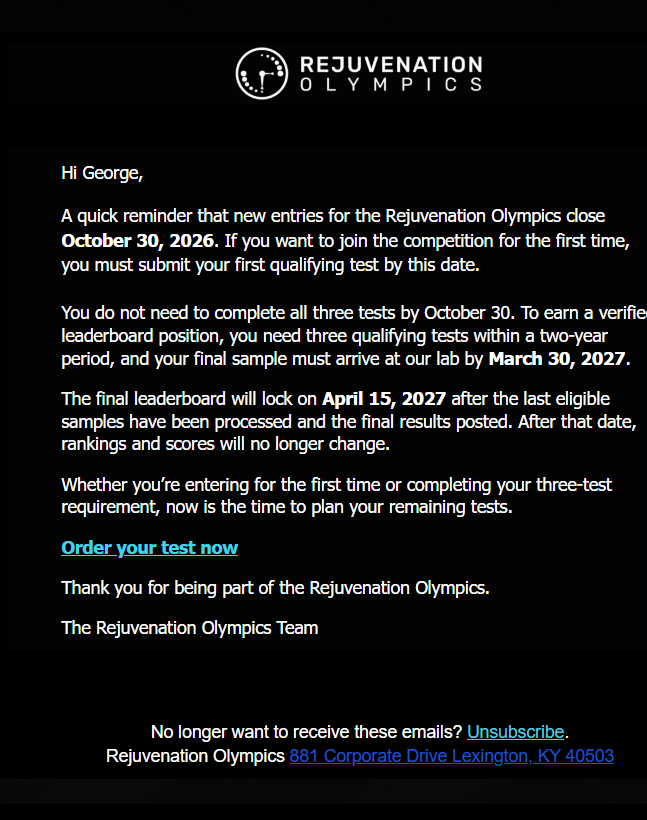
I guess it’s not hard to guess who $ will stay on number 1 forever. lmao