Rhonda Patrick / Found my Fitness also offers a genetic report. It is a narrative report, cannot be sliced and diced like Promethease. Cheap, like $25. Would not get instead of Promethease (or one of the other services) but it does provide some validation and additional insight.
Tempted to look at Nebula and some of the others but given that I now already know the biggest risks as well as the order of magnitude of the danger of the myriad minor risks, I have addressed them and feel kind of maxxed out.
But emphatically encourage getting genetics done. My biggest risk is colon cancer, a surprise though perhaps it should not have been (grandfather) so now I get colonoscopies every three years and pay more attention to fiber. Nearly as big a risk (relatively) is cardiovascular disease/stroke/abdominal aneuryism. So, got imaging, CAC, started Repatha and Ezetimibe, nearly eliminating alcohol, etc. Got lipids and other markers where they need to be.
Before getting the imaging I was focusing primarily on frailty, osteoporosis which, I do believe are the greatest risks â but â surprise â not the only ones.
Also, the genetics tell you some interesting things that didnât seem to me true or make much sense, but after getting both reports and reading around, it became clear what is going on. Example, the report cited a âtendency toward obesity.â Since I have always been thin, this seemed like a mistake. But looking deeper, the signal the report was reacting to is a genetic low level of adiponectin, and a couple of other things that now make sense. So, for me it means: need to take in more protein and lift heavier to counteract the tendency to store fat, especially visceral fat.
I think if I continued looking deeper I would discover more things. And perhaps I will. But they would be insignificant compared to the major findings, and it is about all I can do to address those . . .
4 Likes
30x read is not going to get the info most people want. You will be frustrated. Spend the few extra on at least 100x. Especially for some of the more interesting genes that this forum is looking at.
A re-run of the previous prompt with a focus on 100X:
As of May 2026, the market for 100X Whole Genome Sequencing (WGS) has shifted significantly following the consolidation of several early pioneers (e.g., Nebula Genomics transitioning into DNA Complete). 100X sequencing, or âUltra-Deepâ sequencing, provides a higher signal-to-noise ratio than the 30X clinical standard, making it the preferred choice for detecting low-frequency somatic variants and mosaicism.
The following providers allow direct consumer purchase, provide raw VCF and CRAM files, and do not mandate a recurring subscription for data access.
Top 10 Lowest-Cost 100X Whole Genome Sequencing Sources (May 2026)
Shipping and Logistics Summary
-
DNA Complete: Currently offers a promotional free shipping rate within the Continental USA. International kits involve a flat $45 fee for delivery and return logistics.
-
Sequencing.com: Domestic shipping is $19.99. For the 100X âEliteâ bundle, return shipping is typically included via a prepaid label in the box.
-
YSEQ: Shipping is calculated based on current rates from Germany. Expect roughly $25â$35 for the kit; the customer is responsible for return postage to their laboratory in Berlin.
-
Dante Labs: Includes free global shipping, but users should note that turnaround times for 100X processing can exceed 12 weeks during high-volume periods.
-
BioAro: Offers guaranteed turnaround times (under 4 weeks), but shipping costs vary by region, averaging $30 for North American customers.
Scholarly Analysis & Technical Considerations
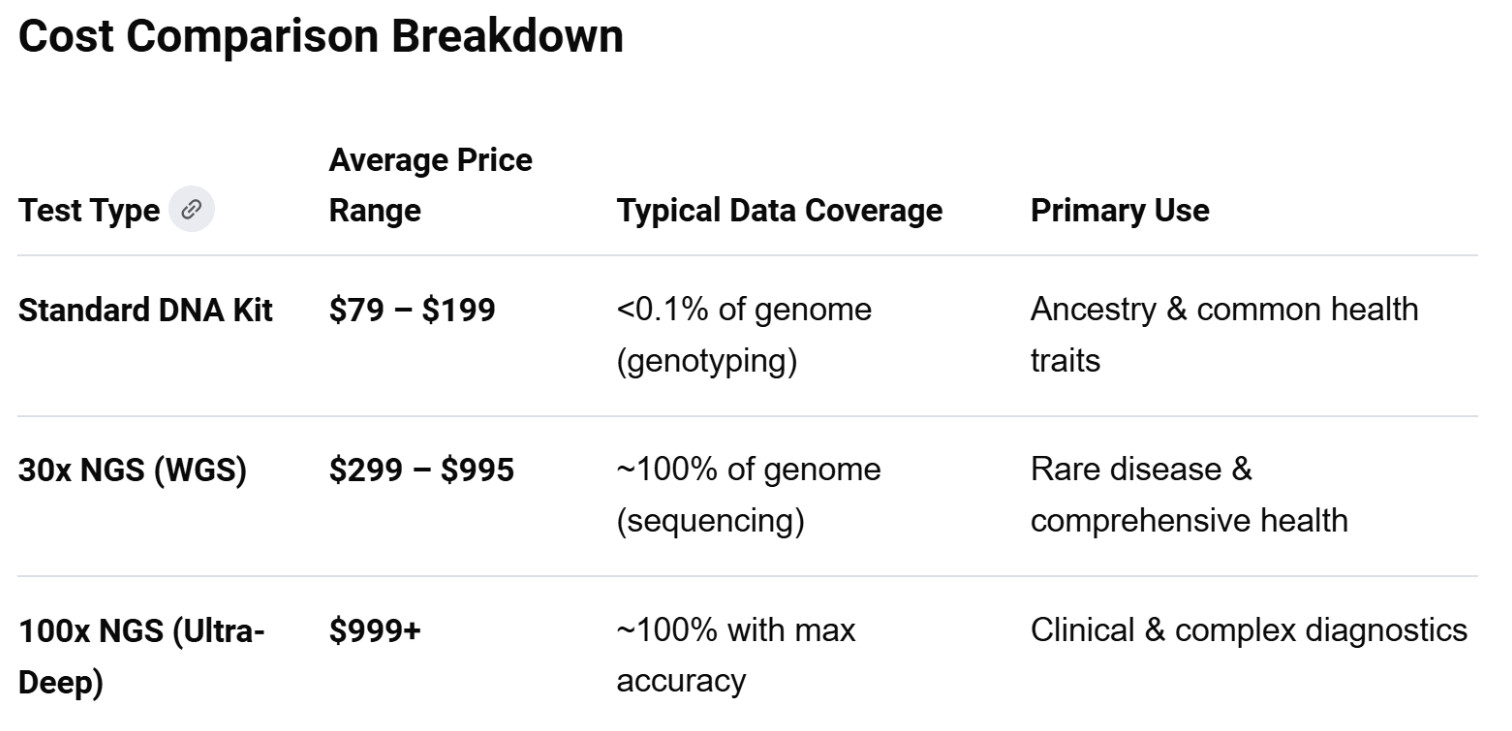
The primary scholarly debate surrounding 100X WGS is whether the incremental benefit of increased depth justifies the $600â$800 premium over standard 30X sequencing.
-
Detection Thresholds: 100X depth is technically required for high-confidence identification of âmosaicâ mutations (mutations occurring in only a fraction of cells), which are increasingly studied in the context of neurodegenerative diseases and longevity science.
-
File Management: A 100X CRAM file typically exceeds 150GB. A knowledge gap exists in the consumer market regarding the necessary local hardware for processing such files; standard consumer-grade laptops often lack the RAM required for local alignment or variant browsing.
-
No-Subscription Access: While the providers above allow one-time raw data downloads, several (DNA Complete, Sequencing.com) host âReport Marketplaces.â Users should distinguish between the sequencing data (which you own) and the interpretative reports (which may require separate fees).
Note on Reliability: Data for smaller providers (e.g., Full Genomes Corp) has been excluded due to inconsistent service availability and âOut of Businessâ flags in recent 2026 market audits. Always verify that the lab utilizes CAP/CLIA-certified pipelines if you intend to share the VCF with a medical professional for clinical intervention.
List needs to be checked extensively. For example, I couldnât find 100x sequencing on sequencing dot com. Some other ones, you couldnât tell whether it was 30x or 100x being offered.
1 Like
Computing Platform for Genome Dataset Analysis:
The evaluation of a 100X Whole Genome Sequencing (WGS) datasetâwhich typically yields a compressed CRAM file of 150GBâ200GB and an uncompressed VCF file of 1GBâ5GBâexceeds the operational capacity of standard consumer hardware. Processing these files requires a focus on high-bandwidth I/O (Input/Output), massive RAM for indexing, and specialized software that âstreamsâ data rather than loading it into memory.
Below are the recommended compute platforms for a consumer to evaluate a 100X genome, categorized by local hardware, prosumer workstations, and cloud-based analysis.
1. Local Hardware: âProsumerâ Specifications
If you intend to browse 100X files locally (using software like IGV), your bottleneck is not just the CPU, but the RAMand Disk Read Speed.
| Component |
Minimum for 100X |
Recommended (Prosumer) |
Note |
| RAM |
32GB DDR5 |
128GB+ DDR5 |
High-depth CRAM indexing consumes massive memory. |
| Storage |
1TB NVMe Gen4 SSD |
4TB+ NVMe Gen5 SSD |
Read speeds of 10GB/s+ are vital for scrolling through 100X reads. |
| CPU |
8-Core (Ryzen 7/i7) |
16-Core+ (Ryzen 9 / M3 Ultra) |
Essential for parallelizing variant filtering. |
| GPU |
Integrated |
NVIDIA RTX 4080 (16GB VRAM) |
Useful for AI-accelerated variant calling (e.g., NVIDIA Parabricks). |
Export to Sheets
-
Optimal Consumer Machine: The Mac Studio (M2/M3 Ultra) with 192GB of Unified Memory is currently the most efficient âoff-the-shelfâ consumer desktop for genomics. The unified memory architecture allows the GPU and CPU to share the massive genomic index files without the latency of a PCIe bus.
2. Cloud-Based Analysis Platforms (Individual Access)
For most users, moving the compute to the data (Cloud) is more practical than moving the data to the compute (Local).
-
Terra.bio (Best for Technical Users): An open platform co-developed by the Broad Institute and Microsoft/Google. It allows individuals to spin up a âCloud Environmentâ (Jupyter Notebook or RStudio) with high-RAM configurations (up to 3.75TB) on a pay-per-use basis. You can host your 150GB CRAM in a Google Cloud bucket and browse it via an integrated IGV instance.
-
Galaxy Project (Best for Non-Coders): A web-based interface for bioinformatics. You can upload your raw data (or import via URL) and run complex workflows (alignment, variant calling, annotation) on public infrastructure. While the free tier has storage limits, the Galaxy Pro or local cloud instances allow for 100X file processing.
-
DNAnexus (Apollo): A clinical-grade platform used by the UK Biobank. It provides a âPrecision Health Data Environmentâ where you can store and analyze 100X genomes using pre-built pipelines (GATK, Sentieon) without writing code.
3. Specialized Software for 100X Data Visualization
Standard âDNA Viewersâ will often crash when attempting to render 100X coverage. Use these optimized tools:
-
IGV (Integrative Genomics Viewer) - Desktop: The gold standard. Pro Tip: Increase the âVisibility Windowâ carefully and allocate at least 16GB of Java Heap Space to the application to prevent crashes during 100X browsing.
-
JBrowse 2: A modern, high-performance browser that handles CRAM files better than its predecessors. It supports âLinear Genome Viewsâ and can be run locally or via a web server.
-
St Jude Cloud Peeker: A specialized visualization tool designed to stream specific genomic coordinates from large files without downloading the entire 150GB.
Scholarly Debate & Knowledge Gaps
There is an ongoing debate in the bioinformatics community regarding Local vs. Remote Indexing. For a 100X CRAM, the .crai index file must be perfectly synced.
-
Knowledge Gap: Most consumers are unaware that CRAM is lossy relative to BAM depending on the âlossy namesâ flag used during conversion. If your provider used a high-compression lossy format for the 100X file, some quality scores (used to distinguish sequencing errors from real mutations) may be simplified, potentially negating the advantage of the extra depth.
-
Computational Bottleneck: The âSecondary Analysisâ (turning CRAM back into VCF with updated filters) is the most resource-intensive part. For a 100X genome, a standard PC might take 48â72 hours to re-run a pipeline, whereas a cloud-based NVIDIA Parabricks instance can complete it in under 30 minutes.
Actionable Recommendation
If you lack a high-end workstation, do not attempt to download the 150GB file to a laptop. Instead:
- Upload the file to an AWS S3 or Google Cloud Storage bucket.
- Use IGV-Web or Terra.bio to âstreamâ only the genes of interest (e.g., FOXO3 for longevity, APOE for neurology) directly from the cloud. This requires only a standard web browser and high-speed internet.
1 Like
A press release today⌠seems like there must be a âcatchâ:
May 11, 2026 /PRNewswire/ â Human Longevity, Inc. today announced the launch of its new Clinical-Grade $599 Whole Genome Sequencing Report , designed to bring advanced genomic medicine and AI-driven disease prevention to the general population.
1 Like
I looked at their website. The price is good⌠thatâs it. Depth: 30x⌠Iâm looking for 100x. Doesnât seem like you get a file - instead, you get an app and they provide analysis which is regularly updated. Not interested in this dynamic - I want the file I can download, in an open format that is not lossy, and Iâll do my own analysis and updates. PASS. YMMV.
1 Like
IMO: Weâre getting down into the weeds here. Unless you have some compelling special reason or have money to burn to satisfy your curiosity, the 30x is more than adequate. You will be paying an additional ~$ 600+ for information that is probably not very relevant. Your bucks, your choice.
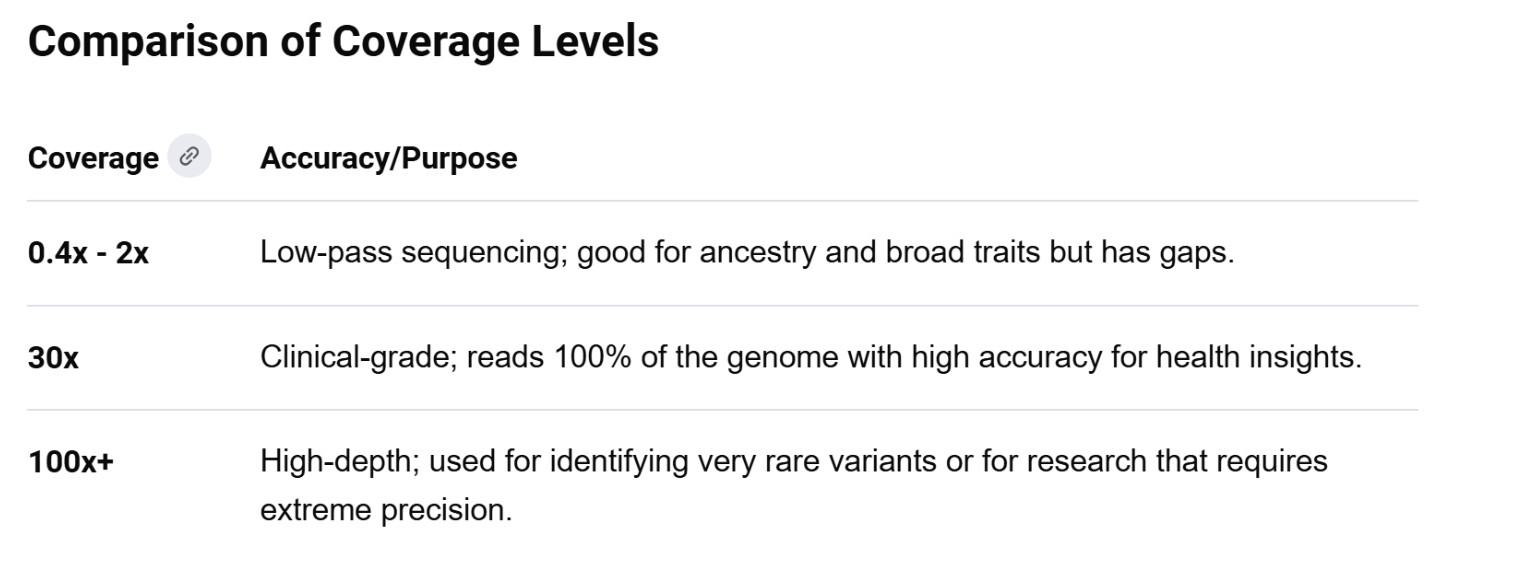
â30xâ refers to the coverage or depth, meaning each part of the genome is read an average of 30 times for accuracy."
2 Likes
Emphasis on average, meaning that some regions are read much less than 30x (maybe 2-10x). Which until now, I didnât know.
According to AI, here are the points for doing 100x sequencing:
- By bumping to 100x, you ensure that even the âlow-coverageâ areas likely receive 20x or 30x hits, providing enough data to distinguish a real mutation from a machine error.
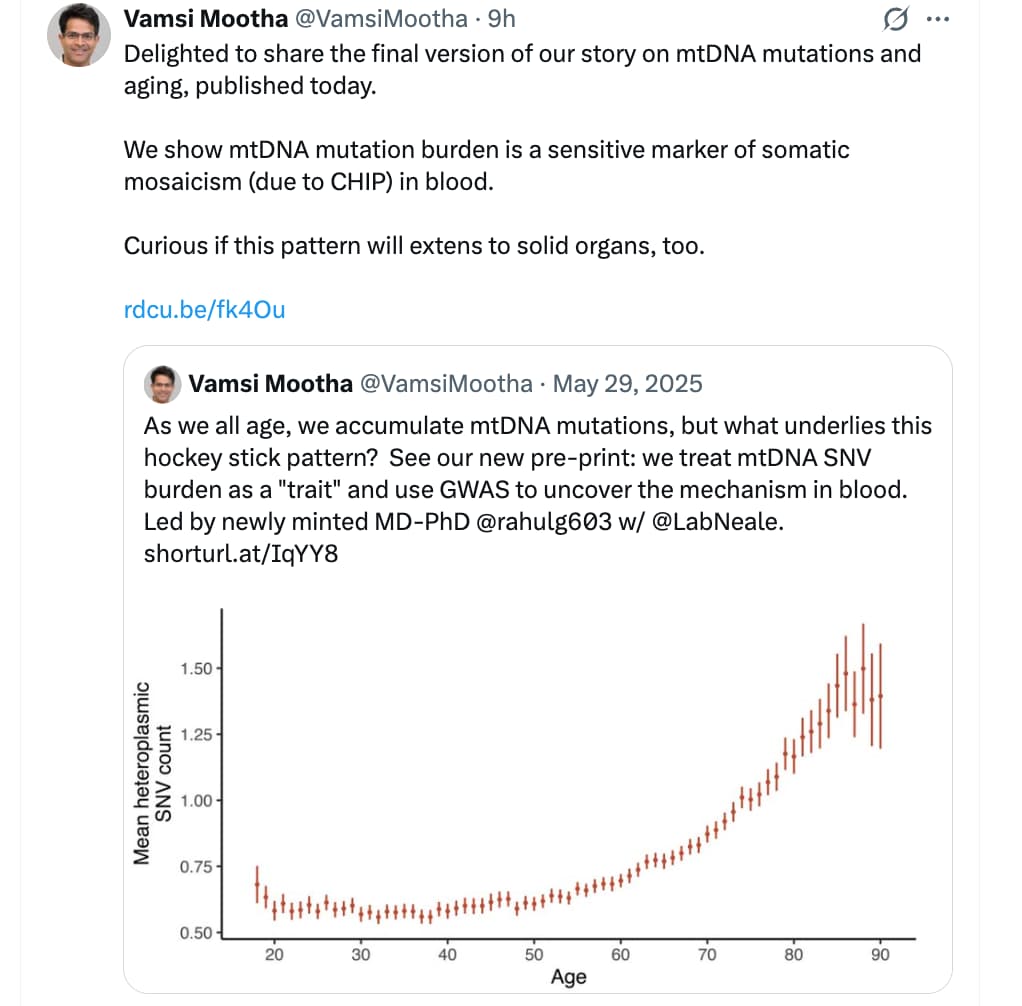
- Rare Variant and Mosaicism Detection: If you are looking for mosaicism (mutations present in only a small percentage of cells) or circulating tumor DNA (ctDNA), 30x will miss them entirely. 100x allows you to detect variants that exist in only 5% to 10% of the sample with high statistical confidence.
- Certain areas, like GC-rich regions (where Guanine and Cytosine are dense), are notoriously difficult for sequencers to read.
Still, the recommnendation for 30x is a good option:
- itâs more cost-effective
- good enough if you are going a general health screening, or looking for inherited traits
4 Likes
Why do you think there is a catch? What is so much better about this than the equivalently priced product from Nebula Genomics?
I was surprised because last year I think they were priced at over $10K, and they are the original company that brought WGS to the market, so I didnât think theyâd be working to equal the prices of the low end competitors. Most of their clientele sign up for the $25K a year program, I think. See this story: Longevity Clinics: Human Longevity Inc., Dr. David Karrow
1 Like