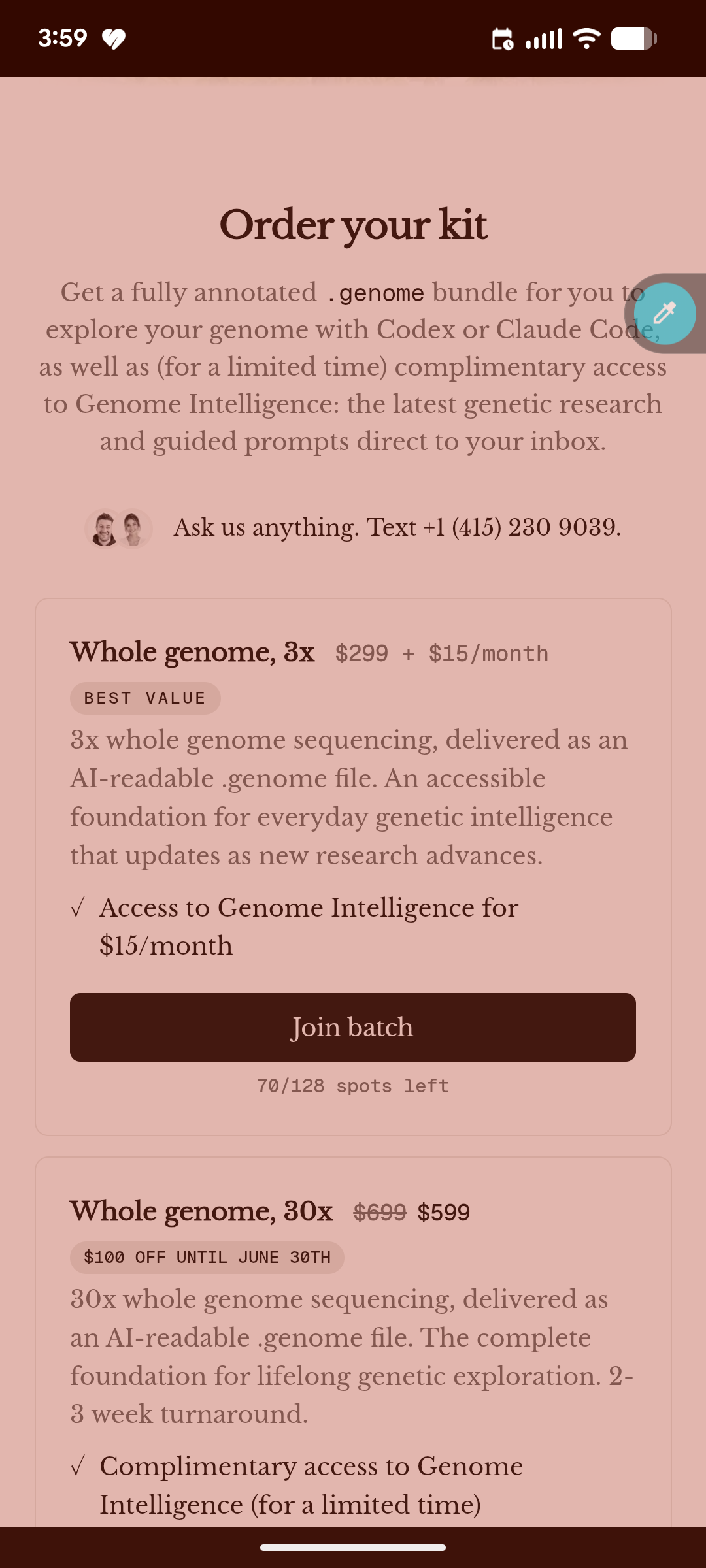
Does anyone know how nucleus genomics compares with nebula? nucleus uses 30x (the same im sure) but they say they use american sequencers.
i have some signs nebula genomics is missing some variants b/c it isnt the highest quality…
Does anyone know how nucleus genomics compares with nebula? nucleus uses 30x (the same im sure) but they say they use american sequencers.
i have some signs nebula genomics is missing some variants b/c it isnt the highest quality…
Did you talk with the Nucleus group at the Longevity Summit conference when you were there? I did talk to them, and they mentioned they were partnered with Illumina for their gene sequencing: Next-Generation Sequencing (NGS) | Explore the technology
I’m not sure what Nebula uses.
I’m working on a writeup on what Kian presented at the Longevity Summit on their approach and perspective. Will post in the next few weeks.
So did you figure out if you are APoE4 or not? If so - how? This would frustrate me, personally
For now, I’m just assuming I am APOE4 (the 2/3 variant). But I should discuss this with a geneticist in the near term.
I think sequencing.com is useful for updates as new research relates to your genome.
If you have multiple family members you can definitely negotiate a substantial discount (not advertised as far as I can tell) on your subscription fees to reduce the cost.
A caution on using Nebula. I used their 30x sequencing. The results were complete garbage. I’m a known carrier for Cystic Fibrosis - validated multiple times with specific tests validated for medical diagnosis. Nebula showed the Cystic Fibrosis gene as normal - all 30 sequences. Which means they’ll use someone else’s sequence for portions of their results if they have any problems processing your sample. Which makes all of the results completely worthless. You’re going to have to spend more to get a reliable sequencing result.
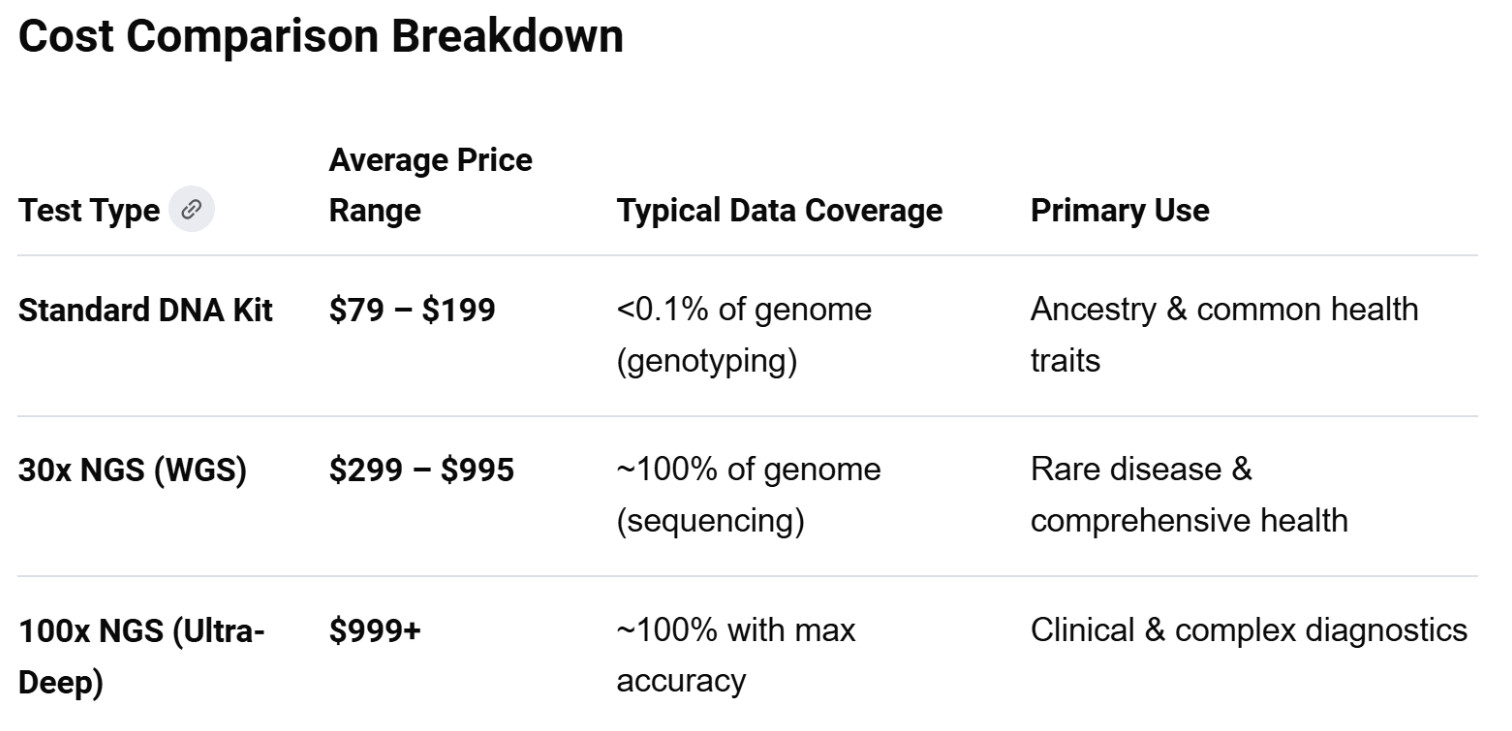
As of May 2026, the landscape for consumer Whole Genome Sequencing (WGS) is dominated by a few high-volume laboratories utilizing high-throughput platforms (like Illumina’s NovaSeq X or Ultima Genomics). Prices fluctuate due to frequent “seasonal” sales, but the following represents the most consistent low-cost options available for direct purchase by consumers in the USA and globally.
| Rank | Product/Brand Name | Vendor | Total Price (USD) |
|---|---|---|---|
| 1 | Low-Pass WGS (1x Coverage) | MyHeritage | $89 |
| 2 | Essential WGS (1x Coverage) | Nebula Genomics | $245 |
| 3 | Ultra Genetic Test (30x WGS) | tellmeGen | $299 |
| 4 | 30x Whole Genome Sequencing | Nebula Genomics | $299 |
| 5 | WGS EDS Special Bundle (30x) | Sequencing.com | $365 |
| 6 | Whole Genome Sequencing (30x) | SelfDecode | $399 |
| 7 | WGS 400 (30x Coverage) | YSEQ | $399 |
| 8 | Premium WGS (30x Coverage) | Dante Labs | $449 |
| 9 | Premium DNA Test (30x WGS) | CircleDNA | $510 |
| 10 | WGS Research (30x Coverage) | Full Genomes Corp | $645 |
The pricing above distinguishes between Low-Pass (1x) and High-Pass (30x) sequencing. While 1x WGS is the cheapest entry point, it is primarily used for ancestry and common trait analysis via imputation. For clinical-grade insights—such as identifying rare variants, pathogenic mutations, or pharmacogenomics—a minimum of 30x coverage is the industry standard.
A significant knowledge gap remains regarding the long-term data storage costs. Many providers (like Nebula or tellmeGen) are shifting toward subscription models to access updated health reports, meaning the “Total Cost of Ownership” over five years may be higher than the initial sequencing fee. Additionally, many “low-cost” results are for educational use only and require a clinical confirmatory test if a serious medical variant is discovered.
I’ve never seen Nebula Genomics for only $299. Every time I’ve looked you’re required to buy a subscription which raises the price. I got it from them for $408 a year or so ago.
Rhonda Patrick / Found my Fitness also offers a genetic report. It is a narrative report, cannot be sliced and diced like Promethease. Cheap, like $25. Would not get instead of Promethease (or one of the other services) but it does provide some validation and additional insight.
Tempted to look at Nebula and some of the others but given that I now already know the biggest risks as well as the order of magnitude of the danger of the myriad minor risks, I have addressed them and feel kind of maxxed out.
But emphatically encourage getting genetics done. My biggest risk is colon cancer, a surprise though perhaps it should not have been (grandfather) so now I get colonoscopies every three years and pay more attention to fiber. Nearly as big a risk (relatively) is cardiovascular disease/stroke/abdominal aneuryism. So, got imaging, CAC, started Repatha and Ezetimibe, nearly eliminating alcohol, etc. Got lipids and other markers where they need to be.
Before getting the imaging I was focusing primarily on frailty, osteoporosis which, I do believe are the greatest risks – but – surprise – not the only ones.
Also, the genetics tell you some interesting things that didn’t seem to me true or make much sense, but after getting both reports and reading around, it became clear what is going on. Example, the report cited a “tendency toward obesity.” Since I have always been thin, this seemed like a mistake. But looking deeper, the signal the report was reacting to is a genetic low level of adiponectin, and a couple of other things that now make sense. So, for me it means: need to take in more protein and lift heavier to counteract the tendency to store fat, especially visceral fat.
I think if I continued looking deeper I would discover more things. And perhaps I will. But they would be insignificant compared to the major findings, and it is about all I can do to address those . . .
30x read is not going to get the info most people want. You will be frustrated. Spend the few extra on at least 100x. Especially for some of the more interesting genes that this forum is looking at.
A re-run of the previous prompt with a focus on 100X:
As of May 2026, the market for 100X Whole Genome Sequencing (WGS) has shifted significantly following the consolidation of several early pioneers (e.g., Nebula Genomics transitioning into DNA Complete). 100X sequencing, or “Ultra-Deep” sequencing, provides a higher signal-to-noise ratio than the 30X clinical standard, making it the preferred choice for detecting low-frequency somatic variants and mosaicism.
The following providers allow direct consumer purchase, provide raw VCF and CRAM files, and do not mandate a recurring subscription for data access.
| Rank | Product/Brand Name | Vendor | Total Price (USD) |
|---|---|---|---|
| 1 | WGS Elite (100X WGS) | DNA Complete | $995 |
| 2 | WGS 100X Deep Sequencing Bundle | Sequencing.com | $1,099 |
| 3 | Whole GenomeZ (100X Coverage) | Dante Labs | $1,199 |
| 4 | WGS Custom (300 Gb Data Allocation) | YSEQ | $1,250 |
| 5 | Ultra-Deep 100X WGS | BioAro | $1,499 |
| 6 | Variant-Plus (100X Research WGS) | Macrogen | $1,650 |
| 7 | Personal Genome 100X Premium | Veritas Intercontinental | $1,850 |
| 8 | DeepSeq WGS Research Protocol | Psomagen | $1,900 |
| 9 | Clinical 100X Whole Genome | HiFiGenomics | $2,100 |
| 10 | Platinum 100X Research WGS | Illumina (Partner Network) | $2,500 |
The primary scholarly debate surrounding 100X WGS is whether the incremental benefit of increased depth justifies the $600–$800 premium over standard 30X sequencing.
Note on Reliability: Data for smaller providers (e.g., Full Genomes Corp) has been excluded due to inconsistent service availability and “Out of Business” flags in recent 2026 market audits. Always verify that the lab utilizes CAP/CLIA-certified pipelines if you intend to share the VCF with a medical professional for clinical intervention.
List needs to be checked extensively. For example, I couldn’t find 100x sequencing on sequencing dot com. Some other ones, you couldn’t tell whether it was 30x or 100x being offered.
The evaluation of a 100X Whole Genome Sequencing (WGS) dataset—which typically yields a compressed CRAM file of 150GB–200GB and an uncompressed VCF file of 1GB–5GB—exceeds the operational capacity of standard consumer hardware. Processing these files requires a focus on high-bandwidth I/O (Input/Output), massive RAM for indexing, and specialized software that “streams” data rather than loading it into memory.
Below are the recommended compute platforms for a consumer to evaluate a 100X genome, categorized by local hardware, prosumer workstations, and cloud-based analysis.
If you intend to browse 100X files locally (using software like IGV), your bottleneck is not just the CPU, but the RAMand Disk Read Speed.
| Component | Minimum for 100X | Recommended (Prosumer) | Note |
|---|---|---|---|
| RAM | 32GB DDR5 | 128GB+ DDR5 | High-depth CRAM indexing consumes massive memory. |
| Storage | 1TB NVMe Gen4 SSD | 4TB+ NVMe Gen5 SSD | Read speeds of 10GB/s+ are vital for scrolling through 100X reads. |
| CPU | 8-Core (Ryzen 7/i7) | 16-Core+ (Ryzen 9 / M3 Ultra) | Essential for parallelizing variant filtering. |
| GPU | Integrated | NVIDIA RTX 4080 (16GB VRAM) | Useful for AI-accelerated variant calling (e.g., NVIDIA Parabricks). |
Export to Sheets
For most users, moving the compute to the data (Cloud) is more practical than moving the data to the compute (Local).
Standard “DNA Viewers” will often crash when attempting to render 100X coverage. Use these optimized tools:
There is an ongoing debate in the bioinformatics community regarding Local vs. Remote Indexing. For a 100X CRAM, the .crai index file must be perfectly synced.
If you lack a high-end workstation, do not attempt to download the 150GB file to a laptop. Instead:
A press release today… seems like there must be a “catch”:
May 11, 2026 /PRNewswire/ – Human Longevity, Inc. today announced the launch of its new Clinical-Grade $599 Whole Genome Sequencing Report , designed to bring advanced genomic medicine and AI-driven disease prevention to the general population.
I looked at their website. The price is good… that’s it. Depth: 30x… I’m looking for 100x. Doesn’t seem like you get a file - instead, you get an app and they provide analysis which is regularly updated. Not interested in this dynamic - I want the file I can download, in an open format that is not lossy, and I’ll do my own analysis and updates. PASS. YMMV.
IMO: We’re getting down into the weeds here. Unless you have some compelling special reason or have money to burn to satisfy your curiosity, the 30x is more than adequate. You will be paying an additional ~$ 600+ for information that is probably not very relevant. Your bucks, your choice.
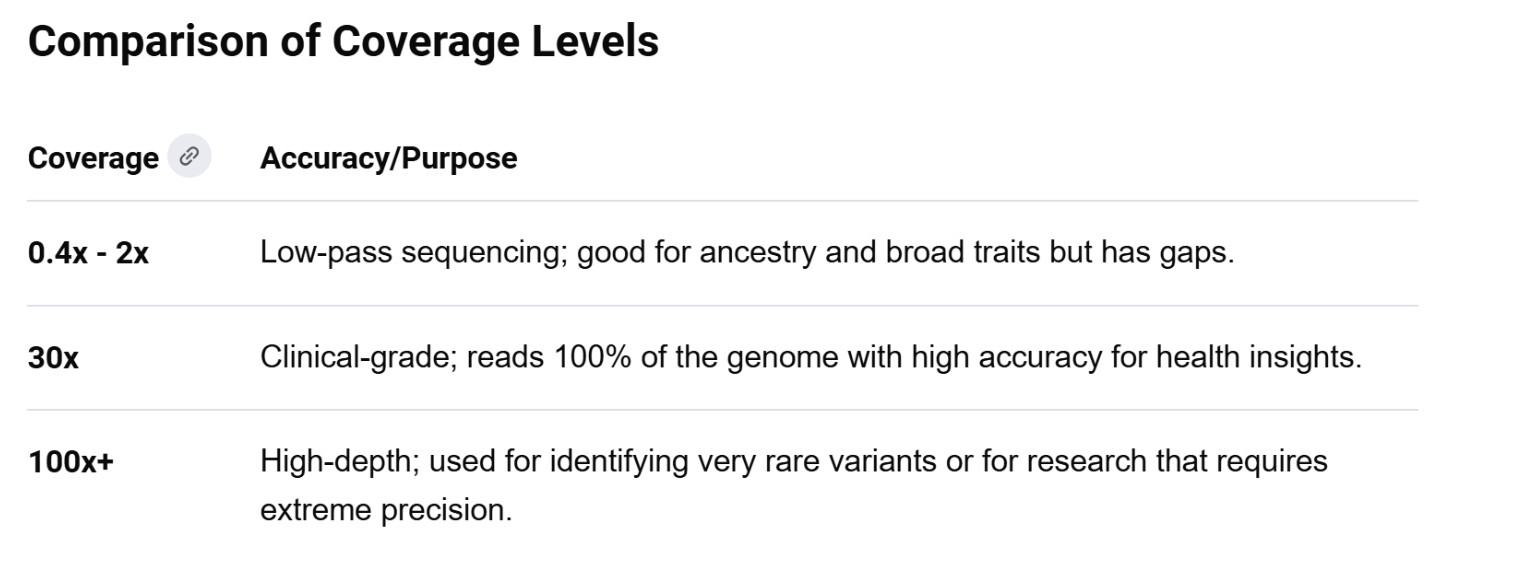
“30x” refers to the coverage or depth, meaning each part of the genome is read an average of 30 times for accuracy."
Emphasis on average, meaning that some regions are read much less than 30x (maybe 2-10x). Which until now, I didn’t know.
According to AI, here are the points for doing 100x sequencing:
Still, the recommnendation for 30x is a good option:
Why do you think there is a catch? What is so much better about this than the equivalently priced product from Nebula Genomics?
I was surprised because last year I think they were priced at over $10K, and they are the original company that brought WGS to the market, so I didn’t think they’d be working to equal the prices of the low end competitors. Most of their clientele sign up for the $25K a year program, I think. See this story: Longevity Clinics: Human Longevity Inc., Dr. David Karrow