chatGPT:
Below is a cleaned-up, readable version of the transcript, followed by a summary and critique.
Tidy transcript
Intro
0:00
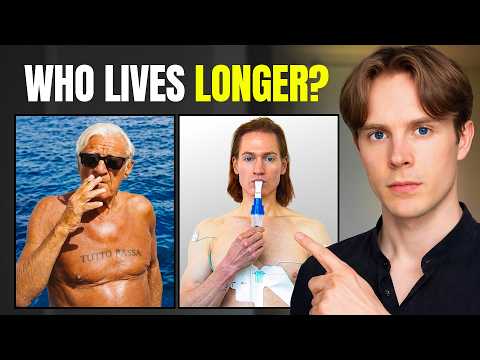
There is a popular meme comparing the average Italian grandpa with Bryan Johnson. One is portrayed as living a perfectly optimized life: strict routine, many supplements, constant measurement, and sun avoidance. The other smokes, drinks wine, sits in the sun, and does not “exercise” in the conventional sense.
The internet often assumes the Italian grandpa will outlive Bryan Johnson. But what does the evidence actually say? In this video, I look at what Mediterranean centenarians really do, how they live, and whether there is evidence that a hyper-optimized lifestyle is better for longevity.
Italian grandpa lifestyle
0:54
The stereotype is an Italian grandpa who eats pasta, drinks wine, smokes, walks everywhere, spends time with friends, and lives a relaxed life.
Italy has one of the highest life expectancies in the world, driven by factors such as diet, activity, social connection, work-life balance, and healthcare. But high life expectancy is not the same as everyone living to 100.
Do Italian centenarians smoke?
1:31
A common stereotype is that these centenarians all smoke, implying smoking is somehow compatible with exceptional longevity.
But the actual evidence points the other way. In one Rome study of 157 centenarians, 83.8% had never smoked, 13.5% were former smokers, and only 2.7% were active smokers. Smokers were mostly men and had more chronic disease after age 65. (PubMed)
So the image of the smoking centenarian is mostly selection bias: a tiny group of outliers gets noticed, while the overwhelming majority of smokers do not reach 100.
The same pattern appears in other longevity regions. In Sardinia, many older people may have smoked in the past, but active smoking among the oldest old is very uncommon. In Ikaria too, many stopped earlier in life, and only a small minority still smoked late in life.
The main point is that active smokers who reach 100 are extremely rare outliers.
Role of genetics in lifespan
3:14
The speaker argues that genetics matters more than many people think.
Older estimates often suggested that longevity is mostly lifestyle and only modestly genetic. More recent work argues that the genetic contribution may be substantially higher once certain confounders are addressed. A recent Science paper estimated intrinsic human lifespan heritability at roughly 50–55% after accounting for extrinsic mortality. (Science)
That does not mean lifestyle is unimportant. It means genetics may play a larger role in determining who reaches exceptional ages than many people assume.
The video also notes criticism of some “blue zone” age records. A demographic analysis did report that introduction of birth certificates in U.S. states was associated with a 69–82% drop in supercentenarian records, suggesting record quality matters a great deal. (BioRxiv)
Why Sardinians live so long
4:25
The video says Sardinia is a genuine case of exceptional longevity because researchers validated ages there. That is broadly true: the Sardinian blue-zone literature emphasizes careful age validation, and Sardinia is unusual in having a much lower female-to-male centenarian ratio than most places. (PMC)
The suggested reasons are:
- genetics linked to long-term geographic isolation
- a traditional diet
- constant low-intensity physical activity from daily life
- a pastoral, mountainous lifestyle
The diet described is not extreme. It includes olive oil, potatoes, bread, cereals, fruit, milk, cheese, coffee, legumes, and some meat and vegetables. The video argues that these communities are neither strongly plant-based nor strongly meat-based, but instead reflect a simple, minimally processed rural diet.
The activity pattern is also important: these men may not “exercise” in a gym, but they walk hills and slopes every day, which likely provides substantial cardiovascular benefit.
Italian grandpa longevity overview
6:24
The speaker’s main takeaways are:
- Italian life expectancy is high, but not everyone lives to 100.
- The smoking centenarian is an outlier, not the rule.
- Genetics strongly influences who reaches 100.
- Blue zones may have more centenarians than average, but not nearly as many as internet mythology implies.
The speaker concludes that the “Italian grandpa approach” works partly because of good genes, plus some genuinely helpful habits:
- strong social relationships
- lower stress
- less overwork
- minimally processed food
But the evidence does not suggest that smoking and drinking are longevity strategies.
Bryan Johnson lifestyle
8:14
The video then shifts to Bryan Johnson as a symbol of maximal health optimization: strict diet, extensive testing, biomarker tracking, many supplements, and rigid routines.
The speaker says there are no studies proving this ultra-strict approach is the optimal route to longevity. That is fair: there is no trial showing that Johnson-style maximal optimization produces the longest lifespan in humans.
The broader argument is that health behavior exists on a spectrum. Most people are neither careless nor obsessive. They may eat reasonably well, exercise, sleep adequately, and do periodic testing without trying to optimize every variable.
Health fanaticism and diminishing returns
9:23
A major argument in the video is that more effort does not always produce proportionally better outcomes.
The speaker says that even with huge effort, Johnson’s biomarkers are not uniquely superior, and that obsessiveness may have diminishing returns. The claimed “sweet spot” is somewhere between neglect and fixation.
He also argues that anxiety about aging may itself be harmful. That general idea is plausible: chronic stress, anxiety, and negative views of aging have been associated with poorer outcomes, though the video overstates how directly this proves that “health fanaticism is bad.”
What optimization can and cannot do
11:44
The video makes a sensible distinction here.
Bryan Johnson’s approach may reduce risk for common chronic diseases by improving standard health variables: body composition, blood pressure, glucose control, lipids, sleep, and early detection. But that does not automatically mean radical lifespan extension.
The speaker argues there is currently no evidence that Johnson’s present regimen will make him live beyond 120, and that many of the experimental interventions he has tried remain unproven for major lifespan extension. That is a fair critique: there is no human evidence that plasma exchange, hyperbaric oxygen, blood filtration, or similar interventions meaningfully extend maximum lifespan. Gene therapies remain speculative in this context.
Genetics and family advantage
13:01
The video emphasizes that exceptional longevity runs strongly in families.
This is supported by the literature. Offspring of centenarians have shown markedly lower mortality and lower disease-specific mortality than controls. One study reported 62% lower all-cause mortality, 71% lower cancer mortality, and 85% lower coronary heart disease mortality in centenarian offspring. (PubMed)
Similarly, sibling studies show strong familial clustering of extreme longevity. Siblings of male 90-year-olds had about 1.73 times the chance of reaching 90, and siblings of those who reached 105 had about 35.6 times the chance of reaching 105, relative to population controls. (PMC)
So the speaker is right that genetics can provide a large “unfair advantage.”
Sun exposure
14:50
The video contrasts Italian outdoor living with Bryan Johnson’s strong sun avoidance.
It cites a 2014 Swedish observational study reporting that women who avoided sun exposure had about twice the all-cause mortality of those with the highest sun-exposure habits, even though higher sun exposure also increased melanoma risk. (PubMed)
That study exists and is often cited in this debate. But it is observational, not a randomized trial, so it cannot prove that sun avoidance itself caused the mortality difference. Moderate sun exposure may be reasonable, but the evidence does not justify heavy sun exposure or dismiss skin-cancer risk.
Final conclusion
15:34
The speaker concludes that the answer depends heavily on genetics.
- A stereotypical carefree lifestyle with smoking and wine is not a reliable route to 100.
- A highly health-conscious lifestyle is probably better than random neglect.
- But there is no evidence that a fully obsessive, 100%-strict lifestyle is better than a balanced, sustainable one.
- The best approach is likely somewhere in the middle: health-conscious, but not neurotic.
The video ends by promoting the speaker’s community and protocols.
Summary
The video argues against two internet caricatures:
-
The “Italian grandpa” myth
It says Mediterranean centenarians are not living to 100 because they smoke and drink. Most centenarians in the cited studies were never-smokers or former smokers, not active smokers. Their longevity is more plausibly linked to genetics, simple diets, daily activity, social connection, lower stress, and healthcare. (PubMed) -
The “perfect biohacker” myth
It argues there is no evidence that extreme optimization, endless biomarkers, and large supplement stacks produce dramatically longer life than a well-executed moderate lifestyle. The speaker sees diminishing returns and suggests that health obsession may itself become counterproductive.
The core thesis is that both genes and lifestyle matter, but internet discussions are distorted by anecdotes and stereotypes. Smoking centenarians exist, but they are rare outliers. Hyper-optimization may reduce disease risk, but there is no proof it radically extends maximum lifespan.
Critique
What the video gets right
1. It correctly rejects the “smoking centenarian” myth.
The Rome centenarian data the speaker cites are real, and they support the point that active smoking among centenarians is uncommon, not typical. (PubMed)
2. It rightly emphasizes selection bias.
People notice unusual survivors and ignore the far larger number who died earlier. That is an important correction.
3. It is broadly right that extreme longevity has a strong familial component.
The centenarian-offspring and sibling data support that point well. (PubMed)
4. It is fair to say that Bryan Johnson-style maximal optimization is unproven as a route to exceptional lifespan.
There is no direct evidence that current “biohacker” protocols can push humans to 120+.
Where the video overreaches
1. It treats “50% genetic” too simplistically.
The speaker uses the newer heritability estimate as though it settles the issue. It does not. Heritability is population-specific and context-dependent. Even if intrinsic lifespan heritability is around 50%, that does not mean half of any one person’s outcome is fixed or that lifestyle is only “the other half” in a neat, deterministic way. (Science)
2. It jumps from “no proof of benefit” to “probably net negative.”
There is a difference between:
- no evidence that extreme optimization adds much lifespan, and
- evidence that it is harmful.
The first claim is reasonable. The second is not established by the evidence presented.
3. It leans too heavily on biomarkers as verdicts.
The video criticizes Bryan Johnson partly by saying his biomarkers are not the best. But current biomarker panels and biological-age algorithms are imperfect surrogates. A person can have “better” markers on one panel and still not have better long-term outcomes. The critique is directionally fair, but overstated.
4. The sun argument is weaker than presented.
The Swedish sun study is observational. It may reflect confounding by health status, behavior, physical activity, or socioeconomic differences. It supports caution against extreme sun avoidance, but not the stronger claim that avoiding sun likely raises mortality. (PubMed)
5. The blue-zone skepticism is only partly handled.
The video notes record-quality problems in some extreme-age claims, which is valid. But it risks overcorrecting. Sardinia does have validated exceptional longevity research behind it, so the critique of blue zones should be nuanced rather than dismissive. (PMC)
6. The “Brian will probably live to 85–90” claim is speculation.
That is not evidence-based. It is plausible, but the video presents it with more confidence than the data justify.
Deeper conceptual issue
The video sets up a false binary:
- careless Mediterranean elder
- hyper-optimized biohacker
But most real-world evidence suggests the biggest gains come from avoiding obvious harms and doing the basics well:
- do not smoke
- maintain healthy weight and fitness
- sleep adequately
- control blood pressure, glucose, and lipids
- stay socially engaged
- remain physically active
- avoid chronic stress overload
- access medical care
That is probably where most of the benefit lies. The video is strongest when it argues for this middle ground, and weakest when it tries to turn that into a sharper anti-biohacker thesis than the evidence supports.
Bottom line
This is a good corrective video with a sound central message:
- the “smoking Italian grandpa lives forever” meme is mostly nonsense
- genetics matters more than many people think
- the basics of healthy living matter
- extreme optimization is not proven to produce extreme lifespan
Its weakness is that it sometimes overstates what can be concluded, especially about:
- the exact proportion of longevity due to genetics
- the harms of health obsession
- sun exposure
- how much we can infer from current biomarker comparisons
Overall, I would rate it as:
Usefulness: high
Scientific caution: moderate
Rhetorical overstatement: moderate
If you want, I can also turn this into a three-column table of claim / evidence / critique.