Which supplements do you think are still worth taking?

Small 2022 study about the combined effect of Magnesium and Vitamin D:

The effect of combined magnesium and vitamin D supplementation on vitamin D status, systemic inflammation, and blood pressure: A randomized double-blinded controlled trial

https://www.sciencedirect.com/science/article/pii/S0899900722000867

Participants who received magnesium and vitamin D had a greater increase in serum 25-hydroxyvitamin D [the usable form of vitamin D produced in the liver] compared with participants in the vitamin D only group.

Magnesium helps the body to “activate” vitamin D / produce the active form.

Addendum: I wrote earlier that this is the “active” form of Vtiamin D that they measured. That form actually takes one more step. The form they measured was 25-hydroxyvitamin D, then that ultimately gets converted in the kidneys to the active form 1,25-dihydroxyvitamin D, or calcitrol. So, it goes

vitamin D → 25-hydroxyvitamin D (liver) → 1,25-dihydroxyvitamin D (kidneys)

3 Likes

Yes Magnesium helps your body absorb vitamin D3. Since most people are deficient in magnesium and vitamin D3, both should be taken if you are vitamin D3 deficient, like myself.

5 Likes

It makes me wonder if the recent study on vitamin D maintaining telomere length would see an even greater effect if they also supplemented with magnesium.

Given that this vitamin D result (the one on telomere lengths) was a bit of a shock to many (assuming it holds up with further testing), it also makes one wonder what other simple interventions could protect cells, maybe even increasing DNA repair efficiency. It could be that a combination of some very common supplements in a high enough dose (but not too high) will do the trick, possibly cutting the rate of DNA damage in half.

5 Likes

2013 study:

Specialty Supplement Use and Biologic Measures of Oxidative Stress and DNA Damage

https://aacrjournals.org/cebp/article/22/12/2312/69717/Specialty-Supplement-Use-and-Biologic-Measures-of

Methods: In the VITamins And Lifestyle (VITAL) biomarker study of 209 persons living in the Seattle area, we examined the association between current use of several specialty supplements and oxidative stress, DNA damage, and DNA repair capacity. Use of glucosamine, chondroitin, fish oil, methylsulfonylmethane (MSM), coenzyme Q10 (CoQ10), ginseng, ginkgo, and saw palmetto was ascertained by a supplement inventory/interview, whereas the use of fiber supplements was ascertained by questionnaire. Supplements used by more than 30 persons (glucosamine and chondroitin) were evaluated as the trend across number of pills/week (non-use, <14 pills/week, 14+ pills/week), whereas less commonly used supplements were evaluated as use/non-use. Oxidative stress was measured by urinary 8-isoprostane and PGF2α concentrations using enzyme immunoassays (EIA), whereas lymphocyte DNA damage and DNA repair capacity were measured using the Comet assay. Multivariate-adjusted linear regression was used to model the associations between supplement use and oxidative stress/DNA damage.

Results: Use of glucosamine (P trend: 0.01), chondroitin (P trend: 0.003), and fiber supplements (P: 0.01) was associated with reduced PGF2α concentrations, whereas CoQ10 supplementation was associated with reduced baseline DNA damage (P: 0.003).

Hmm… why is CoQ10 use associated with reduced baseline DNA damage, but not the others?

4 Likes

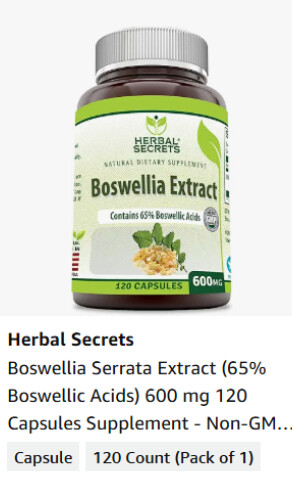
One of my favorite supplements is anti-inflammatory and anti-pyretic, reducing knee pain and lowering hs-CRP. It is Boswellia serrata, otherwise known as frankincense. For me, using it was a life-changer; it (plus rapamycin?) has left me almost entirely pain-free except for some minor lower back pain.

My latest results:

Evidence supports the use of Boswellia serrata extract for knee and joint pain and much more:

  • Boswellia Serrata Extract offers several health benefits, including:
  • Reduction of Inflammation and Pain:
  • Contains boswellic acids with anti-inflammatory properties.
  • Clinical studies indicate effectiveness in reducing pain and improving symptoms in osteoarthritis and rheumatoid arthritis patients.
  • Reduces knee and joint pain.
  • Comparable efficacy to NSAID pain medications but with fewer side effects.
  • Potential Treatment for Autoimmune Diseases:
  • Helps regulate the immune system and inhibits the production of pro-inflammatory cytokines.
  • Shows potential benefits in small studies for conditions like rheumatoid arthritis, Crohn’s disease, and ulcerative colitis.
  • Exhibits anti-proliferative and anti-tumor effects in lab and animal studies, with early indications of anti-cancer benefits.
  • Improvement of Digestive Health:
  • Increases bile flow and may assist in treating digestive conditions such as IBD, IBS, and liver disease.
  • Used for treating gastric ulcers and alleviating acid reflux symptoms.

Provides neuroprotective effects by reducing inflammation in the brain.Small studies suggest benefits for memory, cognition, and mood in patients with brain injuries.

Based on the current evidence, pain, stiffness and joints’ function start to improve after 4 weeks of continuous Boswellia and its extract (at least 100–250 mg).

"a significant decrease in the activity of hs‐CRP in the BSE‐treated group was observed in contrast to that from the placebo receiving group (p < 0.01; Figure 2f). These findings are clearly suggesting that BSE is a powerful inhibitor of hs‐CRP induced by local inflammation in patients

with OA."

Boswellia serrata has Beneficial Anti-Inflammatory and Antioxidant Properties in a Model of Experimental Colitis
https://onlinelibrary.wiley.com/doi/10.1002/ptr.5142

10 Likes

Would you recommend a specific brand or source?

1 Like

I have used several different brands, NOW, Double Wood, etc.

The thing that is weird to me (N=1) is that the first one I tried worked almost immediately. I started to feel relief from the pain in my knee after only a few days. I used this brand exclusively until my knee pain went away. Then I added rapamycin, and my joint pains all disappeared after a few months of high-dose rapamycin.

I am not saying this brand is better than others, but it is the one that worked for me.

image

https://www.amazon.com/s?k=Herbal+Secrets+Boswellia+Serrata+Extract+(65%25+Boswellic+Acids)+600+mg+120+Capsules+Supplement+-+Non-GMO+-+Gluten+Free&crid=1GXQ81QZ0IL15&sprefix=herbal+secrets+boswellia+serrata+extract+65%25+boswellic+acids+600+mg+120+capsules+supplement+-+non-gmo+-+gluten+free%2Caps%2C362&ref=nb_sb_noss

4 Likes

Maybe not fraud, but perhaps flawed? They used C57BL/6 mice, which are a weird inbred strain where the mice are essentially genetically identical to each other. ITP uses a far more representative mouse model. I agree that mice are different to humans, but B6 mice are also very different to normal mice.

Also, the study authors do indeed have a company now selling the product, so they have a very strong bias. Same goes with lots of these products where one group publishes papers showing benefits. The guy selling fisetin had 2 big papers showing it worked amazingly, he collaborated with the ITP and it totally failed. They couldn’t even find differences in senescent cell numbers.

I am totally supportive of these molecules being tested, and the academics starting companies to sell them and make them available to communities like us is great. That’s preferable to it being hidden away somewhere. However, I think it’s important to remind ourselves of the biases and the risks of getting carried away with hype. The Cell Metabolism paper is better than average - they have 182 mice in total - but it’s still a single site, it only worked in female mice, they only tested B6, and it was only barely statistically significant (p = 0.03). I think if you’re going to take any data from mice and relate it to humans, the ITP is the best you can ask for. 3 sites, large samples, totally unbiased.

He’s the co-corresponding author, so I sure hope he had a lot to do with the study, otherwise that’s a form of misconduct.

I’m not sure why iron or MgO2 are in the junk tier. MgO2 is great for keeping bowel movements soft and regular. I don’t think you get all that magnesium from it, but I take 250mg in the AM and PM, and it makes a very noticeable difference to my bathroom performance. It’s different to the bulk-forming fibre like husks.

And iron is something that a surprising amount of people are deficient in. Loads of people (particularly women) walking around out there with borderline low hemoglobin and RBC counts and small MCVs, feeling tired and crappy, all of which is fixed by simple iron supplementation.

1 Like

If you have an iron deficiency, iron is beneficial. However if you are not deficient, iron is linked to shorter lifespans.

Magnesium Oxide is considered to be the worst form of magnesium due to poor bioavailability. If you want Magnesium that keeps you regular then use Magnesium Citrate. If you want Magnesium for your brain, use Threonate. Magnesium Glycinate is also a good choice. Magnesium Oxide is the junk Magnesium.

5 Likes

He’s the co-corresponding author, so I sure hope he had a lot to do with the study, otherwise that’s a form of misconduct.

Yes, and the last-named author was the other co-corresponding author. A corresponding author usually handles the correspondence with the journal (at least it does in my field, but biomedical science may be different), e.g. as the point-of-contact for whom to send the referee reports and galley proofs to; and they can e.g. be like an “elder statesman” that provides direction, reads over the paper, points out little errors, and does contribute some to the ideas, though maybe doesn’t do the hardest technical work or directly carry out the experiments.

What I wrote before was not quite accurate. They say in the paper:

B.K.K. participated in study design, manuscript composition and data analysis.

I vaguely recall (but my memory could be in error, and I’ll never find it, given how many interviews Kennedy has done) he said in a podcast interview something like that the people at TruAge had looked at the kinds of supplements that users of their test were taking, and they saw an outlier when it came to Rejuvant, that it seemed to result in a sizable shift in their TruAge score. So, they (the TruAge people) already knew this before contacting Kennedy (again, assuming my memory is correct). Then Kennedy, and I guess his group, helped do the data analysis and write the paper.

Addendum: Maybe the TruAge people knew the correlation with Rejuvant use, based on what they were seeing from users of their test, and then they contacted Kennedy and ran the test on those 42 individuals, with his help. So, there maybe were two pools of people, one without Kennedy’s help, the other with.

1 Like

I’m afraid that’s not correct. The corresponding author is usually the one who led the study and they are the one who takes ultimate responsibility for the content. (FYI, I am a professor and do my own research, publish papers etc). I think the author participation statement there is reasonable - that he helped design the study, wrote and checked the manuscript etc. That’s pretty much what I do. I don’t get my hands dirty in the lab too often nowadays, hehe.

As for the podcast information, that’s definitely good to know. Thanks for sharing.

I recall that Attia’s advice is to supplement MgO2 up to the point where it gives you bowel problems (i.e. too poops too soft), and then use whatever other forms on top. I guess the main advantage is that it’s incredibly cheap. I’ve never used the citrate form, but I’ll look into it, thanks.

2 Likes

I am a professor, too (full professor), but not in biomedical science. I asked GPT-5-thinking about what you say, and it writes:

In many biomedical and lab sciences, the corresponding author is often the senior/last author (the PI) who directed the work and is seen as taking broad responsibility—even if they didn’t do bench work.

In other fields (math, physics, some social sciences), “corresponding” is mostly administrative; leadership is not inferred from it.

Good to know that distinction.

6 Likes

Ha, interesting! Yes I’m in biomedical science. I actually didn’t know that it’s different in other fields! In biomed the student/postdoc who did the work is usually the 1st author, and it’s like the badge of honour to be the corresponding author because it means it was your group that did the work. So yeah, thanks for sharing and educating me!

5 Likes

Dietary supplements are big business, with one recent estimate showing the industry is worth almost $64 billion in the United States alone. Take a casual scroll through your social media and you’ll find influencers hawking all kinds of supplements. But how effective are they? How are they regulated? And why are these “natural” remedies so appealing to millions of Americans?

To size up the science and culture of supplements, Host Flora Lichtman talks with supplement researcher Pieter Cohen, and Colleen Derkatch, author of Why Wellness Sells: Natural Health in a Pharmaceutical Culture.

3 Likes

I really like this video because it aligns with my current thinking (and my confirmation bias) and the subjective results of using creatine. IMO, to reap maximum brain benefits, it takes about 20 grams of creatine daily.

One of his more controversial statements is using extra salt to replenish electrolytes.

A short executive summary of Dave Asprey’s video, “This Legal Focus Powder Beats Any Dopamine Detox.”

  • Core thesis

Focus problems are usually an energy (ATP) problem, not a dopamine problem. When brain energy—especially in the prefrontal cortex—runs low, attention and impulse control drop. Asprey argues you’ll often get farther by supporting cellular energy than by doing a trendy “dopamine detox.”

  • The “legal focus powder

He’s talking about creatine (monohydrate). Framed as a simple, legal, inexpensive way to buffer ATP via the phosphocreatine system and improve mental stamina/focus. Mechanistically, creatine increases high-energy phosphate availability, which can support neurons under load.

  • Why he downplays “dopamine detox

Asprey’s point: cutting stimulation may help habits, but it doesn’t “reset” dopamine; it also doesn’t fix low cellular energy. That critique aligns with independent commentary noting little scientific support for literal dopamine “detoxes” as a neurochemical reset.

What the science (outside the video) generally shows

Creatine ↔ brain energy/cognition: Human work using MRS shows brain creatine can increase with supplementation; trials/meta-analyses suggest modest cognitive benefits (memory/processing speed), with stronger effects under stress (e.g., sleep loss) or in populations with lower baseline creatine. Not a miracle, but plausible and condition-dependent.

*** Practical takeaways conveyed**

  • If your “focus” issue is largely energy (fatigue, short sleep, cognitively demanding work), raising the ATP buffer may help more than obsessing over dopamine.

Bottom line

Asprey’s message is “treat the power supply, not the neurotransmitter hype.” For many people, especially when tired or under heavy cognitive load, supporting brain energy (ATP)—with creatine as an accessible option—may yield more reliable focus than a dopamine “detox.” Independent evidence broadly supports creatine’s role in brain energy and suggests context-dependent cognitive benefits, particularly under sleep deprivation/energy stress; however, effects in young, well-rested, healthy adults are often small or variable.

Chapters

0:00 – Introduction

0:22 – Brain energy vs dopamine

0:49 – ATP shortage causes fatigue

1:53 – Prefrontal cortex and energy

3:08 – Why ATP fuels focus and mood

4:40 – Stress, sleep and mitochondria

6:00 – Biohacks for energy production

7:39 – Backup battery: phosphagen system

8:46 – Creatine for brain energy & focus

13:18 – Vegans, women and creatine needs

15:07 – Best practices for dosing creatine

17:53 – Daily creatine + electrolytes

6 Likes

I found a subreddit that seems to post a lot of nutraceutical news (maybe the guy who created it uses an AI agent that finds things to post, and then posts them). It’s maybe a starting point to look further – some of the links are to websites like Science Alert, which is maybe not very reliable; but once one sees the topic, one can do a Google search and find more reliable sources. Here is that subreddit:

https://old.reddit.com/r/Nutraceuticalscience/

I recommend clicking on “Top” and then setting the time frame to “past month”. An alternative might be to ask GPT-5.1 or one of the agentic search tools to look for the best stuff (surprising, obscure findings).

1 Like

I came across a recent @felix-harder YouTube video that presented some worrisome findings regarding vitamin B12. Normal levels may not be enough. Bottom line: recommended levels may be too low. The holotranscobalamin (holo-TC) test he suggests is not available from UltaLabs. I guess I will follow the Quest guideline and try to raise my value above 400 pg/mL.

I am sure mine may be too low.

Quest says, "It has been reported that between 5 and 10% of patients with values between 200 and 400 pg/mL may experience neuropsychiatric and hematologic abnormalities due to occult B12 deficiency; less than 1% of patients with values above 400 pg/mL will have symptoms.

“Healthy’ Vitamin B12 Levels Not Enough to Ward Off Neuro Decline”

https://www.ucsf.edu/news/2025/02/429491/healthy-vitamin-b12-levels-not-enough-ward-neuro-decline

https://www.neurology.org/doi/abs/10.1212/01.wnl.0000325581.26991.f2?

https://www.sciencedirect.com/science/article/pii/S2274580725002080

7 Likes

A. Executive Summary (150–300 words)

The video critiques standard serum vitamin B12 testing by demonstrating that “normal” total B12 levels can mask biologically significant functional deficiency. A UC San Francisco neurology group evaluated ~200 cognitively healthy adults (~71 yr) with mean serum B12 ≈415 pg/mL—well above the U.S. deficiency cutoff of 148 pg/mL. Despite apparently adequate total B12, many participants exhibited lower concentrations of active B12 (holotranscobalamin), which is the only fraction able to enter cells. Individuals with lower active B12 showed measurable neurological impairments: slower nerve conduction, slower reaction time, and greater white-matter abnormalities on MRI. Elevated inactive B12 (holo-haptocorrin) also correlated with increased circulating tau, a biomarker of axonal injury and Alzheimer-related neurodegeneration.

The study argues that current deficiency cutoffs underestimate the B12 threshold required for neurological integrity. Total serum B12 is a composite of active and inactive forms; standard testing does not differentiate them, enabling “normal” total B12 despite inadequate cellular delivery. Older adults face reduced intrinsic factor production and gastric acid secretion, further impairing absorption even with stable dietary intake.

The researchers recommend measuring active B12 (holotranscobalamin) and using functional markers—methylmalonic acid (MMA) and homocysteine—to detect subclinical deficiency. The video concludes that B12 status should be reconceptualized as a continuum of neurological sufficiency rather than a binary deficiency threshold.


B. Bullet Summary (12–20 bullets)

  • Study included ~200 healthy seniors, mean age ~71.
  • Mean serum B12 = 415 pg/mL (well above deficiency cutoff).
  • Researchers separated B12 into active (holotranscobalamin) and inactive (holo-haptocorrin).
  • Only active B12 enters cells and supports neurologic function.
  • Many participants had low active B12 despite “normal” total B12.
  • Low active B12 correlated with slower nerve conduction.
  • Low active B12 correlated with slower reaction times.
  • MRI scans showed more white-matter damage in low-active-B12 individuals.
  • High inactive B12 correlated with elevated tau protein.
  • Elevated tau signals axonal injury and Alzheimer-related pathology.
  • Total B12 alone cannot distinguish active vs inactive pools.
  • Aging reduces gastric acid and intrinsic factor → poorer absorption.
  • Older adults may become functionally deficient despite adequate food intake.
  • Active B12 (holotranscobalamin) is a superior diagnostic marker.
  • MMA increases when B12-dependent metabolism fails.
  • Homocysteine rises when B12 or folate are insufficient.
  • Current deficiency cutoff (~148 pg/mL) may be neurologically inadequate.
  • B12 sufficiency for brain health likely requires higher thresholds.
  • Functional deficiency can exist with “normal” total B12 results.
  • More research is required, but implications are biologically plausible.

Full analysis of video:

4 Likes

Paper discussed here: What are your homocysteine levels? What have you done to reduce it? Why isn't it part of PhenoAge or aging.ai clocks? - #124 by adssx

The curves are a joke: What are your homocysteine levels? What have you done to reduce it? Why isn't it part of PhenoAge or aging.ai clocks? - #127 by cl-user

Wrong! While creatine will not damage the kidney, it is metabolized to creatinine. In a patient with chronic kidney disease, it will be difficult to tell if an elevated creatinine level is due to worsening kidney function or due the increased elimination load from the supplement. Patients with chronic kidney disease should avoid creatine supplements for this reason.

1 Like