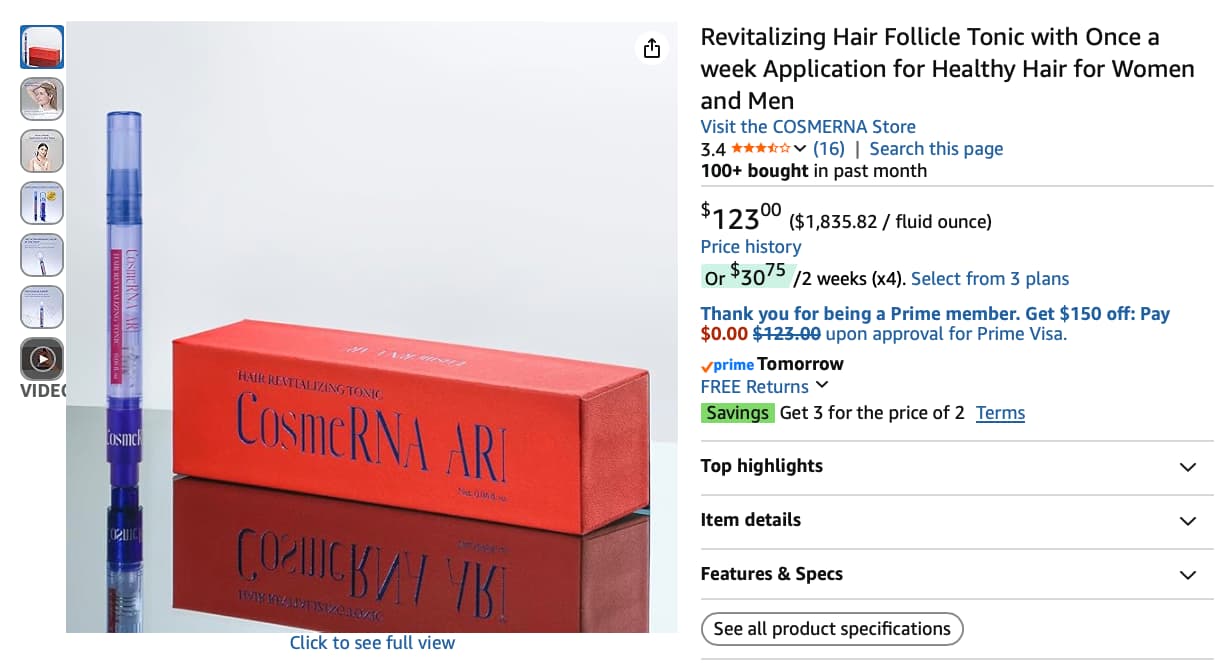
Its always good to do some deeper research on topics like this… see the effectiveness info below:
Active Pharmaceutical Ingredient (API)
The primary functional agent in CosmeRNA is a proprietary short interfering RNA (siRNA) complex designed to degrade the messenger RNA (mRNA) coding for the androgen receptor (AR).
-
Trade Name: SAMiRNA-AR68 (Self-Assembled Micelle interfering RNA)
-
INCI Name: Stearyldisulfidehexyl DNA-2-PED-45/SH-RNA-1
-
Mechanism of Action: RNA interference (RNAi). The siRNA sequence binds to and cleaves the mRNA responsible for producing the androgen receptor protein. By reducing the density of androgen receptors within the hair follicle, the sensitivity to Dihydrotestosterone (DHT) is lowered without altering systemic DHT levels.
-
Delivery System: The “SAMiRNA” technology encapsulates the siRNA in a self-assembling micelle structure to protect it from degradation by nucleases and facilitate penetration through the stratum corneum to the dermal papilla.
Supporting Active Ingredients
These compounds are included to support scalp health and likely to satisfy regulatory requirements for classification as a functional cosmetic rather than a drug.
-
Niacinamide: Anti-inflammatory agent; improves barrier function.
-
Panthenol: Humectant and emollient.
-
Biotin: Cofactor for carboxylase enzymes; standard addition in hair formulations for structural support.
-
Menthol: Vasodilator; provides cooling sensation.
Full Formulation (INCI)
- Aqua
- Phosphate Buffered Saline
- Alcohol
- Butylene Glycol
- Betaine
- Niacinamide
-
Stearyldisulfidehexyl DNA-2-PED-45/SH-RNA-1 (Active)
- Panthenol
- Menthol
- Sodium Bicarbonate (listed as Sodium in some disclosures)
- Biotin
- Citric Acid
Evidence & Clinical Context
A randomized, double-blind, placebo-controlled trial published in Scientific Reports (2022) demonstrated that weekly application of SAMiRNA-AR68 (5 mg/ml) resulted in significant increases in total hair count compared to baseline and placebo after 24 weeks. The product is currently marketed under cosmetic regulations (CPNP in Europe) rather than as an FDA-approved therapeutic.
The following analysis compares the clinical data for SAMiRNA-AR68 (CosmeRNA) as published in Scientific Reports (Yun et al., 2022) against established clinical consensus data for Finasteride (1 mg oral).
Executive Summary
While the Scientific Reports authors claim SAMiRNA-AR68 offers “comparable efficacy” to Finasteride, a direct review of the absolute numbers suggests Finasteride (1 mg) demonstrates superior potency in increasing total hair count (+12.4 vs. +7.6 hairs/cm²) over similar timeframes. However, SAMiRNA-AR68 achieves statistical significance without the systemic hormonal alteration associated with Finasteride.
1. Mechanism of Action: The “Hardware” vs. The “Signal”
The primary biological distinction lies in the target of intervention.
-
Finasteride (The Signal Inhibitor):
-
Target: Type II 5-alpha reductase enzyme.
-
Action: Prevents the conversion of Testosterone to Dihydrotestosterone (DHT).
-
Result: Systemic and local reduction of serum DHT by ~60–70%.
-
Biological Logic: Removes the “trigger” (DHT) that causes follicular miniaturization.
-
CosmeRNA (The Hardware Degrader):
-
Target: Androgen Receptor (AR) mRNA.
-
Action: Uses RNA interference (siRNA) to degrade the genetic instructions for building the Androgen Receptor.
-
Result: Reduces the number of receptors available in the hair follicle to receive the DHT signal.
-
Biological Logic: Removes the “receiver” (AR), rendering the follicle less sensitive to DHT even if systemic levels remain normal.
2. Clinical Efficacy Comparison (24-Week Data)
The following data contrasts the high-dose arm of the CosmeRNA study against meta-analysis data for Finasteride. Note that the CosmeRNA study relied on historical controls for Finasteride comparisons rather than a head-to-head trial arm.
| Metric |
CosmeRNA (SAMiRNA-AR68) |
Finasteride (1 mg Oral) |
| Study Source |
Yun et al., Sci Rep (2022) |
Gupta et al., J Derm Treat (2022) |
| Sample Size |
n=21 (High Dose Group) |
n > 1,000 (Aggregated RCTs) |
| Dosing Frequency |
1x Weekly (Topical 5 mg/ml) |
1x Daily (Oral 1 mg) |
| Total Hair Count |
+7.6 hairs/cm² (Change from Baseline) |
+12.4 hairs/cm² (Net vs. Placebo) |
| % Change |
~4.4% increase |
~9–11% increase |
| Statistical Significance |
p < 0.05 vs. Placebo |
p < 0.001 vs. Placebo |
- Critical Analysis of Efficacy:
-
Absolute Growth: Finasteride consistently outperforms SAMiRNA-AR68 in absolute hair count generation (approx. 12.4 vs 7.6 hairs/cm²). The “comparable” claim in the Scientific Reports paper relies on the lower bound of historical Finasteride efficacy.
-
Sample Size: The CosmeRNA data is derived from a very small sample (n=21 active users), resulting in a wide standard deviation (± 14.3 hairs/cm²), indicating highly variable individual responses.
-
Terminal vs. Vellus: Both treatments successfully convert vellus (miniaturized) hairs back to terminal (thick) hairs, but Finasteride has a more robust dataset confirming long-term maintenance (5+ years).
3. Safety & Side Effect Profile
This is the primary differentiator and value proposition for SAMiRNA-AR68.
-
Finasteride:
-
Systemic Effect: Lowers serum DHT globally (scalp, prostate, blood).
-
Adverse Events: Sexual dysfunction (libido reduction, erectile dysfunction) in ~1.3% to 3.8% of users; potential for “Post-Finasteride Syndrome” (debated but reported).
-
Contraindications: Strictly prohibited for women of childbearing potential (teratogenic).
-
CosmeRNA:
-
Local Effect: The SAMiRNA molecule is large (~100nm) and degrades rapidly in the bloodstream, preventing systemic accumulation.
-
Adverse Events: No significant adverse events reported in the 24-week trial. No changes in systemic hormone levels (Testosterone/DHT).
-
Contraindications: None explicitly listed, though pregnant women are generally excluded from such trials.
4. Conclusion: Position in the Longevity/Biohacking Stack
From a practical biohacking perspective, SAMiRNA-AR68 is likely less potent than Finasteride but offers a viable mechanism for those unwilling or unable to tolerate 5-alpha reductase inhibitors.
-
For Aggressive Intervention: Finasteride remains the “Gold Standard” for halting miniaturization due to its superior efficacy data.
-
For Risk-Averse/Adjuvant Use: CosmeRNA represents a novel “stackable” intervention. Because it operates on the receptor (AR) rather than the hormone (DHT), it could theoretically be used alongside Finasteride (or Dutasteride) to attack the androgenic pathway from both ends (Signal Inhibition + Receptor Downregulation), though no clinical data currently exists for this combination.