Doing this right before the midterms was an interesting strategic decision.
As Julia Roberts in Pretty Woman would say,
“Big mistake. Big. Huge”
Doing this right before the midterms was an interesting strategic decision.
As Julia Roberts in Pretty Woman would say,
“Big mistake. Big. Huge”
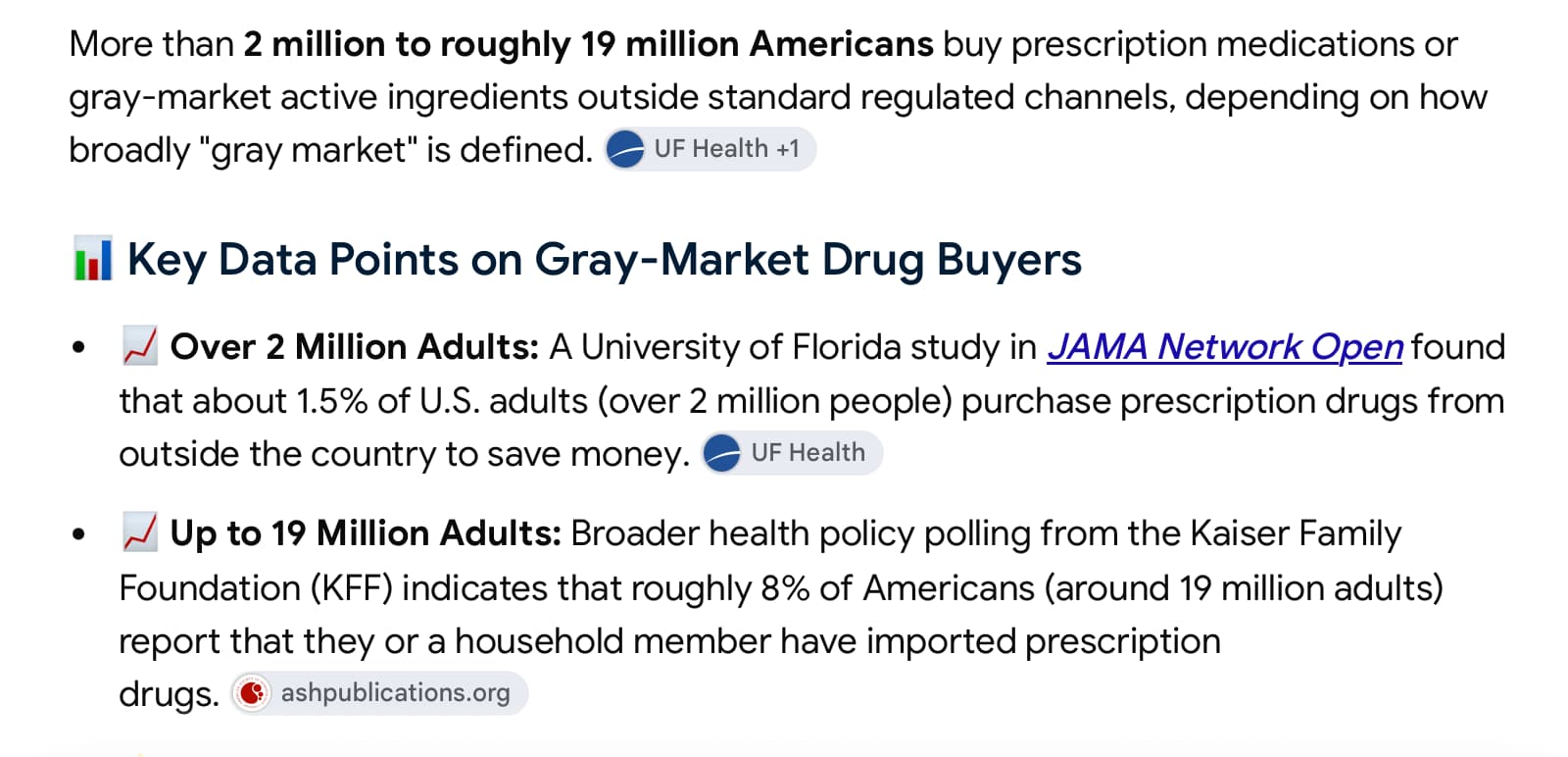
Just was curious how many Americans purchase grey market medications, and who will be impacted by this, so asked Google Gemini:
And to piggy back, I asked if there were any stats showing which states/party might be most impacted, Opus said:
No. I couldn’t find any survey that breaks down drug importers by party or by red vs. blue state. Your guess is plausible but not proven, and the data points in both directions.
Weakest point of this answer: the political part below is my inference from demographic proxies, not measured data. Treat it as an educated guess.
What the best study actually shows
The University of Florida study (JAMA Network Open, 2020) is the one Gemini cited. It used federal survey data from 2015–2017, so it’s old.
Importers were more likely to be older (over 64), Hispanic or immigrant, college-educated, lower-income, and uninsured. The two biggest signals: immigrants had about 3.2 times the odds, and uninsured people about 3.1 times.
Region did matter. Region was among the factors significantly linked to buying abroad. But I couldn’t get the full table to see which regions. I’d bet the West and the Mexico-border states, but that’s a bet.
Why it doesn’t sort cleanly by party
So it’s less “red vs. blue” and more “uninsured, old, or born somewhere with cheaper pharmacies.” Which describes half of Florida regardless of party.
Two catches in the Gemini post
One thing that is measured: support is bipartisan
The policy itself crosses party lines. A majority of Republicans, Democrats, and independents favored allowing Americans to buy drugs from Canada. So this rule annoys everybody roughly equally, which in 2026 is almost a unifying achievement.
And the rapamycin.news crowd is its own demographic: educated, online, buying off-label longevity drugs. Not really captured by any of these surveys.
Your move: Nothing
Open question: None
Ha,
My friend’s Claude has a great personality, so today, I added a line to my instructions:
Respond in the style of Larry David
This was ‘his’ first attempt as sarcasm… kinda loving it.
That 2 to 19 million estimate does seem to include people that buy peptides, except that most peptides are effectively black market products.
I have 0 worries about being able to buy peptides after October.
For stuff from India, biggest worry was around India post shutting down, and more time spent on filling forms, no doubt in anticipation for October. That doesn’t scream shutdown to me yet.
It seems like a shutdown already:
I just posted that I reached out to Maulik to confirm that and there was a miscommunication… Maulik is still sending to the US… all is well!
I’m fine with paying a little more post 10/22 if that is all it is… but confiscating our stuff is obviously a non starter. No idea what to expect.
And yeah, I’m not worried about peptides either… that is so very grey that I feel they will send it over with drug mules if needed 
Nice. The ones I use are still shipping.
Get your orders in now! We don’t know how much longer this is going to last.
Yeah, I’m not sure there will be any political blowback from this at all. My fellow Americans don’t seem to care at all about the constant salami slice abridgments of freedom and creeping authoritarianism. We seem happy to give up even body autonomy - “my body my choice”… not so much… and these are medications, not drugs, they affect nobody else! Only my body! This is insane.
To me it’s funny how land of the free is increasingly less free and home of the brave are no longer brave enough to even just vote to throw the bums out.
My thought is that I have friends all over the place. What if I pay through wise as usual, but ship it to a friend in Mexico, then either take a quick trip to Mexico to pick up the shipment (close from SoCal), or pay someone to bring over. I think it’s still legal to bring meds over on your person from abroad?
Clearly in our system, they want you to have no option but to be extorted for life saving medications, and if too poor, croak. Also, you must be held hostage by a doctor’s lobby for prescriptions - they get to decide what you can and cannot do with your body. At least that’s the design, and we’re collectively OK with this… I’ve seen more discussions in the media of the silly exploits of D grade celebrities than this latest insane attack on medical freedom… clearly folks don’t care. Oh well.
Mexico itself has a solid generics industry. I’ve found it relatively easy to buy medication I was looking for there to bring back into the US.
Republicans are gearing up to lose by 15-20 points regardless.
We Euros have had the issue with Indian medications since forever. Hopefully alternative routes will emerge soon.
Here’s what a Brave query turned up as of today’s information. Best case, it shakes out the marginal suppliers. I posted my wife’s warning from a Canadian pharmacy here a few days ago. I see the usual vagueness characteristic of federal policy – designed to let them execute however they see fit.
There is no indication of a blanket “cutoff” or ban on overseas drug shipments for Americans on October 22, 2026. Instead, U.S. Customs and Border Protection (CBP) is implementing stricter customs entry requirements for international mail shipments subject to other federal agencies’ regulations, such as the FDA.
An entirely different take, dated September 11, 2026:
If you rely on Maple Leaf Meds for affordable medication, place your order now and stock up.
U.S. Customs and Border Protection (CBP) has enacted a new policy governing international mail shipments, with key requirements scheduled to take effect on October 22, 2026. We have just learned that, under the planned implementation by CBP and the Food and Drug Administration (FDA), virtually all prescription medication parcels will be prohibited from entering the United States beginning on that date.
Entry will be prohibited if the medication being imported is commercially available in the United States — even when it costs significantly more — or if the supplying company specifically markets to Americans.
These restrictions will apply to pharmaceutical parcels sent by pharmacies anywhere outside the United States. Taken together, they are expected to effectively close the personal-importation pathway that millions of Americans have relied upon for more than 25 years to obtain safe and affordable medications. We are shocked and deeply disappointed.
Place all available refills and other orders immediately and well in advance of October 22. Your prescription needs time to be reviewed, dispensed, shipped and clear the U.S. border before the new policy takes effect.
If you will need medication at any time during the next year, now is the time to order and stock up. Do not wait until your current supply is running low.
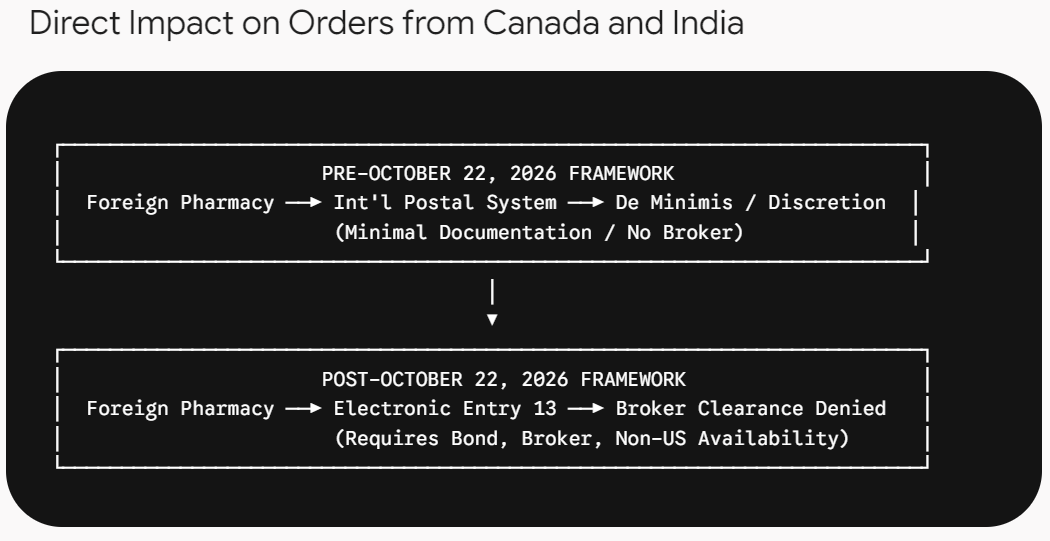
Gemini’s take.
It looks like personal orders would need a broker on this side. Higher prices for certain but perhaps delays until this system was established.
============
GPT’s take. (Important language at the end.)
October 22, 2026 is a customs filing deadline, not the effective date of a new FDA ban on personal prescriptions. It could nonetheless interrupt many small orders from Canadian and Indian pharmacies.
The distinction is that the $800 duty-free de minimis exemption has already been suspended. On October 22, CBP’s temporary allowance for certain low-value international mail shipments ends. A mailed medicine subject to FDA requirements will then need a formal customs entry or an entry through CBP’s new, voluntary Type 13 electronic test. Type 13 still requires an eligible importer of record, a bond, and the applicable FDA information. A parcel’s value below $800—or even below $2,500—does not excuse those requirements.
| Question | What the published rules establish |
|---|---|
| Does October 22 prohibit every personal medicine order? | No. CBP has provided filing routes for qualifying shipments. It has not announced a categorical prohibition on personal-use prescriptions. |
| Is a prescription and a 90-day supply sufficient? | No. FDA says admission of a foreign-market drug is generally restricted; its personal-importation policy permits case-by-case discretion, chiefly under specified circumstances, rather than a general 90-day entitlement. |
| Does ordering from Canada help if the product comes from India? | The October 22 postal rule applies to international mail regardless of which of those countries sends it. FDA admissibility turns on the product and circumstances, not simply the pharmacy’s location. |
| Would switching to a courier solve it? | It avoids this particular postal filing transition, but couriers are also subject to customs entry and FDA import requirements; the de minimis suspension covers nonpostal shipments too. |
The practical forecast is more severe than the rule’s literal wording. The Canadian International Pharmacy Association says the broker used by many postal systems will be unable to handle most ordinary prescription orders under the new arrangements and predicts that “virtually all” routine personal orders will be disrupted. That is the trade group’s assessment of implementation, not a CBP or FDA finding that every such parcel must be refused. Zonos, the broker identified by the group, publicly describes a narrow approach to foreign prescription medicines, particularly when effective treatment is available in the United States.
My judgment is that the disruption risk is substantial for routine refills of foreign-market versions of drugs available in the US, even when the buyer has a valid prescription and orders only 90 days. There are two separate hurdles: finding someone willing and able to file and stand behind the entry, and obtaining FDA admission. The uncertainty is how consistently CBP, FDA, brokers, and postal operators will apply those requirements after October 22. FDA’s published policy still allows individual discretion; it does not promise it for routine price-driven purchases.
For a specific impending order, the most informative question to put to the dispensing pharmacy is: After October 22, will you accept and ship this exact medicine to the US, by which carrier, who will file its customs entry and serve as importer of record, and what will happen if FDA refuses admission? That answer is more useful than a general assurance that the order is “for personal use.”
I wonder how this will affect deliveries from India? While the Canadian pharmacies are required to list the contents of all parcels, my recent Indian shipments don’t.
FWIW…a comment
This may be due to pressure from pharmaceutical companies crying they are losing money.
The other day I placed an order for a medical compound, the product is sold in the US for approximately $1,300.00 per dose,(dose is 3ml]. And most insurance will not cover.
Product has been approved since 2017 in the USA. Approve in the EU 2001
Same product (same name, brand , manufacturer and dose) in EU just under $130.00 yes one hundred thirty dollars.
Why?
This is Beyond Price Gouging.
Flying to EU to purchase will still cost less than buying in the USA.
The Conniving Never Stops
The requirement applies to all countries and contents declarations are electronic and must be pre-cleared by US Customs (or a broker) before India Post will accept the package. Sep 22 to Oct 21 is a trial period, where enforcement may be less strict.
FWIW…
A package was shipped to me yesterday 09/22/2023 it has already been stopped by customs for review (less than 24 hours after it was ship, shipped is by
UPS Worldwide Expedited)
Now I sit and wait.