Urolithin A exhibits a dose-response effect on inflammation, with some RCTs showing that 1000 mg reduces CRP, whereas 500 mg does not.
3 Likes
I’ve taken 1000 and 500… off brand and brand. I don’t feel either one.
Claude Fable told me this:
What the trial shows — Singh 2022, Cell Reports Medicine, Timeline-funded, 88 people, 4 months. Human trial (randomized).
• Strength: hamstring peak torque rose at both 500 mg (p = 0.027 vs placebo) and 1,000 mg (p = 0.029). Roughly 12% and 10% — the two doses are the same on this outcome.
• Endurance: 6-minute walk distance, author-confirmed figures: 500 mg arm −0.74 m, 1,000 mg arm +33 m, placebo −0.52 m. Only 1000 moved. But the pooled result across trials was +17 m and not significant (p = 0.135), low-certainty by GRADE. Meta-analysis.
• Aerobic capacity: peak VO2 rose within the 1000 mg group (p < 0.01), but against placebo only p = 0.058 — just missed.
• Anything else: hand-grip trended up at 1000 only (p = 0.08). Not significant.
4 Likes
I have looked extensively at the literature and personally spent some bucks on urolithin A supplements. Asked all of my paid AIs about it.
Ignore the YouTube gurus:
The consensus is MEH.
Save your money for some better drugs and supplements. Adding urolithin A just increases the number and price of your supplement list.
5 Likes
I have bulk powder and capsules. partly because it is easier, I have been alternating 1,000 mg and 500 mg/day. I do not have any hard metrics but based on my year or so taking it and inadvertently falling off for a couple of months due to a scam product, I would recommend that a first time person try 1,000/per day for at least four months (minimum time for full effect) and then see if you can hold that line with 500 mg.
Another consideration is that you may be too young to see too much benefit. There is some reason to think the benefits accrue mostly to muscles over 65-70. It could also be that some muscles are too old or too far structurally transformed to realize benefit. I believe its effects are complex, that it does not benefit everyone. A deep AI dive, separating mechanistic from functional empirics will suggest significant potential benefit.
2 Likes
Thanks Rob for your comments. Curious what type of testing you were able to do (and where) to confirm your bulk powder is clean and Urolithin A? Do you put it in capsules or sprinkle it on your cheerios  I’m buying the Toniiq stuff but it is still pretty expensive given that a single dose is 6 capsules. Not sure how long I’ll take this stuff, seems there is not a lot of evidence that it is doing much but I like the idea of targeting CNS mitophagy. I don’t feel any different with 500 / day but I’ll bump it to 1000 to see if I sense anything.
2 Likes
I’m using Aeternum bulk powder and Toniq. The Aeternum is comparatively economical in the 100 gram bulk powder form. They have a lab certificate of purity and potency but of course that doesn’t mean the 100 grams I purchased is unadulterated. When the Toniq is gone, I think I will continue with the Aeternum power. The company seems to have a good reputation.
You have no doubt studied the several stages of transformation associated with UA supplementation and their time lines totaling 4-6 months. They align well with my personal experience. I don’t think I could observe any effects for the first two months and since I was engaged in exercise of various kinds and intensities over the period it would be difficult to fully isolate the impact of UA. It wasn’t until I was no longer getting 500-1,000 mg/day that I noticed an unmistakable regression in how my lower body muscles felt and seemed to perform during intense exercise. This benefit could be idiosyncratic. If you look carefully within the findings, ignoring means and p-values, you see a high degree of variation in, suggesting that individual underlying metabolic differences may play a role in whether UA is beneficial.
Two effects, however, are consistent across every adult age bracket: the UA biomarker signature (acylcarnitines down, hsCRP down, muscle mitophagy/OXPHOS proteins up) and, strangely primary-endpoint misses. As I said, the functional hits are almost always secondary or within-group endpoints.
If I were advising someone whether it was worth a minimum four month investment, I would base is on a frank assessment of lower body muscle function. If these muscles are behaving more-or-less according to expectations and as they have in the past, it may not be worth the time and expense.
3 Likes
@RobTuck thanks for the share, I’ll now feel confident to return to Aeternum. I was taking their pills and then switched to Timeline gummies (only during a huge sale and I justified the cost because they are enjoyable sweet treat that I wouldn’t have thought was too much for a month of chocolates (oh, the brain gymnastics I do to justify expenditures!!!)
3 Likes
You are welcome @Beth @59vw (a '59, Wow!). Report back as soon as you have something. I think many of us are on one side or other of the fence on UA, especially those of us who are older. On the other hand, it is possible that further research will demonstrate that it slows decline and is therefore useful for a younger audience.
One issue I would like to see investigated more is whether it has any impact on the gradual replacement of the general category of Type II muscles with a one of the more narrow function Type I muscle fibers – a normal progression in aging and having ties to sarcopenia.
3 Likes
Gut Metabolite Urolithin A Reverses Heart Failure Remodeling by Restoring Mitochondrial Quality Control
Urolithin A, a postbiotic metabolite derived from dietary ellagitannins, significantly alleviates heart failure with preserved ejection fraction in a mammalian model. The compound restores diastolic cardiac function and reduces tissue fibrosis by activating AMPK, inhibiting mTOR, and enhancing mitophagy, while simultaneously remodeling the gut microbiome to lower circulating lipotoxic ceramides.
Heart failure with preserved ejection fraction accounts for approximately half of all heart failure cases globally and currently lacks effective mechanism based cellular therapies. The pathology is heavily driven by systemic metabolic comorbidities such as obesity and hypertension, which converge to cause profound myocardial remodeling, fibrosis, and mitochondrial dysfunction. Researchers investigated Urolithin A to determine if this gut microbiome derived compound could reverse established cardiac pathology.
The study utilized a two hit mouse model combining a high fat diet with a nitric oxide synthase inhibitor to accurately replicate the systemic metabolic stress seen in human patients. Following disease establishment, Urolithin A administration successfully restored diastolic relaxation and reduced cardiac hypertrophy. Notably, the intervention produced these structural cardiac benefits without altering the subjects total body weight, fat mass, or daily food intake.
At the molecular level, the compound activated the AMPK signaling pathway and inhibited mTOR, effectively reestablishing PINK1 and Parkin mediated mitophagy. This clearance of damaged mitochondria preserved cellular architecture and restored oxygen consumption rates. Furthermore, researchers utilized shotgun metagenomic sequencing and lipidomics to discover a secondary systemic mechanism. Urolithin A actively remodeled the gut microbiome, suppressing specific bacterial populations responsible for de novo ceramide biosynthesis. This resulted in a marked reduction of circulating lipotoxic ceramides. This dual action of direct myocardial mitochondrial quality control and systemic microbiome modulation provides a clear mechanistic rationale for evaluating Urolithin A as a targeted therapy for age related cardiac dysfunction.
Actionable Insights
Translating these findings to human healthspan optimization reveals practical applications for maintaining cardiovascular longevity and aerobic capacity. Urolithin A demonstrates a measurable ability to reduce structural cardiac stiffness and preserve mitochondrial spare respiratory capacity under extreme metabolic stress. For individuals actively tracking their VO2 max and performing regular high intensity interval training, maintaining this baseline mitochondrial flexibility is mandatory for optimal cellular energy output and recovery speed.
The data illustrates significant real world effect sizes. Urolithin A reduced pathological cardiac perimysial fibrosis by 50 percent compared to the untreated disease state. Furthermore, the reduction of systemic ceramides via gut microbiome remodeling presents a powerful secondary longevity benefit. Lowering circulating lipotoxic lipids directly supports the maintenance of clean vascular endothelium and aligns perfectly with aggressive targets for apolipoprotein B and high sensitivity C-reactive protein. The intervention also reduced lung congestion markers by 45 percent, fully returning them to baseline control levels. This strongly suggests Urolithin A operates as a potent systemic geroprotector capable of modifying both localized tissue quality and circulating inflammatory lipid profiles.
Context and Source
- Open Access Paper: Urolithin A activates mitophagy via the AMPK-mTOR axis and modulates the gut-ceramide axis to ameliorate cardiac remodeling in HFpEF, Published: 10 July 2026.
- Institution: Gwangju Institute of Science and Technology, Chonnam National University, Prestigebiopharma Innovate Discovery Center
- Country: South Korea
- Journal: Experimental & Molecular Medicine
- Impact Evaluation: The impact score of this journal is approximately 9.5, evaluated against a typical high-end range of 0 to 60+ for top general science, therefore this is a High impact journal.
Biomarker Data (Effect Size Extraction)
Instead of relying solely on statistical significance, the magnitude of the physiological improvements demonstrates the practical strength of the intervention.
-
Diastolic Function (E/A ratio): The ratio worsened to approximately 5.5 in the disease group but improved to 4.0 with treatment, yielding an absolute improvement of 1.5 units and a relative functional recovery of 27 percent.
-
Cardiac Fibrosis: Perimysial ECM accumulation increased from a baseline of 5 percent to 18 percent under stress. Treatment reduced this to 9 percent, generating a relative risk reduction of 50 percent for fibrotic tissue accumulation.
-
Pulmonary Congestion: The lung wet to dry weight ratio increased to a pathological score of 10. Treatment reduced this parameter to 5.5, a 45 percent relative reduction that completely normalized congestion back to control levels
Critical Limitations
- Translational Uncertainty: The 20 week intervention in young mice fails to capture the chronic, multidecade accumulation of metabolic damage, senescence, and structural cross linking characteristic of human cardiac aging [Confidence: High].
- Methodological Weakness (Causality): The connection between microbiome remodeling, ceramide reduction, and cardiac improvement is entirely correlative. The study lacks germ free mouse models or fecal microbiota transplantation to definitively prove that the microbial shift is a primary driver rather than a secondary consequence of improved systemic metabolism [Confidence: High].
- Missing Metabolic Data: Glucose tolerance and systemic insulin sensitivity metrics were not assessed. It remains unknown how much of the cardioprotective effect was downstream of generalized glycemic improvements versus direct cellular action [Confidence: High].
- In Vitro Limitations: Human induced pluripotent stem cell derived cardiomyocytes exhibit an immature, fetal like transcriptional state. Pathological plasticity observed in these cells may overstate the transcriptional vulnerability of fully mature adult cardiomyocytes
5 Likes
2 Likes
Reposting from an earlier thread.
Adding a multi-strain probiotic(50 billion CFU or higer) ensures production of Urolithin A.
A higher proportion of synbiotic participants were capable of converting polyphenols into UroA (Day 91, 100% vs. 44.4%; p < 0.01).


Multi-Species Synbiotic Supplementation Enhances Gut Microbial Diversity,…
Background: In healthy adults, probiotic supplementation alone does not increase Urolithin A (UroA) and rarely increases butyrate, both microbiome-derived metabolites that influence key biological functions involved in regulating gastrointestinal…
Accordingly, this clinical trial evaluated key biological functions of a multi-species synbiotic with 24 probiotic strains and a polyphenol-based prebiotic using capsule-in-capsule delivery technology
Methods : We conducted a randomized, placebo-controlled trial among healthy participants (n = 32). Participants were administered a daily synbiotic (53.6 billion AFU multi-species probiotic and 400 mg Indian pomegranate extract; DS-01) or matching placebo for 91 days.
Results : The synbiotic significantly increased alpha-diversity of Bifidobacterium and Lactobacillus spp. at all timepoints, including at end-of-study (Day 91, p < 0.0001) and increased native beneficial microbes. UroA production was significantly increased in the synbiotic arm at short-term (Day 7, 12-fold, p < 0.02) and long-term (Day 91, 49-fold, p < 0.001) timepoints. A higher proportion of synbiotic participants were capable of converting polyphenols into UroA (Day 91, 100% vs. 44.4%; p < 0.01).
2 Likes
I have reviewed this thread several times, and the best I found was one person who reported possible beneficial results. I didn’t find much on Reddit either. I also reviewed the “clinical” testing of urolithin A, and it seems to have been conducted mostly by the manufacturer of MitoPure, with studies lasting up to four months. I would like to see better human testing, and if the research were conducted by the ITP, I would have much more confidence in the results.
If anyone is certain they have noticed any type of improvement from using urolithin A, please post your experiences. I just don’t see the benefit of starting a new supplement until there is better evidence demonstrating meaningful benefits in humans.
And urolithin A is a very expensive supplement. It reminds me of a $100-per-bottle blend that was mostly water, with plenty of turmeric and a little BioPerine, which I used years ago for joint pain. I was very gullible at the time, and it turned out to be a huge waste of money. But … don’t misunderstand. I do use curcumin (from turmeric) which I find beneficial in that it lowers my hsCRP. But, I don’t pay $100 a bottle for it.
Even if MitoPure’s urolithin A was only 10% of its current price, I still wouldn’t buy it because I just don’t see enough evidence of meaningful benefits at this point.
9 Likes
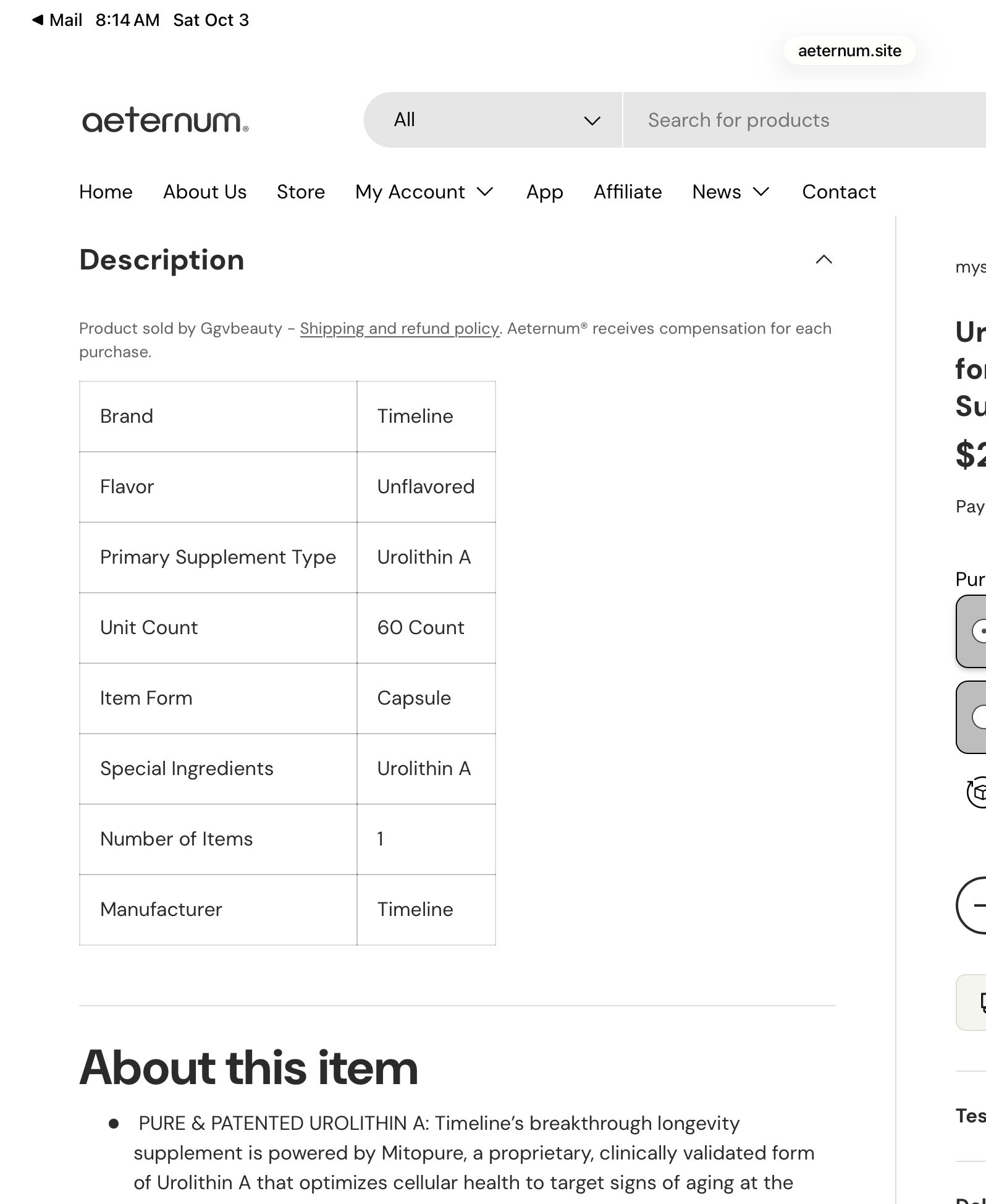
I noticed Aeternum completely changed their UA offering, and on their website, it indicates it’s ‘sold by Ggvbeauty’ . It also says it’s TIMELINE… huh?? 29.99 HUH? It’s too good to be true, so therefore… huh?? Old expired product or?
1 Like
Yes, that appears to be the Timeline product. Maybe Timeline is exploring additional outlets for their product, but at a more reasonable price. Or, maybe it’s a limited time low price.
The product appears in your link, but not when accessing the Aeternum site directly. Searching for Urolithin A from the Aeternum.site presents a Urolithin A MitoPure alternative link that requests an email address. I assumed a link to what you found would be given after providing my email address. But, the link Aeternum sent to my email was for a discount code only.
Thx Jay,
I see it’s available directly from Ggvbeauty, however they seem like a questionable website, so maybe this is damaged or expired product. I’d stock up if trustworthy, but ???
And it’s interesting because the link takes me to the page on the Aeternum site. I have noticed in the past there are things available on their Australian site that were not available in the US… including a discount code. Maybe this is one of those inconsistent things.
1 Like
A very long thread, close to 500 comments and upon review you found one example of benefits claimed? What to make of it? Perhaps indomitable human spirit and hope never dies  …
…
5 Likes
Thoughts?
@CronosTempi @Jay @anyone
I was going to give up on on UA, but after Claude found this, I was going to continue with a less expensive source… but alas, most have seemed to vanish …
Summary written by Claude (Anthropic’s AI) at my request:
Something newer than most of this thread: a heart finding from an academic lab.
Su et al., Science Advances, August 2026. King’s College London, funded by the British Heart Foundation, not by the Mitopure maker.
What they did
- Screened plant compounds for ones that switch on PKGIα, a protein that relaxes heart muscle and blood vessels.
- Urolithin A switched it on by directly modifying one spot on the protein (cysteine 42). That is a new mechanism, separate from the mitophagy story.
What they found
- Mice with HFpEF (heart failure where the heart pumps normally but is stiff and relaxes poorly): one week of oral urolithin A improved relaxation measures, reduced fibrosis and heart enlargement, and the mice ran more.
- Mice engineered without that cysteine got no benefit, so the effect runs through that one switch.
- Heart tissue grown from human stem cells contracted and relaxed faster.
What it does not show
- No humans. Male mice only. One week of treatment. Human tissue from a single donor.
- The mice already had heart failure. It says nothing about prevention in healthy people.
- It does not answer the fair criticism upthread. The human muscle trials are small and short, and a July 2026 meta-analysis (Dao et al., Frontiers in Nutrition) rated that evidence low certainty.
Bottom line: a credible new mechanism from a charity-funded academic lab. Evidence tier: animal and lab. Worth watching for a human trial; not proof of benefit.
Paper: https://www.science.org/doi/10.1126/sciadv.aec8088
Free full text: Targeting PKGIα Cys42 attenuates cardiac dysfunction in heart failure with preserved ejection fraction - PMC
I mean, I can find no relevance for my health from this finding. A single isolated finding in an engineered mouse model might be grounds for further research avenues, but it says absolutely nothing about taking a dodgy supplement in the hopes of… what exactly I can’t even tell. The whole Urolithin A thing is an incredible boondoggle in being marketed as something somehow useful in humans if but and maybe this and that. I can’t even wrap my head around it. Seriously, this is a plant metabolite originally mediated by the gut biome - yet, there is a mountain more evidence of possible benefits from supplemental carotenoids, sparse as those are.
Until there are minimal human results of any kind at all, run by independent researchers and with a control group, I think this is for the birds. Who (medical profile) exactly is supposed to benefit from this? I’m not opposed to gambling - after all I take rapamycin. But there are - super limited - some kind of rapamycin trials in humans, even if indirect as in transplant patients - that gives me enough information about possible downsides, side effects and drug interactions, so even if there are no benefits that pan out, I at least have an idea about the downside exposure of taking rapamycin. When looking at any drug/supplement you should get both the “cost” and “benefit” parts, even if one (or both!) happen to be null values. What do I get with Urolithin A? I personally can’t see anything at all other than a bunch of pie in the sky promises and prolific mechanistic speculation. But I’m sure others have different views, as always. YMMV.
2 Likes
I am grateful for your thorough analysis, as always. It definitely helps me look at it with more objectivity. Anytime I hear anything with a heart benefit, I say I’M IN!
In the meantime, I got the gummies on a big sale and enjoy them as a treat, but I won’t repurchase them unless we learn more. I appreciate you being my eyes and ears as I can’t personally evaluate things as keenly as you do.
THANK YOU!!
1 Like
De nada. We’re all here to learn from each other, and stumble about, hopefully toward the light🙏.
1 Like