Good luck to your wife in the election. And good luck to you - I was co-opted into leaflet delivery for my father as a teen. I was always terrified of the dogs!
I am not surprised by these results. And I don’t think the correct conclusion is to adjust the regularity of your dosage down to the point that your strength gains are the same as they would be if you were not taking rapamycin at all. That to me implies that your victories against cancer may be equally diminished. Dose heavy, lift heavy is still the best strategy in my opinion.
5 Likes
There is no evidence that rapamycin, taken at moderate doses once weekly, increases lifespan in mammals. But now we do have evidence that rapamycin blunts the positive benefits of exercise in the same way metformin does. Overall this suggests that the current approach is simply detrimental and should be changed to (much) higher doses once monthly/bimonthly/every three months or rapamycin needs to be replaced with some potent mTORc1 inhibitor with a very low half life.
5 Likes
The degree of blunting is also important. I don’t think we should have allergic reactions to things that blunt muscle growth - I would expect anti-growth things to be the one things that do work for longevity! Anecdotally I haven’t noticed a significant drop in my performance in the gym when on metformin and weekly rapamycin. I’m sure there is an effect, but the magnitude, at least in my anecdotal experience, seems small relative to the difference between those who train hard and those that don’t.
Eg you train hard and are triple the strength of a keyboard warrior. Then even if you lose 10% from these growth suppression drugs it’s just not enough to be in danger of wasting away. The gap between those who train strength consistently and those who don’t is just so massive that I can’t see the drug induced lower peaks in strength actually ever mattering.
2 Likes
I think people are reading too much into this trial. I don’t think the results suggest that rapamycin is detrimental at all. For short term exercise gain it may be detrimental, and if that’s all you care about then you might want to stay away from it. But the trial couldn’t possible answer whether it has beneficial effects on aging in humans.
Effects on aging would take much longer to show up and wouldn’t show up as changes in exercise performance in the short term. It’s entirely possible that muscle strength and size gains are somewhat reduced in the short term, while over the long run, rapamycin would have protective effects on muscle quality, which would leads to improvements that won’t be detected until someone has taken it for many years, if not decades.
Note that calorie restriction reduces muscle mass for obvious reasons, but when done over the long run it actually prevents sarcopenia and improves muscle quality in rodents. It’s a case of a shorter term sacrifice (in strength and mass) for long term benefits.
The fact that rapamycin slightly blunted gains from exercise might actually be considered somewhat of a confirmation that it’s effectively doing what we want it to do, which is inhibit mTOR.
Btw I recall seeing evidence that blocking mTOR only blocks some of the muscle gain stimulation because some of it is independent of mTOR inhibition. Anecdotally, rapamycin doesn’t appear to have much of an effect on the ability to gain muscle, so the effect is at best small in most people. It’s possible of course that it is more significant in older more frail people.
My hope is that this study doesn’t give rapamycin a negative publicity. People must realize that this study does in no way indicate that rapamycin doesn’t work for slowing down aging. To detect the effects of rapamycin on aging requires much longer trials, and so far we only have animal studies to go by in that regard.
14 Likes
It would be interesting to see if like a year or two later the people who took Rapamycin are in better health, compared to the placebo group. i.e. it might be that a couple weeks of Rapamycin triggers long-term improvements in health.
1 Like
That, of course, is the key issue. A proper test of Rapamycin in Homo sapiens would take quite a long time.
3 Likes
Instinctively this seems right. At least fasting “well” can be beneficial for sarcopenia in the long. The big question with both fasting and rapamycin is what constitutes an optimal dose.
I wonder, given this research and given the recent paper indicating that rapamycin’s benefits largely derive from autophagy…whether we should be inspired by fasting research when deciding the best rapa dosing schedule.
For example I’m disinclined to calorie restrict to the point/edge of side effects - Ive always been disinclined to dose rapa that way.
Instead, here’s my attempt to translate fasting recommendations into rapamycin recommendations…
A weekly “monk” fast for 24 to 36 hours is often cited as the optimal balance for deep cellular benefits without significant muscle catabolism - could this translate to a weekly everolimus dosing?
And a deeper quarterly or bi-monthly 48-72 Hour Fast could use sirolimus with its longer half life?
Either way, as you say, we have easy ability to increase resistance exercise and protein consumption when not in the rapa window to compensate for any negative impact in muscle from either fasting or rapamycin
Looking back at my rapamycin dosing records I decided on dosing having read this forum and read various research papers. The most frequently I have taken rapamycin has been every 21 days. I am now settled on a minimum break of 42 days.
3 Likes
Agreed, there are some studies that show that although rapamycin seems to have a deleterious effect, after time has passed we find out that it has improved function. Here’s one example: https://www.sciencedirect.com/science/article/abs/pii/S0014299925007149
Yes, there are several, and it’s a fascinating subject : The role of mTOR signalling in the regulation of skeletal muscle mass in a rodent model of resistance exercise | Scientific Reports
in this study, we investigated the role of rapamycin-sensitive mTOR in the RE-induced activation of muscle protein synthesis, ribosome biogenesis, PGC-1α expression and hypertrophy. The results indicated that the inhibition of rapamycin-sensitive mTOR could prevent the induction of ribosome biogenesis by RE, but it only partially inhibited the activation of muscle protein synthesis. Likewise, the inhibition of rapamycin-sensitive mTOR only partially blocked the hypertrophic effects of chronic RE. Furthermore, both acute and chronic RE promoted an increase in PGC-1α expression and these alterations were not affected by the inhibition of rapamycin-sensitive mTOR. Combined, the results from this study not only establish that rapamycin-sensitive mTOR plays an important role in the RE-induced activation of protein synthesis and the induction of hypertrophy, but they also demonstrate that additional (rapamycin-sensitive mTOR-independent) mechanisms contribute to these fundamentally important events.
Here’s another one, interesting because it focuses on exercises that lengthen the muscle by mechanical loading:
Here, we show that an increase in mechanical loading induces muscle fiber growth through two distinct mechanisms. Radial growth, reflected by an increase in fiber cross-sectional area, is mediated through an mTORC1-dependent signaling pathway, whereas longitudinal growth, marked by the in-series addition of sarcomeres, is mediated through an mTORC1-independent signaling pathway. To gain further insight into the events that drive longitudinal growth, we combined BONCAT-based labeling of newly synthesized proteins with high-resolution imaging and determined that the in-series addition of sarcomeres is mediated by a process that involves transverse splitting at the Z-lines of pre-existing sarcomeres. Collectively, our findings not only challenge the long-standing view that mechanically induced growth is uniformly governed by mTORC1, but they also lay the framework for a new understanding of the molecular and structural events that drive this process.
To me, the Stanfield study further shows that there is an mtor-indenpendent component to muscle protein synthesis.
2 Likes
No, both groups actually did train the exact same amount so it was a well designed study.
In this study, the proposed mechanism actually showed itself to be true.
And unfortunately, I took my weekly 5mg dose this morning before reading these results. I will not be taking Rapamycin anymore unless I don’t plan to train for a few days after dosing it, which is basically never. This is enough to remove it from my stack. Hopefully I reaped some rewards from it over the last five years I have been taking it though.
3 Likes
I never really understood your dosing protocol but after these new results, I admit you were right all along.
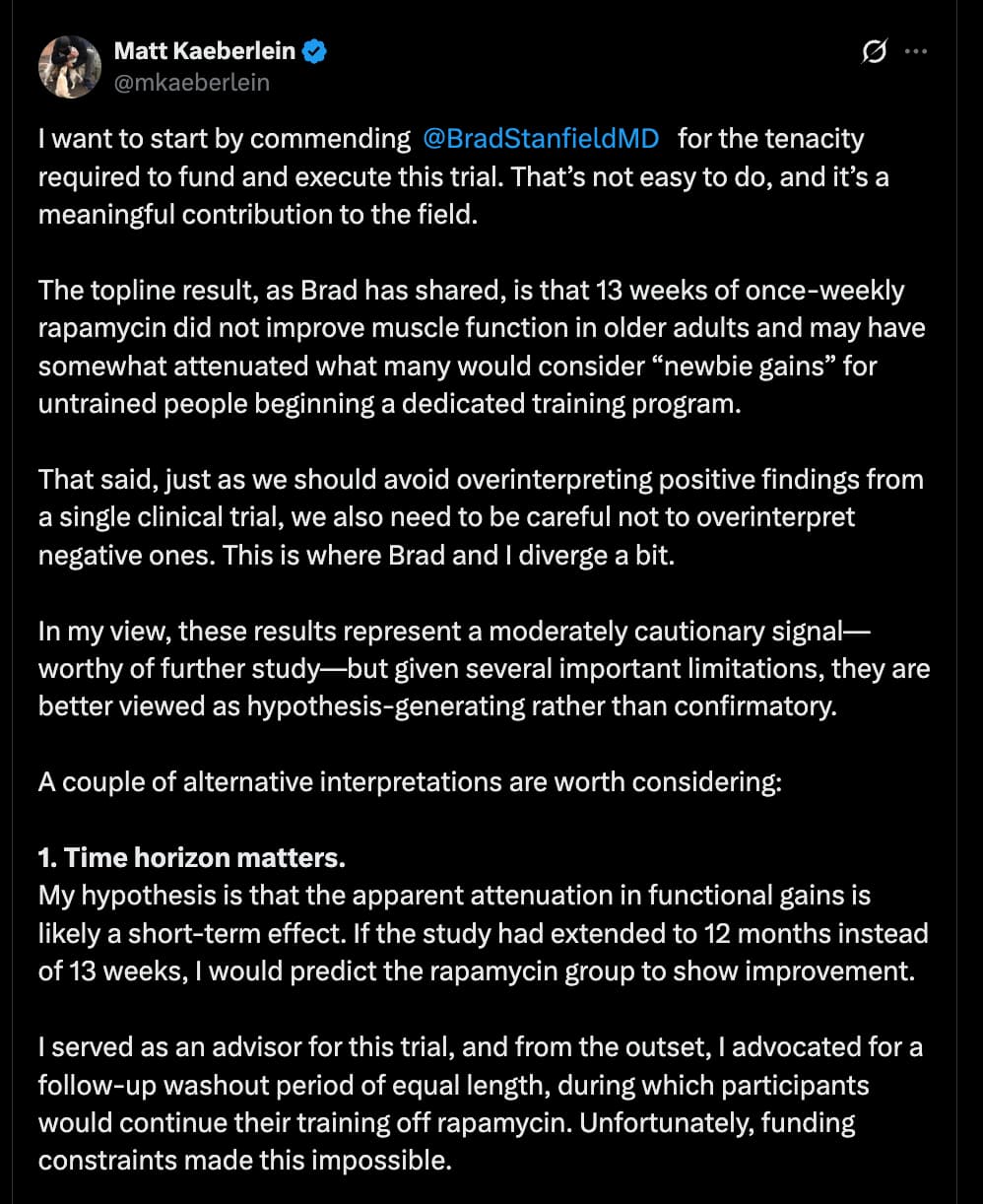
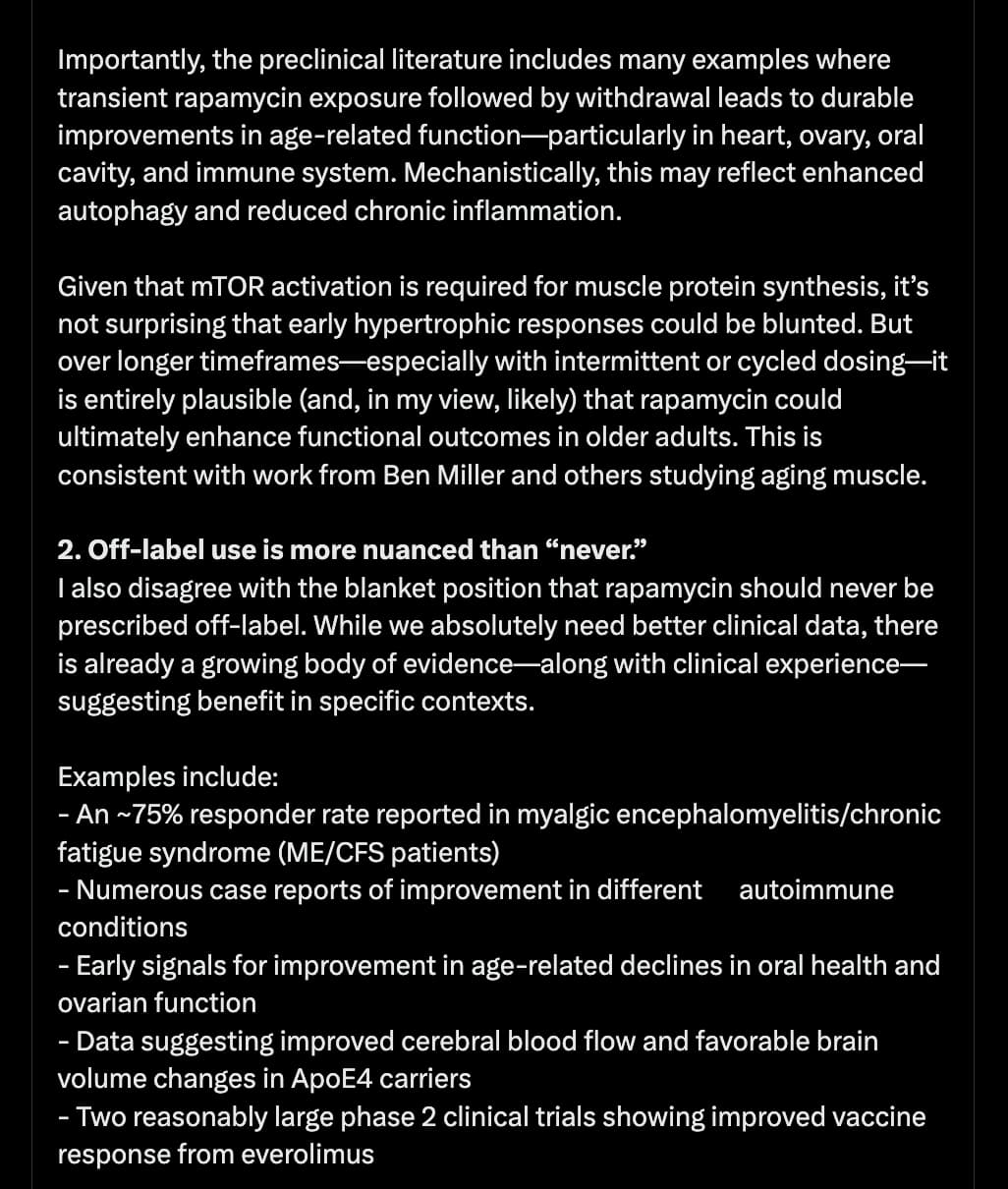
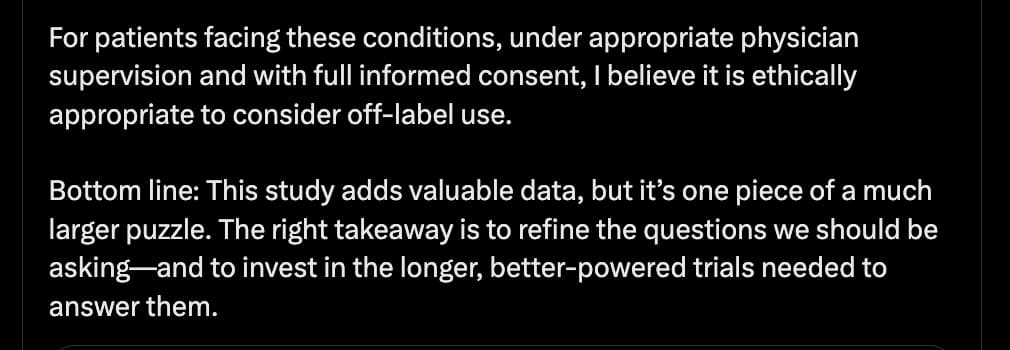
For someone like me, that is mostly focused on metabolic health (which includes muscle building/retention) at this time, the prospect of weekly dosing started to look more and more suboptimal to me. The long half-life makes weekly dosing too frequent for my purposes. I prefer to do short cycles now: taking 3-6mg of rapamycin every 2 weeks, for at most 2 months out of the year. My intuition is that measurable inhibition should be acute, short, and infrequent. The inhibition is only half of the equation, giving the body enough time to recover is the other half.
2 Likes
Thank you for this. My basic argument is that we need an anabolic period as well as a catabolic period. All of these things are variable. It is not a switch between anabolic 100% and catabolic 100%, but variations between the two. I also argue that increasing the level of catabolism is better up to a point. Hence two mild periods of catabolism are not as good as one more serious period of catabolism. There will, of course, be a point where systemic damage could occur from catabolism. Hence care is required.
That is because the mitophagy that occurs is selective mitophagy that destroys the least functional mitochondria.
4 Likes
It’s your decision but you are wrong in my opinion. This study showed/told us exactly what we knew all along that Mtorc inhibition while good (maybe even great) for longevity, it is detrimental to exercising and muscle growth. Last time I checked calorie restriction (which has been shown to have the highest impact in longevity in mammals to date) is not so good if you want to gain muscle either. If you are after longevity, you MUST keep doing Rapa. If you only care for big muscles, then you most likely will do better if you stop it. IMO you can either chose big muscles and an average lifespan, or average muscles (think of a swimmer’s body) and live much longer (like at least 20 years longer than with big muscles). Of course, it is way more nuanced (and when I say big muscles I mean huge like the body builder types) but at the end of day not too many bodybuilders seem to be reaching the supercentenarian status. To each their own, but IMO this study proved once again that RAPA is great for longevity.
3 Likes
I am not sure that the study says anything about longevity.
I am open to be persuaded otherwise, but I don’t think it was designed to test longevity.
What the study does say is that if you exercise you get stronger (well we knew that). Also if you exercise and take rapamycin you get stronger, but not necessarily as much as if you exercise and don’t take rapamycin. (weekly)
3 Likes
Someone else alluded to this I think, but doesn’t Rapa often cause some weight loss at the onset. That would not be helpful for building strength
And this calorie reduction would be particularly an issue for someone a bit older.
2 Likes
Ask yourself a question. How often do you want a period of enhanced catabolism?
We know that weekly is probably too frequent.
What about annually?
What about every 6 months?
I am going for a period of 6 weeks or longer, but there is an interesting question as to where the threshold of benefit lies.
Incidentally I know that my 3 day a week water fast also enhances catabolism and hence reduces muscle gain (although I am still gaining slightly). Muscle gain is not my priority although I would not want any loss. At the moment I am aiming to reduce my weight, but the additional catabolism is good as well.
2 Likes
First, we can’t ignore the fact that Rapamycin was shown to improve muscle gain in animals. Yes, the mechanism would suggest otherwise and we now finally have proof of that in humans. It makes sense I suppose since animals aren’t strength training the same way that humans are.
You actually bring up something important as far as longevity vs muscles is concerned. It does appear that we must have to choose one or the other when it comes to Rapamycin. I was hopeful that Rapamycin wouldn’t interfere with muscle based on the outcomes of all the animal studies showing that it didn’t.
Since we now know it does in humans (at least for once weekly dosing at 6mg), I personally would rather have big muscles while just continuing all other longevity interventions I’m already doing, even if there is a minor trade off in longevity. Just my personal choice.
3 Likes