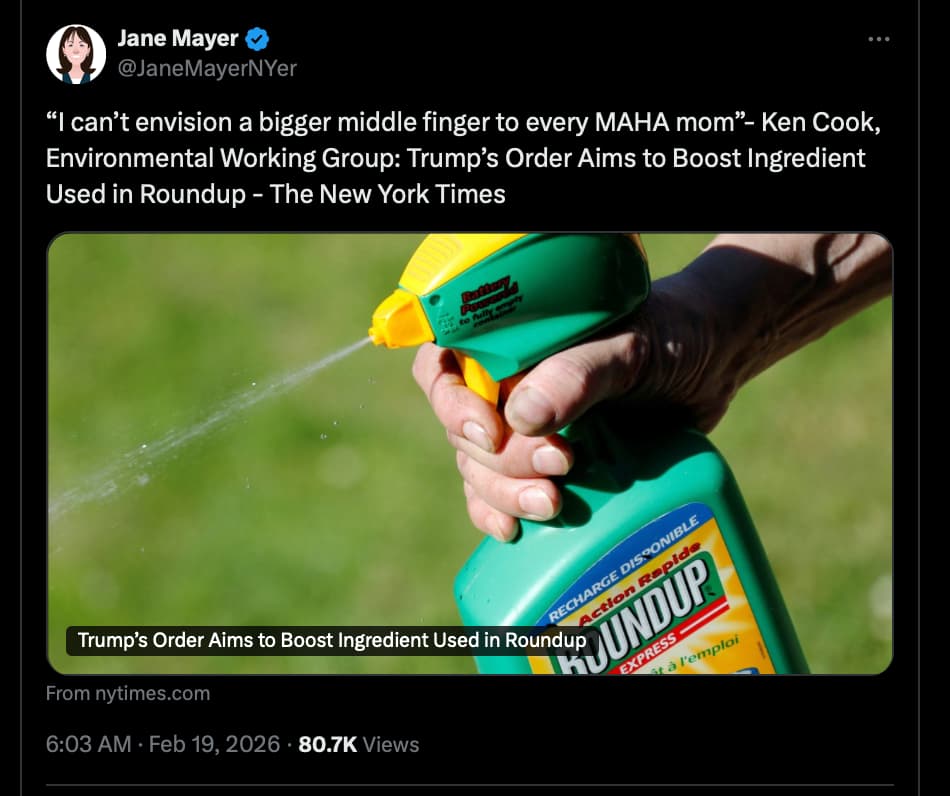
But it also leans into several priorities for the chemical and pesticide industries, from accelerating EPA reviews of new pesticides so they can be brought to market more quickly to increasing the use of non-animal testing to evaluate chemicals’ risks. Already, EPA Administrator Lee Zeldin is transferring many of the agency’s independent scientists to the office tasked with swiftly reviewing new products.
Tough choice coming, and we’ve seen it coming. Waterhemp is becoming impossible to control. We’re now using 4 different herbicides at great expense to try to kill it. Convintro (difulfenican) is what they’re going to try next. It has been used in Europe for years. So the choice is between tillage which uses fuel and time and causes erosion, or a forever chemical, which they are not currently calling a forever chemical, just a very persistent chemical.
I called my weed extension agronomist and talked to him about this and said the chemical companies will not solve the problem as it is not in their interest. I told him we need a gene drive that makes all waterhemp susceptible to a couple herbicides. There will be a refuge in ditches and creeks and roadsides which will continue to force the population to being susceptible. It’s obvious and brilliant and should have been done already. He hadn’t heard of gene drive. He had been breeding conventionally and coming up with schemes that will not work. He said he’d get back to me after talking to his genetics guy. Have not heard back. I hate bothering people but need to do it again.
Robert F Kennedy Jr - “We shouldn’t be talking about Glyphosate, we should be talking about Roundup”
"If you read all of these documents that we’ve gotten [and] see all the sneaky stuff they do… "
KENNEDY - “Even in their most private emails to each other… they’re talking about how nobodies ever tested this and we know that the formulation is much, much more toxic than Glyphosate … [it’s made to] slip through the bark of the plant [and] those same chemicals also enable that molecule to penetrate the blood brain barrier”.
Idk, EWG doesn’t measure roundup and chatgpt (which can sound the alarm hard on microplastics) doesn’t think it’s a huge concern… Maybe I should be more concerned, but it has never independently entered my risk calculus as a chemical of extreme concern.
Polyethoxylated tallow amine — it’s a surfactant (essentially a detergent) added to glyphosate formulations to help the herbicide penetrate plant cell walls and spread evenly on leaf surfaces. Without it, glyphosate doesn’t absorb into plants very effectively.
POEA is considerably more toxic than glyphosate itself. It disrupts cell membranes, and in cell culture studies it’s been shown to be cytotoxic at concentrations where pure glyphosate isn’t. Some of the poisoning cases and animal toxicity attributed to “glyphosate” in the literature were actually driven primarily by POEA — particularly in cases of deliberate Roundup ingestion (which is unfortunately common as a suicide method in parts of Asia).
To its credit, the EU actually banned POEA as a co-formulant in glyphosate products back in 2016 precisely because of these toxicity concerns. Newer Roundup formulations in many markets have switched to alternative surfactants, though the toxicological profiles of those replacements aren’t always well-characterized either.
Many counties have import restrictions on produce, grains, dairy products, feedstock, processed meat, etc. that prohibits importation of products that have been exposed to a wide variety of herbicides, pesticides and other chemicals that are not allowed in their country.
The US is positioning US farmers to have only one market, the US.
And to kill its people with cancer. Totally disgusted by the shear amount of chemicals allowed in USA which are banned in European countries (long time ago). Unreal.
I’m way more concerned about this, and remember the wars over this happened his first term, which delayed his ban [1], though CA is where it matters and where it almost certainly won’t be coming back
[1] given how many almonds I eat, this may have affected my brain. I don’t THNK the effect is too large but it’s worth noting and it still might be slightly concerning
I have been extra mindful of my gut health for more than a decade now as gut problems run in my family (Crohn’s, Celiac). As a result, I know how to dial things in to pretty much perfection diet wise. Within a week of going to Europe (and this has happened many times), any lingering digestive inefficiencies vanish and everything is 100%. In the USA, even with buying organic foods and not eating any foods my body doesn’t like, the best I reach is 85-90%. The soil health in the USA has unfortunately been trashed by big agriculture, food sits in storage for long periods of time thus mold and mycotoxins levels are absurd, and pesticides/herbicides/insecticides/neonicotinoids are effectively impossible to avoid. Glyphosate directly targets microbes through the shikimate pathway. As a geologist, you learn about how much of an impact microbial life has had on our planet. The oxygen we breathe mostly came from plankton, algae, and microbes. Terra preta soil from the Amazon - the richest and healthiest soil ever discovered on Earth - contains more than 10,000 microbial species in a single gram. Most people are unaware of just how important microbial life is to Earth as a whole, and that also applies to just how important the microbiome each of us harbors is to our health. It’s the microbiome-gut-brain-consciousness axis. Believe it or not, the damage that’s been done across North America to the soil (and other symbiotic ecosystems) is a tremendous headwind to everyone who seeks to manifest their greatest potential during their life.
compounds that attract and nourish pests and pathogens. For example, residual exposure to common pesticides like glyphosate and tebuconazole can increase asparagine levels by up to 153% in crop tissues. Even more concerning, these metabolic changes often occur without visible signs of plant stress, creating an invisible mechanism that undermines crop resilience.
The interaction between nitrogen enrichment and pesticide toxicity creates self-reinforcing cycles of vulnerability. Pesticides inhibit crucial enzymes involved in nitrogen assimilation, while high nitrogen availability reduces plants’ carbon-based defenses by 40-60% in many crops. The destruction of beneficial insects and soil microorganisms by broad-spectrum pesticides creates an ecological vacuum where pest populations can explode – parasitoid wasp declines correlate with 300% increases in secondary pest outbreaks.
This creates a vicious cycle: more pesticides lead to stronger pests and weaker natural defenses, nec
I plant a couple hundred acres of conventional (non-GMO) corn every year. Along with quite a bit more Roundup corn. Never a problem with the GMO corn. Conventional has trouble every time. Mostly insects but also weeds that would be easily taken care of by Rup. I’ve seen aphids but never a treatable level.
The reason nearly every farmer in the country used Roundup for as long as it worked was that it was the cheapest and also the most effective spray available. Also does not get into the ground water.
You can argue about mechanisms where maybe it’s making us less healthy (hard to measure and separate). But you won’t convince anybody that the crop is less healthy.
Kennedy has said they will end the practice of using Roundup as a desiccant in wheat. This is a big part of the problem and should never have happened anywhere. I can’t believe they allowed it or thought it was a good idea. It’s been there for years apparently.