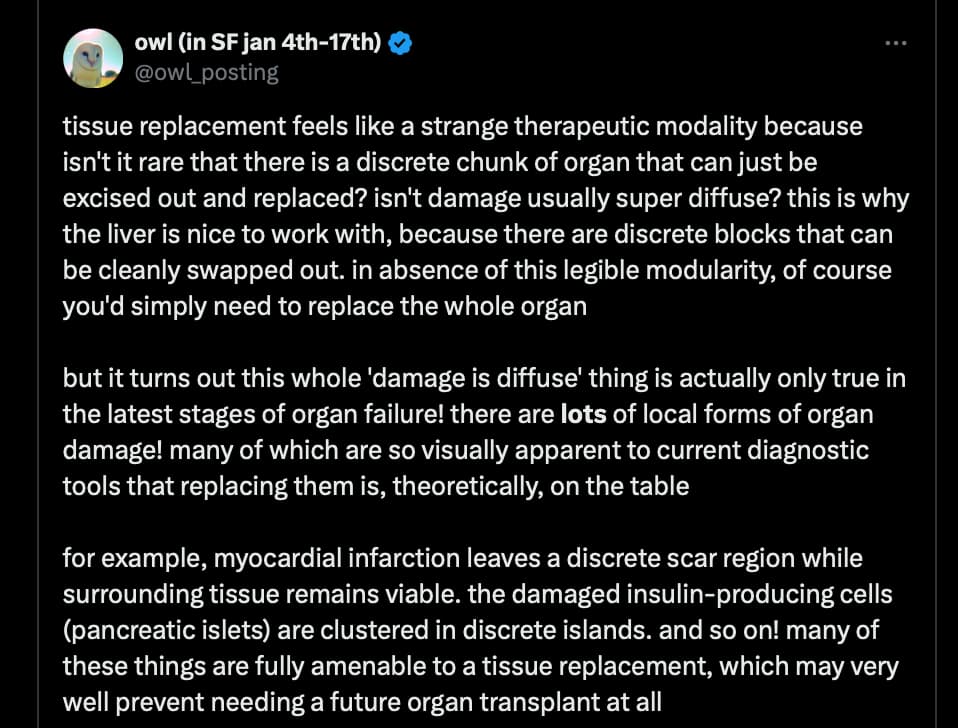
Tissue fractional replacement is way more relevant for younger people than organ replacement (esp as a means of solving aging), but the risks of surgery are still high enough that younger people probably shouldn’t be doing it for quite some time
https://onlinelibrary.wiley.com/doi/10.1111/acel.70516
Our Aging Cell Perspective is out. We propose a roadmap to guide research and innovation integrating replacement, multi-targeted damage-removal and export technologies, and regeneration to reverse an unprecedented fraction of age-related changes, enable whole-body rejuvenation, and extend healthy lifespan beyond what is achievable with conventional therapeutics.
Read the paper here: https://lnkd.in/eCjsefzm
Recent advances in geroscience have made it increasingly clear that sustained multi-tissue rejuvenation and further healthy lifespan extension will require reversal of a vast amount of age-related damage and systemic alterations across molecules, organelles, cells, tissues, organs, and whole-body systems.
• How can we develop systemic rejuvenation strategies that do not rely solely on inherently limited and declining endogenous replacement, repair, clearance, or export processes?
• How might we target age-related changes that are resistant to replacement, including extracellular matrix remodelling and disrupted regulatory networks?
The Perspective recommends combining synergistic bioengineering strategies and biomarkers to enable durable, whole-body rejuvenation:
• Preventive replacement of cellular components, cells, tissues, and organs (incl. bioprinting and progressive brain replacement).
• Biotechnologies that remove or export hundreds of types of damaged molecules and organelles (e.g., dysfunctional mitochondria) from aged cells, tissues, and grafts.
• Personalised cell therapies and inducers that maintain and regenerate the body.
• Ageing biomarkers monitoring long-term rejuvenation and serving as surrogate endpoints for clinical trials targeting ageing.We hope the tables and figure (attached) serve as a practical guide to catalyse and prioritise research directions, clinical development, and multidisciplinary collaboration towards interventions:
• Table 1a: Key challenges
• Table 1b: Emerging research opportunities
• Table 2: Predicted advances and long-term vision
• Fig. 2: Predicted synergy between replacement, regeneration, multi-targeted damage-removal technologies, and biomarkersThis Perspective emerged from the first Replacement in Aging workshop at the Aging Research & Drug Discovery Meeting, featuring talks and discussions by leading pioneers in geroscience and regenerative medicine, all co-authors of the paper: Vadim Gladyshev, Bohan Zhang, Anthony Atala, Kyle Loh, Vera Gorbunova, Thomas Rando, Tony Wyss-Coray, Eric Verdin, Alex Zhavoronkov, Morten Scheibye-Knudsen, Sierra Lore, and Daniela Bakula.
Thanks to Harvard Medical School, Brigham and Women’s Hospital, Broad Institute of MIT and Harvard, National Institute on Aging, Wake Forest Institute for Regenerative Medicine, Stanford University, University of Rochester, UCLA, Buck Institute for Research on Aging, University of Cambridge, Insilico Medicine, and University of Copenhagen for supporting this research direction.
Join the effort towards systemic rejuvenation