chatGPT(5.5paid)
Summary
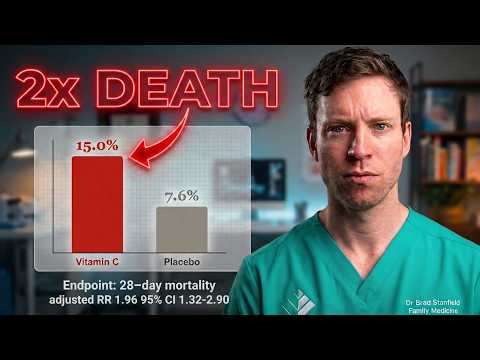
The video argues that “more antioxidant” is not automatically better. It uses a recent severe-burns trial of high-dose IV vitamin C as the opening example: the intervention was biologically plausible, but the trial found no benefit and possible harm, with higher mortality/organ dysfunction signals. The transcript says the dose was 50 mg/kg every 6 hours for 4 days, i.e. roughly 14–16 g/day IV for a typical adult. The published burn trial reports that high-dose IV vitamin C did not reduce 28-day mortality/persistent organ dysfunction and may be harmful. (JAMA Network)
The video then broadens the point to other antioxidants: IV vitamin C in sepsis, beta-carotene in smokers/asbestos-exposed people, vitamin A/E supplementation, and the USPSTF recommendation against beta-carotene or vitamin E for preventing cardiovascular disease or cancer. This is broadly supported: the LOVIT sepsis trial found higher risk of death or persistent organ dysfunction with IV vitamin C, and the USPSTF recommends against beta-carotene and vitamin E for CVD/cancer prevention. (New England Journal of Medicine)
The video’s positive counterexample is AREDS/AREDS2 for age-related macular degeneration: antioxidant/mineral formulas can help in a specific disease context, and replacing beta-carotene with lutein/zeaxanthin improved the risk-benefit profile, especially for smokers/former smokers. The AREDS2 follow-up supports lutein/zeaxanthin replacing beta-carotene, with less lung-cancer concern and a possible further reduction in late AMD progression. (PMC)
Its final practical message is: use the right molecule, dose, timing, and population, rather than taking high-dose supplements just because they are “antioxidants.”
Critique
The central argument is good: it correctly attacks the naïve model that oxidative stress is always bad and antioxidants are always good. Biology uses reactive oxygen species as signals, so indiscriminate suppression can plausibly interfere with adaptation, while very high doses can have off-target toxicity.
The strongest parts are the burn-trial, LOVIT, beta-carotene, USPSTF, and AREDS2 examples. Those are real human-outcome data, not just mechanistic speculation. The beta-carotene point is especially important because observational “healthy diet” signals were not reproduced by high-dose supplementation in smokers; large trials instead found increased lung-cancer risk. (PMC)
The main weakness is that the video sometimes moves quickly from hard clinical outcomes to plausible mechanisms. For example, oxalate nephropathy and iron-driven pro-oxidant chemistry are plausible mechanisms for high-dose vitamin C harm, but the transcript itself acknowledges that the pro-oxidant explanation is likely rather than proven. That distinction matters.
A second weakness is “antioxidants” are treated as a convenient category, but it is chemically loose. Vitamin C, alpha-tocopherol, beta-carotene, lutein/zeaxanthin, NAC/glycine, resveratrol, and metformin are not interchangeable. Some are vitamins, some are carotenoids, some are redox-active small molecules, and metformin is not usually classed simply as an antioxidant.
The exercise section is directionally plausible but should be read cautiously. A 2025 meta-analysis reported beneficial or at least non-harmful effects of antioxidant supplementation on muscle condition in older adults, but this does not prove that antioxidants generally “beat exercise alone” for all older people or all outcomes. (Nature) GlyNAC is interesting and has randomized human data in older adults, but the trial evidence is still relatively small and marker-heavy; it is not proof of lifespan extension. (PubMed)
The 2026 lutein/zeaxanthin teenage-screen-use trial is interesting but early. A 6-month trial reporting improved attention and processing speed is worth noting, but it should not yet be treated as settled evidence for broad cognitive supplementation in teenagers. (ScienceDirect)
Tidied transcript
Earlier this month, one of the most rigorous trials ever run on a vitamin was stopped early because the people receiving the vitamin were dying faster than the people receiving nothing.
The vitamin was vitamin C, given at high dose directly into the vein, in patients with severe burns.
The idea sounded right. Burns flood the body with damage, and vitamin C can mop up oxidative damage, so why not give plenty of it?
But the result went the other way. Deaths were roughly doubled, and the trial’s safety board had to stop the study early.
This matters even if you have never touched an IV infusion, because it reflects the same trap seen again and again with over-the-counter supplements: assuming that more of a good antioxidant is automatically better.
A severe burn sets off a storm of oxidative stress. You can think of it as cellular rust: free radicals tearing at tissue. Vitamin C is an antioxidant, so it can neutralise that kind of damage. The simple logic is: more rust, so add more rust remover.
The doses show how far beyond normal nutrition the trial went: 50 mg/kg every 6 hours for 4 days. For a typical adult, that works out at roughly 14–16 grams of vitamin C per day, delivered straight into the bloodstream. Compare that with the 75–90 mg most adults need in an entire day. This was not nutritional supplementation. It was a pharmacological flood.
And that flood backfired.
The main result — death or lasting organ failure — went in the wrong direction. The exact death estimate is uncertain because the trial was stopped early with relatively few deaths, but every analysis pointed the same way: roughly a doubling. That is why the oversight board pulled the plug.
This trial is not a one-off. The same dose of intravenous vitamin C had been tested four years earlier in critically ill patients with sepsis. It showed the same pattern: a higher rate of death or organ failure, 44.5% versus 38.5%.
So, two trials, the same vitamin C flood, two different groups of very sick patients — and both pointed the wrong way.
How can an antioxidant do harm?
The researchers point to two possible explanations.
First, the kidneys turn excess vitamin C into oxalate. With very high doses, oxalate can crystallise and damage the kidneys — exactly the wrong thing in someone already fighting for organ function.
Second, there is a paradox. Vitamin C is normally a free-radical mop, but a badly burned body is flooded with loose iron from damaged tissue. When massive doses of vitamin C meet loose iron, the chemistry can run backwards. Instead of soaking up free radicals, vitamin C can help generate them, producing hydrogen peroxide that harms the very cells it was meant to protect.
In that setting, the antioxidant can become a pro-oxidant.
This is actually the same kind of reaction scientists have tried to use experimentally to kill cancer cells. The authors are careful to call this a likely explanation, not a proven one.
The “more is better” approach has also backfired in the supplement world.
Start with beta-carotene, a compound the body can convert into vitamin A. On paper, it looked like a beautiful cancer fighter. Researchers gave it to more than 18,000 people at high risk of lung cancer: smokers, former smokers, and asbestos workers. The beta-carotene group had a 28% higher rate of lung cancer, and that trial was stopped early too.
It was not the only one. A separate large trial in male smokers found a similar signal: about 18% more lung cancer in the beta-carotene group.
Then there is vitamin A itself. A large review that pooled 67 trials and more than 230,000 people found that, in the most careful studies, antioxidant supplements as a group slightly increased the risk of dying. Vitamin A was one of the worst, increasing mortality by about 16%.
Then there is vitamin E. This one should stop people in their tracks because it was not tested in sick patients or smokers, but in healthy men. One of the largest prevention trials ever run gave about 35,000 men a common megadose of vitamin E: 400 international units. For context, the recommended daily allowance is around 22 international units. The men given vitamin E ended up with significantly more prostate cancer.
In 2022, the US Preventive Services Task Force looked at the evidence and put it plainly: for beta-carotene, the harms outweigh the benefits; for vitamin E, there is no net benefit.
A common objection is that vitamin E trials often used synthetic alpha-tocopherol, whereas “full-spectrum” forms such as tocotrienols are supposed to be safer. The problem is that we do not yet know that. Researchers have gathered the randomised tocotrienol trials in humans: around 30 trials involving about 2,600 people. They measured short-term blood markers. None tracked whether people lived longer, got less cancer, or had fewer heart attacks. Most lasted only weeks to months.
So the harm seen with high-dose alpha-tocopherol is real and measured. The idea that a different form must be safe is an assumption without long-term outcome data behind it.
That is exactly the kind of “sounds good on paper” reasoning that keeps getting people into trouble. It may be plausible, but it is not proven.
Used in the wrong way — the wrong form, wrong population, wrong dose, or wrong assumption — antioxidants can backfire.
But used in the right way, they can genuinely help.
The clearest proof starts with the same villain: beta-carotene.
There is a common eye disease called age-related macular degeneration. It slowly destroys the centre of vision. For a long time, the only supplement formula that genuinely slowed progression contained vitamins C and E, zinc, and beta-carotene. It worked: it cut the risk of the disease getting worse by about a quarter.
But there was a problem inside the formula: beta-carotene. That same ingredient had increased lung-cancer risk in people who had smoked. So there was a strange situation: the treatment helped save vision, but included an ingredient that increased cancer risk in the wrong population.
Researchers looked for an alternative.
Lutein and zeaxanthin are pigments that give corn and egg yolks their yellow colour. The body deliberately stockpiles them in one tiny spot at the centre of the retina: the part responsible for sharp vision. They act as a built-in filter, soaking up damaging light before it reaches the cells behind them.
Supplementing them supplies the eye with what it already uses, rather than trying to feed it a foreign antioxidant.
Researchers built a second trial, AREDS2, and asked a direct question: what happens if you take beta-carotene out and replace it with lutein and zeaxanthin?
That is the whole lesson in one experiment. It is not “we assume a different form is safer.” It is: test the replacement head-to-head with hard outcomes.
The results were clear. On safety, lung cancer was about 2% in people receiving the formula with beta-carotene, compared with 0.9% in people receiving the formula without it. When beta-carotene was removed, that signal went away.
The second question was whether the new formula still worked. In direct comparison, the lutein/zeaxanthin formula was at least as good as the old beta-carotene formula at slowing disease progression — slightly better, in fact.
So it was safer and at least as effective. The field switched. Beta-carotene was dropped in favour of lutein and zeaxanthin.
There has also been a change in the thinking about antioxidants and exercise.
If you are young, healthy, and training, taking a big dose of antioxidant vitamins around your workout is probably a mistake. Exercise produces brief bursts of free radicals, and those bursts are signals that tell the body to adapt. If you interfere with that signal using high-dose vitamin C and E, you can blunt the cellular machinery that exercise is trying to build.
It is not just antioxidant supplements that can interfere with exercise benefits. Metformin, in people without diabetes, can blunt some of the positive effects of exercise. In a resistance-training study, the placebo group built more muscle than the metformin group. Resveratrol can do the same. If you are exercising, adding these compounds may be another version of the “more is better” mistake.
For years, this made antioxidants look like a bad idea for anyone who trains.
But in older adults, the picture may flip.
With age, the balance can tip too far towards oxidative stress. In that group, antioxidant support paired with exercise may perform better than exercise alone.
This does not mean older adults should megadose antioxidants. It illustrates the central point: the same intervention can have different answers depending on who you are.
If you are young and exercising, taking antioxidant doses above the recommended daily intake is probably not a good idea. If you are older, and oxidative stress is already higher, modest antioxidant support may help.
For clarity, that flip applies to antioxidants. Metformin and resveratrol may still blunt some of the positive effects of exercise.
One interesting approach is GlyNAC: glycine plus N-acetylcysteine. Rather than flooding the body with a finished antioxidant, it gives the body raw materials to make its own glutathione, allowing more self-regulation. In older adults, GlyNAC improved a range of ageing-related markers in a recent clinical trial.
Finally, there is a frontier area with thinner but interesting evidence. The eye antioxidants lutein and zeaxanthin do not just accumulate in the eyes; they also build up in the brain. In a 2026 trial in teenagers with high screen use, supplementation improved attention and processing speed.
The lesson is not that antioxidants are bad. The lesson is that you need the right form, at the right dose, for the right person.
That beats megadosing every time.
This is not a small point. It is why a carefully designed formula matters more than the instinct to throw more at a problem. “More is better” is the idea that keeps backfiring.
The practical takeaway is: do not megadose by default. When a label boasts hundreds or thousands of percent of the recommended daily intake for different vitamins and minerals, treat that as a warning sign, not a selling point.
Use third-party testing resources where possible, such as ConsumerLab or Labdoor. And remember: the same antioxidant dose may blunt exercise adaptation in a young person but help in an older person. Context matters.