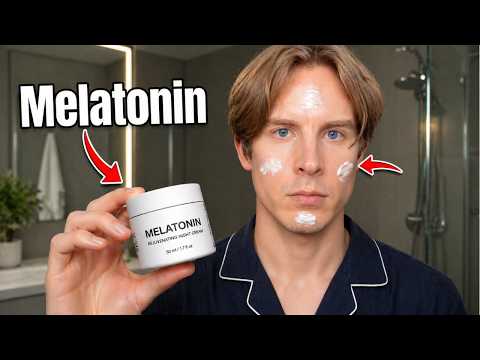
chatGPT(5.5paid):
Summary
The video argues that topical melatonin may have useful skin anti-ageing effects, mainly through antioxidant, anti-inflammatory, UV-protective, and possibly mitochondrial/mitophagy-related mechanisms. It presents topical melatonin as complementary to sunscreen and retinoids, not a replacement. The strongest claims are around pre-UV application, where melatonin appears to reduce UV-induced erythema, and around radiodermatitis, where a melatonin cream reportedly reduced dermatitis in women undergoing radiotherapy.
The video also discusses weaker evidence for wrinkles, skin hydration, roughness, pigmentation, and hair growth. Several studies used combination products containing melatonin plus other compounds such as vitamin E, beta-glucans, carnosine, or Helichrysum italicum extract, making it difficult to isolate melatonin’s independent effect.
The presenter’s practical conclusion is: topical melatonin may be best used as a night-time antioxidant cream, or as a pre-UV adjunct, but sunscreen, retinoids, vitamin C/ferulic acid, and niacinamide remain better-established options for mainstream skin anti-ageing.
Critique
The argument is plausible but somewhat over-enthusiastic. The mechanistic case for melatonin is strong: it is an antioxidant, can influence inflammatory pathways, and is biologically relevant in skin. However, mechanistic plausibility does not prove clinical anti-ageing efficacy.
The UV-protection evidence is interesting, but the video itself acknowledges an important limitation: topical melatonin seems to work best before UV exposure, not after. That makes it more like an adjunctive antioxidant/photo-protective agent than a repair treatment. It should not be framed as remotely equivalent to sunscreen.
The wrinkle and pigmentation claims are less secure. Some cited studies used multi-ingredient formulations, so improvements in wrinkles, UV spots, brown spots, or roughness cannot confidently be attributed to melatonin alone. A proper critique would distinguish between:
- melatonin-only trials;
- melatonin plus other actives;
- mechanistic/in vitro evidence;
- cosmetic outcome studies.
The hair-growth section is also promising but tentative. The video notes that some studies lacked control groups, which is a major weakness. Hair density and anagen/telogen ratios can vary, and androgenetic alopecia studies need strong placebo-controlled designs because cosmetic outcomes are vulnerable to measurement and expectation bias.
The sponsor segment weakens the scientific tone. The sauna claims are not central to the melatonin topic and include large epidemiological risk-reduction figures. Those are association-based claims and should not be treated as proof that a sauna blanket reproduces the same health outcomes.
Overall: topical melatonin is biologically plausible and may be worth studying or using as a low-risk adjunct, especially for oxidative stress/photoageing, but the evidence base is not yet comparable to sunscreen, tretinoin/retinoids, niacinamide, or vitamin C/ferulic acid systems.
Tidy transcript
A new skin anti-ageing cream enters the chat.
Everyone knows about the potential of sunscreen or retinol for skin anti-ageing, but did you know about melatonin — topical melatonin?
I have been a fan of melatonin for a long time, not only because of its sleep benefits, but also because of its effects on different longevity and inflammation pathways. It turns out you can also use melatonin topically for potential skin anti-ageing benefits.
In this video, I am going to dig into the research on topical melatonin for skin anti-ageing.
Clinical studies using topical melatonin have found that it may protect the skin against UV radiation, reduce radiodermatitis, reduce DNA damage caused by UV exposure, improve skin barrier function, reduce skin inflammation and redness, and reduce transepidermal water loss.
The first evidence for melatonin being able to protect the skin against radiation was published in the 1990s. Twenty healthy volunteers with Fitzpatrick skin types II and III were irradiated with UVB on four small areas of the lower back. Immediately after irradiation, each area received either 0.05%, 0.1%, or 0.5% melatonin in a gel, or the carrier alone.
They saw a dose-response trend, with 0.5% melatonin performing the best. However, the statistically significant benefit was mainly seen eight hours after irradiation and mainly in the subgroup of strong reactors. So, overall, topical melatonin at 0.5% may modestly suppress early UV-induced erythema, especially in people with a strong inflammatory response to UVB light.
In a follow-up study by the same authors, they found that the timing of gel application also mattered. They applied the melatonin gel either 15 minutes before, or 30 and 240 minutes after, UV radiation. Applying melatonin gel 15 minutes before UV radiation almost completely suppressed the development of UV-induced erythema.
In another study, they tested topical melatonin before UV radiation. Applying melatonin gel after UV radiation exposure provided no significant protection. Topical melatonin did not provide protection when applied immediately after exposure either. So it appears that you need to apply the melatonin gel before exposure to the sun.
As you can see, topical melatonin could provide the skin with some protection against UV radiation, especially if you apply it before UV exposure. Of course, this does not replace sunscreen. The effects are not as significant or as effective for skin anti-ageing purposes as regular sunscreen. However, melatonin might also protect against more general radiation, which sunscreen does not do.
In a 2016 study on women undergoing cancer radiotherapy, melatonin cream was seen to reduce the occurrence of radiation dermatitis — basically, an inflammatory skin response caused by radiation exposure. The occurrence of grade 1 to 2 acute radiation dermatitis was significantly lower in the melatonin group: 59% versus 90%. Women older than 50 had significantly less dermatitis than younger patients: 56% versus 100%.
Dermatitis is an itchy, blistering inflammation of the skin that can be caused by radiation exposure or other immune-related reasons. So, if topical melatonin can reduce dermatitis, it could be quite useful for people who are sensitive.
[Sponsored segment]
I want to take a quick break to tell you about the Bon Charge infrared sauna blankets. This is my go-to way of getting 20-minute sauna sessions on the go without needing to spend an hour warming up a regular sauna.
Taking a sauna is, in my opinion, one of the best things for your overall health and heart function. Studies show that taking a sauna regularly is associated with a 63% lower risk of sudden cardiac death, 63% reduced heart disease mortality, 46% lower risk of hypertension, and 40% reduced all-cause mortality. This is mediated by an increase in body temperature and increased heart rate that mimic a cardiovascular workout, while also improving arterial stiffness, endothelial function, blood flow, immune function, blood pressure, and metabolic health.
It does not matter whether it is a traditional wooden sauna, an infrared sauna, an infrared sauna blanket, or anything else that elevates your body temperature above normal. Bon Charge infrared sauna blankets have the advantage of shining far-infrared light that can penetrate deeper into your tissues than regular saunas can. It warms up in two minutes to the optimal temperature of 70°C and is low in EMF. You can get a 15% discount by heading over to Bon Charge and using the code SEAM.
[End sponsored segment]
All right, back to the video.
What about regular skin ageing? Is there any evidence that topical melatonin reduces wrinkles or improves skin elasticity?
First of all, anything that counteracts UV damage or protects against UV exposure will have general skin anti-ageing effects, because much extrinsic skin ageing is driven by UV exposure. That is why, if topical melatonin is applied before UV exposure, it may have skin anti-ageing effects.
But what about standalone skin anti-ageing effects?
In a 2012 study, the combined use of topical and oral melatonin, vitamin E, and beta-glucans was seen to reduce wrinkling and improve general skin appearance. The best results were seen with combined therapy compared with just oral or topical melatonin.
In a 2018 randomized controlled trial, topical melatonin cream was able to improve skin hydration and reduce skin roughness after three months. The women were around 55 years old. These studies indicate that topical melatonin might improve skin ageing and reduce wrinkles. However, in these studies, there was not always a group taking topical melatonin alone; it was often combined with other things. Therefore, it is hard to differentiate how large the effect of topical melatonin alone was.
Using melatonin cream before bed for 12 weeks has been seen to reduce brown spot count by 5.5%, UV spots by 13.2%, and wrinkle count by up to 18.9%. This study was done on 117 individuals, who were told to apply a night-time cream containing melatonin, carnosine, and Helichrysum italicum extract before bed.
The results indicate that melatonin may reduce oxidative stress caused by environmental factors such as air pollution. Again, however, melatonin was used with other ingredients. We cannot be 100% confident that all the results were due to topical melatonin, although we can be reasonably assured that melatonin has relevant mechanisms.
So how does it work? In what way does melatonin have skin anti-ageing effects?
Melatonin is a potent antioxidant. It protects skin cells from oxidative stress, UV radiation, and environmental damage by directly scavenging free radicals and activating endogenous defence systems such as superoxide dismutase, SOD, and glutathione peroxidase.
It also regulates the immune system, which can help with dermatitis and wound healing. Melatonin also has skin-cancer-fighting effects by inhibiting skin cancer cell growth and triggering their death through apoptosis. Collectively, these effects may protect the skin and slow down its ageing.
Melatonin administration has also been shown to activate mitophagy, the process of mitochondrial autophagy or cellular recycling. It also increases NADK2 expression and restores proline synthesis, which promotes collagen regeneration and alleviates the structural and functional manifestations of cutaneous ageing.
Through mitophagy, melatonin helps preserve mitochondrial function, which is an underappreciated aspect of skin ageing. It may help recycle old, worn-out cellular components that spread inflammation and can lead to cellular senescence.
In terms of melatonin concentrations, at the low end, 0.01% cream has data for human skin penetration. For anti-ageing, 0.1% cream has the clearest direct human studies. For photoprotection, creams from 0.5% up to 12.5% have studies, and the strongest clinical evidence overall is for a 2.5% cream.
Interestingly, topical melatonin has also been investigated for hair growth. In a 2023 review of 11 studies, topical melatonin showed positive outcomes in eight studies in men with androgenetic alopecia. They saw improvements in scalp hair regrowth, density, and hair shaft thickness.
Effective topical melatonin dosing was reported as 0.0033% or 0.1% solution applied once a day for 90 to 180 days, compared with 1.5 mg oral melatonin twice a day for 180 days. The reason for this is that melatonin regulates hair growth and follicle growth. In fact, melatonin levels are higher in hair follicles than in serum.
In 2004, topical melatonin was seen to increase anagen hair growth in women with androgenetic alopecia or diffuse alopecia. The anagen phase is the active growth phase of the hair cycle, where cells in the root divide rapidly and produce new hair. It lasts for two to seven years.
A 0.1% melatonin or placebo solution was applied to the scalp once a day for six months. The melatonin group saw an 8.7% increase in anagen hairs, compared with 3.9% in the placebo group.
In a 2007 study on male androgenetic alopecia, topical melatonin at 0.1 mg in a hydroalcoholic lotion, applied daily to the scalp for six months, resulted in significant improvements in hair density, from 119 to 156 hairs per square centimetre.
The most interesting thing about these studies is that the hair growth did not stop and did not revert back to baseline after they stopped using topical melatonin. However, the challenge is that some of these studies did not have a control group, so you cannot be completely sure about the results. Still, it shows promise.
Overall, there is some evidence for topical melatonin in androgenetic alopecia. Is it going to be as effective as some other hair-loss medications? Probably not, but you can use it in addition to standard treatments.
Overall, topical melatonin is something I was not expecting. It turns out it has quite a lot of evidence, especially for skin ageing.
Here is how topical melatonin compares with more conventional treatments.
Compared with sunscreen, it is not a replacement. Think of it more as a complementary oxidative-stress defence. During the day, you would still see more protection from wearing sunscreen, since the sun is responsible for a large proportion of extrinsic skin ageing. However, you could apply topical melatonin before sun exposure for some additional protection.
What about retinoids? Compared with retinoids, topical melatonin has much weaker evidence for structural remodelling. Retinol would still be more effective for reducing wrinkles.
What about vitamin C, vitamin E, and ferulic acid systems? Mechanistically, topical melatonin could compete in oxidative defence, but it is not as broadly validated clinically. Topical melatonin could be better or equal, but there is not enough evidence to claim that yet.
What about niacinamide? Topical melatonin has less clinical evidence for skin barrier and skin tone. Niacinamide would help more with skin tone.
The best evidence overall is for using topical melatonin as a night-time agent, together with retinol, or as a pre-UV antioxidant. Regardless of the skin studies, melatonin as a molecule and as a supplement is, in my opinion, top-tier. It is one of the most important anti-ageing and longevity hormones in your body.
Check out my video where I tested mega-dosing melatonin at 100 mg a day.
I corrected obvious terms such as erythema, superoxide dismutase, mitophagy, cutaneous, senescence, androgenetic alopecia, niacinamide, and ferulic acid. “NADK2” is left as stated because it is probably what was intended, but I would want the cited paper before treating that specific mechanism as secure.