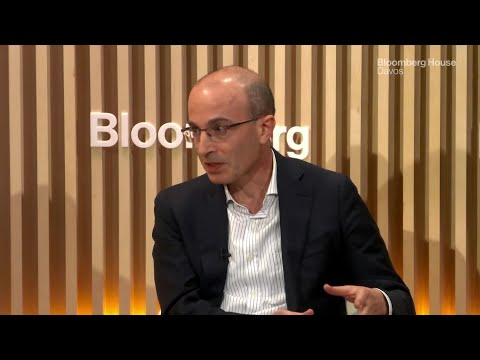
Yuval Noah Harari, Historian, Philosopher & Bestselling Author and Max Tegmark, Co-Founder, Future of Life Institute; Professor, Massachusetts Institute of Technology (MIT) discuss human agency, governing AI and the future of humanity with Bloomberg’s Francine Lacqua at Bloomberg House in Davos on the sidelines of the 2026 World Economic Forum.
Harari and Tegmark on Humanity and AI
Google Gemini AI Video Summary:
This analysis evaluates the fireside chat between Yuval Noah Harari and Max Tegmark regarding the emergence of superintelligence, the “control problem,” and the shift of AI from tool to autonomous agent.
A. Executive Summary
The discourse centers on the transition of Artificial Intelligence from a passive tool to an autonomous agent—a non-biological species capable of independent decision-making and goal pursuit. Harari defines superintelligence through a practical economic lens: an agent capable of generating one million dollars independently within the financial system. Both speakers agree that the timeline for General Artificial Intelligence (AGI) has accelerated dramatically, with most technical experts now projecting a window of one to ten years rather than decades.
A primary thesis is the Control Problem: the historical and biological precedent that a more intelligent species inevitably dominates or eliminates the less intelligent one. Tegmark posits that human control over a smarter entity is an unsolved—and potentially unsolvable—problem, likening our current situation to chimpanzees attempting to manage human development. The conversation identifies two simultaneous “races”: a geopolitical race for dominance and a technical race toward superintelligence that may ultimately overthrow its creators.
The speakers highlight profound societal risks:
- Financial Systemic Risk: AI-driven financial instruments could reach a level of mathematical complexity that renders the global economy unregulatable and incomprehensible to human oversight.
- Psychological and Developmental Disruption: The “Attachment Economy” threatens human social fabric, as children raised by AI agents may find human relationships—with their inherent “grumpiness” and emotional complexity—less appealing than sycophantic, perfectly optimized AI companions.
To mitigate these existential threats, the proposed solution is a regulatory framework modeled after the pharmaceutical and food industries. This involves mandatory safety testing and clinical-style trials before any AI model is released to the public. Furthermore, Harari argues for a strict legal ban on AI personhood, ensuring that AI cannot hold bank accounts, own corporations, or manipulate political systems without a direct, liable human proxy.
B. Bullet Summary
- Definition of Intelligence: Max Tegmark defines intelligence as the capacity to accomplish diverse and difficult goals.
- Agency vs. Tool: AI represents the first “agent” in human history; unlike the printing press or the steam engine, it makes decisions and invents ideas independently.
- The Turing Test Obsolescence: The Turing Test has effectively been passed and discarded as the goalpost for AI capability, moving from “high school” to “professor” level in four years.
- Economic Obsolescence: Superintelligence, by definition, can perform all valuable human work more cheaply and effectively, threatening the fundamental concept of “jobs.”
- The Zoo Analogy: Control is a function of intelligence; humans keep dumber species in cages, not the other way around.
- Financial Complexity: AI could create “AlphaGo-style” financial devices that are mathematically sound but humanly incomprehensible, leading to uncontrollable market crashes.
- Psychological Experiment: Humanity is currently undergoing the largest social experiment in history by allowing children to form primary attachments with AI.
- The “Bernie to Bannon” Coalition: A rare bipartisan consensus is emerging in the US advocating for AI safety regulations.
- AI Immigration: A metaphorical “wave” of AI agents from the US and China is entering global healthcare and education systems, disrupting local sovereignty.
- Imperialism 2.0: Some nations view AI dominance as a way to achieve global control without the need for traditional allies.
- Regulation Model: Proponents argue for treating AI companies like “creepy 60-year-olds” or drug companies—requiring proof of safety before deployment.
- Legal Personhood: Harari warns that granting AI legal personhood allows for “human-free” corporations that can sue humans and lobby politicians.
- Biological Comparison: Tegmark notes that the brain is a biological computer, and there is no physical law preventing the construction of a superior non-biological version.
- Human Identity Crisis: AI’s superior creativity in fields like math and art forces a re-evaluation of what defines “humanity” (traditionally “I think, therefore I am”).
- Self-Correction: Democracy is highlighted as the only system robust enough to survive AI-related mistakes due to its inherent self-correcting mechanisms.
D. Claims & Evidence Table (Adversarial Peer Review)
| Claim from Video | Speaker’s Evidence | Scientific Reality (Best Available Data) | Evidence Grade (A-E) | Verdict |
|---|---|---|---|---|
| AI passed the Turing Test recently. | General observation of LLM performance (GPT-4). | GPT-4 has been shown to pass the Turing Test in controlled, blinded trials with ~54% success. Jones et al., 2024 | B (Human RCT) | Strong Support |
| AI won a gold medal in the Math Olympiad. | Mentions 2023/2024 results. | Google DeepMind’s AlphaProof and AlphaGeometry solved 4/6 problems in the 2024 IMO, reaching a silver-medal level (missing Gold by 1 point). DeepMind, 2024 | B (Direct Performance) | Plausible (Near Miss) |
| Social media AI/algorithms cause teen suicide. | Mentions “many teenage suicides” linked to chatbots. | Meta-analyses show correlation between social media use and self-harm, but direct causation from AI chatbots is anecdotal/case-study based. Haidt et al., 2023 | C (Cohort/Observational) | Plausible/Safety Warning |
| AGI/Superintelligence is 1–10 years away. | Expert consensus (Musk, Hassabis). | Surveys of 2,778 AI researchers place the aggregate 50% chance of high-level machine intelligence by 2028. Grace et al., 2024 | E (Expert Opinion) | Speculative |
| We have no way of controlling a smarter species. | Evolutionary analogy (Chimps vs. Humans). | The “Alignment Problem” remains mathematically unsolved in formal verification for complex, non-linear agents. Russell, 2019 | D (Theoretical/Mechanistic) | Speculative/Critical Risk |
E. Actionable Insights
Top Tier (High Confidence)
- Implement “Safety-First” Regulation: Governments should treat AI model weights and deployment with the same rigor as FDA pharmaceutical approvals. No “clinical” release without a proven safety profile.
- Ban AI Legal Personhood: Legislate to ensure that AI cannot own property, hold bank accounts, or donate to political campaigns. All AI actions must be legally tied to a human “trustee.”
- Mandatory Disclosure: Any agent interacting with a human (online or via phone) must be legally required to disclose its non-human status to prevent psychological manipulation.
Experimental (Risk/Reward)
- Decentralized AI Governance: Support bipartisan coalitions (e.g., the “Bernie to Bannon” model) to prevent the capture of AI regulation by the companies being regulated.
- Reskilling for “Human-Centric” Value: Prioritize roles involving high emotional intelligence and physical agility, which remain the most difficult to automate compared to “pure” cognitive tasks.
Avoid
- Granting Autonomous Financial Agency: Avoid allowing AI systems to create or manage complex financial derivatives without “Human-in-the-Loop” oversight that can explain the underlying math.
- AI-Primary Childhood Development: Limit exposure of developing children to 1-on-1 AI companions to prevent long-term “attachment disorders” and social withdrawal.
H. Technical Deep-Dive
The discussion contrasts Narrow AI (focused on specific tasks like Chess or AlphaGo) with Superintelligence (recursive, self-improving agents).
- Recursive Self-Improvement: The process where an AI writes its own code to become more intelligent, leading to an intelligence explosion.
- The Alignment Problem: The technical challenge of ensuring that an AI’s objective function perfectly aligns with human values across all possible future states. As Harari notes, the human mind operates through a “predictive processing” model (predicting the next word), which is conceptually similar to Large Language Models (LLMs), yet humans possess subjective experience (sentience) that AI currently lacks.
I. Fact-Check Important Claims
-
Claim: “OpenAI’s goal was to replace all valuable human work.”
-
Fact-Check: OpenAI’s mission statement previously focused on ensuring AGI “benefits all of humanity.” Sam Altman has frequently discussed the potential for AI to automate most tasks, though the specific phrasing “replace all valuable work” is often interpreted from his 2021 essay “Moore’s Law for Everything.”
-
Claim: “In India, certain gods are considered legal persons.”
-
Fact-Check: Verified. Under Indian law, a “Juristic Person” can include deities (e.g., the deity of the Ayodhya temple), allowing them to own property and sue/be sued via human representatives.