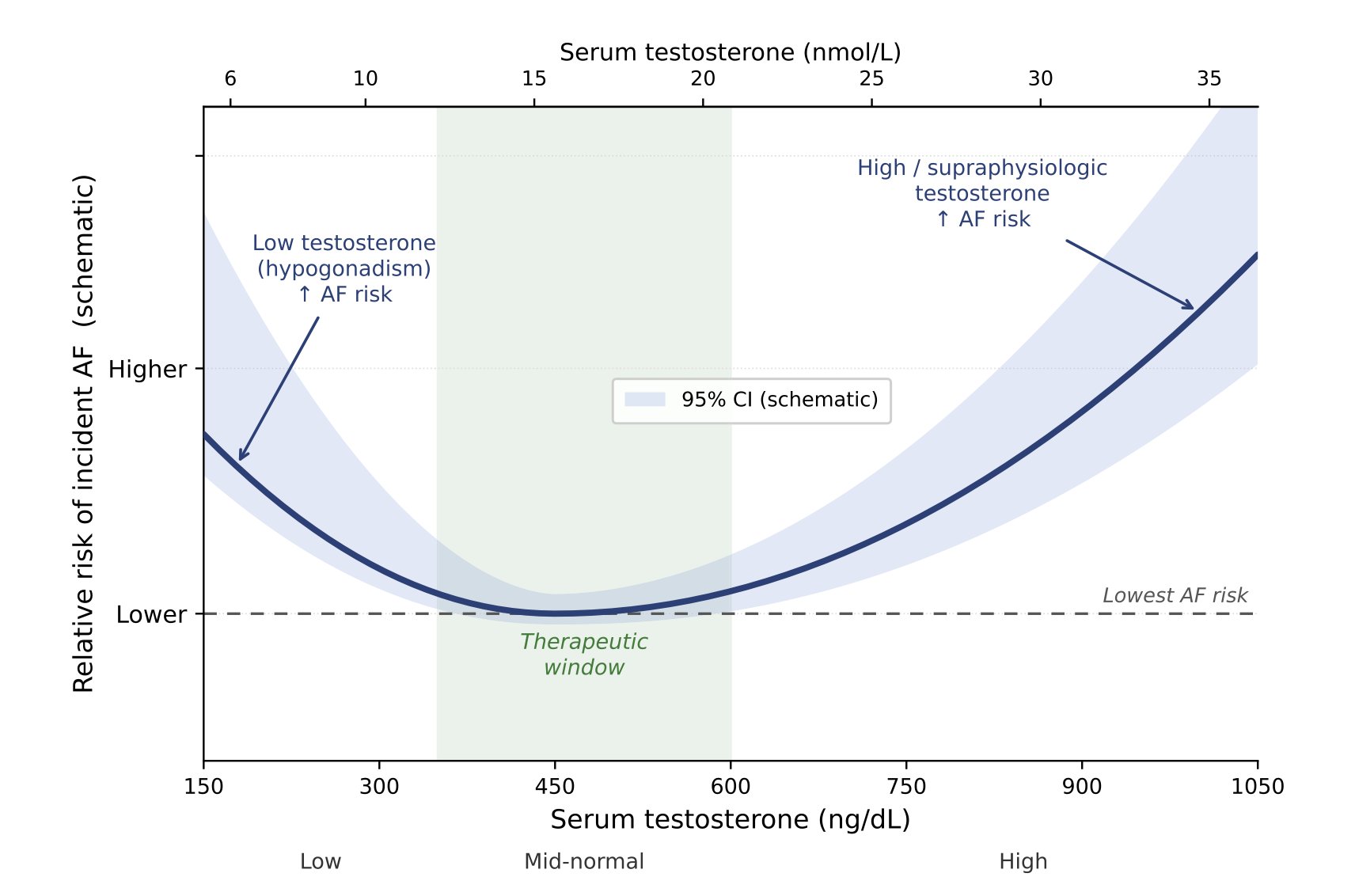
In an era where male hormonal health is in decline and the temptation of Anabolic-Androgenic Steroids (AAS) is rising, a new review from the Mayo Clinic provides a critical appraisal of “natural” testosterone optimization. The central thesis is that testosterone (T) levels are not merely a product of genetics, but a dynamic readout of energy availability, environmental exposure, and recovery status. The authors argue that before turning to exogenous hormones—which carry severe risks of infertility and cardiovascular strain—athletes and biohackers must first address the “low-hanging fruit” of physiological inhibition.
The review systematically dismantles and validates various “biohacks.” It confirms that energy deficiency (Relative Energy Deficiency in Sport, or REDs) is a primary, often overlooked castration mechanism in natural athletes. It validates sleep not just as rest, but as the active window of T-synthesis, specifically linked to REM cycles. Crucially, it challenges popular recovery modalities; notably, Cold Water Immersion (CWI) is flagged as potentially counterproductive for hypertrophy and testosterone availability immediately post-training.
Furthermore, the paper elevates the conversation around environmental toxins, positioning Endocrine Disrupting Chemicals (EDCs) like bisphenols and phthalates as invisible suppressors of the Hypothalamic-Pituitary-Gonadal (HPG) axis. It also touches on controversial topics, offering cautious support for supplements like Eurycoma longifolia (Tongkat Ali) while debunking the efficacy of most commercial “testosterone boosters”. Ultimately, this is a manifesto for “subtracting interference” (stress, toxins, deficits) rather than just “adding agonists.”
Source:
- Open Access Paper: Testosterone-Optimizing Strategies in Athletes
- Institution: Mayo Clinic, USA
- Journal: Sports Health: A Multidisciplinary Approach, 2026, Feb 2
- Impact Evaluation: The impact score of this journal is 2.6 (Impact Factor) and 6.4 (CiteScore), therefore this is a Medium impact journal.
Biohacker Analysis
Study Design Specifications
- Type: Narrative Review (Level 5 Evidence).
- Subjects: N/A (Review of existing human and animal literature).
- Methodology: Database search of PubMed for English-language peer-reviewed articles focusing on legal testosterone enhancement.
Lifespan Analysis
- Relevance: The interventions discussed (e.g., avoiding EDCs, optimizing sleep) are generally aligned with healthspan extension, but the paper offers no direct mortality data.
Mechanistic Deep Dive
The review highlights specific molecular and systemic pathways regulating the HPG axis:
- HPG Axis Suppression via Energy Stress: The hypothalamus integrates signals of energy availability. Low Energy Availability (LEA) suppresses Gonadotropin-Releasing Hormone (GnRH) pulses, downstreaming to reduced Luteinizing Hormone (LH) and T production. This confirms that caloric restriction (CR), while pro-longevity in some contexts, is anti-anabolic and anti-androgenic if too severe.
-
Aromatase Inhibition & SHBG Modulation:
- Eurycoma longifolia is highlighted for its ability to inhibit aromatase (preventing T to Estrogen conversion) and dissociate Free Testosterone (FT) from Sex Hormone Binding Globulin (SHBG).
- Zinc acts as a cofactor for steroidogenic enzymes and antioxidant defense in Leydig cells, essential only in deficiency states.
- Cortisol Antagonism: High-intensity resistance exercise acutely spikes T, but chronic stress/cortisol competes with T for receptors and inhibits steroidogenesis. Managing the T:Cortisol ratio is cited as a key anabolic lever.
- Environmental Toxicity: EDCs (plastics, pesticides) mimic estrogens or block androgen receptors (AR), directly disrupting testicular function.
- Radiofrequency Electromagnetic Radiation (RF-EMR): The paper suggests a mechanism where RF-EMR (e.g., cell phones in pockets) induces oxidative stress (ROS) in testicular tissue, damaging Leydig cells.
Novelty
- The “Cold” Warning: Unlike general wellness advice that praises cold plunges, this review specifically warns that post-exercise cold water immersion may blunt the acute testosterone response and downstream hypertrophy signaling. This is a critical nuance for biohackers combining resistance training with cryotherapy.
- Technological Toxicity: It explicitly categorizes RF-EMR (cell phones) and Blue Light/Sleep disruption as endocrine disruptors, moving them from “wellness speculation” to “clinical consideration” for athletes.
- Dietary Nuance: It differentiates between healthy fats (pro-T) and high-protein/low-carb diets, noting that excessive protein (>3.4 g/kg) with low carbs may actually lower basal testosterone.
Critical Limitations
- Low Level of Evidence: As a “Level 5” Narrative Review, the conclusions are based on the authors’ selection of studies rather than a systematic, quantitative meta-analysis.
- Conflicting Data on “Biohacks”: The evidence for Sauna is deemed “unclear” with studies showing neutral or inconsistent effects on T, despite its popularity in longevity circles. Similarly, the link between RF-EMR and human T levels is inconsistent, relying heavily on rodent data.
- Translational Gaps: Many mechanistic claims (e.g., Eurycoma mechanisms, specific EDC thresholds) are extrapolated from animal models or small, short-term human trials. The clinical impact of these transient hormonal changes on long-term performance or hypertrophy remains unquantified.
- Female Data Deficit: The authors explicitly admit that most strategies are extrapolated from male physiology, with significantly less data available for female athletes.
Here is the external verification and hierarchy analysis of the claims made in the paper.
Claims & Verification
Claim 1: “Low Energy Availability (LEA) suppresses the HPG axis, lowering testosterone in men (REDs).”
- Evidence Level: Level A (Systematic Reviews & Clinical Consensus)
- Verification: Multiple systematic reviews confirm that LEA is a primary etiological factor for REDs in male athletes, characterized by hypothalamic suppression of the gonadal axis.
- Citation: Relative Energy Deficiency in Sport (REDs) and Its Effect on Health and Performance in Men: A Systematic Review (2025)
- Note: The IOC consensus statement (2014, updated 2018) is the gold standard here, identifying LEA as the cause of functional hypogonadism in males.
Claim 2: “Post-exercise Cold Water Immersion (CWI) blunts anabolic signaling and testosterone response.”
- Evidence Level: Level A (Meta-Analysis)
- Verification: A systematic review with meta-analysis confirms that CWI following resistance exercise attenuates muscular strength gains and hypertrophy. While some acute hormonal data is mixed, the downstream effect on anabolism is negative.
-
Claim 3: “Eurycoma longifolia (Tongkat Ali) significantly increases testosterone in men.”
- Evidence Level: Level A- (Systematic Review & Meta-Analysis of RCTs)
- Verification: A 2022 meta-analysis of RCTs supports a significant improvement in total testosterone (SMD = 1.352) in men receiving Eurycoma longifolia, particularly in hypogonadal subgroups.
- Translational Note: While statistically significant, the absolute clinical magnitude in healthy, eugonadal men remains debated.
Claim 4: “Sleep restriction (specifically total sleep deprivation) lowers testosterone.”
- Evidence Level: Level A (Systematic Review & Meta-Analysis)
- Verification: A meta-analysis confirms that total sleep deprivation (>24h) significantly reduces testosterone. However, the data on partial sleep restriction (e.g., 5 hours/night) is more nuanced, showing transient drops (10-15%) but not always statistical significance across all studies.
- Citation: Effect of partial and total sleep deprivation on serum testosterone in healthy males: a systematic review and meta-analysis (2021)
Claim 5: “Cell phone radiation (RF-EMR) lowers testosterone and damages sperm.”
- Evidence Level: Level C/D (Conflict: Observational vs. Animal Data)
- Verification: [Translational Gap] Animal studies (rats/mice) consistently show histopathological damage and reduced testosterone from RF-EMR. However, human data is conflicting. A recent Mendelian Randomization study (Level A methodology applied to genetic data) found no causal linkbetween mobile phone usage duration and testosterone levels in men.
- Citation (Null Result): Mobile phone usage duration and male fertility: A two-sample Mendelian randomization analysis (2025)
- Citation (Positive Animal Data): Histopathologic effects of mobile phone radiation exposure on the testes and sperm parameters: a systematic literature review of animal studies (2025)
Claim 6: “High-protein (>3.4 g/kg), low-carbohydrate diets decrease testosterone.”
- Evidence Level: Level A (Systematic Review & Meta-Analysis)
- Verification: A systematic review identified that “very high protein” diets (>3.4 g/kg/day) combined with low carbohydrates are associated with a significant decrease in testosterone (~5.23 nmol/L). Moderate protein intakes (up to ~3 g/kg) do not show this effect.
- Citation: High-protein diets and testosterone (2022)
- Note: This is a crucial threshold. Most “high protein” diets fall well below 3.4 g/kg, making this relevant primarily to extreme biohackers/bodybuilders.
Claim 7: “Ashwagandha increases testosterone and DHEA-S.”
- Evidence Level: Level B (RCTs / Crossover Studies)
- Verification: Randomized, placebo-controlled trials confirm that standardized Ashwagandha extracts (e.g., Shoden, KSM-66) are associated with statistically significant increases in DHEA-S (18%) and Testosterone (14.7%) in aging, overweight males.
- Citation: A Randomized, Double-Blind, Placebo-Controlled, Crossover Study Examining the Hormonal and Vitality Effects of Ashwagandha (Withania somnifera) in Aging, Overweight Males (2019)