The Stiffening Trap: How Aging Tissues Strangle Their Own Blood Supply

A group of NIH gerontologists propose that aging is driven by a self-feeding vicious circle in which a hardening extracellular matrix chokes off blood flow, starving mitochondria of oxygen, which in turn produces more cellular damage that hardens the matrix further. They argue this single loop could be a unified target for anti-aging therapy.

Why do tissues fail as we age? The dominant story has been about inflammation, senescent “zombie” cells, and worn-out mitochondria — each treated as a somewhat separate culprit. A new perspective from Luigi Ferrucci’s group at the National Institute on Aging argues these are not separate problems at all, but links in one chain that bites its own tail.

The proposed villain is the extracellular matrix (ECM) — the structural scaffold surrounding every cell. With age, this scaffold stiffens. Collagen fibers become chemically cross-linked (partly by sugar-derived “advanced glycation end-products,” the same AGEs that brown a seared steak), elastin frays, and the membranes lining tiny blood vessels thicken. A stiffer scaffold is a worse plumbing system: small vessels lose their ability to dilate, capillaries thin out (a process called rarefaction), and patches of tissue slide into chronic or intermittent oxygen starvation.

Here is where the authors close the loop. Oxygen-starved cells switch on a master regulator called HIF-1, which deliberately throttles mitochondrial respiration to conserve oxygen. That is a sensible short-term fix, but it is a bad long-term bargain: glycolysis alone cannot fund the expensive housekeeping — DNA repair, protein quality control, ion pumping — that keeps cells healthy. Energy-starved mitochondria leak reactive oxygen species and their own DNA, which trips inflammatory alarm systems (cGAS-STING, the inflammasome). The result is more senescent cells, more inflammatory secretion, more matrix-stiffening enzymes — and the scaffold hardens further. ECM stiffening → poor perfusion → hypoxia → mitochondrial failure → energy crisis → damage → senescence → more stiffening.

The “big idea” is that aging tissue is a systems-level failure of matrix-metabolic coupling, where the scaffold stops translating mechanical and chemical signals into repair. The authors are careful — almost unusually so — to label this a conceptual model rather than proven fact, and they note the loop has no fixed starting point; a hit to any node can kick it off.

The therapeutic payoff, if real, is that you don’t have to win at every node — breaking the loop anywhere could slow the whole thing. The paper catalogs candidate entry points already in play: senolytics, anti-cross-linking and anti-glycation drugs, NAD+ boosters, glycocalyx protectants, exercise, and even hyperbaric oxygen. None of this is demonstrated in the paper itself; it is an honest map from one of the most credible groups in geroscience. Treat it as a hypothesis-generating framework and a literature entry point — not as evidence for any intervention.

Actionable Insights

The honest take-home: this paper offers a framework, not a dosed protocol. The single most strongly endorsed lever is exercise, which the authors call among the most potent modulators of the entire axis. They state it reverses microvascular rarefaction, improves glycocalyx integrity, and reduces ECM AGE accumulation and collagen cross-linking — but cite these as qualitative findings from animal models.

Secondary, weaker-evidence levers mentioned: glycemic control and caloric restriction (reduce AGE-driven cross-linking); NAD+ repletion and sirtuin activation (restore energetic flexibility); anti-glycation compounds (aminoguanidine, pyridoxamine, carnosine); and glycocalyx support (sulodexide, hyaluronan, possibly omega-3s). For glycocalyx-targeted therapy the authors explicitly concede that effects in older humans have been mixed.

Source:

  • Open Access Paper: The senescence-stiffening loop: Extracellular matrix remodeling, hypoperfusion, and mitochondrial dysfunction drive tissue aging , June 15, 2026
  • Institution: National Institute on Aging (NIA), National Institutes of Health — Translational Gerontology Branch, Laboratory of Cardiovascular Science, and Laboratory of Genetics and Genomics.
  • Country: United States (Baltimore, MD).
  • Journal: Cell Metabolism (Cell Press / Elsevier).
  • Impact Evaluation: The impact score of this journal is 30.9 (Clarivate JCR Impact Factor, 2024 edition), with a complementary CiteScore of 40.7, therefore this is a High-to-Elite impact journal
3 Likes

All five interventions are now validated against current literature with live sources. Before the report, one framing caveat that governs everything below: the source is a conceptual Perspective with no original data , these interventions are extrapolated from the nodes of its proposed loop (mitophagy, senescence/SASP, AGE cross-linking, NAD+/energetics, microvascular perfusion).

PART 1 — Actionable Interventions & Evidence Validation

Urolithin A — Mitophagy Induction

The Core Strategy. Urolithin A (UA), a gut-microbiome metabolite of ellagitannins, induces PINK1/Parkin-mediated mitophagy and supports PGC-1α-linked mitochondrial biogenesis. It maps directly onto the paper’s “mitochondrial dysfunction / impaired mitophagy” node — the proposed point where energy failure and incomplete clearance of depolarized mitochondria perpetuate the loop. Intended outcome: restored mitochondrial quality control, improved muscle endurance, reduced inflammatory load.

Fisetin — Senolytic / SASP Suppression

The Core Strategy. Fisetin is a flavonoid senolytic that selectively triggers apoptosis in some senescent cell populations, reducing the SASP (IL-6, IL-8, TNF-α, MMPs) the paper identifies as a primary driver of matrix remodeling and vascular dysfunction. Targets the senescence node of the loop. Intended outcome: lowered senescent-cell burden and inflammatory secretion.

Pyridoxamine — Advanced Glycation (AGE) Cross-Link Inhibition

The Core Strategy. Pyridoxamine (a B6 vitamer) inhibits post-Amadori AGE formation and scavenges reactive carbonyls and ROS, directly targeting the paper’s “structural mechanism” — AGE-driven collagen cross-linking that stiffens long-lived ECM and thickens basement membranes. Intended outcome: slowed matrix stiffening and preserved microvascular compliance.

Translational Dosing Protocol.

  • BSA from the rat ribose-nephropathy model (effective at 25 mg/kg, “as effective as aminoguanidine”): 25 × (6/37) = 4.05 mg/kg → ×70 kg = ~284 mg/day.
  • Human trials bracket this: Phase 2 used 50–250 mg twice daily; Phase 3 (Pyridorin) used 150 mg or 300 mg twice daily. The BSA-derived ~284 mg/day sits squarely inside the clinically tested range — a relatively clean translational convergence.
  • Pharmacokinetics: Water-soluble, renally excreted; this drives the relevant safety caution (renal impairment).

Literature Validation & Source Verification.

Nicotinamide Mononucleotide (NMN) — NAD+ Repletion

The Core Strategy. NMN is a direct NAD+ precursor via the salvage pathway. The paper frames falling NAD+/ATP as the choke point that disables SIRT1/SIRT3-dependent resilience during the loop’s “energetic failure” phase. Intended outcome: restored NAD+ pools, sirtuin reactivation, improved vascular and metabolic function.

Structured Aerobic Exercise — Microvascular / Glycocalyx Restoration

The Core Strategy. The paper singles out exercise as among the most potent modulators of the entire axis — it reverses microvascular rarefaction, improves endothelial glycocalyx integrity, enhances VEGF-HIF responsiveness and mitochondrial biogenesis, and reduces ECM AGE accumulation. It hits multiple loop nodes simultaneously, which no single compound does. Intended outcome: improved perfusion, shear-NO coupling, and matrix quality.

PART 2 — Strategic Feasibility & Target Engagement

Biomarker Verification (target engagement in humans)

Intervention Direct PD / target-engagement biomarker Downstream / outcome biomarkers
Urolithin A Plasma UA + conjugates; skeletal-muscle mitophagy gene expression (biopsy) ↓ plasma acylcarnitines, ↓ ceramides, ↓ CRP
Fisetin p16INK4a in PBMCs/T cells; SA-β-gal in tissue biopsy SASP panel (IL-6, IL-8, TNF-α, MMPs), GDF15
Pyridoxamine Serum/skin AGEs (CML, pentosidine); skin autofluorescence (AGE Reader) TGF-β1, urinary albumin (renal context), arterial stiffness (PWV)
NMN Whole-blood NAD+ (gold-standard direct readout); NMN/NAM metabolites Pulse-wave velocity, lipid panel, urinary methylnicotinamide
Exercise VO2peak; perfused boundary region (sublingual GlycoCheck, glycocalyx) Capillary-to-fiber ratio (biopsy), FMD, HbA1c, skin AGE autofluorescence

Critical gap: Only NMN (blood NAD+) and exercise (VO2peak) have cheap, validated, accessible engagement markers. Fisetin’s biggest weakness is that no validated circulating senescence biomarker exists — you cannot easily confirm it did anything in a human. Urolithin A’s mitophagy readout requires muscle biopsy. Pyridoxamine’s AGE markers (skin autofluorescence) are accessible but slow-moving.

Sourcing & Financial ROI

Intervention Procurement status Est. monthly cost (HED) ROI assessment
Urolithin A Supplement (Mitopure / generic UA) ~$50–100 (500–1,000 mg/day) Medium — best human evidence among the compounds; branded premium inflates cost
Fisetin Supplement (bulk flavonoid) ~$15–30 (intermittent high-dose) Low-cost but uncertain ROI— poor bioavailability, unproven human senolysis
Pyridoxamine Regulatory gray zone — FDA has asserted it is excluded from supplement status due to prior drug (Pyridorin) investigation; availability varies by vendor/region ~$20–40 Low — convergent dosing but Phase 3 renal endpoint was not clearly positive
NMN Supplement — FDA reversed its exclusion in late 2025, confirming NMN lawful in dietary supplements ~$30–60 (600 mg/day) Medium — reliably raises NAD+; purity/quality varies widely between brands
Exercise Free (time cost only) ~$0 Highest ROI — multi-node, no toxicity, best-evidenced

Comparative Verdict

The cleanest benefit-to-risk-to-cost ranking from this set is: (1) exercise (dominant on every axis), (2) urolithin A (strongest compound-level human data, clean safety, verifiable mechanism), (3) NMN (reliable surrogate engagement, now unambiguously sourceable, but surrogate-only outcomes), (4) pyridoxamine (good mechanistic fit and dose convergence, but a failed-to-clearly-succeed Phase 3 and murky sourcing), (5) fisetin (cheap and mechanistically attractive, but unproven in humans, poor PK, no engagement biomarker, and a real CYP3A4 interaction with rapamycin/PDE5i).

Overarching limitations and dissent. Every compound here is supported by surrogate endpoints (NAD+ levels, muscle endurance, AGE markers) — none has demonstrated extension of human lifespan or healthspan in a controlled trial, and the source paper itself provides zero outcome data. The senolytic field’s central unresolved dispute is whether fisetin clears senescent cells in humans at all (only D+Q has shown human senescent-cell clearance, and even that is contested). NAD±precursor benefit beyond raising the metabolite is disputed. Anti-glycation as a route to reversing established cross-links remains largely theoretical in vivo. Treat this as a mechanistically-rationalized, surrogate-validated stack — not an outcome-proven one.

1 Like

Enhanced-bioavailability fisetin products

Here are the commercially available enhanced-bioavailability fisetin products I could verify, with live links and current pricing. One critical caveat first, because it changes how you should read this list: the “more bioavailable” products are mostly dosed for low-dose daily use, not for the senolytic protocol. Life Extension’s Bio-Fisetin, for example, delivers only 8 mg of actual fisetin per capsule (the rest of the “44.5 mg proprietary blend” is fenugreek fiber). Even at the claimed 25×, that’s ~200 mg-equivalent — far below the ~1,400 mg (20 mg/kg) Mayo senolytic dose. So enhanced absorption and senolytic dosing are somewhat at odds in the current market.

Enhanced-bioavailability products (verified links + pricing)

Product Formulation Actual fisetin/serving Price (approx.) Link
Life Extension Bio-Fisetin Galactomannan (fenugreek), claims up to 25× 8 mg (30 caps) ~$11–15 Bio-Fisetin on Amazon
Renue By Science LIPO Fisetin Liposomal, claims 1.6–27× 150 mg (90 caps) See page (often ~$40–50) LIPO Fisetin — official site · on Amazon
Neurogan Fisetin (liposomal) Liposomal 1,000 mg ~$50 (≈$0.83/cap) Neurogan fisetin collection
Neurogan Fisetin (capsule) Standard + 500 mg dose 500 mg ~$30 Neurogan fisetin collection

For context on the high-purity (not formulation-enhanced) alternatives the same retailers compare against: DoNotAge charges $95 for 60 capsules at 400mg each… ProHealth Longevity sells a 60-count bottle of 125mg capsules for $55. Those are pure fisetin at higher doses rather than enhanced-absorption formulations — a different strategy (brute-force dose vs. better delivery). Neurogan Health

How to read these claims critically

The fold-claims are vendor-stated and internally generated. Renue’s own page says liposomal Fisetin was shown to be 1.6 to 27x more bioavailable — note the enormous range, which reflects that the number depends heavily on conditions, and these are not independent human PK trials. Life Extension’s “25×” is similarly internal research. Treat them as “plausibly better than raw powder,” not validated multiples. Renue By Science

Dose × bioavailability is what matters, not either alone. Bio-Fisetin’s high relative absorption is applied to a tiny absolute dose, so it’s a daily “cellular maintenance” product. If your goal is the senolytic mechanism from the earlier analysis, a liposomal product at a meaningful dose (Renue 150 mg, or a 1,000 mg liposomal) is the more coherent choice — though still without human senolytic-efficacy validation for any formulation.

Liposomal ≠ standardized. “Liposomal” is unregulated as a label; encapsulation efficiency varies between brands. Prefer products that publish a third-party Certificate of Analysis (Renue posts a batch COA on the product page; several Amazon listings cite HPLC testing).

The interaction caveat scales with absorption. As flagged before, better-absorbed fisetin raises the CYP3A4 concern with rapamycin and PDE5 inhibitors more, not less — and any product bundling piperine (common in “senolytic complex” blends) compounds that.

1 Like

Pyridoxamine from India

yes, it’s the same compound. The drug used in the trials I cited (Pyridorin, originally BioStratum, later NephroGenex) is literally pyridoxamine dihydrochloride — the same salt, the same vitamin B6 vitamer, the same AGE-inhibition / carbonyl-scavenging mechanism. The dihydrochloride is simply the fully protonated pharmaceutical salt of pyridoxamine (it has two basic nitrogens), and FDA’s own analysis treats the “active moiety” as pyridoxamine regardless of the salt. So an India-sourced pyridoxamine dihydrochloride tablet contains the identical active substance to the Phase 2/3 nephropathy trials. The fact that it’s a dihydrochloride tablet rather than a bulk powder is mildly consistent with a pharmaceutical-style manufacture, which is a point in its favor on the “is this actually the right molecule” axis.

Dose per unit. The trials dosed 150–300 mg per dose , twice daily (300–600 mg/day); my BSA-derived human-equivalent estimate was ~284 mg/day. A 75 mg tablet is a fraction of that — you’d need roughly 4 tablets/day to reach the BSA estimate, or up to ~8/day for the upper trial dose.

Options on Vendors of Pyridoxamine Dihydrochloride from India

From Google Gemini 3.5 Flash Extended:

Longevity Therapeutics Context & Scholarly Debate: Pyridoxamine dihydrochloride serves as a critical geroprotective compound via its mechanism as a post-Amadori inhibitor. It traps reactive carbonyl species (RCS) such as methylglyoxal and malondialdehyde, effectively halting the conversion of early glycation products into advanced glycation end-products (AGEs). This pathway preserves cross-linked structural proteins like vascular collagen, mitigating arterial stiffness and organ aging.

A prominent scholarly debate revolves around the clinical translation of this compound: while Western clinical trials (e.g., historical phase III trials for Pyridorin) investigated high-dose monotherapy up to 300 mg twice daily, the Indian domestic market offers this molecule exclusively in fixed-dose combinations (FDCs) with Acetylcysteine (NAC). This combination presents a clinical confounder for isolated geroscience protocols, as the mandatory co-ingestion of NAC shifts the cellular redox balance via glutathione upregulation, making it impossible to isolate the pharmacokinetics and biological endpoints of pyridoxamine alone. A significant knowledge gap remains regarding the long-term human safety and optimal minimum dose of pure pyridoxamine for structural collagen preservation in non-diabetic populations.

Option 1: Nefrosave Forte by Fourrts (India) Laboratories Pvt Ltd

  • Available Dosages (Live Search): Fixed-dose combination film-coated tablets containing 50mg Pyridoxamine Dihydrochloride and 300mg Acetylcysteine. Current market circulation and retail SKU availability are verified via Tata 1mg.
  • Quality Rationale: Fourrts (India) Laboratories Pvt Ltd is an established mid-tier pharmaceutical entity with a documented international regulatory footprint. The firm maintains active product listings with the US FDA, including valid National Drug Code (NDC) configurations for oral solid dosages exported through its regulatory arm, Fourrts Pharmaceuticals USA LLC. The manufacturing facilities utilize advanced automated tablet compression lines capable of ensuring strict weight uniformity and content homogeneity for multi-component formulations. A definitive data limitation exists regarding backward integration: public procurement registries do not confirm internal API synthesis for pyridoxamine dihydrochloride, indicating that the raw chemical is sourced from audited external chemical manufacturers.
  • Compliance Note: A comprehensive screening of the US FDA’s Enforcement Reports, Warning Letter databases, and Form 483 inspection logs over the past 5 years indicates zero systemic Good Manufacturing Practice (GMP) failures, data integrity citations, or active product recalls for Fourrts (India) Laboratories.

Option 2: Renosave Forte by Alniche Life Sciences Pvt Ltd

  • Available Dosages (Live Search): Fixed-dose combination tablets containing 50mg Pyridoxamine Dihydrochloride and 300mg Acetylcysteine. Formulation profiles and current multi-strip supply availability are verified via MrMed Specialty Pharmacy.
  • Quality Rationale: Alniche Life Sciences Pvt Ltd is a highly capitalized, specialized nephrology and critical care enterprise in India. Alniche implements strict quality management overlays across its certified manufacturing facilities to meet WHO-GMP and ISO equivalent standards. The available 50mg dosage tier aligns mechanically with incremental low-dose anti-aging protocols (e.g., titrating up to 100–150 mg/day split across multiple administrations). However, because Alniche relies on specialized contract manufacturing structures rather than absolute vertical integration for this specific orphan molecule, it carries a slightly lower regulatory tracking certainty compared to tier-1 fully backward-integrated multinational conglomerates.
  • Compliance Note: No regulatory enforcement actions, serious product recalls, or formal FDA Warning Letters have been registered against Alniche Life Sciences Pvt Ltd within the last 5-year audit window. Detailed documentation concerning internal site audits or regional regulatory compliance variations represents an unquantified data limitation.

Executive Summary

  1. Pyridoxamine Dihydrochloride Nefrosave Forte by Fourrts (India) Laboratories Pvt Ltd - [50mg Pyridoxamine Dihydrochloride / 300mg Acetylcysteine]

  2. Renosave Forte by Alniche Life Sciences Pvt Ltd - [50mg Pyridoxamine Dihydrochloride / 300mg Acetylcysteine]

From Claude Opus 4.8:

Product 1 — STYLECYSTIN FORTE

  • Composition: N-Acetylcysteine 300 mg + Pyridoxamine dihydrochloride 75 mg, film-coated tablet (Steris product page; Tata 1mg listing).
  • Marketer/manufacturer: Steris Healthcare Pvt. Ltd. (Sterispharma), Jaipur, Rajasthan / Navi Mumbai. The firm describes itself as a WHO-GMP and ISO 9001:2018-certified specialty pharma marketing company founded in May 2018 with 750+ products across many therapeutic segments. (Certifications are self-declared marketing claims; not independently verified here.)
  • Quality assessment: This is the weakest of the verified options against your criteria. A 2018-founded, ~750-SKU multi-segment marketing house with weekly product launches is the textbook profile of a branded-generic/PCD marketer, not an integrated manufacturer with an FDA/EMA footprint. No US ANDA, no in-house API integration evident, no product-level WHO-PQ.
  • Red flag — identity confusion: The same product is described inconsistently across Steris’s own pages as a “dietary supplement,” an “advanced therapeutic formulation,” and (on Tata 1mg) a prescription drug, with some pages even conflating pyridoxamine with pyridoxine. That regulatory-category ambiguity is itself a QA signal — it suggests marketing copy written without tight regulatory control.
  • Compliance note: No FDA 483/recall/warning-letter record located. For a firm with no US filings, absence of findings is uninformative, not reassuring.

Product 2 — RENOSAVE FORTE (Alniche)

  • Composition: N-Acetylcysteine 300 mg + Pyridoxamine dihydrochloride 75 mg, film-coated; ~₹272 per strip of 10; prescription-required on Tata 1mg (1mg; GetOMeds price).
  • Marketer: Alniche Life Sciences Pvt. Ltd. — but the tablets are actually manufactured by a third party, Supermax Drugs & Pharmaceuticals Pvt. Ltd. (Unit-II, Bhagwanpur/Roorkee, Uttarakhand), with Alniche only marketing (SastaSundar manufacturer disclosure).
  • Quality assessment: Modestly stronger brand footing than Steris — Alniche runs an established multi-SKU nephrology “Renosave” franchise (Renosave, Renosave Plus, Renosave P, etc.). But the marketer≠manufacturer split is the key QA issue: actual GMP responsibility sits with a contract manufacturer in the Uttarakhand excise-belt, a region with a heterogeneous GMP track record. You’d be auditing Supermax, not Alniche.
  • Red flag — dose inconsistency: Listings disagree on the pyridoxamine strength: most say 75 mg, but at least one pharmacy (MrMed) and a Nagpur wholesaler list 50 mg (MrMed). Either there are two SKUs in circulation or there’s labeling drift — both warrant a physical CoA check against the strip.
  • Compliance note: No FDA enforcement record for Alniche or Supermax located; again outside the US perimeter, so uninformative.

Product 3 — “CADRAY” pyridoxamine dihydrochloride 75 mg

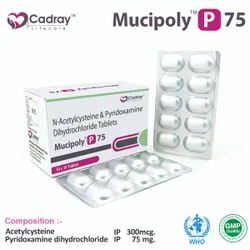
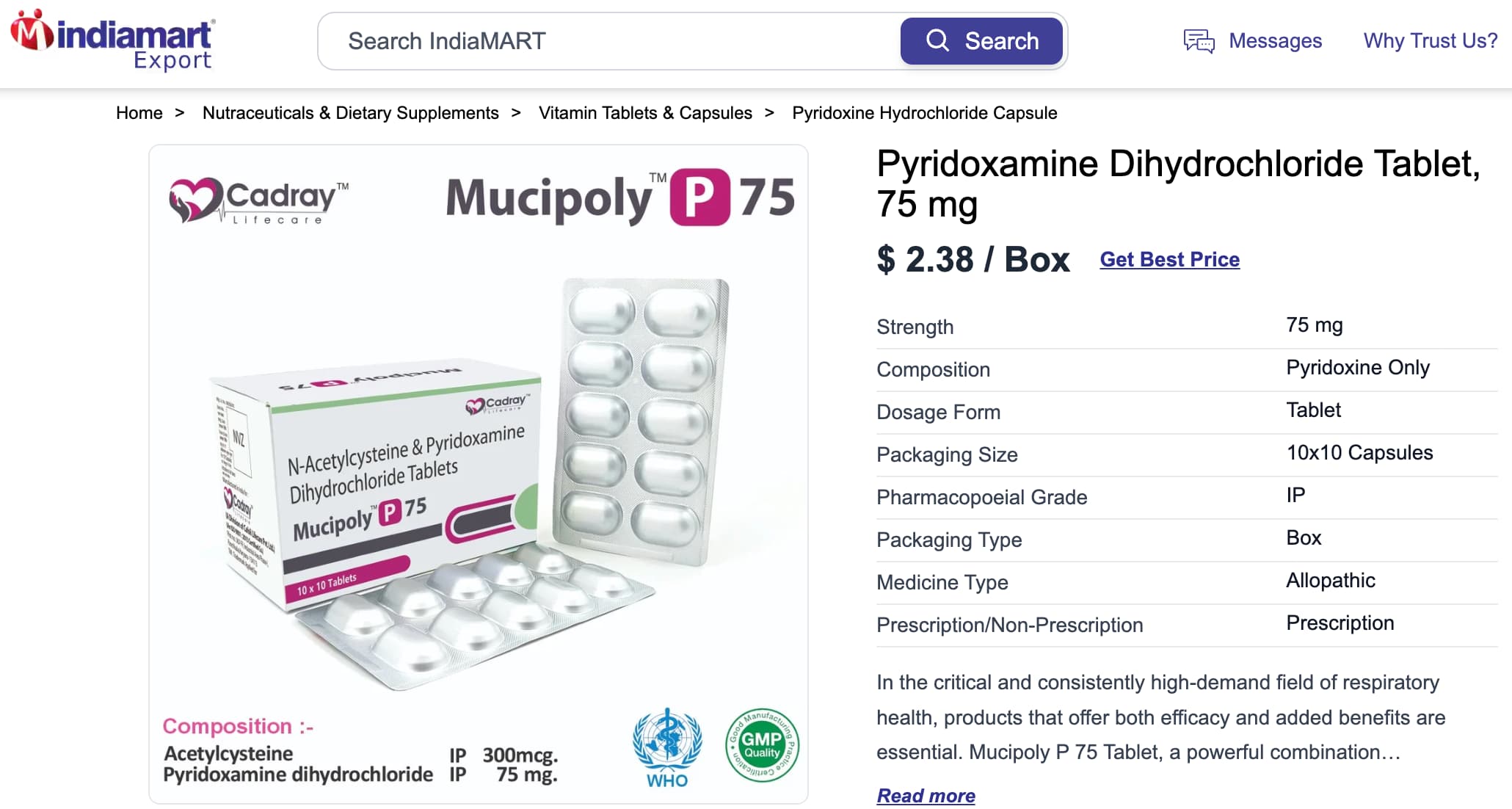
  • Status: UNVERIFIED — empty result. No product, manufacturer, or marketer under the name “Cadray” with pyridoxamine 75 mg surfaced on any Indian e-pharmacy (Tata 1mg, Apollo, Netmeds, PharmEasy, Truemeds) or B2B database (IndiaMART, TradeIndia). I’m reporting this as a genuine negative rather than guessing. If you have the source where you saw it (a strip photo, a CIMS/Drugs.com entry, or a distributor quote), send it and I’ll run it down — it may be a typo for another brand, a regional-only SKU, or a very small marketer not indexed online.

Executive summary (consolidated, all leads)

The most useful analytical takeaway is the cross-positioning itself. The identical NAC 300 + pyridoxamine 75 mg tablet is sold by Cafoli as a respiratory mucolytic, by Alniche/Steris as a nephroprotective, and (on some pages) as a dietary supplement — three incompatible regulatory framings for one molecule. That’s the signature of a marketing-led fixed-dose combination with no settled, regulator-sanctioned indication behind it, riding on the antioxidant/anti-AGE rationale of two component molecules whose combination was never approved in a stringent market. None of these four products clears your top-tier entry bar; they’re branded-generic/PCD marketing SKUs.

NAC 300 mg + Pyridoxamine dihydrochloride 75 mg fixed-dose tablets — India-only category, no FDA/EMA approval:

  • Renosave Forte — Alniche Life Sciences (mfd. by Supermax Drugs, Roorkee). Most established brand; on Tata 1mg ~₹272/10. Dose listed 50 mg on some sites.
  • Stylecystin Forte — Steris Healthcare (Jaipur). 2018 marketing-led firm; regulatory-category confusion (supplement vs Rx).
  • Mucipoly P 75 — Cafoli Life Care (Panchkula). PCD franchise marketer; B2B-only listing; manufacturer undisclosed; lowest transparency.
  • “Cadray” 75 mgdoes not exist as a verifiable brand; the source URL is Cafoli’s Mucipoly P 75.

For your actual purpose, the conclusion from the last message holds and is now reinforced: if you want pyridoxamine for an anti-AGE protocol, all three finished products lock you into a fixed 75 mg pyridoxamine bundled with 300 mg NAC from quality-opaque marketers — bulk API plus an independent certificate of analysis remains the cleaner route for identity, purity, and dose control.