Another write-up by Cristin Glorioso:
Dietary Fat and the Brain: What the Science Actually Says About Dementia Prevention
Your brain is roughly 60% fat by dry weight. It is the fattiest organ in your body. So it should come as no surprise that the fat you eat plays a major role in whether your brain thrives or deteriorates as you age. What might surprise you is how much controversy still exists about which fats help, which fats harm, and how much fat is optimal for long term brain health.
I’ve been on a personal journey with this topic. As many of you know, I practice intermittent fasting and I was recently tipped into functional ketosis by extending my fasting windows. My biomarker results showed a worrying increase in ApoB (85→108), LDL, and CRP. That sent me down a rabbit hole into the dietary fat and dementia literature, which I wrote about in my article Keto or Ket-no for Brain Health?. This article is the companion deep dive focused specifically on dietary fat itself: how much, what type, and what the evidence actually supports.
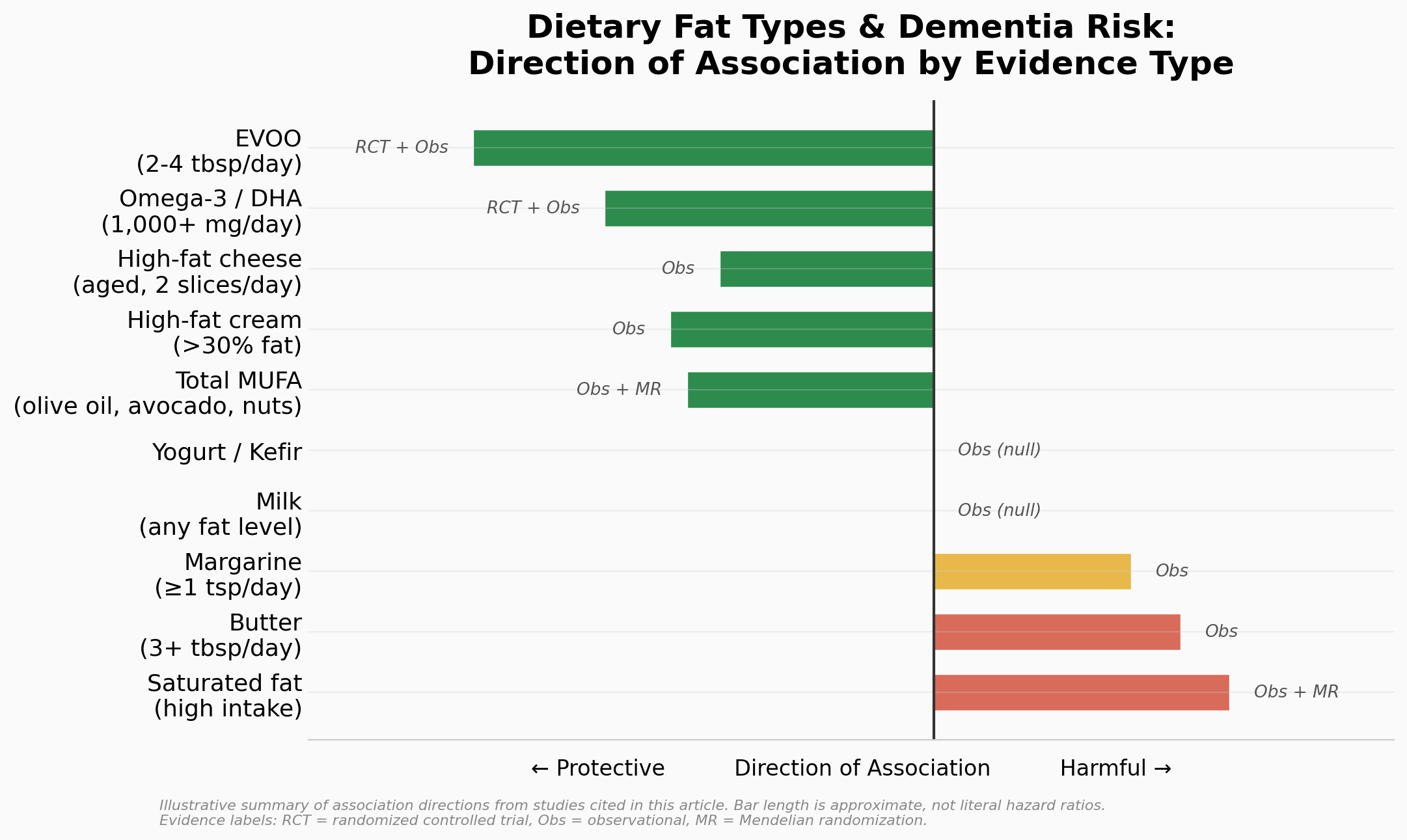
A caveat to be aware of is the evidence quality varies dramatically depending on which fat question you’re asking. Some claims are supported by large, well designed randomized controlled trials (RCTs). Others rest entirely on observational data, which can tell us about associations but not causation. I’ll walk through each category and be transparent about where the science is strong, where it’s suggestive, and where we’re still guessing.
Before we get into the evidence for each fat type, here is a practical framework for how to think about your daily fat intake for brain health. The standard USDA recommendation is 20 to 35% of calories from total fat. But the Mediterranean diet, which is the dietary pattern most consistently associated with lower dementia risk, runs closer to 35 to 40% of calories from fat. The difference is not the amount of fat but where it comes from. The AHA recommends up to 15% of calories from monounsaturated fat (MUFA), 8 to 10% from polyunsaturated fat (PUFA), and less than 10% from saturated fat (or less than 7% if you have elevated cardiovascular risk).
What does this look like in actual grams? On a 2,000 calorie diet with a brain-health-optimized Mediterranean fat profile of roughly 35 to 40% of calories from fat:
Total fat: roughly 78 to 89 grams per day. This is not a low fat diet. Your brain needs fat. The goal is to fill this budget with the right kinds.
Read the full article: Dietary Fat and the Brain: What the Science Actually Says About Dementia Prevention