Market Availability Status
There are currently no consumer-oriented internet resellers that sell ribulose-1,5-bisphosphate carboxylase/oxygenase (Rubisco) in 1 to 10kg bags. The market for isolated Rubisco remains strictly divided between low-volume, high-cost R&D chemical suppliers and early-stage business-to-business (B2B) agricultural biotechnology firms that do not offer direct retail pricing or consumer-facing digital storefronts.
Structural Bottlenecks to Commercialization
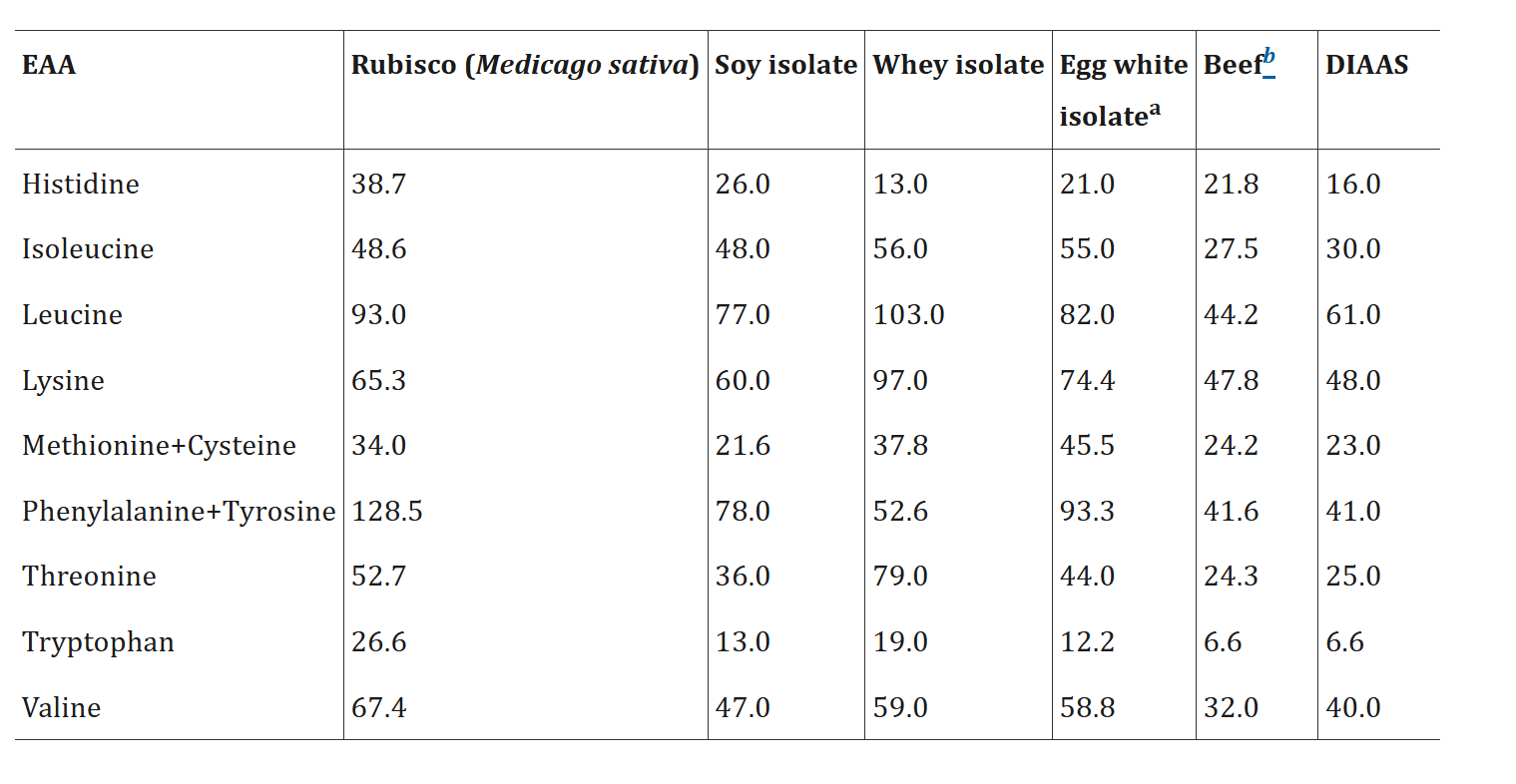
While Rubisco is recognized as a nutritionally complete protein with an essential amino acid profile and gelation performance comparable to animal proteins like casein and whey, industrial-scale extraction for human consumption remains highly constrained (Pearce & Brunke, 2022).
-
Extraction and Purification Hurdles: Isolating native Rubisco requires separate, intensive processing to detach the protein from the green leaf biomass while fully removing green pigments (chlorophyll) and bitter, astringent polyphenols (Balfany et al., 2023; Grácio et al., 2023).
-
Scale and Infrastructure Deficits: Major food technology companies (such as Impossible Foods) historically abandoned early product prototypes utilizing Rubisco as a structural binder because no scaled agricultural processing infrastructure existed to manufacture the protein isolate reliably (Pearce & Brunke, 2022).
Current B2B and R&D Providers
Biotech entities currently focusing on commercializing leaf-protein concentrates or isolates operate strictly on a contract or venture-backed partner model (García Martínez et al., 2025).
| Provider Type |
Entities / Suppliers |
Estimated Pricing & Scale |
| B2B Biotech Innovators |
Plantible Foods (extracting from duckweed/Lemna), Leaft Foods (extracting from alfalfa/leafy crops), Rubisco Foods |
Proprietary wholesale pricing. Supply is limited to pilot batches for commercial food manufacturing partners rather than public sale. |
| Scientific R&D Suppliers |
MilliporeSigma / Sigma-Aldrich, Fisher Scientific, Cayman Chemical |
$150 to $400 per milligram. Scaling this to a 1 to 10kg quantity is cost-prohibitive (exceeding hundreds of millions of dollars) and restricted to laboratory use. |
Knowledge Gaps and Required Data
To establish transparent retail market pricing for bulk consumer applications, the following industry milestones must first be achieved:
-
Standardization of Yield Data: Publicly verifiable pilot plant processing data indicating the exact capital and energy costs required to process raw input mass (e.g., wet alfalfa or duckweed) into a dry, white Rubisco isolate.
-
Regulatory Milestones: Broad FDA Generally Recognized as Safe (GRAS) clearances and European Food Safety Authority (EFSA) novel food approvals across a wider array of crop sources to allow open-market bulk trading.
References
Balfany, C., Gutierrez, J., Moncada, M., & Komarnytsky, S. (2023). Current status and nutritional value of green leaf protein. Nutrients, 15(6), 1327. https://doi.org/10.3390/nut15061327 Cited by: 32
García Martínez, J. B., Behr, J., Pearce, J., & Denkenberger, D. (2025). Resilient foods for preventing global famine: a review of food supply interventions for global catastrophic food shocks including nuclear winter and infrastructure collapse. Critical Reviews in Food Science and Nutrition, 1–27. https://doi.org/10.1080/10408398.2024.2431207 Cited by: 17
Grácio, M., Oliveira, S., Lima, A., & Boavida Ferreira, R. (2023). RuBisCO as a protein source for potential food applications: A review. Food Chemistry, 419, 135993. https://doi.org/10.1016/j.foodchem.2023.135993 Cited by: 65
Pearce, F. G., & Brunke, J. E. (2022). Is now the time for a Rubiscuit or Ruburger? Increased interest in Rubisco as a food protein. Journal of Experimental Botany, 74(2), 627–637. https://doi.org/10.1093/jxb/erac414 Cited by: 43