Unfortunately it’s going to be a controlled substance (currently waiting for DEA classification before the med can be sold), so that’s going to limit access and ability to import any future generic version.
3 Likes
I can see that being true.
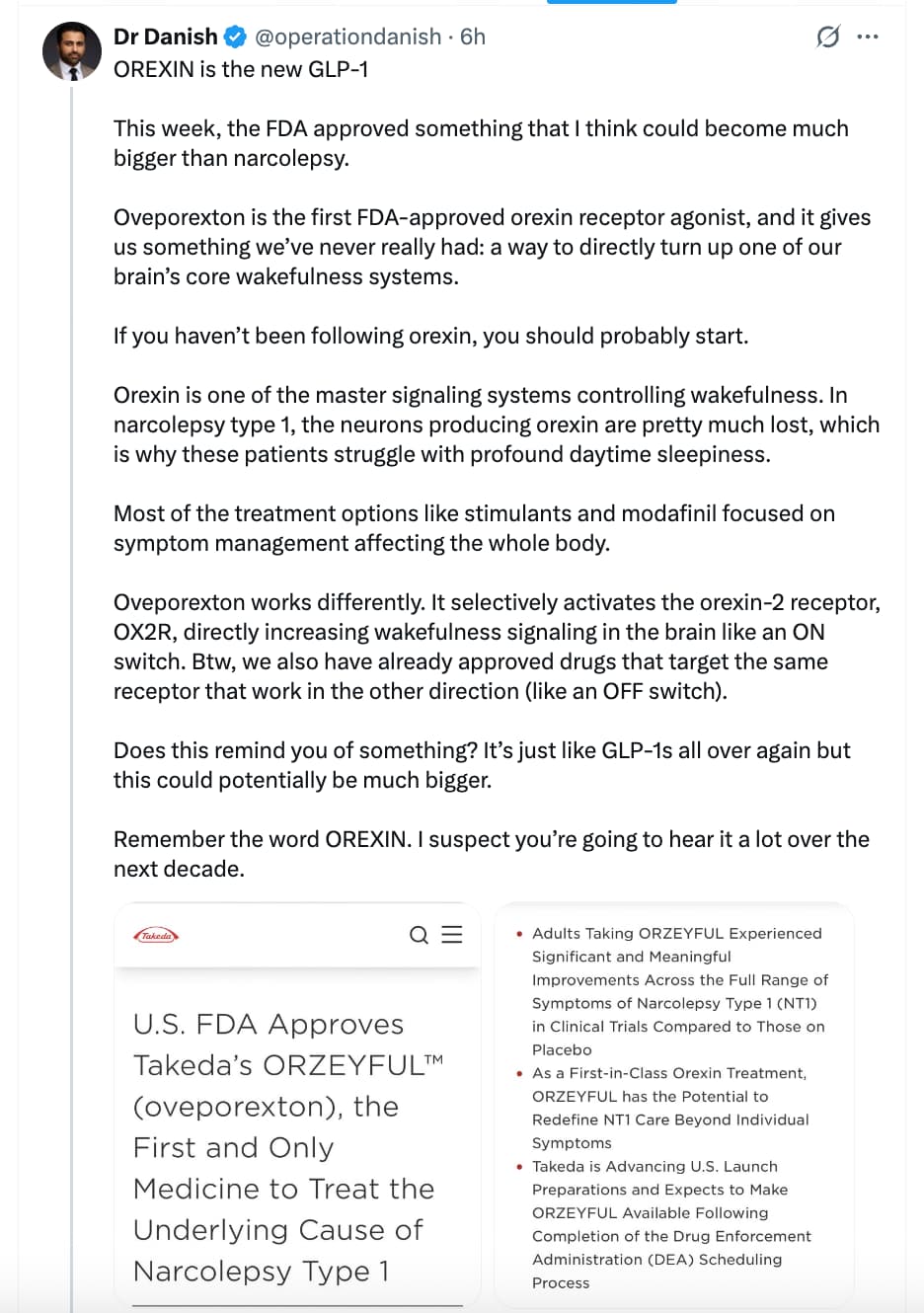
2 Likes
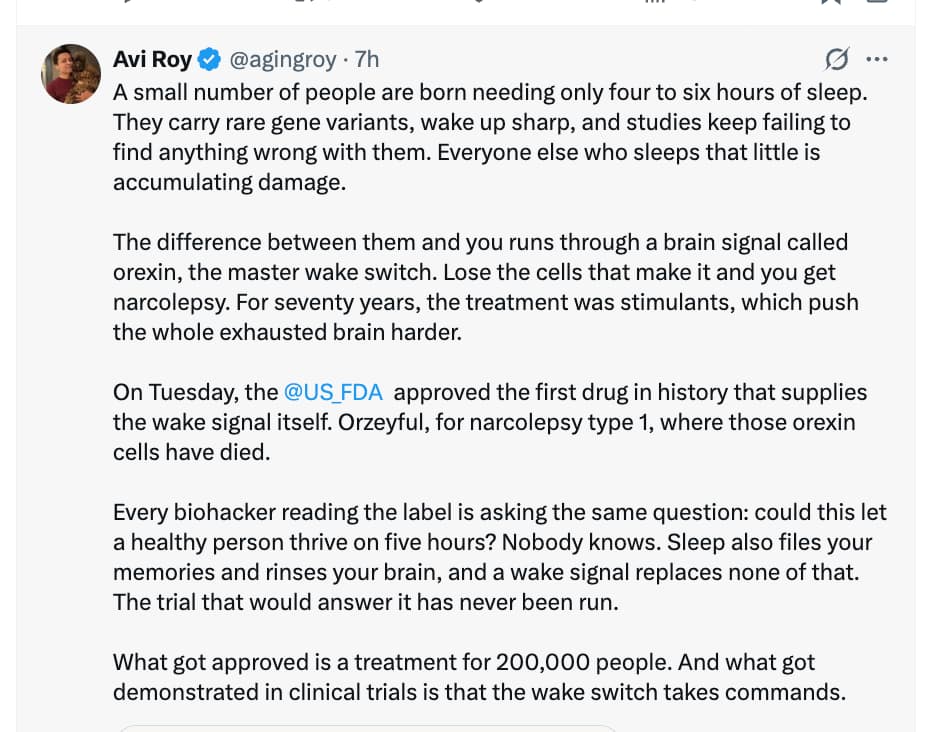
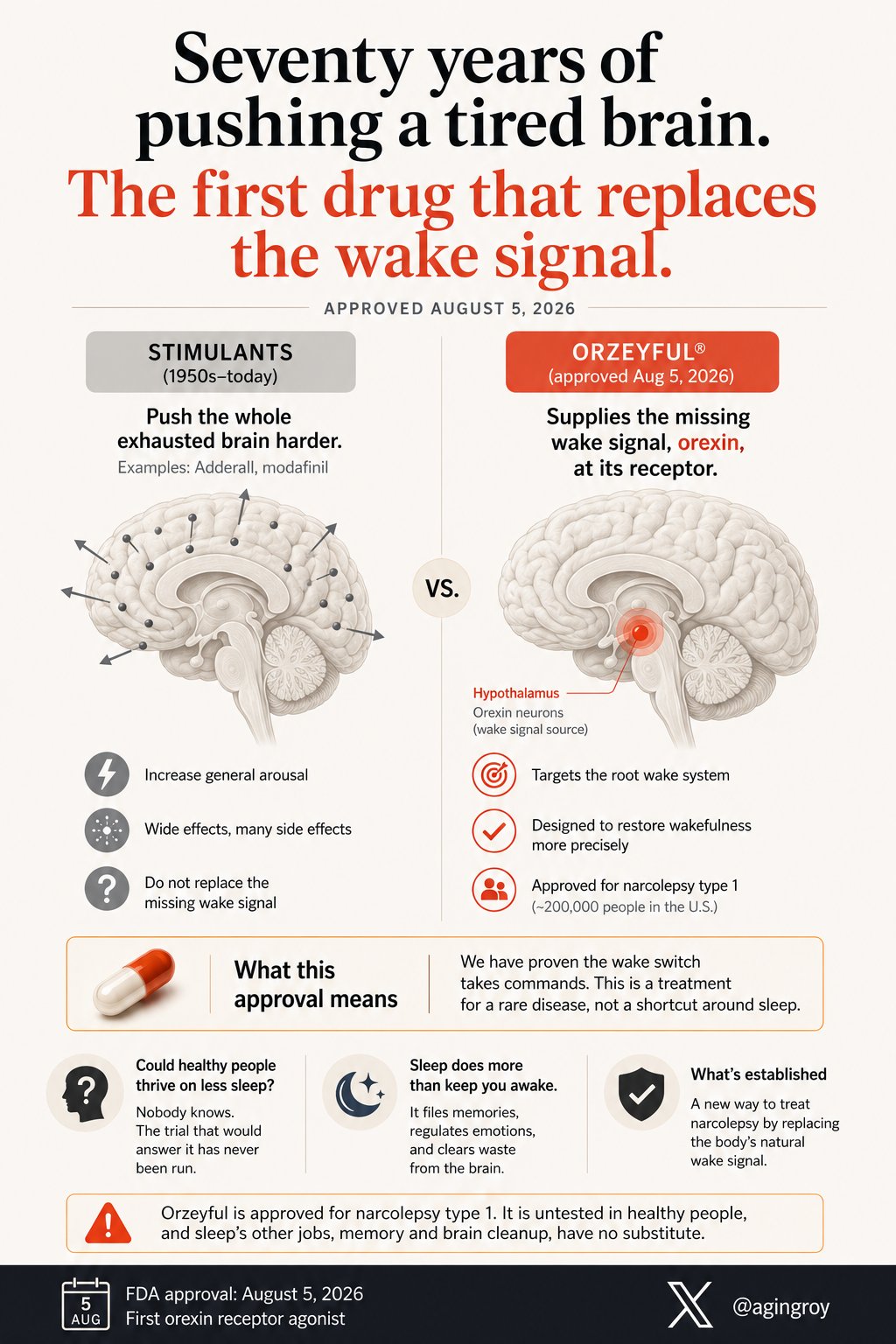
I don’t think we’re anywhere near replacing the need for sleep. We should focus more on improving sleep quality if we’re aiming at reducing the total time of sleep needed, this is a superior approach to just aiming to stimulate the body during waking hours.
Still excited about these types of stimulant/wakefulness tools however.
2 Likes
Orexin antagonist before bedtime to accentuate sleep quality, and an orexin agonist upon waking to accentuate wakefulness during the day. Better living through pharmacology?
At 85, modanfil works quite well for me. It seems to be quite good as a motivator. I am back to doing projects that I had set aside before taking modafinal. From the responses I’ve seen, it is not for everybody. If you have a problem with daytime sleepiness, it’s worth a try until something better becomes affordable and widely available.
Modanafil: “Push the whole exhausted brain harder.” A little nonsense here. I am happy modafinal pushes the whole brain a little harder.
3 Likes
China Becomes First to Approve New Narcolepsy Drug Ahead of US and Japan
China has authorized Orzeyful, a novel treatment for narcolepsy type 1, making it the first country to do so. The approval is based on two international trials and targets patients from age 16. The drug offers a new approach by restoring orexin signaling, setting it apart from existing therapies.
On July 22, China became the first country to approve Orzeyful, a new medication for narcolepsy type 1, for patients aged 16 and older. The decision, announced by the National Medical Products Administration, marks a significant step in the treatment of this chronic neurological disorder, which is characterized by excessive daytime sleepiness and sudden loss of muscle tone known as cataplexy.
Orzeyful, also known as oveporexton, is an oral selective agonist of the orexin receptor 2 (OX2R). Unlike current therapies that mainly address individual symptoms, this drug aims to restore the disrupted orexin signaling in the brain—a core issue in narcolepsy type 1. Orexin is a neuropeptide that stabilizes the sleep-wake cycle, and its deficiency leads to the hallmark symptoms of the disease.
How Orzeyful Works
Narcolepsy type 1 is caused by the loss of neurons that produce orexin, resulting in persistent drowsiness, cataplexy, fragmented nighttime sleep, sleep paralysis, hallucinations, and attention difficulties. Orzeyful does not replace lost neurons or offer a cure, but it selectively stimulates the OX2R receptor to help restore orexin signaling and promote wakefulness. The drug also targets REM sleep-related symptoms, including cataplexy. The current approval in China is limited to patients aged 16 and above with narcolepsy type 1, excluding younger patients and those with other hypersomnia disorders.
Clinical Trials and Results
The approval is based on two phase 3 studies—FirstLight and RadiantLight—conducted over 12 weeks in 19 countries with a total of 273 participants. FirstLight enrolled 168 patients and compared two daily doses of Orzeyful to placebo, while RadiantLight included 105 patients and tested a two-milligram twice-daily regimen. Both studies met their primary and secondary endpoints, evaluating wakefulness, sleepiness, cataplexy, attention, and quality of life.
According to Takeda, the manufacturer, nearly 85% of treated participants achieved levels of sleepiness similar to healthy individuals. The median reduction in weekly cataplexy episodes exceeded 80%, with patients gaining four to five cataplexy-free days per week compared to none at baseline. No serious treatment-related adverse events were reported; the most common side effects were insomnia, urinary urgency, and increased urination. Over 95% of those who completed the trials entered an extension study.
Source: China Becomes First to Approve New Narcolepsy Drug Ahead of US and Japan
2 Likes
I would be really interested to hear anecdotes on how oveporexton differs from modafinil.
1 Like
And the excitement is not just about narcolepsy, which is estimated to afflict one person in 2,000 in America. Orexins help coordinate sleep, attention, motivation and the brain’s reward system. Drugmakers hope orexin medicines could eventually treat depression, attention-deficit hyperactivity disorder (ADHD) and addiction, conditions that burden hundreds of millions of people.
2 Likes
Yes - I think the next big peptide could be a sleep drug that actually works; rather than a wakefulness one.
1 Like
Feels like we’re getting close with DORAs but given how important orexin is for wakefulness I am concerned about the long term impact of these drugs on orexin receptors, but studies show no tolerance, no rebound insomnia, no withdrawal and orexin recovering after stopping the drug.
But I still think we need more. We need to be able to specifically modulate how much of each stage of sleep we get, and the ability to get to sleep and stay asleep without having grogginess the next day. If we can combine this with modalities like seen in the 40hz trials which cleared plaques from the brain quickly we can get a truly rejuvenating sleep that may have us waking up younger than when we went to bed.
IMO sleep may be one of the most powerful levers we have for achieving actual longevity.
3 Likes
I got access to this paywalled paper, so here is a summary:
Orexin Neurons Encode the Expectation and Effort Required for Reward
Researchers have demonstrated that orexin neurons in the rat hypothalamus dynamically encode the expectation of a reward and the physical effort required to obtain it. Using a combination of chemogenetics, optogenetics, and in vivo calcium imaging, the study reveals that orexin neuron activity increases prior to reward acquisition and scales directly with the amount of work demanded. Ablation or inhibition of these neurons drastically reduces the motivation to pursue rewards, an impairment that can be partially rescued by the administration of methylphenidate.
The drive to sustain physical and cognitive effort toward a goal is fundamental to survival and behavioral healthspan. Deficits in this motivational control are hallmarks of various neuropsychiatric conditions and age-related cognitive decline. This research investigates the neurobiological architecture of motivation by analyzing orexin, a neuropeptide traditionally associated with wakefulness and energy homeostasis.
Through precise cell-type-specific manipulation in transgenic Long-Evans rats, the researchers found that chemogenetic activation of orexin neurons increased the breakpoint in a progressive ratio test, meaning the animals were willing to work significantly harder for a food reward. Conversely, when orexin neurons were selectively destroyed using diphtheria toxin A, the animals’ willingness to exert effort dropped substantially.
In vivo fiber photometry tracking calcium signals showed that orexin neuronal activity is not static. Activity spikes precisely during the anticipation phase of reward seeking and immediately declines once the reward is consumed. Notably, if a predicted reward is withheld, orexin neuron activity remains elevated, suggesting the system encodes a biological response to prediction error and unresolved expectation. Furthermore, the magnitude of the neuronal response increases as the physical effort required by the operant task increases.
The pharmacological data isolate this effect primarily to the orexin 1 receptor. Administration of the orexin 1 receptor antagonist SB-334867 suppressed reward-seeking behavior, while an orexin 2 receptor antagonist had no such effect. The data strongly suggests that orexin acts as a critical biological bridge between the cognitive expectation of a reward and the sustained physical action required to achieve it.
Actionable Insights
For individuals focused on healthspan optimization, maintaining dopaminergic and orexinergic tone is vital to preventing the apathy and reduced voluntary physical activity commonly seen in aging. The study provides concrete evidence that orexin signaling directly dictates behavioral drive.
The ablation of orexin neurons reduced the behavioral breakpoint to 52 percent +/- 7.22 percent of normal capacity, effectively cutting the motivation to work for a reward by nearly half. This represents a massive negative effect size on physical output and motivation.
However, treatment with methylphenidate at a dose of 1 mg/kg completely rescued this effort deficit in the orexin-ablated models. The practical takeaway is two-fold. First, preserving endogenous orexin function through strict circadian rhythm adherence and quality sleep is foundational for sustained daily motivation. Second, in clinical cases of severe neuro-apathy or chronic fatigue where behavioral drive is compromised, dopaminergic modulators like methylphenidate may offer a viable pharmacological intervention to restore baseline effort exertion.
Context/Source
- Paywalled Paper: Reward prediction is encoded by orexin neuron activity during motivated behavior.
- Institution: Nagoya University Graduate School of Medicine (and collaborating institutions). * * Country: Japan (with German and Chinese affiliations). Journal Name: PNAS (Proceedings of the National Academy of Sciences).
- Impact Evaluation: The impact score of this journal is approximately 11, evaluated against a typical high-end range of 0 to 60+ for top general science, therefore this is a High impact journal.
1 Like
A summary of the recent Nature news article on the first Orexin agonist drug FDA approved:
Wake-Up Call: First-in-Class Orexin Agonist Secures FDA Approval for Narcolepsy and Opens Doors for Broad Neurological Enhancement
The United States Food and Drug Administration has approved Takeda’s oveporexton, the first oral small-molecule orexin 2 receptor agonist designed to treat narcolepsy type 1 by directly addressing its underlying neurochemical deficit. Clinical trial data demonstrate a dramatic increase in objective wakefulness metrics, shifting standard treatment paradigms away from broad central nervous system stimulants and prompting immediate industry investigations into orexin modulation for combating fatigue, cognitive impairment, and age-related neurological decline.
The recent regulatory approval of Takeda’s oveporexton, marketed as Orzeyful, represents a fundamental paradigm shift in neurology and sleep medicine. For decades, the standard of care for narcolepsy type 1 relied heavily on broad-spectrum stimulants, wakefulness-promoting agents, and histamine receptor modulators. These interventions merely masked the superficial symptoms, leaving thirty to forty percent of patients with a significant, unaddressed disease burden. Oveporexton is the first oral small-molecule drug formulated to specifically agonize the orexin 2 receptor, effectively replacing the vital neurochemical signaling lost when endogenous orexin-producing neurons are destroyed.
Narcolepsy type 1 affects approximately one to one and a half million people globally and is formally diagnosed by low levels of orexin in the cerebrospinal fluid. By agonizing the OX2R receptor, oveporexton has demonstrated the profound clinical ability to make individuals with severe narcolepsy function fundamentally like people without the disorder. This mechanism is not a superficial stimulant effect but a true restoration of baseline neurobiology.
The systemic implications of this targeted mechanism extend far beyond narcolepsy. Orexin acts as a master regulator within the human brain, actively modulating the release of critical neurotransmitters including serotonin, dopamine, histamine, and noradrenaline. Because of this broad influence on interconnected neural circuitry, orexin signaling regulates sustained attention, cognition, mood, and global metabolism. Pharmaceutical developers are rapidly exploring this physiological pathway for a wide range of neuropsychiatric and neurodegenerative conditions. Industry leaders increasingly hypothesize that orexin agonists could become the neurological equivalent of GLP-1 agonists, offering systemic, broad-spectrum benefits for chronic fatigue and cognitive dysfunction.
The development of these complex molecules has historically been hindered by the physical tightness of the OX2R receptor binding pocket and severe off-target liver toxicities that halted previous high-profile clinical trials. Oveporexton belongs to a highly potent novel chemical class, allowing for therapeutic micro-dosing that currently exhibits a remarkably clean safety profile. The ability to pharmacologically command the sleep-wake cycle and restore circadian neurotransmitter tone offers a profound new tool for neurology.
Actionable Insights For individuals focused on optimizing biological longevity and peak cognitive performance, the approval of oveporexton validates pharmacological orexin modulation as a powerful new mechanism for maintaining alertness and metabolic tone. While currently restricted to diagnosed narcolepsy type 1 patients, the future clinical expansion of OX2R agonists strongly suggests upcoming targeted interventions for age-related circadian degradation and subjective daily fatigue.
The clinical effect size observed in the pivotal phase three trials is extraordinarily large. In the Maintenance of Wakefulness Test, untreated patients typically fell asleep within approximately four minutes. Following twelve weeks of oveporexton treatment, mean sleep latency increased to approximately twenty minutes.
To quantify this specific magnitude, the intervention produced a four hundred percent absolute increase in sustained wakefulness time over the baseline condition. Healthy controls typically remain awake for thirty to thirty-five minutes in this same clinical test. Therefore, the drug restored wakefulness to roughly sixty percent of the healthy physiological baseline. Because the source text omits specific sample standard deviations, calculating a precise mathematical Cohen’s d is impossible. However, the complete non-overlap between the baseline four-minute latency and the treated twenty-minute latency points to a massive standard effect size, translating to highly visible, real-world improvements in daily functional capacity.
Context/Source
How to get Oveporexton
Oveporexton (ORZEYFUL) — Global Availability and Access Map
Bottom line up front: there is no consumer retail market for this drug, and a ranked vendor/price table cannot honestly be built. ORZEYFUL is a prescription-only medicine that the FDA has flagged for abuse potential; it is awaiting a DEA controlled-substance schedule and will be distributed through a single restricted specialty-pharmacy channel, not through retail, mail-order, or online sellers. As of today (August 23, 2026) it has not been dispensed to a patient anywhere in the world. Any website currently offering “oveporexton for sale” is either a research-chemical supplier selling non-pharmaceutical-grade material explicitly not for human use, or a counterfeit operation — so I have not listed them as sources.
What I can give you is the real procurement picture: where it is approved, when supply actually opens, and the legitimate channels in order of soonest access.
Approval and Availability by Country
| Rank | Country | Product (exact title) | Regulatory status | Earliest realistic availability | Channel | Source |
|---|---|---|---|---|---|---|
| 1 | China | ORZEYFUL (oveporexton) | Approved 22 July 2026 by NMPA under accelerated review; adults and adolescents 16+ with NT1 | Launched market — hospital/specialist supply ramping now | Hospital prescription via sleep medicine or neurology specialist | Takeda China release |
| 2 | United States | ORZEYFUL (oveporexton) tablets, 0.5 mg / 1 mg / 2 mg | Approved 5 August 2026 by FDA; adults with NT1 | Expected by November 2026 — blocked until DEA assigns a schedule (about 90 days from approval) | Restricted specialty pharmacy only; Rx from a prescriber | Takeda · orzeyful.com |
| 3 | Japan | Oveporexton (TAK-861) | Application under MHLW review with Sakigake (priority) designation | Late 2026 to 2027, if approved | Would be prescription-only through Japanese specialists | Pharma Japan |
| 4 | EU / UK / Canada / Australia and all others | Not yet marketed | No approval; Takeda has said additional submissions are planned through 2026 | 2027 or later | Not available; no import pathway open | Takeda |
Legitimate Access Channels, Ranked by Speed
- Register the interest now at ORZEYFUL.com. Takeda’s site has a sign-up for patients and for healthcare providers that notifies you the moment prescribing opens. This is the single highest-value action available today — orzeyful.com
- Get the NT1 diagnosis documented before supply opens. The label is narrow: narcolepsy type 1 (with cataplexy) in adults. A specialty pharmacy will require a confirmed diagnosis — typically polysomnography plus MSLT, or a documented low CSF hypocretin-1. Patients without that workup completed will be the ones waiting in December.
- Line up a prescriber in sleep medicine or neurology. First-in-class launches through restricted channels are almost always prescribed by specialists, not primary care.
- Takeda patient support / hub services. Takeda has not yet published the program name or the specialty pharmacy partner. Both are normally announced at launch, alongside copay assistance and prior-authorization support.
- Clinical trials as a bridge. Takeda’s broader orexin franchise (including TAK-360 and TAK-495) remains in active development, and open-label extensions from the oveporexton phase 3 program have been the only route to the molecule to date. ClinicalTrials.gov is the place to check current enrollment.
- Expanded access / compassionate use. Not announced for this product, and unlikely now that it is approved — but a treating specialist can inquire with Takeda Medical Information directly.
On Non-Prescription and Cross-Border Channels
You asked me to cover these, so here is the straight assessment rather than a list:
- DEA scheduling is the gate, not a formality. Until it lands, no US pharmacy — specialty or otherwise — can legally dispense a single tablet. That also means there is no legitimate US supply to divert, so anything appearing for sale right now is not the real product.
- Personal importation from China is not a workable path. FDA personal-import discretion generally applies to drugs unapproved in the US for serious conditions with no domestic alternative. Oveporexton is now approved domestically, which removes the basis for that discretion, and a controlled substance cannot be imported by an individual regardless.
- Research-chemical suppliers are not a source. Sites like MuseChem sell TAK-861 as a laboratory reference compound. It is not pharmaceutical grade, not sterile-tested, not dose-verified, and is sold explicitly not for human consumption.
- Watch for lead-generation sites. Searches for the brand already surface pages like “Orzeyful access support near you” targeting specific US cities. These are not Takeda, are not the specialty pharmacy, and generally exist to capture patient contact details. Start at the manufacturer’s site instead.
Pricing and Shipping
Neither is published yet. Takeda has not announced a US list price (WAC) or the specialty pharmacy partner, and no Chinese price has been disclosed publicly. Specialty pharmacies in the US typically ship to the patient at no charge with signature required for scheduled substances, but that cannot be confirmed for this product until the dispensing partner is named. I would expect price and copay-program details around the November availability date.
Can ORZEYFUL (oveporexton) pills be split and still function properly (as designed) for narcolepsy?
No — the label explicitly prohibits it. Takeda’s prescribing information states, in Dosage and Administration:
“Swallow ORZEYFUL tablets whole with water. Do not split, crush or chew tablets.”
A few reasons that instruction is worth taking literally rather than treating as boilerplate:
- The tablets are not scored. They are described as round, debossed, film-coated tablets in three colors (0.5 mg light orange, 1 mg orange, 2 mg dark red) with no score line. An unscored tablet split by hand routinely yields halves varying by 10 to 25 percent, and at a 0.5 mg starting strength that variance is a meaningful fraction of the dose.
- The dose ladder is already built in. The three strengths exist precisely so the prescriber can titrate — 0.5, 1, and 2 mg — without anyone needing to halve anything. If a dose between those steps is wanted, that is a conversation with the prescriber, not a pill cutter.
- Timing is tight. Doses are taken twice daily, separated by 3 to 5 hours, with the second dose no later than 1 PM to avoid interfering with night sleep. A film coat that is breached can change how fast the drug is absorbed, which matters more for a wake-promoting agent on a fixed schedule than it would for many other drugs.
- The film coat may be doing real work. Since the PI does not characterize the tablet as immediate or modified release, there is no basis to assume splitting is pharmacokinetically neutral.
Two practical notes: ORZEYFUL still is not dispensable in the US pending DEA scheduling, so this is a question for the prescriber and the specialty pharmacy once supply opens around November. And if the underlying motivation is stretching a supply or trimming cost, the copay assistance and hub support that Takeda typically announces at launch is the better lever — I would ask about it at the first fill rather than splitting tablets
1 Like
I’m curious if (given the many constraints currently limiting distribution and access to this medication) this medication might be viably available (to some people, in some countries) via some of the “lab use only” suppliers for these types of chemicals and reagents. I am wondering if there are any special pharmaceutical design / packaging issues and PK/PD bioavailability issues associated with the raw powder, vs. packaged product that Takeda will be selling. Here is the result of my research:
TAK-861 Details
TAK-861 (international nonproprietary name: oveporexton ) is an investigational, orally bioavailable, non-peptide small-molecule agonist that selectively targets the orexin receptor 2 (OX2R / HCRTR2) . Developed by Takeda Pharmaceutical Company, it is designed as targeted replacement therapy for conditions characterized by central orexinergic neuron loss, primarily Narcolepsy Type 1 (NT1) .
Chemical & Structural Identity
-
IUPAC Name: N -{(2S ,3R )-4,4-difluoro-1-(2-hydroxy-2-methylpropanoyl)-2-[(2,3’,5’-trifluoro[1,1’-biphenyl]-3-yl)methyl]pyrrolidin-3-yl}ethanesulfonamide.
-
Core Scaffold: A substituted difluoropyrrolidine backbone coupled with a polyfluorinated biphenyl moiety and an ethanesulfonamide group.
-
Optimization Lineage: Rational structural modification derived from earlier iterations (such as the intravenous proof-of-concept peptide/small-molecule danavorexton and the discontinued oral candidate TAK-994). Structural refinement was specifically aimed at optimizing central nervous system (CNS) penetration and eliminating reactive metabolic intermediates responsible for off-target hepatic injury.
Pharmacokinetics & ADME Profile
| Parameter | Observed Pharmacokinetic Characteristics |
|---|---|
| Absorption | Rapid oral absorption; median time to peak plasma concentration (Tmax) is 1 to 4 hours. |
| Distribution | High blood-brain barrier (BBB) permeability with efficient CNS penetration and sustained occupancy at central OX2R targets. |
| Metabolism | Primary hepatic clearance driven predominantly via the CYP3A4 oxidative metabolic pathway. |
| Dosing Regimens | Evaluated clinically in once-daily (QD) and twice-daily (BID) oral regimens (ranging from 0.5 mg to 2.0 mg BID). |
Common Treatment-Emergent Adverse Events (TEAEs): Most reported side effects reflect on-target peripheral and central orexinergic activation:
- Insomnia (~48%, largely transient during treatment initiation and resolving within 1 week)
- Pollakiuria / Urinary urgency (32% to 33%, secondary to central and peripheral modulation of the micturition reflex)
- Salivary hypersecretion
Tablet Core Formulation & Excipient Dynamics
The commercial oral tablet formulation is engineered for immediate release (IR) to support rapid central target engagement.
| Formulation Component | Selected Excipients | Pharmacokinetic / Functional Role |
|---|---|---|
| Solubilizing Matrix / Binders | Microcrystalline cellulose (MCC), Hypromellose (HPMC), Hydroxypropyl cellulose (HPC) | Prevents recrystallization and micro-precipitation in the gastric fluid; creates a hydrophilic dispersion network. |
| Superdisintegrants | Croscarmellose sodium, Sodium starch glycolate | Drives rapid tablet fragmentation via rapid capillary water intake (wicking) and swelling within <60 seconds. |
| Lubricants & Glidants | Magnesium stearate, Colloidal silicon dioxide | Minimizes punch adhesion during high-speed direct compression or wet granulation without retarding dissolution. |
| Buffering / Stabilizers | Neutral to slightly acidic pH-adjusting microenvironment agents | Suppresses potential base-catalyzed hydrolysis of the ethanesulfonamide and amide linkages. |
Functional Film Coating
TAK-861 does not employ delayed-release, enteric, or extended-release membrane coatings. Sustained systemic exposure into the evening would induce refractory nocturnal insomnia by chronically overriding homeostatic sleep drive.
- Moisture-Barrier Polymer Layer: Tablets are coated with non-functional/protective film coatings (typically formulated with hypromellose/polyvinyl alcohol [PVA] systems such as Opadry® variants).
- Photolytic Protection: Inclusion of titanium dioxide (TiO2) and iron oxide colorants protects the fluorinated biphenyl moiety from free-radical photo-oxidation during shelf life.
- Gastric Disintegration Dynamics: The film coat rapidly dissolves in gastric fluid (pH 1.2) in <5 minutes, presenting no barrier to systemic absorption.
Primary Packaging Specifications
Due to the chemical sensitivity of fluorinated small molecules and the tight physical stability required for micronized low-dose tablets (0.5 mg to 2.0 mg), primary packaging requires strict moisture exclusion:
- High-Density Polyethylene (HDPE) Bottles: Induction-sealed with integrated desiccants (molecular sieves or silica gel canisters) to maintain head-space relative humidity below critical crystallization/hydrolysis thresholds.
- Unit-Dose Blisters: High-barrier thermoformed laminates, including Alu/Alu (cold-form foil) or high-grade Aclar® (polychlorotrifluoroethylene) films, preventing ambient moisture ingress and maintaining dosage uniformity.
PK/PD Consequences of Formulation Engineering
- Rapid Tmax Attainment (1 to 4 hours): Enables prompt post-dose central OX2R occupancy in the tuberomammillary nucleus and locus coeruleus, coinciding with daytime wakefulness demands.
- Minimal Negative Food Effect: The combination of micronization and hydrophilic binders minimizes negative lipid or caloric food effects on total systemic area under the curve (AUC).
- Controlled Plasma Washout: The immediate-release profile pairs with TAK-861’s intermediate terminal elimination half-life, ensuring that therapeutic drug concentrations fall below the waking threshold prior to the patient’s nighttime major sleep period.
Reagent Suppliers & Procurement Sources for TAK-861 (>50 mg)
TAK-861 (Oveporexton) — Chemical Structure: N-{(2S,3R)-4,4-difluoro-1-(2-hydroxy-2-methylpropanoyl)-2-[(2,3’,5’-trifluoro[1,1’-biphenyl]-3-yl)methyl]pyrrolidin-3-yl}ethanesulfonamide; CAS Registry Number: 2460722-04-5 (Formula: C23H25F5N2O4S, MW: 520.52 g/mol).
Because TAK-861 is a novel, patent-protected investigational entity undergoing clinical trials, catalog vendors stock small analytical aliquots (1 mg to 10 mg) at steep markups ($150 to $400/mg). Sourcing quantities above 50 mg (e.g., 50 mg, 100 mg, 500 mg, or 1 g) requires engaging either bulk fine chemical/custom synthesis houses (which offer the lowest unit cost per milligram) or submitting bulk/custom quotation requests to standard biochemical catalog distributors.
Sourcing Comparison Table
| Rank & Supplier | Catalog / ID | Sourcing Model & Quantity Tiers (>50 mg) | Typical Purity | Sourcing Dynamics & Pricing Tier |
|---|---|---|---|---|
| 1. ECHEMI / Xi’an Horlden Bio Industries | CAS 2460722-04-5 |
Direct B2B fine-chemical synthesis; offers 100 mg to multi-gram quantities. | ≥98–99%(HPLC) | Lowest unit cost ($0.40–$0.80/mg at 1 g scale; FOB manufacturing rate). |
| 2. Shaanxi Dideu Medichem | 2460722-04-5 |
Custom chemical synthesis / B2B bulk API contract manufacturing. | ≥98% (HPLC) | Wholesale B2B pricing for multi-hundred mg to gram-scale custom production. |
| 3. Biosynth | FO184504 |
Semi-bulk to bulk catalog; lists 500 mg and 1 g packaging options. | ≥98% | Intermediate wholesale pricing ($12 to $24/mg at multi-hundred mg tiers). |
| 4. BenchChem | B15617484 |
Standard catalog tiers (10 mg, 50 mg, 100 mg) and bulk custom synthesis. | ≥98% (HPLC) | Mid-tier reagent pricing; automated tier discounting above 50 mg. |
| 5. Glixx Laboratories | GLXC-29070 |
Research laboratory vendor offering custom batch synthesis for 50 mg+. | >98% (HPLC) | Competitive custom synthesis rates on demand via direct sales inquiry. |
| 6. AnyMole | HIT214323288 |
Specialized small-molecule hit supplier; custom scaling above 50 mg. | ≥98% | Lower-overhead custom synthesis pricing compared to major brand-name catalogs. |
| 7. Probechem Biochemicals | PC-23032 |
Standard 1 mg/5 mg listings with quote tiers for 10 mg, 50 mg, and 100 mg. | ≥98%(HPLC/MS) | Reagent catalog tier; requires direct RFQ for volume discount above 50 mg. |
| 8. TargetMol Chemicals | T39807 |
Bioactive screening library supplier; bulk quote available for >50 mg. | ≥98% | Standard bio-reagent catalog; volume discount available for institutional orders. |
| 9. ChemScene | CS-1234180 |
Analytical packs (1–10 mg) with custom scale-up synthesis requests. | 99.68% | High analytical purity; premium price per mg unless scaling past 500 mg. |
| 10. Selleck Chemicals | E4740 |
Global biological reagent vendor; in vivo batch and bulk custom quotes. | High purity (validated via HPLC/NMR) | Premium global supplier; highest retail markup, but fully characterized for in vitro/in vivo research. |
Key Sourcing Considerations & Procurement Strategy
-
Primary Chemical Synthesizers vs. Catalog Distributors:
- Distributors like Selleck Chemicals and TargetMol are optimized for microgram-to-milligram assay kits, which carry retail markups reflecting quality-control certification and packaging overhead.
- Fine-chemical synthesis providers (e.g., ECHEMI/Horlden, Shaanxi Dideu, or Biosynth) yield significantly lower cost per unit when purchasing batches >50 mg or ≥1 g.
-
Stereochemical Purity Verification:
- TAK-861 possesses two defined chiral centers: (2S,3R) on the fluorinated pyrrolidine core.
- Sourcing from lower-cost custom manufacturers requires requesting a full **Certificate of Analysis (CoA)**including Chiral HPLC, 1H-NMR, 19F-NMR, and high-resolution mass spectrometry (HRMS) to ensure correct enantiomeric excess (ee>99%) and stereospecific target affinity at human OX2R.
-
Research Use Restrictions:
- All available vendor materials are designated strictly for in vitro laboratory and in vivo preclinical research use only.
Tablet and Compound Characteristics
Based on the published clinical trial data and pharmacological characterization of oveporexton (TAK-861):
Tablet Design, Release Mechanics, and Absorption (Tmax)
-
Formulation Type: Oveporexton is formulated as a standard, immediate-release, orally bioavailable small molecule. It is not engineered as an osmotic pump, enteric-coated, or extended-release matrix tablet.
-
Pharmacokinetics & Timing: The molecule has high oral bioavailability and rapid absorption naturally, reaching peak plasma concentration (Tmax) within 1 to 4 hours post-dose.
-
Regimen Design vs. Formulation Design: To sustain wakefulness during the working day while preventing nighttime sleep disruption, the developers did not use a delayed-release or modified-release formulation. Instead, they relied on chronotherapeutic dosing: administering immediate-release tablets in two spaced doses in the morning (approximately 8:00 AM and 11:00 AM). Because oveporexton has a relatively long terminal elimination half-life (approximately 16 to 24 hours), this front-loaded morning schedule achieves therapeutic daytime exposure without needing complex multi-phase release coatings.
Tablet Splitting
-
Splittability: In the clinical trials, oveporexton was manufactured and supplied in exact whole dose strengths (specifically 1 mg and 2 mg tablets) matched against identical placebos to maintain double-blinding.
-
Because commercial release tablets are immediate-release (uncoated/film-coated core without a rate-controlling membrane), splitting does not risk “dose dumping” in the manner of extended-release formulations. However, unless manufactured with an approved functional score line, splitting micro-gram to low-milligram tablets (1 mg / 2 mg) introduces substantial dose variability.
Special Packaging Requirements
- Oveporexton is a stable, fluorine-rich pyrrolidine sulfonamide small molecule. It does not require cold-chain storage, desiccated moisture-barrier containment, or specialized light-blocking glass packaging beyond standard USP/ICH compliant pharmaceutical blister packs or HDPE bottles maintained at standard controlled room temperature.
1 Like
Do we have an online source to buy DORAs?
I found one seller in India but it was $117AUD for 12x 5mg lemborexant. Not a seller recommended by anyone here but I think they can be trusted.
I’ve seen cheaper ones on Indiamart but I don’t trust random sellers from India, I need ones people can trust.
This makes a lot of sense. Among other funcions, orexin increases hunger and drops after eating. It makes sense to have more motivation when you are hungry and in need to find something to eat and for the motivation to temporarily drop when you had your fill of food.
1 Like
Orexin: How animals helped solve the mystery of narcolepsy — 2026 Lasker Prize
Sleep is one of the foundational pillars of animal existence. Groundbreaking research by Emmanuel Mignot (Stanford University School of Medicine) and Masashi Yanagisawa (University of Tsukuba) transformed our understanding of how we maintain wakefulness. The 2026 Albert Lasker Basic Medical Research Award honours their work in mice, rats and dogs, that sparked a revolution in sleep science and holds the potential to help millions of people around the world get better rest.
Key messages:
- The 2026 Lasker Basic Medical Research Award honours Emmanuel Mignot (Stanford University) and Masashi Yanagisawa (University of Tsukuba) for discovering the brain chemical orexin and its role in causing narcolepsy.
- Orexin is a brain signaling molecule that regulates wakefulness; when the orexin system fails – whether from a missing peptide or a mutated receptor – animals experience sudden, uncontrollable sleep attacks.
- Emmanuel Mignot identified the gene responsible for narcolepsy in dogs in 1999, discovering that dobermans and labradors with inherited narcolepsy carried mutations in the same orexin receptor gene that Masashi Yanagisawa had independently linked to sleep regulation in rats – a convergence that helped establish orexin’s central role in narcolepsy.
- In humans, narcolepsy is generally caused by an autoimmune attack, often triggered by infections such as influenza.
- Narcolepsy affects around 1 in 2,500 people worldwide with 30,000 sufferers in the UK alone, and the discovery of orexin has led directly to new treatments, including orexin receptor-blocking drugs for insomnia.
- The first orexin receptor-activating drug for narcolepsy, oveporexton (Orzeyful™) by Takeda, received FDA approval in August 2026, marking a major treatment milestone stemming from this research.