A new podcast interview with the CEO of Alkermes, with lots of discussion on the news Orexin targeted drugs in clinical testing:
2 Likes
Here’s the current landscape of orexin (OX2R) agonists in clinical development, ranked by anticipated availability — soonest first. Note these are the “wake-promoting” orexin-2 receptor agonists for narcolepsy/sleep disorders.
Ranked by anticipated availability
| Drug (company) | Stage / Phase 3 status | Est. Phase 3 completion | Anticipated launch (if successful) |
|---|---|---|---|
| Oveporexton (TAK-861) — Takeda | Phase 3 complete (FirstLight/RadiantLight in NT1, all endpoints met). NDA accepted, FDA Priority Review, PDUFA Q3 2026 | Done (NT1); NT2 Phase 3 ongoing | H2 2026 / late 2026(US, NT1) — clear front-runner |
| Alixorexton (ALKS-2680) — Alkermes | Phase 3 Brilliance studies initiated Q1 2026 (NT1 & NT2); IH program planned | ~2028 | ~2029 |
| Cleminorexton (ORX750) — Centessa (being acquired by Eli Lilly, close expected Q3 2026) | Registrational/Phase 3 program initiated Q1 2026 (NT1, NT2, IH) | ~2028 | ~2029 |
| TAK-360 — Takeda | Phase 1 → early Phase 2; oral, for NT2 & IH; FDA Fast Track | ~2029–2030 | ~2030+ |
| ORX142 — Centessa/Lilly | Phase 1, clinical studies expanding Q1 2026 | ~2029–2030 | ~2030+ |
| ORX489 — Centessa/Lilly | Phase 1 (IND-stage) | later | early 2030s |
| TAK-495 — Takeda | Early/Phase 1 | later | early 2030s |
| BP1.15205 — Harmony Biosciences | Phase 1; PK data expected mid-2026 | later | early 2030s |
Stalled / discontinued (for completeness)
- JZP-441 (DSP-0187) — Jazz/Sumitomo: Phase 1 paused over visual disturbances and cardiovascular effects; not advancing.
- Danavorexton (TAK-925) — Takeda: IV agent, proof-of-concept established but discontinued for narcolepsy.
- TAK-994 — Takeda: oral, discontinued earlier due to hepatotoxicity (superseded by oveporexton).
Key takeaways
Oveporexton is in a class of its own — it’s the only one with completed Phase 3 data and a pending FDA decision, so it should be the first orexin agonist to market, realistically late 2026, initially for narcolepsy type 1.
Alixorexton and cleminorexton (ORX750) are the clear second wave, both having just entered Phase 3 in Q1 2026, putting them on roughly parallel ~2028 readout / ~2029 launch trajectories, with broader label ambitions (NT1, NT2, and idiopathic hypersomnia). Everything else is Phase 1/early stage, so any launch is 2030 or later and far less certain.
One caveat: only the oveporexton date is firm (tied to an actual PDUFA date). All later dates are my estimates built from standard timelines — roughly 2 years of Phase 3 plus ~10–12 months of regulatory review — and will shift with trial enrollment, readouts, and filing strategy.
Sources:
- Takeda — Positive Phase 3 oveporexton results
- Takeda — FDA accepts NDA / Priority Review, PDUFA Q3 2026
- Alkermes — Phase 3 Brilliance studies initiated
- Centessa Q3 2025 update — ORX750 registrational program
- BioSpace — Lilly’s $6.3B Centessa acquisition
- Harmony Biosciences 8-K — BP1.15205 Phase 1 PK mid-2026
- NeurologyLive — Advances in orexin therapies
- Sleep Review — Jazz halts JZP-441 (DSP-0187)
- PMC review — OX2R agonists for narcolepsy type 1
New data released, and looking good:
Takeda shared results from 2 pivotal studies at the SLEEP 2026 Annual Meeting which showed that oveporexton (TAK-861) improved daily functioning, cognition, and sleep-related symptoms associated with narcolepsy type 1 (NT1).1 Psychiatric Times interviewed Elena Koundourakis, PhD, the head of the Orexin Franchise Development & Neuroscience Programs at Takeda, to learn more.
These new data, she said, suggest restoring orexin signaling may improve “the full spectrum” of NT1 symptoms — not just excessive daytime sleepiness and cataplexy but also cognition, functioning, and nighttime sleep.
https://www.psychiatrictimes.com/view/reducing-microsleeps-oveporextons-impact-on-patient-outcomes
2 Likes
Spotlight On: Alkermes’ NT2 data boost case for broad potential of orexins
PUBLISHED : JUNE 19, 2026
Much of the excitement around orexin 2 receptor (OX2R) agonists hinges on their ability to impact diseases not driven directly by an orexin deficiency, meaning this week’s update for Alkermes’ alixorexton is a win for it and perhaps the entire class.
The backstory
A consensus has already crystallised around an expectation that OX2R agents are poised to revolutionise narcolepsy type 1 (NT1), a condition driven by an insufficiency in the neuropeptide orexin.
Several therapies have generated encouraging clinical data supporting this hypothesis. These include Takeda’s oveporexton and alixorexton, along with cleminorexton from Centessa Pharmaceuticals, which is in the process of being bought out by Eli Lilly for $6.3 billion.
Important as the success of the class is in NT1, some of the more eye-popping sales projections for alixorexton and other OX2R agonists are based instead on their ability to succeed in adjacent indications, beginning — but not ending — with narcolepsy type 2 (NT2).
What happened
On Wednesday, Alkermes presented detailed results from the Vibrance-2 sleep study in which once-daily alixorexton was confirmed as hitting the primary endpoints, demonstrating a significant benefit on the maintenance of wakefulness test (MWT) and Epworth Sleepiness Scale (ESS), in 93 patients with NT2 after eight weeks.
Interestingly, and more tantalisingly, the company also unveiled data looking at exploratory measures beyond wakefulness, which suggest that alixorexton achieved a meaningful improvement on patient-reported outcomes focused on cognition and fatigue. The benefits were observed as early as week two and continued throughout the 13-week open-label extension study.
Why this matters
“When Alkermes showed randomised data in NT1 on cognition, etcetera, it was very encouraging, but it wasn’t 100% clear if we could generalise that to larger indications, because NT1 pts have very low baseline orexin levels,” noted Evercore ISI analyst Umer Raffat.
These new functional findings are especially impressive, according to Raffat, because NT2 is a condition where patients have more normal orexin levels, so the fact that they responded to a therapy like alixorexton suggests that agonising OX2R is having a more profound physiological impact.
3 Likes
Full press release on this announcement:
https://investor.alkermes.com/news-releases/news-release-details/alkermes-alixorexton-demonstrated-sustained-improvement
This new drug class seems increasingly likely to be a large factor in quality of life for people over 50:
Orexin: The brain’s secret to staying motivated
What enables us to sustain effort toward goals, even when the task becomes increasingly difficult? A recent study by researchers at Nagoya University in Japan revealed the underlying brain mechanism, showing that orexin neurons play a crucial role in driving and regulating motivated behavior. The findings were published in Proceedings of the National Academy of Sciences of the United States of America (PNAS).
Motivational deficits, including loss of motivation, are often seen in mental disorders such as depression, addiction and ADHD. However, the brain mechanisms behind these problems remain largely unclear.
The research team, led by Hiroyuki Mizoguchi, associate professor, and Kiyofumi Yamada, professor emeritus, at Nagoya University’s Graduate School of Medicine, focused on orexin neurons. These neurons regulate essential physiological functions such as sleep, appetite and energy expenditure. Although recent studies suggest that orexin neurons also influence motivation, their exact role has remained unclear.
This study used rats to examine how changes in orexin neuron activity influence motivation to obtain food rewards. While most previous studies used mice, rats offer superior learning abilities and are better suited for complex behavioral experiments. Because of technical challenges in targeting specific neurons in rats, research in this area has been limited.
To address this limitation, the team developed genetically modified “orexin-Cre” rats, allowing precise targeting and manipulation of orexin-producing neurons. This model was used to investigate how these neurons influence motivation.
First, using chemogenetics, the researchers activated the rats’ orexin neurons and had them perform a progressive ratio test where the number of touches required to earn a food reward increased with each trial. The point at which a rat gave up (the breakpoint) measured motivation intensity. Rats with activated orexin neurons showed higher breakpoints, meaning they worked harder for the reward. Conversely, in a model where orexin neurons were selectively degenerated, breakpoints were lower, indicating reduced motivation.
Next, using fiber photometry, the team recorded real-time activity of orexin neurons as the rats anticipated and received their reward. Activity increased before the reward was obtained, decreased once it was received, and remained elevated when an expected reward failed to arrive. Notably, the more effort required, the stronger the orexin neuron activity became. The researchers say this pattern may reflect how the brain links reward expectation to the effort required to pursue them.
To test this causally, the researchers used optogenetics to control orexin neuron activity at the moment a reward was anticipated. When orexin neuron activity was suppressed using an inhibitory protein, the rats’ motivated behavior decreased — they took longer to complete effort-based tasks, and their breakpoints dropped. By contrast, when the team attempted to boost orexin neuron activity at that moment using an excitatory protein, no further increase in motivated behavior was observed, even though the stimulation reliably activated the neurons.
In other words, suppressing orexin neurons impaired motivation, but artificially exciting them beyond natural levels did not enhance it. The researchers say this asymmetry suggests orexin neurons are necessary for sustaining motivated behavior, though simply raising their activity may not be sufficient to increase it. Further studies are needed to determine what governs this effect, such as the duration or pattern of orexin neuron activity.
Mizoguchi concluded, “Our study demonstrated significant changes in orexin neuron activity depending on expected rewards and the effort required, suggesting a potential mechanism for translating expectations into sustained action.”
Future research will investigate the input and output circuits connected to orexin neurons. A deeper understanding of orexin function may inform new approaches to addressing motivational deficits, including loss of motivation or challenges in sustaining goal-directed behavior.
Publication information:
Yutao Dong, Sheikh Mizanur Rahaman, Wenjun Zhu, Ayumu Inutsuka, Daisuke Ono, Rinako Tanaka, Tetsuo Matsuzaki, Eiji Shibata, Madoka Isobe, Shuntaro Izawa, Akihiro Yamanaka, Kiyofumi Yamada, and Hiroyuki Mizoguchi, 2026. Reward prediction is encoded by orexin neuron activity during motivated behavior, Proceedings of the National Academy of Sciences of the United States of America, Paywalled Paper: DOI: 10.1073/pnas.2520677123
2 Likes
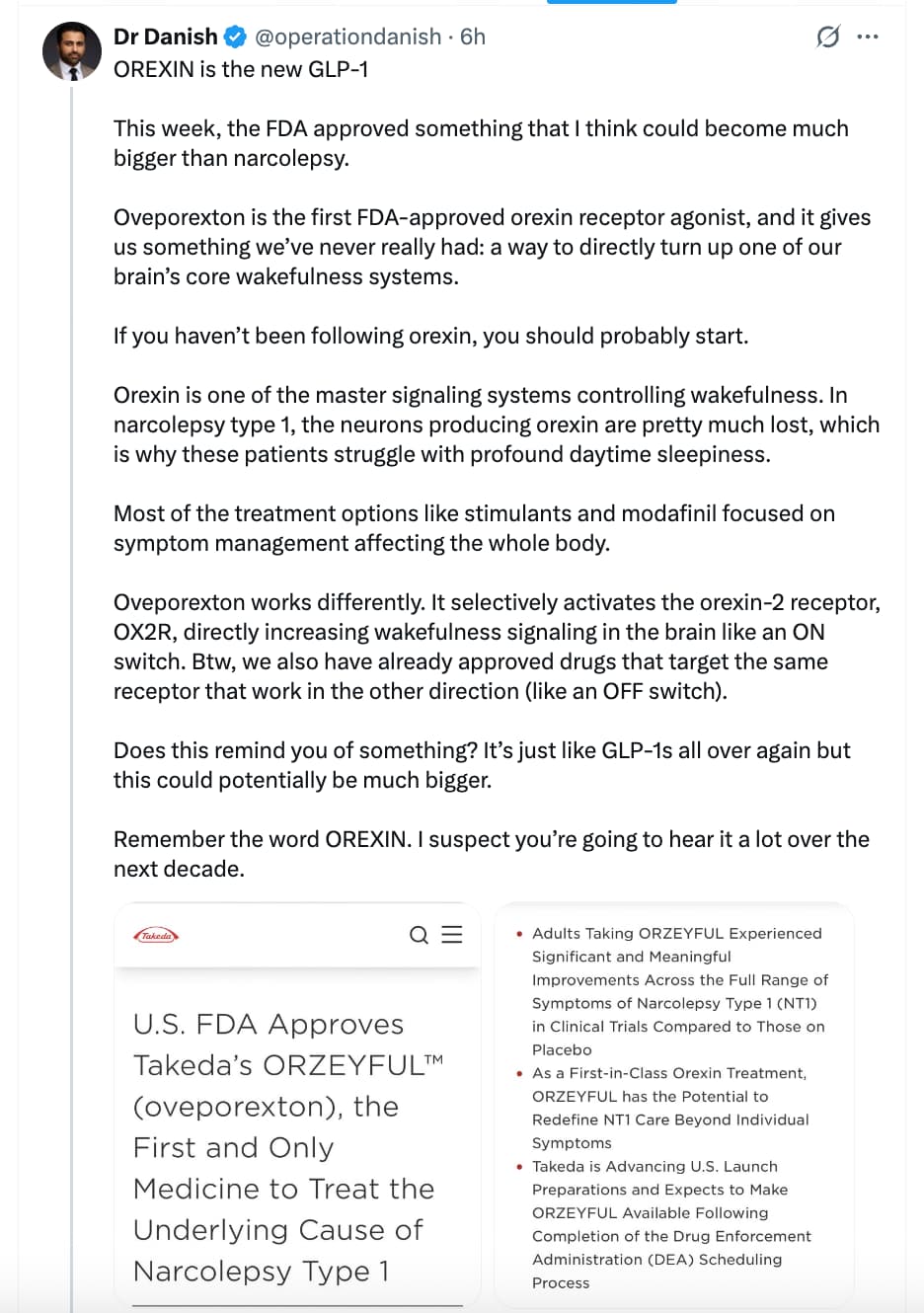
The first of many to be approved… I think this could be big, with broad appeal (when prices come down, and access goes up):
New drug is the first to directly restore orexin signaling, targeting the underlying biological cause of narcolepsy type 1
2 Likes
WSJ on this new drug approval:
Existing treatments are decades-old stimulants and sedatives that target one symptom at a time, but Orzeyful and its competitor drugs are designed to treat the disease as a whole. The science of targeting these chemicals has impact beyond narcolepsy. Takeda is testing orexin-targeting drugs in other conditions, including sleep apnea, chronic daytime sleepiness and in sleep-deprived healthy volunteers, and early results are promising.
Takeda has seen benefits using the orexin medication “in every population we’ve ever looked at,” said Andy Plump, Takeda’s head of research and development. “The potential is really quite immense.”
Several companies are right behind Takeda. In April, Eli Lilly announced a $6.3 billion acquisition of Centessa Pharmaceuticals to get its own orexin-targeting drug, which is still in testing. Alkermes has pushed its own version into late-stage trials. Drugmakers racing to develop orexin-mimicking compounds have poured more than $10 billion upfront in deals. Today, more than a dozen orexin drugs are in development and being tested in more than 70 trials, according to biopharma market-intelligence firm Sleuth.
Competitors are testing their drugs even more broadly. Alkermes’ drug is already in early stage trials for fatigue tied to multiple sclerosis and Parkinson’s disease, and for attention-deficit hyperactivity disorder.
Full article: The Race to Come Up With the Next Big Sleep Drug (WSJ)
2 Likes
If I were over 70 and wanted to restore my youthful vitality (SPA and NEAT) I would work hard to find a Telehealth company to prescribe this drug to me for the physical activity and energy benefits that it seems likely to have. If anyone does this, please post results and sources for others here.
Also - be sure to get a Fitbit (or similar activity / sleep monitor) and do a pre-treatment benchmark, and then monitor after you start dosing. And post pre and post results.
3 Likes
Unfortunately it’s going to be a controlled substance (currently waiting for DEA classification before the med can be sold), so that’s going to limit access and ability to import any future generic version.
3 Likes
I can see that being true.
2 Likes
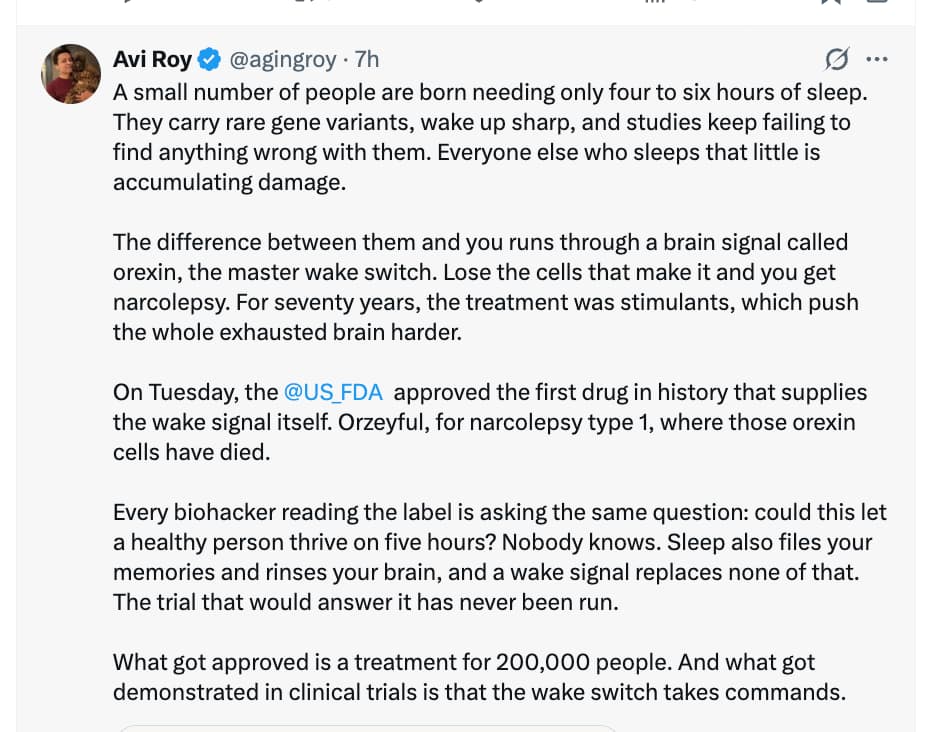
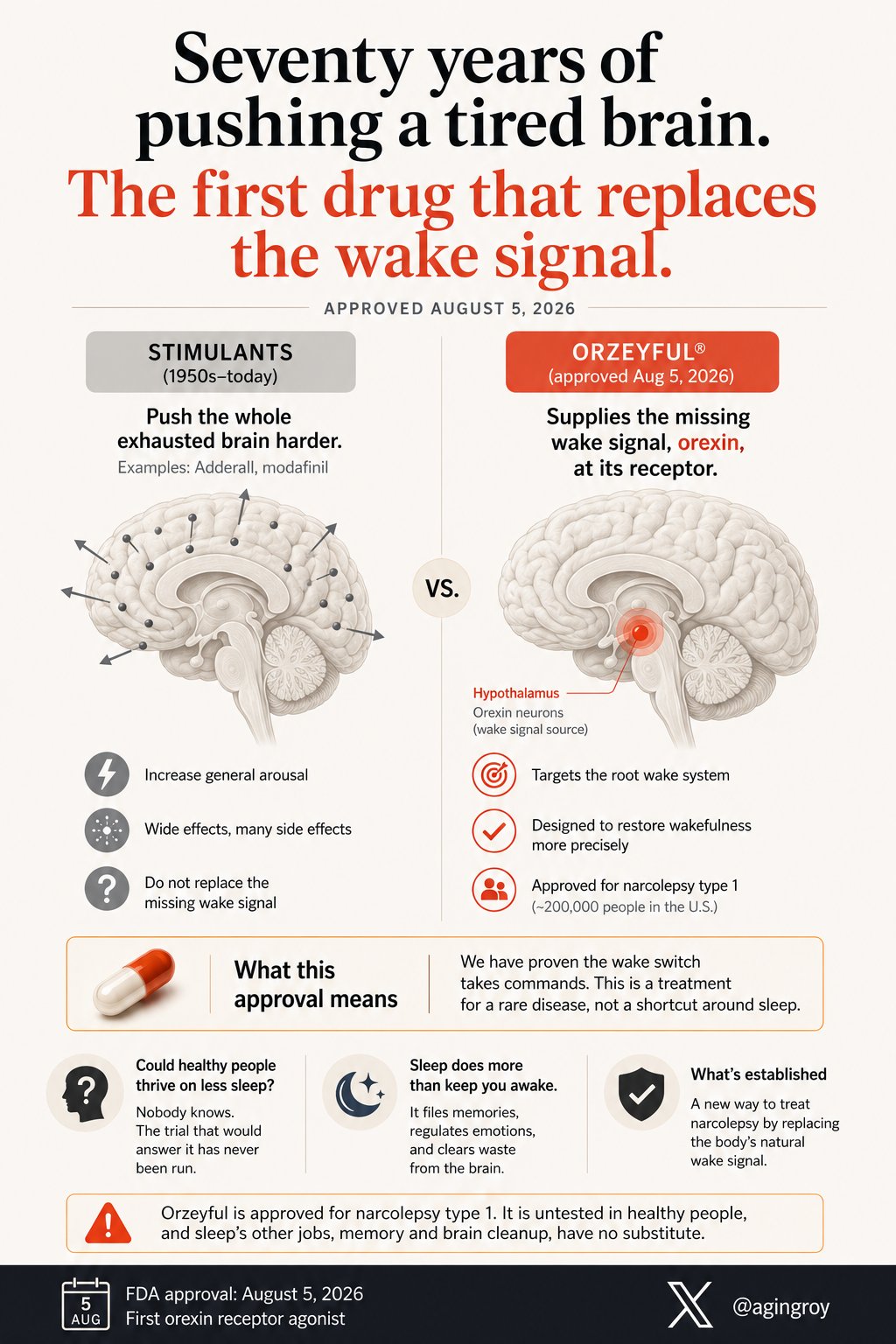
I don’t think we’re anywhere near replacing the need for sleep. We should focus more on improving sleep quality if we’re aiming at reducing the total time of sleep needed, this is a superior approach to just aiming to stimulate the body during waking hours.
Still excited about these types of stimulant/wakefulness tools however.
2 Likes
Orexin antagonist before bedtime to accentuate sleep quality, and an orexin agonist upon waking to accentuate wakefulness during the day. Better living through pharmacology?
At 85, modanfil works quite well for me. It seems to be quite good as a motivator. I am back to doing projects that I had set aside before taking modafinal. From the responses I’ve seen, it is not for everybody. If you have a problem with daytime sleepiness, it’s worth a try until something better becomes affordable and widely available.
Modanafil: “Push the whole exhausted brain harder.” A little nonsense here. I am happy modafinal pushes the whole brain a little harder.
3 Likes
China Becomes First to Approve New Narcolepsy Drug Ahead of US and Japan
China has authorized Orzeyful, a novel treatment for narcolepsy type 1, making it the first country to do so. The approval is based on two international trials and targets patients from age 16. The drug offers a new approach by restoring orexin signaling, setting it apart from existing therapies.
On July 22, China became the first country to approve Orzeyful, a new medication for narcolepsy type 1, for patients aged 16 and older. The decision, announced by the National Medical Products Administration, marks a significant step in the treatment of this chronic neurological disorder, which is characterized by excessive daytime sleepiness and sudden loss of muscle tone known as cataplexy.
Orzeyful, also known as oveporexton, is an oral selective agonist of the orexin receptor 2 (OX2R). Unlike current therapies that mainly address individual symptoms, this drug aims to restore the disrupted orexin signaling in the brain—a core issue in narcolepsy type 1. Orexin is a neuropeptide that stabilizes the sleep-wake cycle, and its deficiency leads to the hallmark symptoms of the disease.
How Orzeyful Works
Narcolepsy type 1 is caused by the loss of neurons that produce orexin, resulting in persistent drowsiness, cataplexy, fragmented nighttime sleep, sleep paralysis, hallucinations, and attention difficulties. Orzeyful does not replace lost neurons or offer a cure, but it selectively stimulates the OX2R receptor to help restore orexin signaling and promote wakefulness. The drug also targets REM sleep-related symptoms, including cataplexy. The current approval in China is limited to patients aged 16 and above with narcolepsy type 1, excluding younger patients and those with other hypersomnia disorders.
Clinical Trials and Results
The approval is based on two phase 3 studies—FirstLight and RadiantLight—conducted over 12 weeks in 19 countries with a total of 273 participants. FirstLight enrolled 168 patients and compared two daily doses of Orzeyful to placebo, while RadiantLight included 105 patients and tested a two-milligram twice-daily regimen. Both studies met their primary and secondary endpoints, evaluating wakefulness, sleepiness, cataplexy, attention, and quality of life.
According to Takeda, the manufacturer, nearly 85% of treated participants achieved levels of sleepiness similar to healthy individuals. The median reduction in weekly cataplexy episodes exceeded 80%, with patients gaining four to five cataplexy-free days per week compared to none at baseline. No serious treatment-related adverse events were reported; the most common side effects were insomnia, urinary urgency, and increased urination. Over 95% of those who completed the trials entered an extension study.
Source: China Becomes First to Approve New Narcolepsy Drug Ahead of US and Japan
2 Likes
I would be really interested to hear anecdotes on how oveporexton differs from modafinil.
1 Like
And the excitement is not just about narcolepsy, which is estimated to afflict one person in 2,000 in America. Orexins help coordinate sleep, attention, motivation and the brain’s reward system. Drugmakers hope orexin medicines could eventually treat depression, attention-deficit hyperactivity disorder (ADHD) and addiction, conditions that burden hundreds of millions of people.
2 Likes
Yes - I think the next big peptide could be a sleep drug that actually works; rather than a wakefulness one.
1 Like