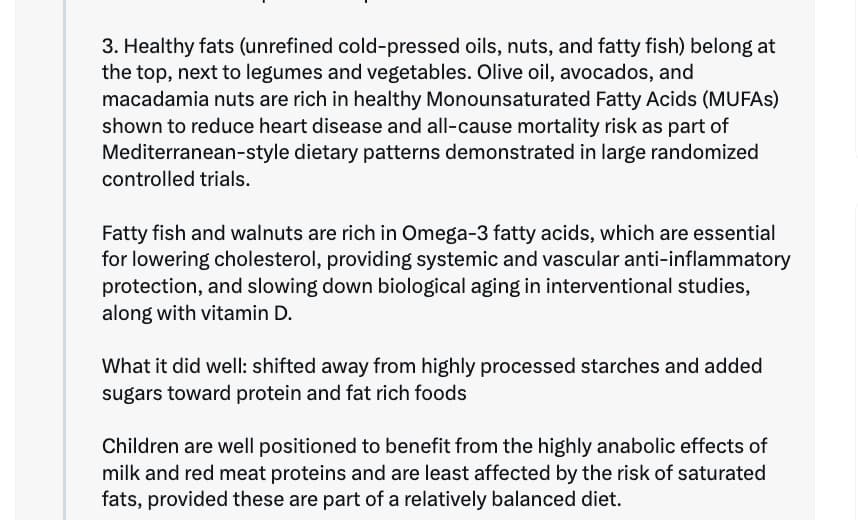
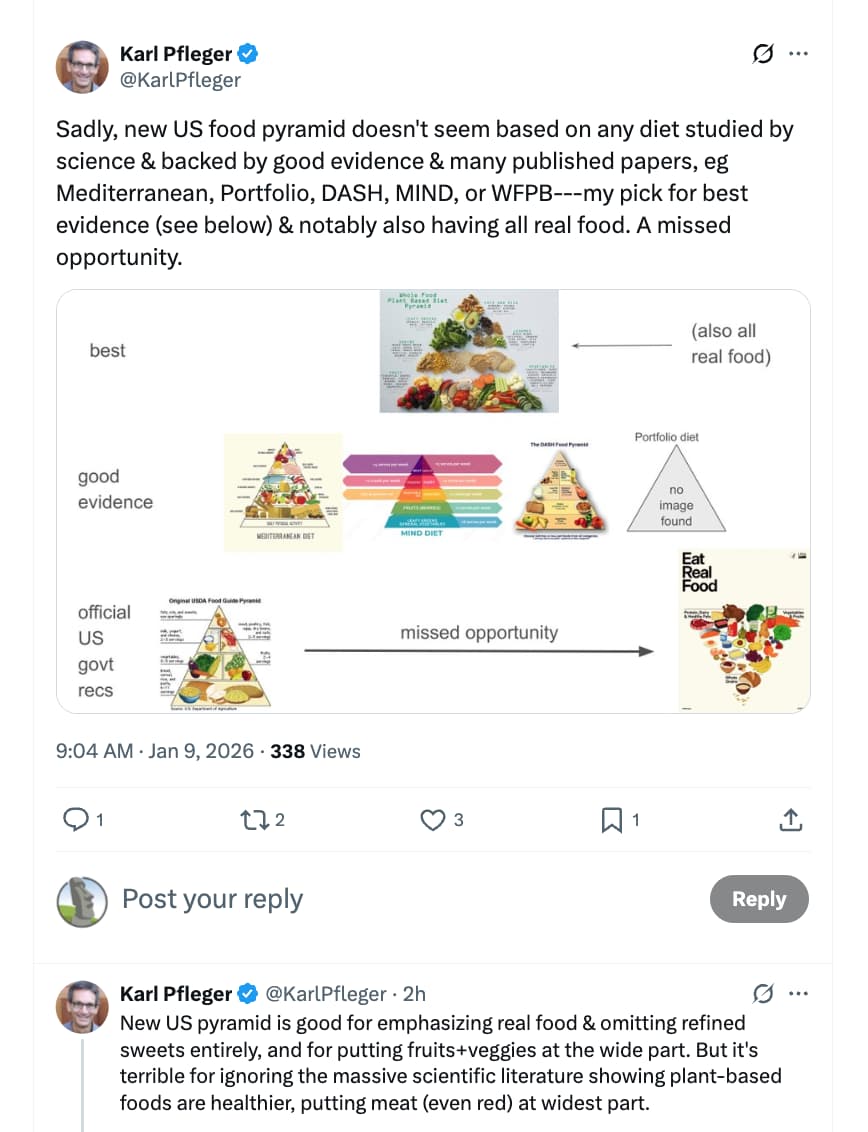
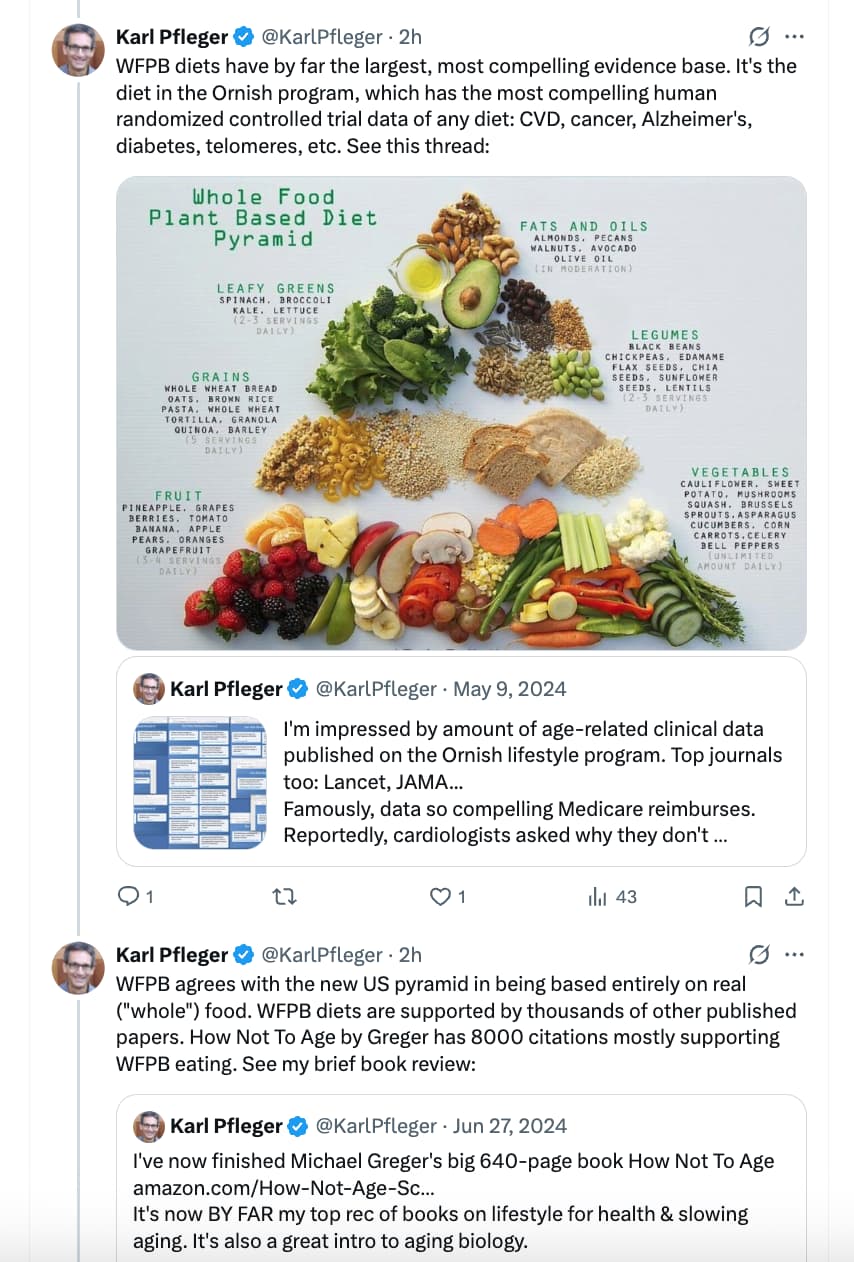
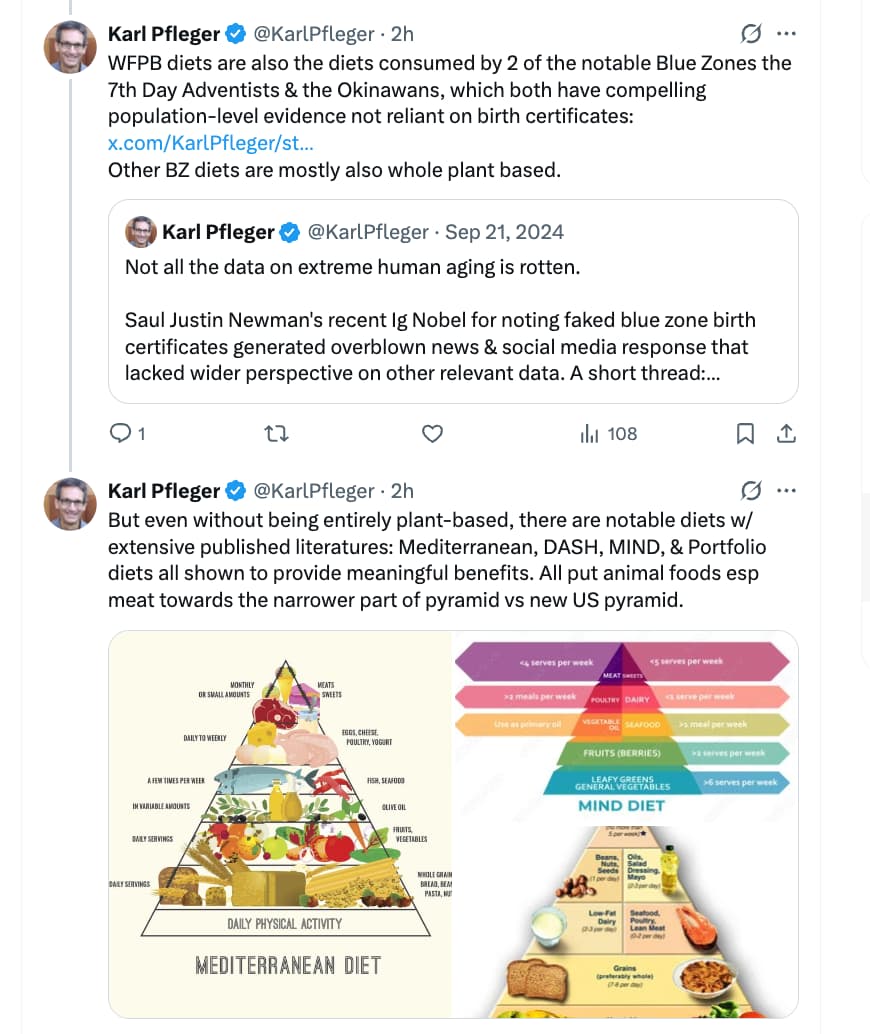
I’ve been reading some of what has been published. In the appendices you can see the study for every decision, and the inconsistent outcomes and reasoning.
It’s dumb to equate extra virgin olive oil with butter. Calling it a healthy fat is not true.
I’ve been reading some of what has been published. In the appendices you can see the study for every decision, and the inconsistent outcomes and reasoning.
It’s dumb to equate extra virgin olive oil with butter. Calling it a healthy fat is not true.
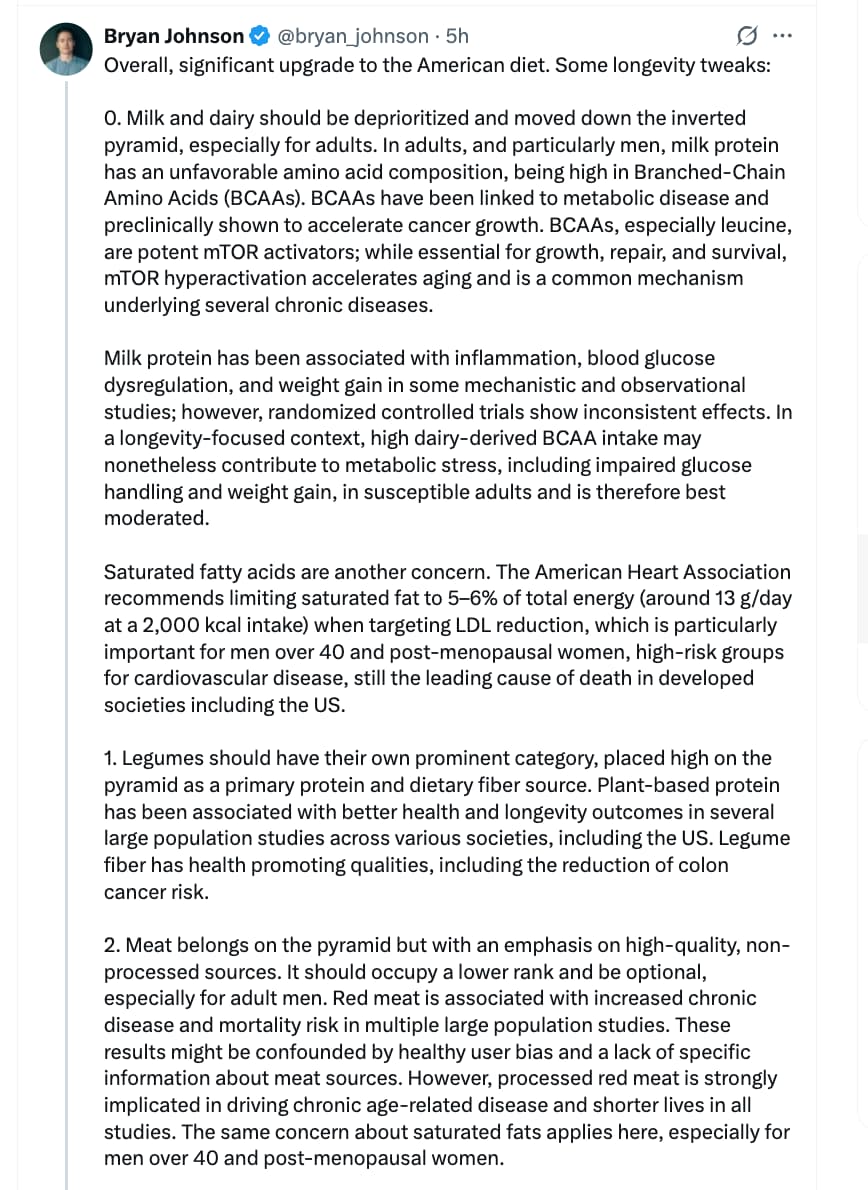
B Johnson (for once) has it 100% correct. He summed it best. This pyramid is a real good one for kids and younger crowd not so good for old and older adults. The rest of them claiming conflict of interest and this and that are all full of something. B. Johnson wins with this unbiased, pragmatic, no bs type of review.
Now that I think of it I really think they should have had one for young people (this one) and another one for people past 30 with Johnson’s noted changes. Maybe they didn’t think of it that way. Perhaps, some well-connected person from these boards should try to relay such recommendation to them
@Kelman I also thought BJ’s summary was excellent … wish he sounded this grounded all the time.
In thinking out loud, the only issue I can see with an age based recommendation is we form habits on what we eat in our youth and then it becomes hard to change. Curing cancer would have been easier than getting me off chocolate PopTarts!
When it comes to the massive federal government, you gotta take your wins. This may only be one battle but changing the pyramid is a good start for the public at large.
Not as horrible as I thought. Is it perfect? Definitely not. But, IMO, if people actually ate like this, we’d probably be better off than we are now. I think characterising this as “encouraging people to add more red meat” is a bit misleading. End of the day, I guess we would rather have people eating steak and drinking milk than eating poptarts/hotdogs and drinking coke.
That Nick guy sounds dramatic. “Millions of people could die” lol
That’s what would happen if you increased population serum lipoprotein levels for long by decreasing PUFA, MUFA, and increasing saturated fat.
I looked closely and did not see a single mushroom. Mushrooms are important for health and longevity.
You have to replace sugar with fat. Low carb works for many people. The diet looks generally good to me.
My sister in law went all in on the Atkins diet decades ago, she’s doing great. Her daughter ( as some do ) went the other way and is all vegetarian. She’s also healthy as near as I can tell. Don’t get too excited folks, it doesn’t matter that much. Think how many people you would have to carefully watch for their lifetimes to make a significant conclusion. This one you can make it up as you go.
Sorry, I can’t agree. From a population basis, diet and exercise are the 2 most important pillars.
There are plenty of N=1 doing great on low carb diets but the vast majority eat terrible fat and protein sources. And doing great is something you don’t really know until they die. And the fact is people die younger when they eat red meat in quantity.
Now, someone here who eats grass fed filet once a week and has an apoB less than 50 isn’t representative of the population at large.
I suppose millions of people die every year so the number is somewhat meaningless. Beef is quantity limited in the US because the herd is down. So it isn’t like things are going to change much in that regard.
What is good news from my perspective is that the most significant practical result of the pyramid is school lunches and as stated above, this isn’t bad for kids.
I suppose everyone is different but I eat nothing like I did as a kid - exactly zero habits carried through my education. I used to drink diet coke and snack on frosted mini wheats. Never much cared for pop tarts. My mother hated beans so I had none and now I eat at least a serving a day.
That being said, I now have to pack my 15yo son’s lunch because school food is so disgusting to him. He may like some basic junk food but he’ll eat blueberries, avocado and eggs for breakfast.
I agree with some people who have said it’s an improvement over the last one but obviously not perfect. It appears a lot of social media brainwashing shaped some of the beliefs behind it but what else is new. At least they didn’t recommend keto or carnivore.
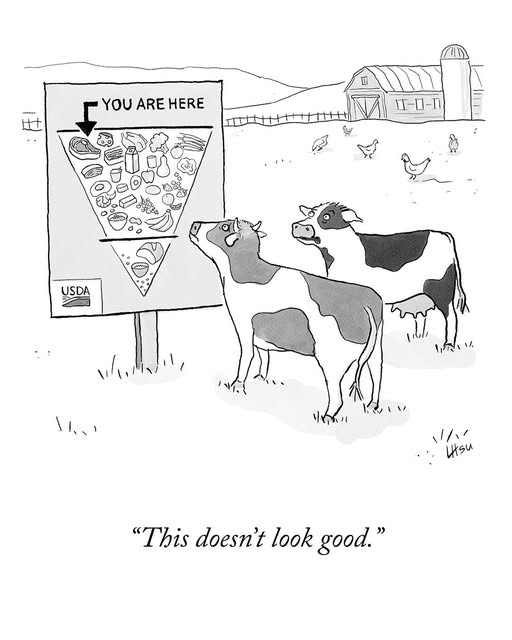
New federal guidelines, which emphasize protein, meat and milk, were informed by a panel of experts with several ties to the meat and dairy industries.
Soon after Robert F. Kennedy Jr. was sworn in as the nation’s health secretary, he promised to overhaul the federal nutrition guidelines. A key step, he said, would be to “toss out the people who were writing the guidelines with conflicts of interest.”
His own panel, he said, would “have no conflicts of interest.” But the new guidelines, which were released Wednesday and emphasize protein, meat, cheese and milk, were informed by a panel of experts with several ties to the meat and dairy industries.
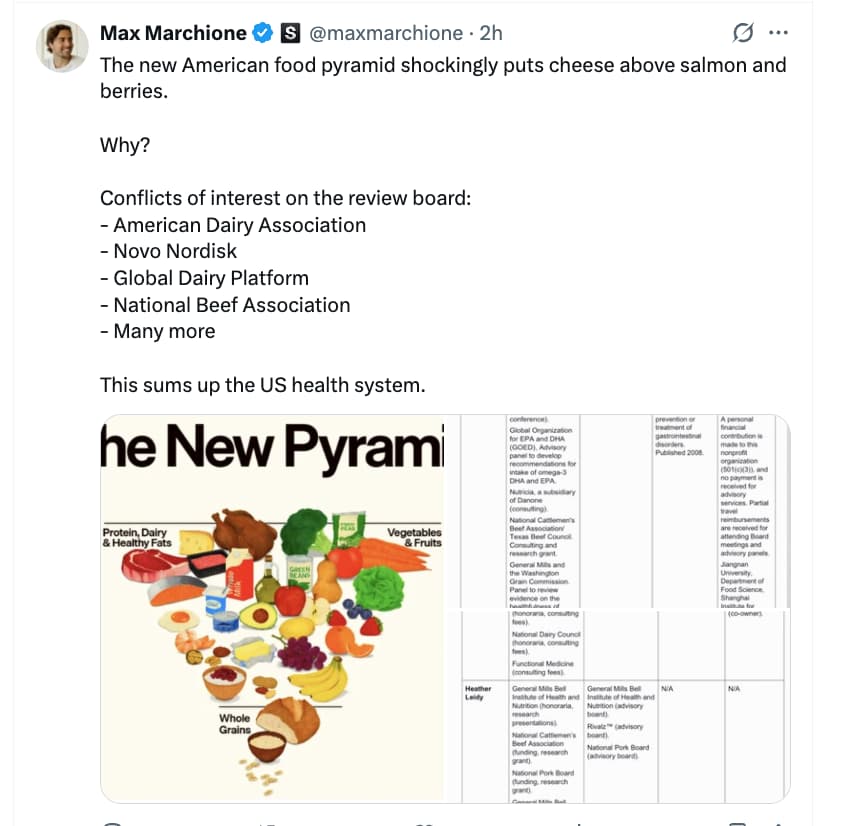
Three of the nine members have received grants or done consulting work for the National Cattlemen’s Beef Association; one of those also received a research grant from and serves as an adviser to the National Pork Board. At least three members — including two of the same ones who have done work for red meat groups — have financial ties to dairy industry organizations, such as the National Dairy Council. Another is a co-creator of a high-protein meal replacement product. The experts did not write the guidelines, but produced reviews of scientific evidence on which the guidelines were based.
Such conflicts have been a problem “for a very long time,” said Marion Nestle, an emeritus professor of nutrition, food studies and public health at New York University, who was on the guidelines committee in 1995. Mr. Kennedy and his allies were right to criticize previous versions for being influenced by industry, she said, but their actions since then have been hypocritical.
“They’ve just done the same thing,” Dr. Nestle said, adding of Mr. Kennedy, “If he views the members of previous committees as being sold out to industries, it’s very difficult to understand why the same designation doesn’t apply to these people, except that these people are associated with the meat and dairy industries, and they like that.”
Andrew Nixon, a spokesman for the health department, said the guidelines were based on “rigorous scientific review and independent oversight” and that it was “absurd to suggest that anything other than gold standard science guided our work on this presidential priority.”
Unlike in previous editions, the experts’ ties were clearly enumerated in a scientific report that accompanied the new guidelines, and Dr. Nestle commended the authors for that. Some experts also praised the guidelines for being far tougher on the processed food industry than previous editions were.
“This is the first dietary guidelines I’ve seen in my lifetime that really throws the gauntlet down to industry,” said Dr. Dariush Mozaffarian, a cardiologist and the director of the Food Is Medicine Institute at Tufts University.
But other experts said the guidelines appeared to benefit different industries. And organizations including the Center for Science in the Public Interest and the American Society for Nutritioncriticized the lack of transparency during the process of developing the guidelines, saying it compromised public trust in the document.
Disclosing conflicts of interest at the end of the process “isn’t really going to cut it,” said Mark Kennedy, the senior vice president of legal affairs for the Physicians Committee for Responsible Medicine, which supports plant-based diets and has filed a complaint with the government saying it should withdraw the guidelines. “Because if nobody ever had a chance to weigh in, and nobody other than the government behind closed doors had a way to assess it, there’s no way to ensure there’s fair balance.” (Mr. Kennedy is not related to the health secretary.)
In late 2024, the Biden administration released detailed recommendations for new guidelines, developed through a two-year process with public meetings and opportunities for public comment. But when the Trump administration came in, it questioned those recommendations and sought advice from other experts through a quicker and less transparent process, which did not include the standard opportunities for public comment ahead of the guidelines’ release.
It also did not follow standard procedures for reviewing evidence in a transparent and systematic way. And it didn’t appear to have safeguards to ensure that no one person had outsize influence over a given portion of the guidelines, one way to minimize the impact of conflicts of interest.
Some parts of the guidelines represent such a departure from previous versions that it seems like the administration “handpicked” scientists likely to support those conclusions, “versus undertaking a neutral review of the science,” said Lindsey Smith Taillie, a professor of nutrition at the U.N.C. Gillings School of Global Public Health.
Most of the panel members who disclosed financial ties did not respond to requests for comment. But one of them, Donald K. Layman, described the Physicians Committee’s complaint as “a lazy way to discredit a report when they’re not intelligent enough to read the science.”
Dr. Layman, a professor emeritus of food science and human nutrition at the University of Illinois Urbana-Champaign, was one of two scientists who summarized protein evidence for the government; he has received honorariums and consulting fees from the National Cattlemen’s Beef Association and the National Dairy Council. He said the dairy work was “at least 10 years ago,” but he has an ongoing contract reviewing grants for the beef association for an hourly rate that he estimated added up to about $5,000 a year.
Dr. Layman said that the health department contacted him and the other protein expert — Heather Leidy, an associate professor at the University of Texas at Austin — because it had already determined that reassessing protein recommendations was a priority.
“The reason they reached out is because of my research — I mean, I’m known for publishing the higher-protein, lower-carb diets,” he said. “My research literally mirrors the new dietary guidelines. They knew who I was.”
He and Dr. Leidy did not set priorities or write the guidelines, Dr. Layman emphasized; rather, they submitted a review of scientific evidence to the government. But the protein guidelines “came out very close” to the conclusions of his and Dr. Leidy’s evidence report, which he said had been peer-reviewed after they submitted it. (Dr. Leidy, who reported having received research grants from the National Cattlemen’s Beef Association and the National Pork Board, did not respond to a request for comment.)
On Thursday, even as critics were pointing out the financial relationships involved in his own report, Mr. Kennedy denounced the American Heart Association — which praised parts of the guidelines and criticized others — for urging Americans to minimize foods like red meat and butter that are high in saturated fats.
The association’s advice was untrustworthy, he suggested, because it received funding from industry groups.
I tend to agree that beef is not a health food. Also it is not affordable at this time. They have spent many years thinning the herd, I think for other reasons. Also there is a sugar molecule called Neu5Gc that is particularly heavy in beef that causes chronic inflammation. I don’t eat it much, but don’t turn it down either. For my meat I eat deer almost exclusively. We grind it with beef fat to make it taste good. Fat doesn’t have much Neu5Gc. Deer fat is inedible.
I think they should replace the steak with a mushroom. We’re all different with the food and drugs, you have to keep trying things and see what works. Remember the waterfall plots.
Post one well controlled study that demonstrates red meat has any negative health benefits. Not observational, not epidemiological, etc. What do you think our species ate that led sapiens to develop bigger brains and out survived all other homos species. Including plant eaters. Also, go back to pre 1970s and meat, eggs, etc. consumption was prioritized and little heart disease and diabetes. It was the advent of grains in out diet along with seed oils that triggered and an obesity and diabetes epidemic