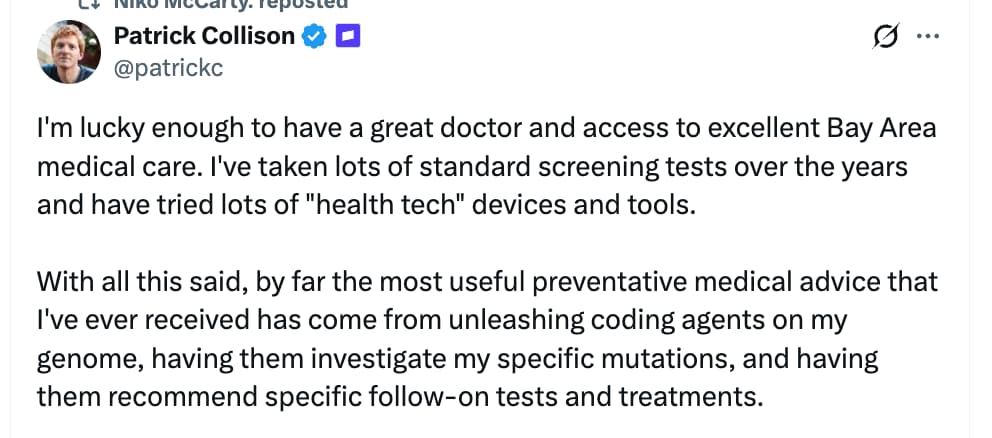
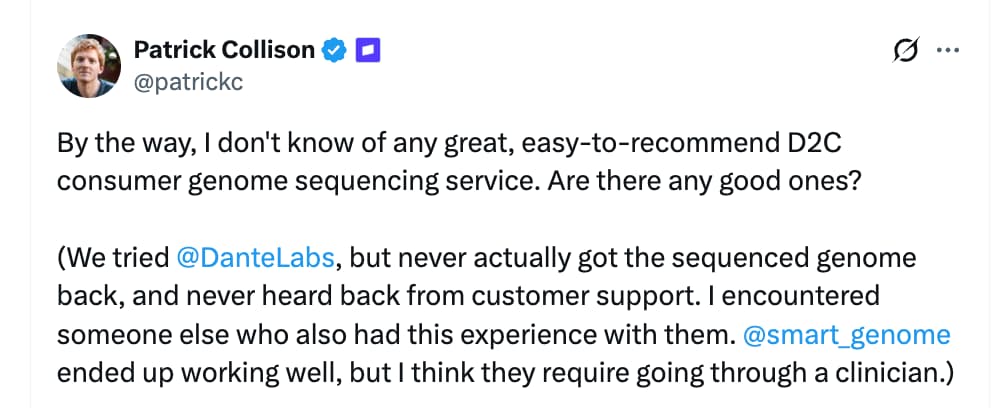
I’m lucky enough to have a great doctor and access to excellent Bay Area medical care. I’ve taken lots of standard screening tests over the years and have tried lots of “health tech” devices and tools.
With all this said, by far the most useful preventative medical advice that I’ve ever received has come from unleashing coding agents on my genome, having them investigate my specific mutations, and having them recommend specific follow-on tests and treatments.
Population averages are population averages, but we ourselves are not averages. For example, it turns out that I probably have a 30x(!) higher-than-average predisposition to melanoma. Fortunately, there are both specific supplements that help counteract the particular mutations I have, and of course I can significantly dial up my screening frequency. So, this is very useful to know.
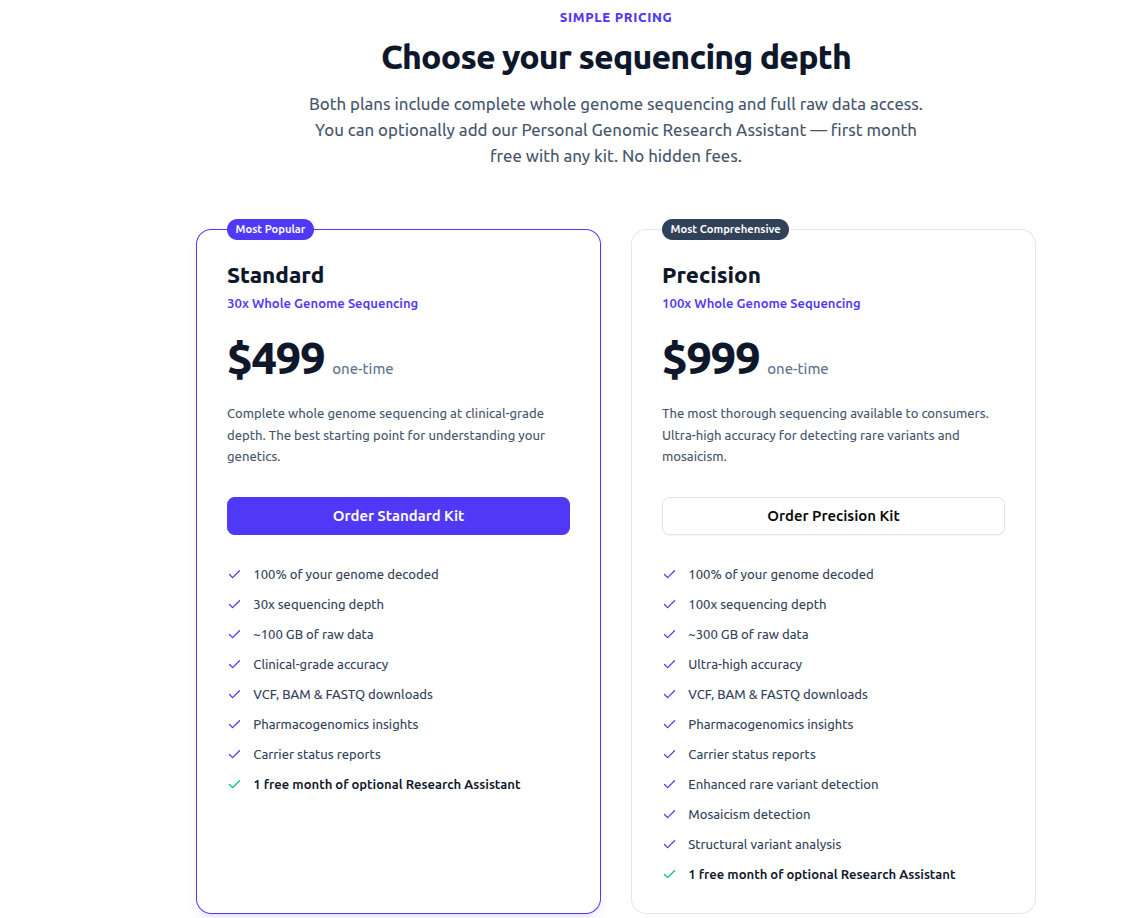
I don’t know exactly how much the analysis cost, but probably less than $100. Sequencing my genome cost a few hundred dollars.
(One often sees papers and articles claiming that models aren’t very good at medical reasoning. These analyses are usually based on employing several-year-old models, which is a kind of ludicrous malpractice. It is true that you still have to carefully monitor the agents’ reasoning, and they do on occasion jump to conclusions or skip steps, requiring some nudging and re-steering. But, overall, they are almost literally infinitely better for this kind of work than what one can otherwise obtain today.)
There are still lots of questions about how this will diffuse and get adopted, but it seems very clear that medical practice is about to improve enormously. Exciting times!
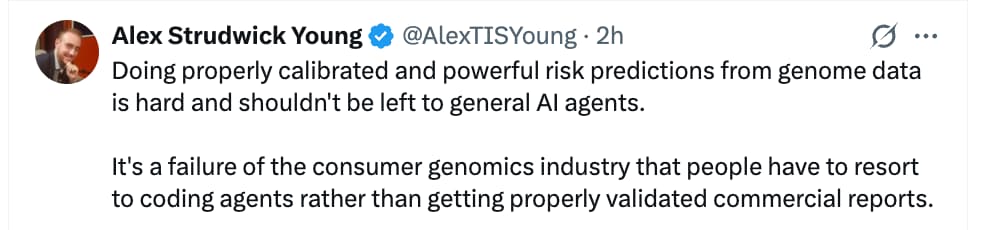
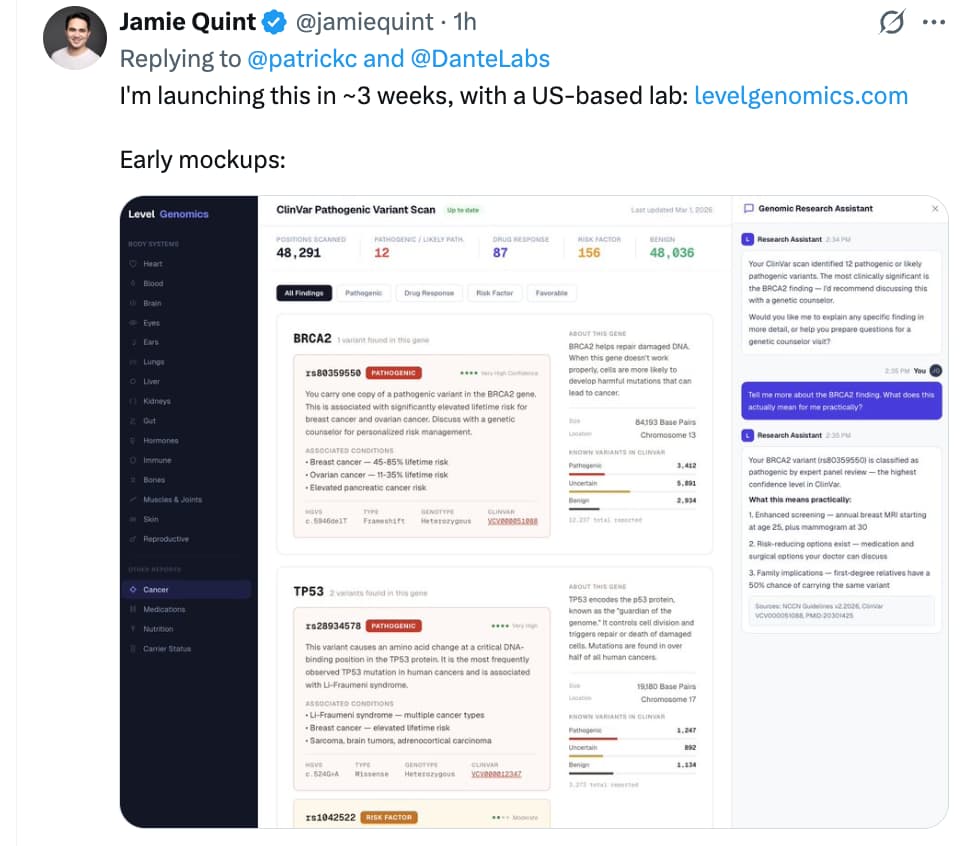
Just as soon as the consumer genomics industry is willing and able to provide us regular human beings with validated commercial reports at a reasonable price, I’m sure we’ll stop using AI instead.
I’m not saying it’s not worth it. Maybe it is. I’m saying, this is a whole lot more expensive than a year’s worth of Claude-pro and that doesn’t include the interactive AI, which is an add-on. (About $100/year). Maybe it’s worth it, but it’s not cheap.
I’ve paid $400 to sequencing.com for my full genome sequencing, which I expect will take a few months to complete before I can access my data file. While waiting, I’m teaching myself genomic analysis basics with Claude’s help to avoid paying subscription fees for report generation. I think that that with some effort, I can ensure my reports use the highest quality and most recent population studies (GWAS datasets). My limited background in R coding, combined with Claude’s assistance, I hope will give me the skills needed to update my reports as new population studies become available. My plan is to first obtain my percentile rankings and then use AI to focus on lifestyle interventions that address my highest risk areas.
Claude Pro will end up charging you twice this much in “extra usage” fees to do this level of analysis. I run out of usage every day by 10 AM doing straightforward code experiments; and that requires much less compute than what’s needed to both analyze the genome and apply every known bit of research on genomic mutations and anomalies. I just upgrade to Claude Max and I’m waiting to see how quickly that too runs out.
I put significant time into studying how to use Claude Pro cost-effectively. I used to run out on weekly and daily usage meter, but now I don’t. I don’t go over or pay extra usage fees.
In short: I use a sonnet instance to do most of the work and only use opus for the harder questions. I keep all my information in log and reference files which I frequently upload to new instances so that I don’t incur the longer conversation usage costs.
I pretty much never use Opus. So I don’t know what you’re doing with Claude, but I promise you if you start trying to analyze your genome you will run out of usage fast.
When I do the deep dives in genetic pathways, it uses a lot of Claude Opus tokens and I could not even finish one with a Claude Pro subscription so I had to switch to a Claude Max one for that.
@cl-user and @cl-user , would be very grateful if you were to share the type of data and the data file types you are providing Claude. I am considering providing it PRS scores along with the GWAS summary data that allowed me to calculate the PRS in a CVS format. Would love to hear others views.
Generally speaking, lower-priced products come with lower sequencing depth, resulting in many loci that cannot be detected or measured accurately. Personally, I highly recommend third-generation whole-genome sequencing. Currently, humans have about 20,000 protein-coding genes, but the number of actionable pathogenic variant genes defined by the American College of Medical Genetics seems to be just over 80, accounting for 0.4%. There is still a lot I’d like to say—I’m just not sure if the forum needs such content. Maybe I can write something specifically on this topic another day.
I used 23&Me raw data, uploaded to Promethease and also to the engine that Rhoda Patrick offered. Promethease gives you a data base that you can sort and filter. The RP report is static but provides some additional insights. Between the two of them I learned enough to know what my biggest risks are, and that’s plenty for me to focus on. Not sure what the marginal utility would be for having even more information. Argue with me!
You’re very lucky—they just upgraded their sequencing technology at the end of March this year. BTW, just a complaint: a technology that has long been widely used in many labs is still迟迟 not being rolled out to consumers.