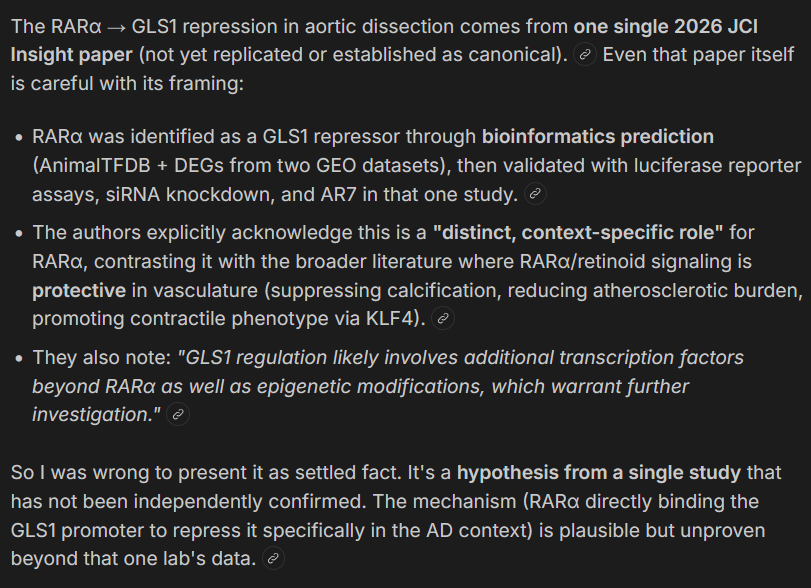
“next version is going to drop GHK-Cu, as well as NMN is missing, but it maybe get replaced, something about TMG protects from 4PY (N1-methyl-4-pyridone-3-carboxamide); not sure…”
At the moment, I will keep GHK-Cu with the peptide mixture, but I will drop NMNH for a little while. As well, NMNH might be working differently than NMN, which has different properties than NR. They all seem to converge, but still have some idiosyncrasies that need to be addressed.
I have not added Dehydrocorydaline yet. I will check on the sourcing. I would rather isolate than eating some strange herb.
The changes are made for safety’s sake. None of this has serious RCTs, there is no medical claim here. I am using this protocol, but never used a senolytic nor ATRA. Everything else I’ve used.
IASO AEGIS PROTOCOL v18.0 — THE DAILY STACK (ACTIVE)
MORNING (10:00 AM) — Peptides (Sub-Q)
- Pre-Mixed Sub-Q Blend (Custom/Research): GHK-Cu (2.5 mg) + KPV (0.5 mg) + MT-1 (0.5 mg) — Schedule: Mon–Fri (5/2)
- Retatrutide (Custom/Research): 2.0 mg — Schedule: Mon / Thu
MORNING (10:00 AM) — Daily Oral Support
- Olmesartan (Prescription): 10 mg (20 mg split daily)
- Grape Seed Extract EXTRA STRENGTH (Natural Factors): 400 mg (100:1 concentration)
- 5-Loxin AKBA (Vitacost-Synergy): 150 mg (1 Cap)
- BioCoenzymated Active B Complex (Natural Factors): 1 Cap
- Taurine (Organika): 1,000 mg
- Vitamin C (Jamieson): 250 mg
- Magnesium Bis-Glycinate (CanPrev): 200 mg
MORNING (10:00 AM) — Contractile Phenotype & Phenolic Stagger
- Dehydrocorydaline (DHC Isolate): [Dose TBD] — Schedule: Mon–Fri (5/2)
- Doctor’s Best Curcumin Phytosome: 500 mg — Schedule: Daily
- Berberine (PlantVital): 500 mg — Schedule: Mon–Fri AM
- Quercetin Pulse (Nutrawave): 1,200 mg — Schedule: Tue / Wed / Thu ONLY (Take min 3 hours after peptide injection)
MIDDAY (2:00 PM) — Mitochondrial/Repair
- PQQ (California Gold Nutrition): 20 mg — Schedule: Daily
- L-Ergothioneine (Toniiq): 30 mg — Schedule: Daily
- TMG (Just Glow): 500 mg — Schedule: Daily
- NAC (Natural Factors): 600 mg — Schedule: Mon/Wed/Fri
- Zinc Picolinate 3-in-1 (Herba): 1 Cap (Zn 25mg / Cu 2mg / Se 200mcg) — Schedule: Daily
- Vitamin D3 + K2 (Nutritionn): 5k IU / 240 mcg (2 Caps) — Schedule: Daily
- TUDCA (Generic): 500 mg — Schedule: Daily
- Dill-Berry Extract (Custom): 500 mL — Schedule: Daily
- Manganese Chelate: 8 mg — Schedule: SUNDAY ONLY
EVENING MEAL (With Dinner / Fats) — 5-LOX & Anti-Glycation Window
- Alpha Lipoic Acid (California Gold Nutrition): 600 mg
- 5-Loxin AKBA (Vitacost-Synergy): 150 mg (1 Cap)
- Berberine (PlantVital): 500 mg — Schedule: Mon–Fri PM
BEDTIME (10:00 PM) — The Shield Engine (Daily)
- Olmesartan (Prescription): 10 mg (Split)
- Rosuvastatin (Prescription): 10 mg
- Honokiol (Econugenics, HonoPure): 250 mg — Schedule: 5 days ON / 2 days OFF
- EGCG (EBYSU): 500 mg — Schedule: Mon–Fri EVENING (5/2)
- Glycine: 5g
- CoQ10 (Ubiquinol): 100 mg
- Taurine (Organika): 1,000 mg
- Vitamin C (Jamieson): 250 mg
- Magnesium Bis-Glycinate (CanPrev): 200 mg
SECTION TWO: PHASE ARCHITECTURE (Mitochondrial & Telomerase Reset)
Since you are removing the Senolytic and ATRA phases, we can optimize the sequential 14-week mitochondrial enhancement framework. The logic here is strict: you must seal the mitochondrial membrane (SS-31) before you stimulate biogenesis and telomerase extension (MOTS-c + Epitalon).
Phase 1: Stabilization & ROS Reduction (Weeks 1–6)
-
Primary Action: Bind cardiolipin, stabilize the electron transport chain (ETC) supercomplex, and reduce mitochondrial swelling and ROS leakage.
-
SS-31 (Elamipretide): 5.0 mg Sub-Q — Schedule: Monday through Friday (2-day rest is required to prevent receptor downregulation).
-
Note: No MOTS-c or Epitalon during this phase.
Phase 2: Biogenesis & Telomerase Extension (Weeks 7–12)
-
Primary Action: Now that the ETC is stable, use AMPK activation to drive the creation of new, healthy mitochondria to meet the high ATP demands of vascular smooth muscle cell (VSMC) matrix repair and telomere lengthening.
-
MOTS-c: 5.0 mg Sub-Q — Schedule: Tuesday and Friday ONLY (Bedtime dosing).
-
Epitalon (Khavinson Protocol): 1.0 mg Sub-Q — Schedule: Daily for the first 10 days of Week 7 ONLY. This directly upregulates TERT for telomere extension in the vascular progenitor pool, fueled by the MOTS-c metabolic floor.
Phase 3: Maintenance & Consolidation (Week 13 onward)
-
Primary Action: Return to the baseline daily stack to allow the extracellular matrix (ECM) cross-linking and structural remodeling to mature.
-
MOTS-c: Optional ongoing maintenance at 5.0 mg (Tue/Fri) if metabolic markers (like fasting insulin) require it.
-
SS-31 / Epitalon: Discontinued until the next 6-month cycle.
APPENDIX: Protocol Rationale & Adjustments
-
Curcumin Phytosome (Doctor’s Best): Curcumin is retained primarily for its interaction with the PPAR-γ axis and its suppression of NF-κB and MMP-9. Because its effects are directed at blunting enzymatic degradation of the aortic wall (reducing Ang II-induced inflammation), it will not produce an acute, perceptible physical sensation.
-
Manganese Accumulation: Consolidating Manganese to a single 8mg Sunday dose is a structurally sound method to provide the necessary co-factors for LOX enzymes while safely minimizing the risk of heavy metal plasma accumulation.
-
Senolytic & ATRA Phase Removal: The Senolytic phase (D+Q / Fisetin) and the ATRA Phase have been successfully decoupled from the architecture. This aligns with avoiding forced VSMC apoptosis and sidestepping the severe hepatic/CYP26A1 autoregulation and plasma half-life decay caused by ATRA.