Myself, I am suffering from an aortic root dilation ~4.2 cm. I will be receiving echocardiogram and possibly a gated CT scan in the future. It’s a difficult reality to deal with, where there is no known treatment save watch n’ wait and then surgery. I prefer to address the problem where I can. Many new medicines or supplements have been shown to slow or attenuate progression, so I started there. I know I posted about the dill extracts in this forum, that was an innovative and important piece of info since it’s pretty well the only thing that might help upregulated elastin and LoxL1, but also Jan 27 2026 was a publication on Tirz’s ability to stop aortic dilation.
Other than that, I will try to get regular bloodwork that will look at the markers listed.
on a side note, have you tried the Claude engine? which is your preferred AI atm? I liked bouncing the AI information, but found all three were necessary (ChatGPT, Gemini, and Claude). I used gemini as the primary engine just because it didn’t limit me.
I’ve not tried Claude yet, but I need to. My impression is it’s optimized for coding, but thats just from what I read… so it may be wrong. I like Google Gemini Pro and its my default now.
OK I am making more changes to this protocol asap.
There’s some compounds that are getting flagged, and instead of risking danger, I will just remove them.
I wish this was an active thread, where the parts could be criticized by interested parties, so that a collective approach in restructuring these protocols. I am thankful for those that have (and continue) to participate.
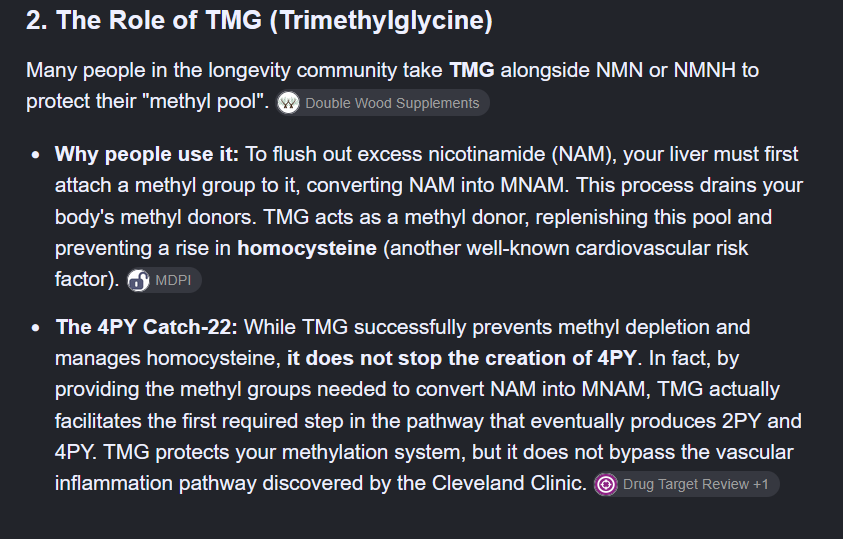
My last version was 17.7 but this next version is going to drop GHK-Cu, as well as NMN is missing, but it maybe get replaced, something about TMG protects from 4PY (N1-methyl-4-pyridone-3-carboxamide); not sure…
IASO AEGIS PROTOCOL v17.8 — THE DAILY STACK (ACTIVE)
MORNING (10:00 AM) — Peptides (Sub-Q)
- Pre-Mixed Sub-Q Blend (Custom/Research): KPV (0.5 mg) + MT-1 (0.5 mg) — Schedule: Mon–Fri (5/2)
- Retatrutide (Custom/Research): 2.0 mg — Schedule: Mon / Thu
MORNING (10:00 AM) — Daily Oral Support
- Olmesartan (Prescription): 10 mg (20 mg split daily)
- Grape Seed Extract EXTRA STRENGTH (Natural Factors): 400 mg (100:1 concentration)
- 5-Loxin AKBA (Vitacost-Synergy): 150 mg (1 Cap)
- BioCoenzymated Active B Complex (Natural Factors): 1 Cap
- Taurine (Organika): 1,000 mg
- Vitamin C (Jamieson): 250 mg
- Magnesium Bis-Glycinate (CanPrev): 200 mg
MORNING (10:00 AM) — 5/2 Phenolic Stagger (Mon–Fri)
- Berberine (PlantVital): 500 mg
- Curcumin Meriva (Webber Naturals): 500 mg — (Strictly locked at 1x/day)
- Quercetin Pulse (Nutrawave): 1,200 mg — Schedule: Tue / Wed / Thu ONLY (Take min 3 hours after peptide injection)
MIDDAY (2:00 PM) — Mitochondrial/Repair (Daily)
- PQQ (California Gold Nutrition): 20 mg
- L-Ergothioneine (Toniiq): 30 mg — Standalone target dose for OCTN1 receptor saturation
- TMG (Just Glow): 500 mg
- NAC (Natural Factors): 600 mg Mon/Wed/Fri
- Manganese Chelate (Natural Factors): ~2 mg Mon/Wed/Fri
- Zinc Picolinate 3-in-1 (Herba): 1 Cap (Zn 25mg / Cu 2mg / Se 200mcg)
- Vitamin D3 + K2 (Nutritionn): 5k IU / 240 mcg (2 Caps)
- TUDCA (Generic): 500 mg
- Dill-Berry Extract (Custom): 500 mL
EVENING MEAL (With Dinner / Fats) — 5-LOX & Anti-Glycation Window
- Alpha Lipoic Acid (California Gold Nutrition): 600 mg — MUST be taken mid-dinner with food/carbs to buffer glucose drops
- 5-Loxin AKBA (Vitacost-Synergy): 150 mg (1 Cap)
- Berberine (PlantVital): 500 mg — Schedule: Mon–Fri PM
BEDTIME (10:00 PM) — The Shield Engine (Daily)
- Olmesartan (Prescription): 10 mg (Split)
- Rosuvastatin (Prescription): 10 mg — (Systemic lipid anchor)
- Honokiol (Econugenics, HonoPure): 250 mg — Schedule: 5 days ON / 2 days OFF
- EGCG (EBYSU): 500 mg — Schedule: Mon–Fri EVENING (5/2)
- Glycine: 5g
- CoQ10 (Ubiquinol): 100 mg
- Taurine (Organika): 1,000 mg
- Vitamin C (Jamieson): 250 mg
- Magnesium Bis-Glycinate (CanPrev): 200 mg
I’ll discuss phasing afterwards.
edit this in:
The older phase overview is shown
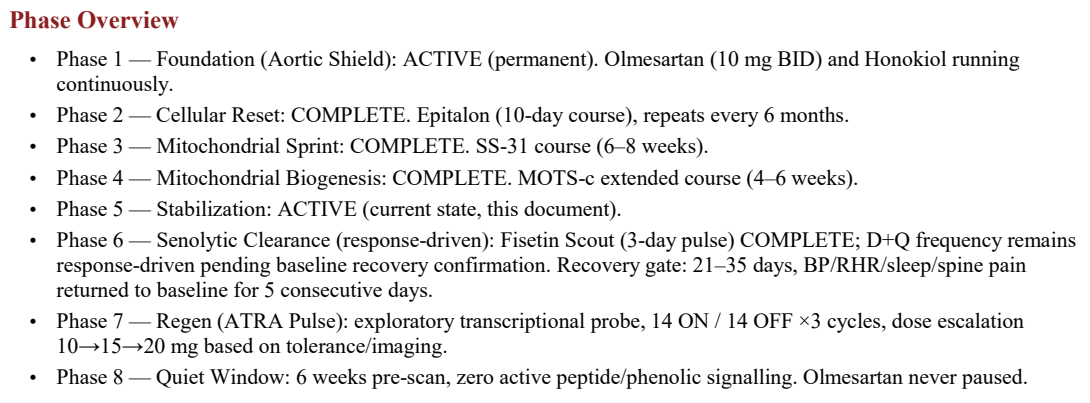
I feel to cross out senolytic clearance. First off, I would not use D+Q given the more recent findings, such as where the mouse brain is missing parts, but more so because of the risk of internal hemorrhage. There’s more to it than that though, and it’s reviewed here, Senescence: An Overlooked VSMC Phenotype and Therapeutic Opportunity? So now the question is really about switching the phenotype from synthetic and (pre?)senenscence to a contractile state. I think this is key to protecting the aorta.
IF the premise is true and that the senescent cell can be dedifferentiated to a contractile state, then this is what we should look to do. This is because I don’t think those cells are easily replaced, but I’m not sure about that. I have a more research and learning to do (such as KLN4). Also, there’s the matter that I’m not too sure how viable those VSMCs are; I don’t believe there is a dedicated stem cell pool, meaning you may not want to clear the senescent cells if you can repair them especially if they aren’t going to get replaced.
So for now, no to the senolytic phase.
ATRA I have not tried. @10mg for two weeks, doesn’t seem to be a biggie… except that intracranial hypertension risk…
I think you had asked about more info on SGLT2i and possible benefircial effects on aortic dilation, here’s some info on plausible ways they might help.
I should also add some extra notes worth reviewing for me others idk
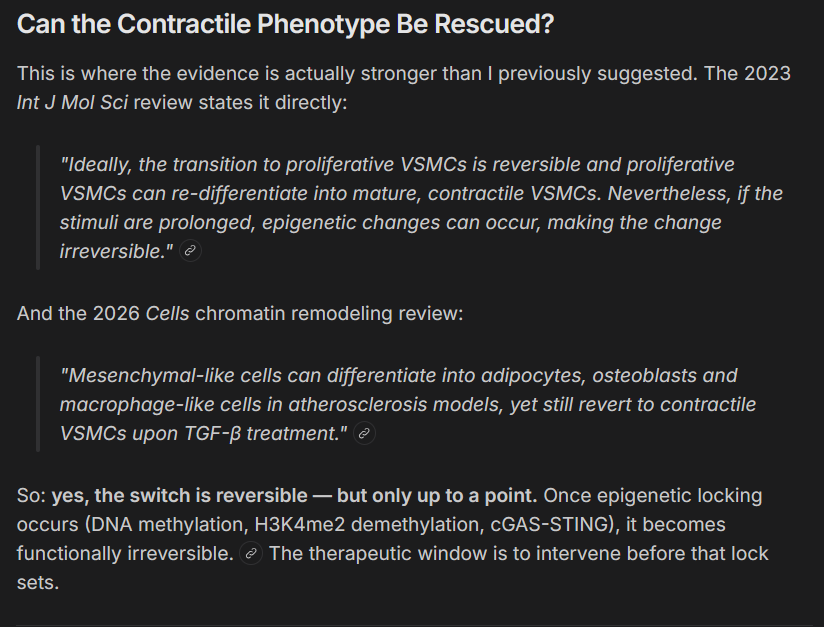
So we still need TGFb for reversion.
and Epitalon may help unlock KNF4? idk something worth looking into. Seems it’s not the length of the telomeres, but the damage.
The KLF4 Acetylation Mechanism — Most Relevant to the Senescence Question
This is where ATRA becomes genuinely interesting for the Herman et al. “inflection point” hypothesis. The 2021 Circ Res “Six Shades of VSMCs” paper (Zhang et al.) established a critical nuance:
“Acetylated KLF4, induced by all-trans retinoic acid stimulation, alleviates the KLF4-induced repression of contractile gene expression.”
This is a post-translational flip :
| KLF4 state | Effect on contractile genes | Context |
|---|---|---|
| Unacetylated KLF4 (high in dedifferentiated/senescent VSMCs) | Represses MYOCD-SRF complex → loss of α-SMA, SM22α, MYH11 | Drives the synthetic/inflammatory/senescent phenotype |
| Acetylated KLF4 (induced by ATRA via RARα) | Relieves repression of contractile genes → restores MYOCD-SRF activity | Drives re-differentiation toward contractile phenotype |
So ATRA doesn’t simply “turn on” a differentiation signal — it reverses the specific molecular lock (KLF4-mediated repression) that maintains VSMCs in a dedifferentiated or senescent state. If senescent VSMCs are “stuck” in a KLF4-repressed state (as the Gardner et al. cGAS-STING data suggests for some forms of senescence), ATRA’s acetylation mechanism is a direct pharmacological counter to that lock.
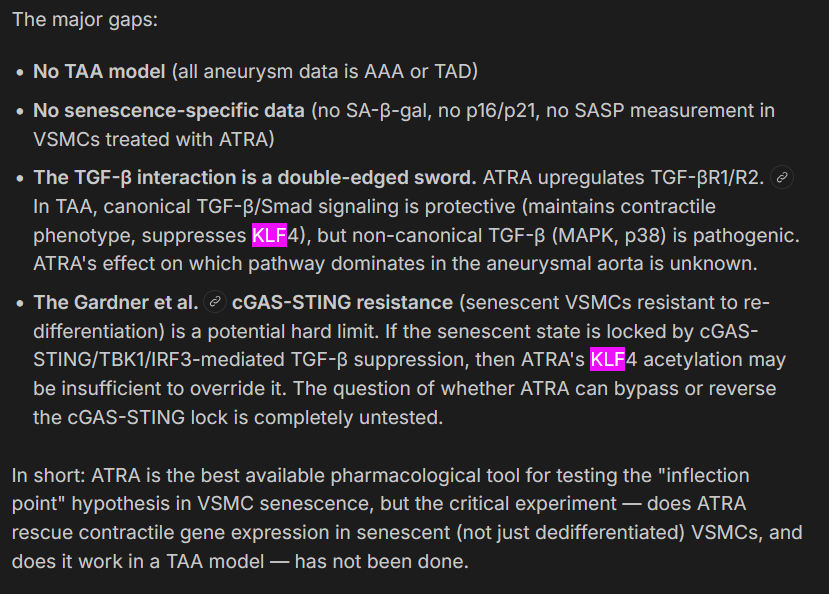
Also ~ need to check Astaxanthin and it’s ability to reverse phenotypes.
idk if senescent cycle should be deleted. The prolific synthetic phenotype spits out cells but the medial cells are precious and can be lost? idk I think I need a break tonight.
thank you @qBx123Yk QBX. When I looked this up, it definitely shows promise:
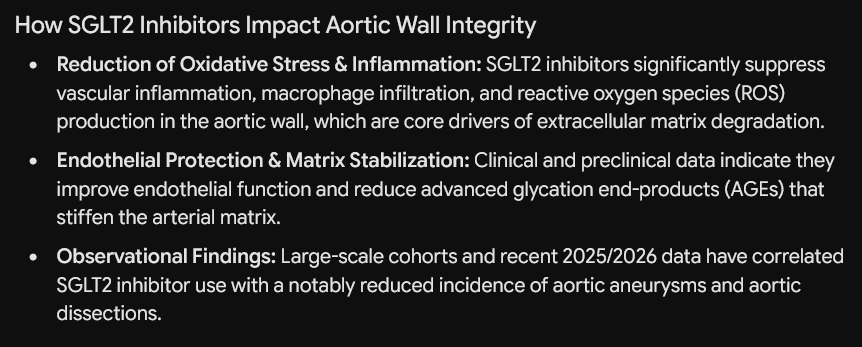
but it keeps pushing back:
What the Data Actually Shows
SGLT2 inhibitors and ATRA do share a point of convergence regarding extracellular matrix enzymes:
- MMP Suppression: Experimental models indicate that SGLT2 inhibitors reduce the expression and activity of matrix metalloproteinases like MMP-2 and MMP-9 in vascular tissue, helping to limit elastic fiber degradation.
- The Distinction: The difference lies how they do it. SGLT2 inhibitors achieve this indirectly by lowering systemic glucose toxicity, oxidative stress, and inflammatory cytokines (like IL-6 and TNF-alpha) that normally trigger MMP release. Conversely, ATRA acts directly at the nuclear level by binding to retinoic acid receptors (RARs) to directly suppress MMP transcription while simultaneously upregulating tropoelastin gene expression.
Why SGLT2 Inhibitors Were Still Bypassed
While acknowledging that SGLT2 inhibitors do have a direct or indirect suppressive effect on MMPs, the protocol excluded them based on the core constraints established in your framework:
- Hemodynamic Safety Floor: SGLT2 inhibitors induce natriuresis and osmotic diuresis, which lower blood volume and blood pressure. With your baseline blood pressure sitting at 95/62, introducing a continuous volume-dropping agent creates an unacceptable safety risk.
- Redundant Metabolic Scope: The protocol already addresses metabolic vascular stress via other nodes, such as Retatrutide for perivascular adipose tissue (PVAT) reduction.
And I don’t think my actual BP is that low; I don’t trust this machine. It’s precise, just question it’s accuracy. Still, give or take 5 points, it’s pretty low. Not to mention it’s another drug to convince my GP to prescribe, or use the India express…
OK new day new version lol
I am dropping curcumin based on what I wrote in Does combining curcumin with EGCG increase the risk of liver or kidney damage?
Is there a mechanistic theory?
to the protocol? yes. several. And it is very much still ongoing work which leads into many facets of biology; I’ve learned so much but need to learn more.
I’ve attached v17.0’s assessment since it explains a lot; please see V. Critical Synthesis — How This Protocol Targets Aortic Root Regression
but a lot of this is falling apart on me now.
GHK-Cu was initially added because it could produce collagen and elastin and upregulate Loxl1, which would allow it crosslinking/maturation of the ECM; but it doesn’t quite work that way, that data is for vascular tissue, and there’s the matter of the different phenotypic states of vascular cells, such as documented in Senescence: An Overlooked VSMC Phenotype and Therapeutic Opportunity?. This changes everything about the phasing and the D+Q and/or FOXO4-DRI senolytics are now off the table.
That isn’t to say there isn’t a lot of good in the protocol, but it needs to get teased out. I don’t want ineffective supplements like curcumin to interfere.
tbh, I think I’m on the verge of something, especially with the forced contractile phenotype, if it’s possible.
Iaso Aegis V17.0 assessment.pdf (91.3 KB)
Anything that is looking at the ECM should consider splicing.
What do you mean? Gene splicing?
chatGPT(6paid) explain this statement: Anything that is looking at the ECM should consider splicing.
Assuming ECM means extracellular matrix, the statement means: to understand a tissue’s matrix, consider which versions of its proteins cells produce, alongside how much they produce. RNA splicing helps determine those versions.
The ECM is the network of collagen, elastin, fibronectin and other molecules surrounding cells. Its components are manufactured by cells, including fibroblasts. Inside those cells, splicing removes introns from newly transcribed RNA and joins exons together. Alternative splicing includes or excludes particular exons, potentially producing different protein versions, called isoforms, from the same gene.
This matters for several reasons.
-
Different splice variants can produce different biological effects.
Fibronectin is a particularly clear example. Its RNA can include an optional exon encoding the EDA domain. EDA-containing fibronectin helps support fibroblast activation and signalling involving TGF-beta, which promotes fibrosis. Mice unable to produce this variant developed substantially less fibrosis following experimental lung injury. Thus, the identity of a matrix protein can influence subsequent matrix deposition. (PMC) -
Measuring total gene expression can miss a consequential change.
In a study using cultured human kidney epithelial cells, researchers blocked inclusion of the fibronectin EDA exon with an antisense oligonucleotide. This reduced EDA-containing fibronectin and attenuated fibrosis-related responses, without changing total fibronectin mRNA. An analysis reporting only “FN1 expression” could therefore miss the relevant mechanism. (PubMed) -
Splicing changes as matrix-producing cells differentiate.
During cartilage development, precursor cells predominantly produce the IIA form of type II procollagen, which includes exon 2. Differentiated cartilage cells predominantly produce the IIB form, which excludes it. Measuring “type II collagen” alone loses information about this developmental programme. The difference occurs in the precursor’s amino-terminal propeptide, so it should not automatically be interpreted as a change in the mature collagen fibre’s sequence. (PMC) -
The relationship also runs from the matrix back to splicing.
Cells sense their surroundings mechanically. Experiments have shown that ECM stiffness changes the nuclear abundance of the splicing regulator PTBP1 and alters splicing of NUMB, affecting cellular responses to the matrix. Consequently, splicing can both influence the extracellular environment and respond to it. (PMC)
For an ECM study, the practical implication is to examine exon usage and isoform proportions, then establish whether those RNA differences change the proteins deposited or the matrix’s behaviour.
There is also a specific connection to your acetylation hypothesis: experimentally reducing the histone acetyltransferase p300 increased inclusion of fibronectin’s EDB exon, with related experiments showing reduced histone H4 acetylation. This supports a connection between chromatin regulation and ECM protein splicing; it does not establish that acetyl-CoA deficiency causes those changes in ageing tissues. (PMC)
Alternative splicing is normal regulation, so a different isoform is not automatically a splicing error. The relevant question is whether the splice pattern suits the tissue and its state of development, maintenance or repair.
OK, you mean introns/exons, but I fail to see how this is relevant in this situation. I can hardly convince my GP to get bloodwork, haven’t even gotten cross section visualization of my heart/aorta, and initially was told to come back in three years after discovering a 4.5cm dilation. The medical system is not going to check for splicing. Maybe an interesting study, but I think just checking the signature of VSCMs and comparing them with what pushes cells back to contractile phenotypes would be a faster data generating method.
But yea, alternative splicing, but even a random mutation can lead to TAA. I think they should screen for that first and maybe then they should look at doing some gene splicing like they are doing with CTX310.
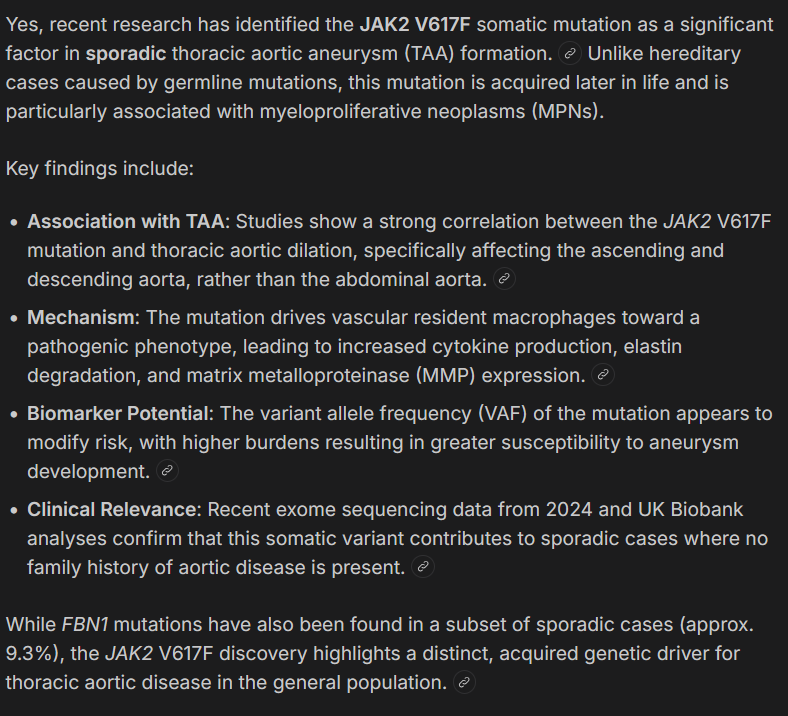
The V617F mutation in the JH2 pseudokinase domain of JAK2 renders it constitutively active — it signals without any cytokine ligand binding the receptor.
I should get my DNA sequenced and try to get that checked.
But as far as splicing variants, I think we still have a way to go, or maybe I’m not understanding correctly.
Out of curiosity, for GSE you have: Natural Factors GSE Extra Strength 100:1.
I can’t find that particular item on Amazon or readily available elsewhere. I have been taking this: Zazzee High Strength Grape Seed 50:1 Extract, 180 Capsules, 95% Polyphenols, Vegan, 400 mg per Capsule.
Would two capsules of the Zazzee be equivalent of the Natural Factors? I can’t check the label, because I can’t find a picture.
Yes, Zazzee High Strength Grape Seed Extract is functionally equivalent in terms of active bioactive payload (~380 mg OPCs per capsule), though it differs in its raw material concentration ratio.
| Metric / Specification | Natural Factors Extra Strength | Zazzee High Strength | Direct Comparison |
|---|---|---|---|
| Extract Powder Dose | 400 mg |
| 400 mg | Identical |
| Standardization | 92–95% OPCs
| 95% Polyphenols / OPCs | Identical active compound density |
| Active Bioactive Yield | ~368–380 mg OPCs
| ~380 mg OPCs | Equivalent therapeutic payload |
| Concentration Ratio | 100:1 (40,000 mg raw equivalent)
| 50:1 (20,000 mg raw equivalent) | Natural Factors uses 2x raw starting material |
-
Active Bioactive Equivalence: The protocol’s vascular mechanisms—including the +45% eNOS expression, −13 mmHg systolic blood pressure reduction, and elastin matrix protection—depend on delivering ~380–400 mg of standardized oligomeric proanthocyanidins (OPCs). Because both brands standardize 400 mg of extract to ~95% polyphenols, both yield the target ~380 mg of active bioactives per capsule.
-
Understanding the Extraction Ratio: The 100:1 vs 50:1 ratio describes how many grams of raw grape seeds were processed to create 1 gram of finished extract powder. Because both extracts undergo isolation to hit a ~95% polyphenol endpoint, Natural Factors simply starts with a higher volume of raw seed, but the final active density in the pill remains identical.
-
Protocol Verdict: Zazzee is a viable substitute for the Natural Factors 400 mg line item without compromising the required OPC payload or vascular shielding efficacy.
This is a good inclusion given that Natural Factors is a Canadian Brand, which is fine for me, but given the tariff situation, may not be viable choice for my neighbors.
Thank you, @trojanrapamycin - I’m glad what I’m taking is a viable option. Now back to studying olmesartan  .
.
yea ATRA got some nasty associations …
1. The ATRA Double-Edged Sword
ATRA operates through two contradictory mechanisms simultaneously via the same receptor, making it a biological double-edged sword:
- The Nuclear Benefit (Pro-Contractile): ATRA induces HDAC2 phosphorylation, which increases KLF4 acetylation. This acetylated KLF4 acts as a tumor suppressor, alleviating the repression of critical contractile genes like SM22$\alpha$ and $\alpha$-SMA.
- The Metabolic Danger (Anti-Contractile): Simultaneously, ATRA activates RAR$\alpha$, which acts as a direct transcriptional repressor of GLS1 (glutaminase 1).
2. The GLS1 Dissection Threat
The repression of GLS1 exposes the aortic wall to a severe metabolic vulnerability.
- GLS1 loss impairs glutamate metabolism, which crashes local glutathione and $\alpha$-ketoglutarate levels.
- This triggers massive reactive oxygen species (ROS) accumulation and mitochondrial dysfunction.
- This mitochondrial burnout drives the VSMC back into the destructive, synthetic phenotypic switch—and significantly worsens aortic dissection outcomes.
- Because RAR$\alpha$'s transcriptional repression of GLS1 is a baseline property of the receptor, this metabolic starvation likely occurs in stable aneurysmal tissue as well, not just in active dissections.
3. Safer Contractile Alternatives
Because ATRA carries this metabolic counter-risk, the literature points to agents that push the contractile phenotype without triggering RAR$\alpha$-mediated GLS1 repression:
- Colchicine: Bypasses RAR$\alpha$ entirely, acting as a primary phenotype-restoring agent by restoring the dominant MYOCD-SRF axis.
- Nicotinamide Riboside (NR): Directly addresses the metabolic state by fueling the NAD$^+$ $\rightarrow$ Tfam $\rightarrow$ mtDNA $\rightarrow$ OXPHOS pathway. This supplies the mitochondrial energy required to maintain actin polymerization and the contractile phenotype safely.
- Metformin: Drives transcriptional restoration through the AMPK $\rightarrow$ NOTCH1 + PGC-1$\alpha$ pathway. It directly upregulates SM22$\alpha$, $\alpha$-SMA, and SMMHC with 50 years of human safety data and no identified dissection risk.
The Bottom Line on ATRA
ATRA must be downgraded from a safe “repair engine” to a high-risk agent. You cannot safely assume the KLF4 acetylation benefits outweigh the GLS1 metabolic disruption. The lack of a cardiac MRI is a critical blind spot; without confirming the absence of subtle intramural hematoma or intimal irregularity, activating RAR$\alpha$ is a genuine gamble.
EDIT
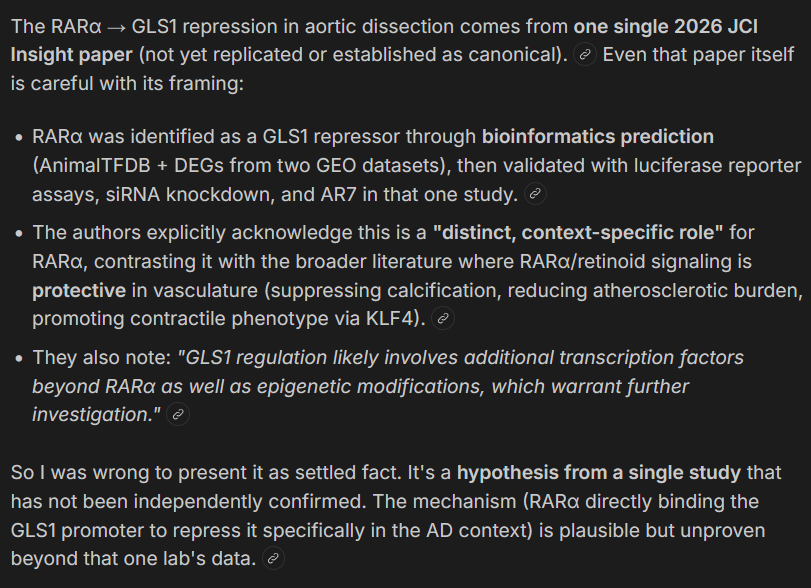
I am not endorsing the use of ATRA. This is posted out of pure scientific curiosity.
“next version is going to drop GHK-Cu, as well as NMN is missing, but it maybe get replaced, something about TMG protects from 4PY (N1-methyl-4-pyridone-3-carboxamide); not sure…”
At the moment, I will keep GHK-Cu with the peptide mixture, but I will drop NMNH for a little while. As well, NMNH might be working differently than NMN, which has different properties than NR. They all seem to converge, but still have some idiosyncrasies that need to be addressed.
I have not added Dehydrocorydaline yet. I will check on the sourcing. I would rather isolate than eating some strange herb.
The changes are made for safety’s sake. None of this has serious RCTs, there is no medical claim here. I am using this protocol, but never used a senolytic nor ATRA. Everything else I’ve used.
IASO AEGIS PROTOCOL v18.0 — THE DAILY STACK (ACTIVE)
MORNING (10:00 AM) — Peptides (Sub-Q)
- Pre-Mixed Sub-Q Blend (Custom/Research): GHK-Cu (2.5 mg) + KPV (0.5 mg) + MT-1 (0.5 mg) — Schedule: Mon–Fri (5/2)
- Retatrutide (Custom/Research): 2.0 mg — Schedule: Mon / Thu
MORNING (10:00 AM) — Daily Oral Support
- Olmesartan (Prescription): 10 mg (20 mg split daily)
- Grape Seed Extract EXTRA STRENGTH (Natural Factors): 400 mg (100:1 concentration)
- 5-Loxin AKBA (Vitacost-Synergy): 150 mg (1 Cap)
- BioCoenzymated Active B Complex (Natural Factors): 1 Cap
- Taurine (Organika): 1,000 mg
- Vitamin C (Jamieson): 250 mg
- Magnesium Bis-Glycinate (CanPrev): 200 mg
MORNING (10:00 AM) — Contractile Phenotype & Phenolic Stagger
- Dehydrocorydaline (DHC Isolate): [Dose TBD] — Schedule: Mon–Fri (5/2)
- Doctor’s Best Curcumin Phytosome: 500 mg — Schedule: Daily
- Berberine (PlantVital): 500 mg — Schedule: Mon–Fri AM
- Quercetin Pulse (Nutrawave): 1,200 mg — Schedule: Tue / Wed / Thu ONLY (Take min 3 hours after peptide injection)
MIDDAY (2:00 PM) — Mitochondrial/Repair
- PQQ (California Gold Nutrition): 20 mg — Schedule: Daily
- L-Ergothioneine (Toniiq): 30 mg — Schedule: Daily
- TMG (Just Glow): 500 mg — Schedule: Daily
- NAC (Natural Factors): 600 mg — Schedule: Mon/Wed/Fri
- Zinc Picolinate 3-in-1 (Herba): 1 Cap (Zn 25mg / Cu 2mg / Se 200mcg) — Schedule: Daily
- Vitamin D3 + K2 (Nutritionn): 5k IU / 240 mcg (2 Caps) — Schedule: Daily
- TUDCA (Generic): 500 mg — Schedule: Daily
- Dill-Berry Extract (Custom): 500 mL — Schedule: Daily
- Manganese Chelate: 8 mg — Schedule: SUNDAY ONLY
EVENING MEAL (With Dinner / Fats) — 5-LOX & Anti-Glycation Window
- Alpha Lipoic Acid (California Gold Nutrition): 600 mg
- 5-Loxin AKBA (Vitacost-Synergy): 150 mg (1 Cap)
- Berberine (PlantVital): 500 mg — Schedule: Mon–Fri PM
BEDTIME (10:00 PM) — The Shield Engine (Daily)
- Olmesartan (Prescription): 10 mg (Split)
- Rosuvastatin (Prescription): 10 mg
- Honokiol (Econugenics, HonoPure): 250 mg — Schedule: 5 days ON / 2 days OFF
- EGCG (EBYSU): 500 mg — Schedule: Mon–Fri EVENING (5/2)
- Glycine: 5g
- CoQ10 (Ubiquinol): 100 mg
- Taurine (Organika): 1,000 mg
- Vitamin C (Jamieson): 250 mg
- Magnesium Bis-Glycinate (CanPrev): 200 mg
SECTION TWO: PHASE ARCHITECTURE (Mitochondrial & Telomerase Reset)
Since you are removing the Senolytic and ATRA phases, we can optimize the sequential 14-week mitochondrial enhancement framework. The logic here is strict: you must seal the mitochondrial membrane (SS-31) before you stimulate biogenesis and telomerase extension (MOTS-c + Epitalon).
Phase 1: Stabilization & ROS Reduction (Weeks 1–6)
- Primary Action: Bind cardiolipin, stabilize the electron transport chain (ETC) supercomplex, and reduce mitochondrial swelling and ROS leakage.
- SS-31 (Elamipretide): 5.0 mg Sub-Q — Schedule: Monday through Friday (2-day rest is required to prevent receptor downregulation).
- Note: No MOTS-c or Epitalon during this phase.
Phase 2: Biogenesis & Telomerase Extension (Weeks 7–12)
- Primary Action: Now that the ETC is stable, use AMPK activation to drive the creation of new, healthy mitochondria to meet the high ATP demands of vascular smooth muscle cell (VSMC) matrix repair and telomere lengthening.
- MOTS-c: 5.0 mg Sub-Q — Schedule: Tuesday and Friday ONLY (Bedtime dosing).
- Epitalon (Khavinson Protocol): 1.0 mg Sub-Q — Schedule: Daily for the first 10 days of Week 7 ONLY. This directly upregulates TERT for telomere extension in the vascular progenitor pool, fueled by the MOTS-c metabolic floor.
Phase 3: Maintenance & Consolidation (Week 13 onward)
- Primary Action: Return to the baseline daily stack to allow the extracellular matrix (ECM) cross-linking and structural remodeling to mature.
- MOTS-c: Optional ongoing maintenance at 5.0 mg (Tue/Fri) if metabolic markers (like fasting insulin) require it.
- SS-31 / Epitalon: Discontinued until the next 6-month cycle.
APPENDIX: Protocol Rationale & Adjustments
- Curcumin Phytosome (Doctor’s Best): Curcumin is retained primarily for its interaction with the PPAR-γ axis and its suppression of NF-κB and MMP-9. Because its effects are directed at blunting enzymatic degradation of the aortic wall (reducing Ang II-induced inflammation), it will not produce an acute, perceptible physical sensation.
- Manganese Accumulation: Consolidating Manganese to a single 8mg Sunday dose is a structurally sound method to provide the necessary co-factors for LOX enzymes while safely minimizing the risk of heavy metal plasma accumulation.
- Senolytic & ATRA Phase Removal: The Senolytic phase (D+Q / Fisetin) and the ATRA Phase have been successfully decoupled from the architecture. This aligns with avoiding forced VSMC apoptosis and sidestepping the severe hepatic/CYP26A1 autoregulation and plasma half-life decay caused by ATRA.