chatGPT:
Below is a tidied transcript, followed by a summary and critique. This is based on the uploaded transcript of the YouTube video.
Tidy transcript
Maline Cloth, a graduate student at the University of Michigan, stumbled across something that would turn out to be embarrassing for the microplastics research field.
We have often been told that the amount of plastic in a credit card is roughly the amount that enters our body every week. But when Cloth was running a routine air sampler on the roof of the chemistry building for her microplastics research, the numbers coming off her sampler were thousands of times higher than expected. She could not explain it. The benches were clean, the water was clean, and the samples she was testing were clean.
So why was her sampler generating sky-high results?
She called it a wild goose chase. What she found would send shock waves through the microplastics research field.
To understand why her strange results matter, we have to go back to where the “credit card” headline came from. In 2019, the World Wildlife Fund commissioned a report estimating how much plastic the average person consumes in a week. They hired the consultancy firm Dalberg Advisers to do the calculation. The consultants, working with researchers at the University of Newcastle, combined more than 50 earlier studies.
Those studies used different measurement methods, different definitions of how small a piece had to be to count, and different assumptions about how much people would actually swallow. When all that data was combined, the estimated range was 0.1 g to 5 g per week — a 50-fold range.
The press picked up the top end: five grams, roughly the weight of a credit card. That made for a clickable headline. But when other groups reran the calculation using more careful assumptions, the answers were much smaller. One alternative estimate was less than the weight of a grain of salt per week.
This overestimation of microplastics exposure, based on an exuberant calculation, is the first of three major issues in the field.
The second issue comes from Cloth’s discovery. To check whether a sample contains plastic, researchers shine a focused infrared beam at it. Different materials vibrate at different frequencies. Plastic has one fingerprint; fat has another. The instrument matches the sample against a library of reference fingerprints. This is called vibrational spectroscopy, and it is one of the main methods used in microplastics research.
Cloth’s question was simple. The microplastics field had spent 20 years worrying about experimental contamination. Researchers cleaned equipment carefully and worked on clean benches to make sure lab equipment was not shedding microplastics into samples and distorting the results.
When Cloth’s air sampler produced extremely high readings, she checked the equipment. Was the contamination coming from a plastic squirt bottle? Was it particles floating in the lab air where she prepared sampling discs? She ruled these out one at a time.
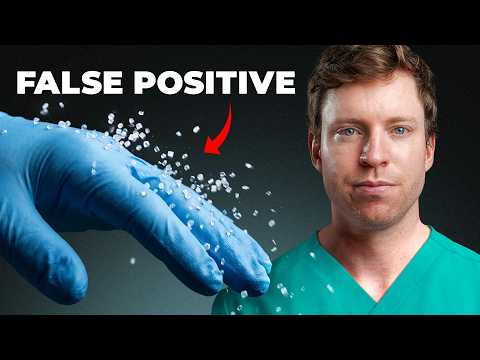
Then she had a eureka moment. Everyone wears nitrile or latex gloves while handling samples. That is standard laboratory practice. But almost nobody had checked whether the gloves themselves were shedding particles into the samples.
She tested seven brands of gloves: three latex, three nitrile, and one clean-room nitrile glove. She pressed each glove against a clean surface with a fixed amount of pressure, then tested what was left behind. Standard gloves produced about 2,000 false-positive particles per square millimetre. Clean-room gloves produced about 100.
That was what her air sampler was detecting: particles from her gloves.
The contaminant turned out to be stearate, a slippery coating manufacturers use so gloves do not stick to moulds during production. Stearate has a fingerprint similar to polyethylene, the most common plastic. Vibrational spectroscopy was confidently calling it polyethylene by mistake.
Cloth then wondered whether the whole microplastics field had made the same mistake. Were some studies detecting glove contamination rather than real microplastics? She reviewed methods sections in recent microplastics quality-control papers. Eighty-one percent recommended wearing gloves, but only two flagged the risk of sample contact.
The field had a blind spot, and it was sitting on researchers’ hands.
The video notes that this warning should arguably have been caught earlier. Six years before Cloth’s paper, in 2020, a group at the German Federal Institute of Hydrology had published essentially the same warning.
So far, there are serious issues with the original estimate of how much microplastic people ingest each week, and serious issues with experiments that may have been contaminated by the gloves researchers were wearing.
The third major issue concerns another method: pyrolysis gas chromatography–mass spectrometry, or Py-GC-MS. This method does not use the same fingerprint technique. Instead, it heats a sample and analyses the chemical fragments released. It can estimate how much plastic is present in tissues, which is why it is often used in headline-grabbing claims about plastic in organs.
For example, in February 2025, Nature Medicine published a paper claiming that human brain tissue samples contained a median of 4,917 micrograms of microplastics per gram of brain tissue. That would imply roughly half a percent of the brain by weight was plastic.
Cassandra Rauert, who runs a lab in the Queensland Alliance for Environmental Health Sciences, was sceptical. In January 2025, her group published a paper challenging these kinds of claims.
The problem is that when fat is heated, it breaks down into fragments that can look exactly like polyethylene to the instrument. The two are not easily distinguished. Rauert’s group found that the risk of mistaking fat for plastic had not been adequately addressed in prior studies, including the prominent brain-tissue study. Other researchers independently raised similar concerns.
So the video identifies three separate methodological problems: suspect exposure calculations, glove contamination, and fat being mistaken for plastic.
Given all this uncertainty, are microplastics actually accumulating in our bodies and causing harm? The video says this is difficult to answer.
What we have more certainty about is exposure to plastic-related chemicals such as bisphenol A, phthalates, and PFAS. BPA is used in hard, clear plastics and food-can linings. Phthalates are softeners added to vinyl plastic. Both can leach out, especially when plastic is heated or scratched.
Unlike microplastic particle detection, BPA and phthalates can be measured directly in human urine. The test looks for actual molecules, not a spectral fingerprint. So there is less concern about the matching errors discussed earlier.
The video says we do not yet have randomized controlled trials, but observational human studies link these exposures to cardiovascular mortality, metabolic disruption, and reproductive problems. This is described as the strongest evidence connecting plastic-related chemicals to human disease.
PFAS, or “forever chemicals,” are a large class of compounds used in products such as non-stick cookware and waterproof fabrics. Research is ongoing, but there is evidence linking PFAS exposure to decreased fertility, increased cancer risk, and hormone disruption.
The video then recommends practical ways to reduce exposure: do not heat food in plastic containers; use glass or ceramic in the microwave; avoid non-stick cookware where possible; consider stainless steel or cast iron pans; check whether floss contains PFAS; and choose BPA-free and PFAS-free products, especially for food preparation.
The video ends by comparing this microplastics revision story with another case where measurement methods may have distorted a signal: claims about rapidly falling testosterone levels.
Summary
The video argues that much of the public alarm about microplastics rests on uncertain or flawed measurement.
Its core claims are:
-
The widely repeated “credit card of plastic per week” figure came from the high end of a very broad estimate, not a robust central estimate.
-
Some microplastics studies may have false positives because common lab gloves shed stearate-containing particles that can be misidentified as polyethylene.
-
Some tissue studies using Py-GC-MS may mistake breakdown products from fat for polyethylene, especially in lipid-rich tissues such as brain.
-
Therefore, claims about high levels of microplastic accumulation in human organs should be treated cautiously.
-
The video shifts the main practical concern away from microplastic particles and toward plastic-associated chemicals such as BPA, phthalates, and PFAS, where exposure measurement and epidemiological links are stronger.
Novelty / useful insight
The useful element of the video is that it separates microplastic particles from plastic-derived chemicals. These are often blurred together in public discussion.
The video’s strongest point is methodological: it shows how contamination and analytical artefacts can create apparently dramatic findings. The glove example is especially important because it is a plausible, mundane source of systematic error. It also illustrates a broader problem in environmental exposure science: when expected concentrations are extremely low, tiny sources of contamination can dominate the signal.
The fat/Py-GC-MS issue is also important. If lipid pyrolysis products can mimic polyethylene markers, then claims about plastic in fatty tissues need careful validation with blanks, digestion controls, spike-recovery experiments, orthogonal methods, and polymer-specific confirmation.
Critique
The video is persuasive on the weaknesses of some microplastics measurements, but it may lean slightly too far toward scepticism.
First, showing that some studies are vulnerable to contamination does not prove that most microplastic findings are false. It means the field needs stricter protocols, better blanks, and independent confirmation. The conclusion should be “uncertain and method-dependent,” not “probably wrong” across the board.
Second, the video appears to use a few methodological failures to frame the whole field. That is rhetorically effective, but a balanced critique would distinguish between low-quality studies, studies with contamination controls, and studies using multiple convergent methods.
Third, the video does not fully address particle biology. Even if mass estimates are overblown, very small particles could still matter biologically if they cross barriers, induce inflammation, adsorb pollutants, or accumulate in specific cell types. Toxicological significance may depend more on particle size, shape, surface chemistry, dose rate, and tissue location than on total mass.
Fourth, the comparison with BPA, phthalates, and PFAS is sensible, but these are chemically distinct problems. PFAS are not simply “plastic chemicals” in the same way as BPA or phthalates. The practical advice is reasonable, but the categories should not be merged too loosely.
Fifth, the video notes observational links between BPA/phthalates/PFAS and disease, but observational associations are vulnerable to confounding. The evidence is stronger than many microplastic particle claims, but it is still not the same as direct causal proof in humans.
Bottom line
The video’s central message is sound: headline claims about microplastics in the body should be treated cautiously because the measurement science is still immature and prone to artefact.
However, the better conclusion is not that microplastics are harmless. It is that the particle-exposure evidence is uncertain, while the evidence for harm from plastic-associated chemicals such as BPA, phthalates, and PFAS is currently more actionable. Practical exposure reduction — especially avoiding heating food in plastic and reducing PFAS-contact foodware — is a reasonable low-cost response.