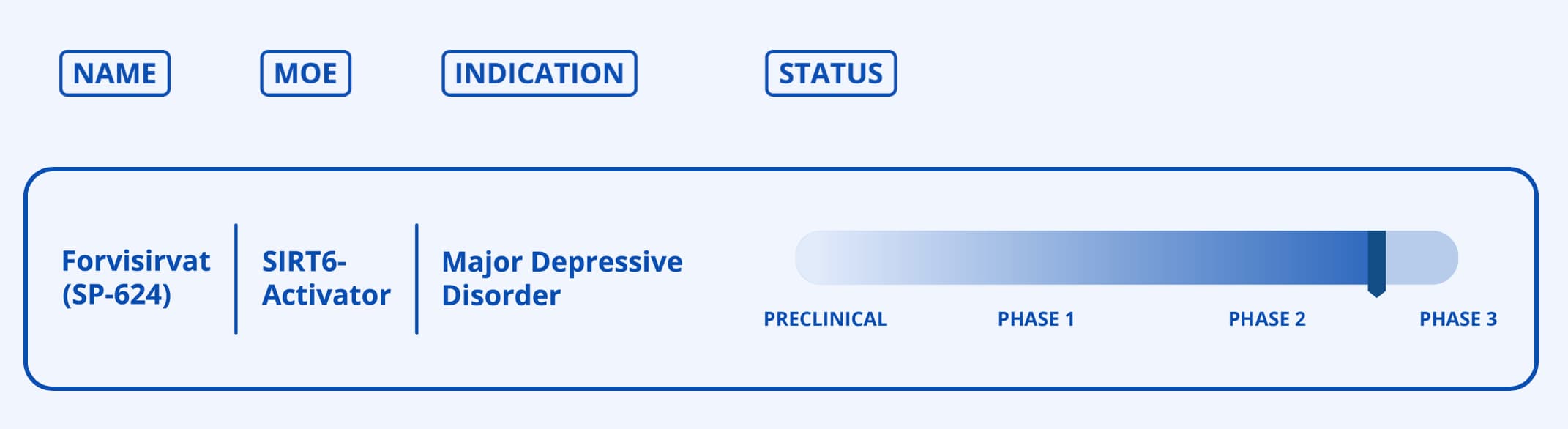
For the first time, a potent small-molecule activator of SIRT6—the so-called “longevity gene”—has successfully cleared Phase 1 safety trials in humans. This study, conducted by Sirtsei Pharmaceuticals (USA) and published in Clinical Pharmacology in Drug Development, marks a critical milestone in translating sirtuin biology from mouse cages to clinical reality.
While the primary indication is Major Depressive Disorder (MDD), the implications for longevity enthusiasts are profound. SIRT6 is a master regulator of DNA repair, telomere maintenance, and glucose metabolism; its overexpression has been shown to extend lifespan in male mice by ~15%. The study confirms that SP-624 is orally bioavailable, brain-penetrant, and achieves plasma concentrations well above the threshold required for biological activity (>3.28 ng/mL) with a clean safety profile. Unlike previous sirtuin activators (e.g., Resveratrol/SIRT1) which failed to deliver robust clinical results, SP-624 targets the more potent SIRT6 isoform using a specific epigenetic mechanism. The successful demonstration of safety and target engagement paves the way for “off-label” interest in SP-624 as a potential geroprotector, although it is currently only being developed for psychiatric indications.
Source:
- Open Access Paper: Phase 1, Single-Center, Double-Blind, Randomized, Placebo-Controlled Studies of the Safety, Tolerability, and Pharmacokinetics of Single and Multiple Ascending Oral Doses of the Sirtuin 6 Activator SP-624 in Healthy Adults
- Institution: Sirtsei Pharmaceuticals / Arrivo BioVentures, NC, USA.
- Journal: Clinical Pharmacology in Drug Development., 2025 January
- Impact Evaluation: The impact score of this journal is ~2.5 (JIF), evaluated against a typical high-end range of 0–60+ for top general science; therefore this is a Low/Medium impact journal, specialized in pharmacokinetic and early-phase drug development data.
Part 2: The Biohacker Analysis
Study Design Specifications
-
Type: Clinical Trial (Phase 1).
- Study 101: Single-Ascending Dose (SAD) with food-effect arm.
- Study 102: Multiple-Ascending Dose (MAD) for 10 days.
-
Subjects: Human (Healthy Volunteers).
- N=55 total randomized (32 in SAD, 23 in MAD).
- Demographics: Mixed sex (SAD Part B mostly women), aged 18–55, healthy BMI.
-
Lifespan Analysis: N/A (Human Safety Trial).
- Context: While this study did not measure lifespan, it targets the SIRT6 pathway. In mice, SIRT6 overexpression extends lifespan significantly (up to 15-30% in males) SIRT6 protects against aging (2012).
- Control Ref: Standard murine lifespan is ~900 days; SIRT6-deficient mice die prematurely (~30 days), highlighting the enzyme’s critical role in survival.
Mechanistic Deep Dive
The study validates SP-624 as a tool to modulate the SIRT6 pathway in humans.
- Epigenetic Remodeling: SIRT6 acts as a histone deacetylase (specifically H3K9ac, H3K18ac, H3K56ac). By deacetylating these residues, it compacts chromatin, silencing repetitive elements (like LINE1 retrotransposons) that otherwise drive genomic instability and “sterile inflammation” during aging SIRT6 silences transposons (2014).
- Mitochondrial & Neural Health: The paper links SIRT6 activation to improved mitochondrial quality and DNA repair in the brain. The authors hypothesize that depression is, in part, a disease of accelerated cellular aging and mitochondrial dysfunction—a theory gaining traction as the “Inflammatory/Metabolic Theory of Depression.”
- Target Engagement: The drug achieved a Cmax (peak concentration) of ~20–200 ng/mL, far exceeding the predicted efficacy threshold of 3.28 ng/mL derived from rat depression models.
Novelty
- First-in-Class: This appears to be one of the first highly selective, potent small-molecule SIRT6 activators to report Phase 1 human data. Most “SIRT6 activators” on the supplement market (e.g., high-dose Niacin, Fucoidan) are indirect or weak. SP-624 is a verified, purpose-built NCE (New Chemical Entity).
- Brain Penetration: The text confirms SP-624 exhibits “good brain penetration in rats,” a critical feature often lacking in polyphenol-based sirtuin activators.
Critical Limitations
- Short Duration: The longest exposure was only 10 days. Long-term safety (crucial for a longevity drug) is unknown.
- Healthy Volunteers: The subjects were healthy. We do not yet know if the drug actually upregulates SIRT6 activity in vivo in humans to a degree that impacts biomarkers of aging (e.g., DNA methylation age) or depression.
- Food Effect: A high-fat meal reduced peak absorption (Cmax) by ~30%, though total exposure (AUC) was unchanged. This suggests strict dosing protocols may be needed.
Part 3: Claims & Validation
Claim 1: SP-624 is a selective activator of SIRT6 intended for MDD and potentially neurodegenerative disorders.
- Source Text: “SP-624… is an orally active, selective activator of SIRT6 intended for the treatment of MDD… and neurodegenerative and metabolic disorders.”
- Evidence Level: D (Pre-clinical) for the “treatment” claim; Level B for the “orally active” claim.
- Verification: SIRT6 is a well-established target for metabolic and neurodegenerative health in animals. However, clinical efficacy in human MDD is still in Phase 2 trials (mixed results in Phase 2a, showing signal in women).
- Consensus: Strong mechanistic support in animals; unproven in humans.
Claim 2: SIRT6 activation enhances DNA repair and mitochondrial health.
- Source Text: “Enhanced DNA repair and maintenance of mitochondrial health may be novel mechanisms for treating MDD.”
- Evidence Level: D (Mechanistic/Animal).
- Verification: Confirmed by multiple high-impact publications. SIRT6 recruits PARP1 to DNA damage sites and regulates glucose homeostasis.
- Consensus: High. This is the “textbook” function of SIRT6.
Claim 3: SP-624 is safe and well-tolerated in humans up to 30mg (single) and 20mg (multi-dose).
- Source Text: “No serious adverse events were observed… SP-624 was well tolerated.”
- Evidence Level: B (Phase 1 RCT).
- Verification: Validated by the provided text and consistent with Phase 2a press releases from Arrivo BioVentures.
- Safety Signal: Side effects were mild (headache, GI urgency).
- Consensus: High (within the context of this specific study).
Claim 4: A food effect lowers Cmax significantly.
- Source Text: “A food effect resulted in significantly lower Cmax… for fed versus fasting participants.”
- Evidence Level: B (Phase 1 RCT).
- Verification: High fat meals delayed absorption and blunted the peak spike, but total drug absorbed (AUC) remained similar.
- Translational Note: For conditions requiring high peak saturation (perhaps acute depression relief), fasting might be superior. For steady-state longevity, fed state might be acceptable.
Part 4: Actionable Intelligence
The Translational Protocol (Rigorous Extrapolation)
-
Human Equivalent Dose (HED):
- Study Dose: The trial established 20 mg/day as the target therapeutic dose for Phase 2.
- Allometric Scaling: For a 70kg human, 20mg is roughly 0.28 mg/kg.
- Mouse Equivalent: 0.28×12.3≈3.4 mg/kg.
- Comparison: Animal studies of similar SIRT6 activators (e.g., Icariside II) often use 10–20 mg/kg. SP-624 appears highly potent if 20mg total is effective in humans.
-
Pharmacokinetics:
- Half-life: ~7 hours. This supports once-daily (QD) or twice-daily (BID) dosing.
- Bioavailability: Good, but high-fat meals blunt the Cmax by 33%.
- Protocol: Based on this data, optimal administration would be on an empty stomach or with a light, low-fat meal to maximize peak brain concentrations.
Feasibility & Sourcing
- Availability: None. SP-624 (Forvisirvat) is a proprietary pipeline asset of Arrivo BioVentures. It is not available as a research chemical or supplement.
-
Natural Alternatives: Since you cannot buy SP-624, the closest actionable interventions to activate SIRT6 are:
- Fucoidan: A sulfated polysaccharide from brown seaweed. Recent pre-print data suggests it activates SIRT6 and extends lifespan in mice SIRT6 activator fucoidan extends lifespan (2025).
- Caloric Restriction / Fasting: The most potent physiological activator of SIRT6 expression.
- Sirtuins Co-factors: Maintaining NAD+ levels (via NR/NMN) is required for SIRT6 function, as it is an NAD±dependent enzyme.
Safety & Toxicity Check
- Safety Profile: Clean in healthy adults up to 20mg/day for 10 days.
-
Signals to Watch:
- GI Issues: Diarrhea/urgency was noted in the high-dose group.
- Headache: Most common adverse event.
- Liver/Kidney: No signals in this short study, but SIRT6 heavily regulates liver metabolism (gluconeogenesis). Long-term modulation could theoretically impact fasting blood glucose (risk of hypoglycemia if over-activated, though not seen here).
Part 5: The Strategic FAQ
Q1: Why is a “longevity gene” drug being tested for depression? A: This is likely a regulatory strategy. The FDA does not recognize “aging” as a treatable indication. Companies must select a specific disease. Since SIRT6 regulates mitochondrial function and neuroinflammation—both compromised in Major Depressive Disorder (MDD)—depression is a logical, patentable “Trojan Horse” to get the drug approved.
Q2: Will SP-624 work for men, or is it female-specific? A: [Confidence: Medium] Phase 1 data (this paper) showed similar PK in men and women. However, subsequent Phase 2a data (external search) suggested efficacy was statistically significant only in women. Arrivo is now prioritizing female MDD cohorts. This sex-dimorphism is common in longevity interventions (e.g., Acarbose/Rapamycin often show sex-specific magnitude).
Q3: Can I combine this with Rapamycin? A: [Speculation] Theoretically, yes. Rapamycin inhibits mTOR, while SP-624 activates SIRT6. These are complementary pathways (SIRT6 negatively regulates mTOR signaling in some tissues). However, no interaction data exists.
Q4: How does this compare to taking NAD+ boosters (NR/NMN)? A: They are synergistic but distinct. SIRT6 needs NAD+ to function. Taking NR/NMN fuels the engine (NAD+), while SP-624 presses the gas pedal (allosteric activation). Doing both would theoretically be the most potent strategy.
Q5: Is there a commercially available equivalent? A: Fucoidan is the strongest candidate currently available. A 2025 study identified it as a dual activator of SIRT6 deacetylation and ADP-ribosylation. Supplementing with high-quality Fucus vesiculosus extract is the closest “biohacker” proxy right now.
Q6: Does SP-624 have off-target effects? A: The study claims high selectivity. It was screened against human transporters and CYP enzymes with no major inhibition/induction. However, SIRT6 suppresses HIF1-alpha (hypoxia response) and increases gluconeogenesis, so “on-target” side effects could include blunted muscle hypertrophy or alterations in glucose handling.
Q7: What is the half-life, and does it require cycling? A: t1/2 is ~7 hours. Steady state is reached in 3 days. Given that SIRT6 is a repair enzyme, continuous activation might be safe, but biological systems often habituate. No data supports cycling yet.
Q8: Did the study show any biomarkers of aging reversal? A: No. This was a Phase 1 safety study. They measured drug levels (PK) and safety labs, not DNA methylation clocks or inflammatory cytokines (IL-6, TNF-a).
Q9: Does food intake ruin the effect? A: It dampens the spike. High-fat breakfast reduced Cmax by 33%. For a brain-targeted effect (depression), the spike might matter. For general systemic longevity, the total AUC (which was unaffected) might be sufficient.
Q10: What is the next step for this drug? A: Arrivo is currently enrolling a Phase 2b/3 trial specifically for women with MDD. If successful, this could be the first FDA-approved drug with a primary mechanism of SIRT6 activation, opening the door for off-label longevity use around ~2028-2030.