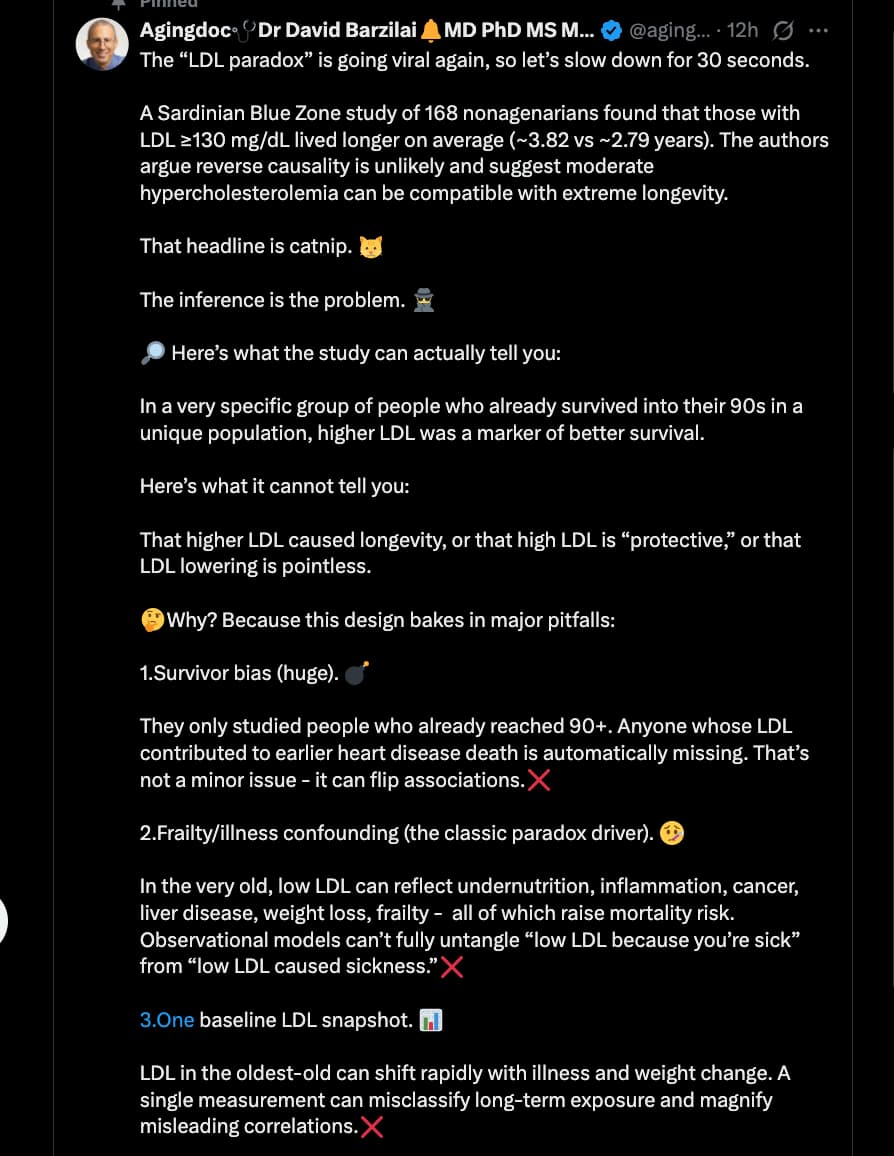
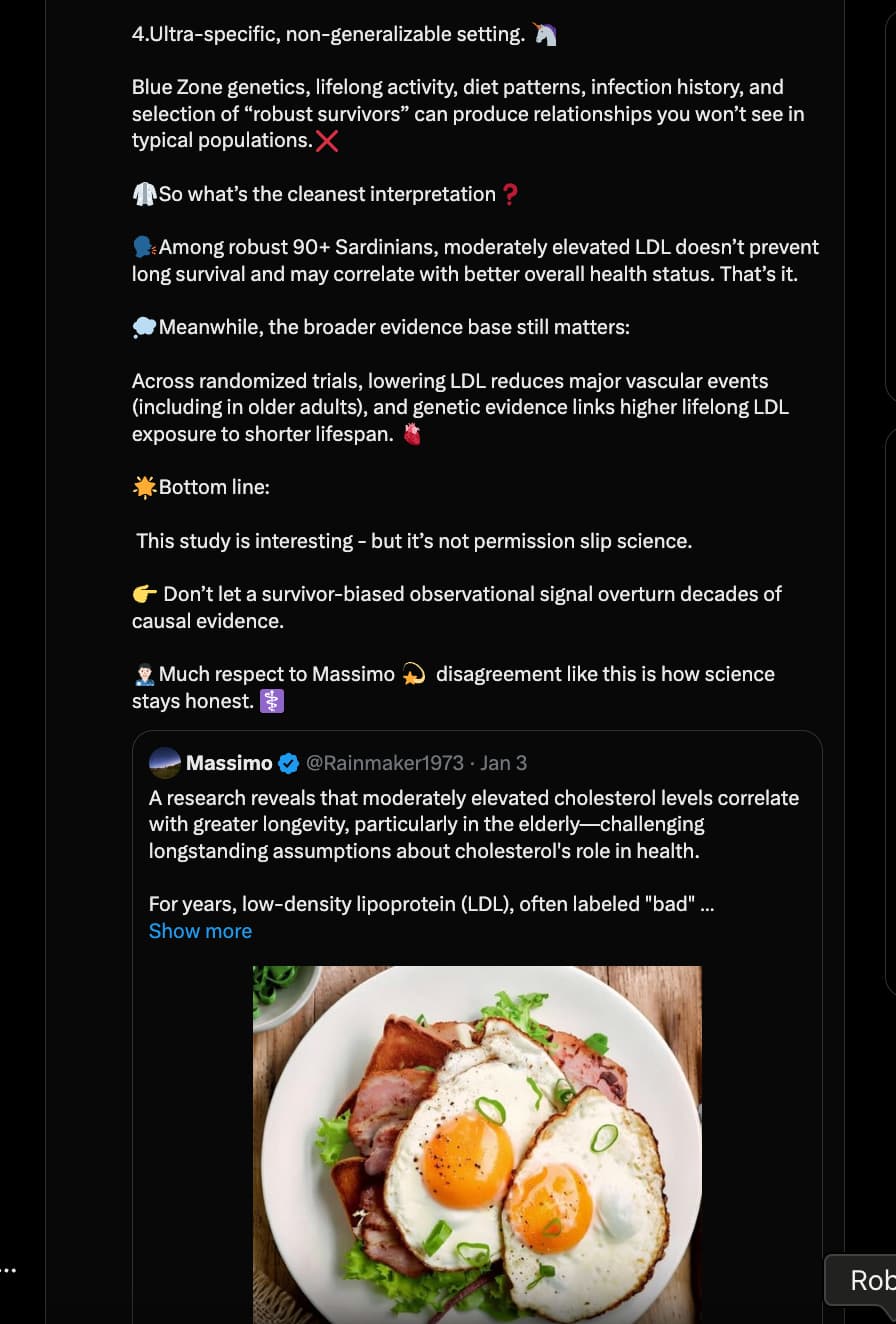
I know, I know, there have been countless discussions . . .but . . .I would like to focus on cholesterol in older people.
So, there seems to be agreement that it is good to get APOB down to at least below 70. And lower is better. And, starting earlier is better.
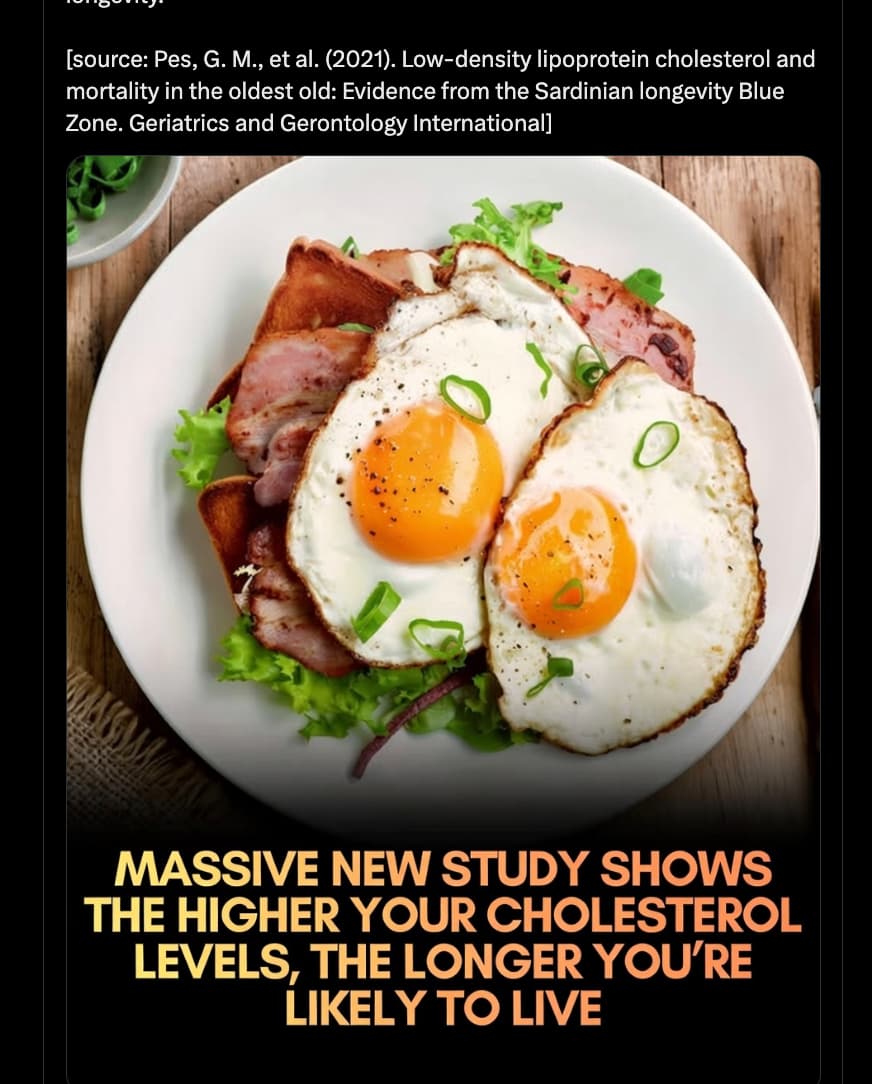
But-- what about the elderly? what about the (can I use the word?) studies that suggest that moderately higher cholesterol is beneficial in old age, and that there is a correlation between moderately high LDL (110-130?) and longer life?
I am 76. I have a bit of coronary artery disease, picked up on an abdominal CAT scan, and a CAC of 0.96. Two years ago, when I discovered that my Lp(a) was 40, I went on Repatha and Exetimibe. The Lp(a) is now 27. APOB is now 49 and LDLC is 42. Low trigs, and very high HDL. Before I started the meds my LDL was about 110.
I should be happy – but – what about the recent suggestions that for older people, moderately high LDL is not a bad thing and might be a good thing?
There is a correlation between cholesterol and food intake. Low cholesterol is correlated with low/poor food intake and sickness. Old people will die sooner, if they don’t eat correctly, than from plaque accumulation that takes years to accumulate.
It might be a bit of a sidetrack from your original question, but when cholesterol levels fall there can also be a drop in hormone levels, in my case testosterone. This might affect quality of life and health.
"Statins are among the most commonly prescribed drug classes worldwide, and atorvastatin is the most widely used statin for treating conditions such as high cholesterol and other lipid disorders. By lowering cholesterol, which is the basic building block for the steroid hormone production pathway, atorvastatin may reduce levels of testosterone and other androgens, hormones that play important roles in many biological functions. A fall in androgen levels from atorvastatin could be harmful in most situations, but in polycystic ovary syndrome (PCOS), where androgen levels are often excessively high, lowering them with atorvastatin may actually be beneficial."
Before starting high‑dose atorvastatin treatment at 80 mg daily, my testosterone levels were around 28–32 nmol/L, which corresponds to approximately 800–920 ng/dL, quite high for a 63‑year‑old man. After three months on atorvastatin 80 mg, my testosterone had fallen to 17 nmol/L, about 490 ng/dL, which is a substantial reduction. The only other change I made to my regimen during this period was adding nattokinase 1200 IU and serrapeptase 500 000 units.
Higher testosterone or other androgen levels benefit older adults (male and female) by counteracting age-related declines in muscle mass, bone density, energy, and mood. While most research focuses on men, very low cholesterol levels—which serve as a precursor for steroid hormone production—could create a conflict by limiting androgen synthesis. Androgens promote lean body mass, muscle strength, and physical function such as walking speed and stair climbing, helping to prevent frailty and sustain independence. They enhance bone mineral density and strength in the spine and hip, lowering osteoporosis risk and fracture likelihood. Elevated levels boost energy, improve mood, alleviate depressive symptoms, and support cognitive functions like memory. Higher androgens also increase libido, sexual desire, erectile function, and activity, enhancing overall quality of life.transalating results from male therepy to females should of course be done in a genderspecific way.
So I can relate to your question about whether cholesterol, as an androgen precursor, can be too low. In my case, I view this in the context of fighting the number one killer of modern humans—cardiovascular disease—which is a priority for me.
Statins decreasing testosterone is established and some evidence the diminishment increases with the “elderly”
“Treatment with statins and testosterone levels in men,” published in Endokrynologia Polska (2014) by Marek Mędraś et al.
Research focused on a population sample of 237 men (average age ~58, but including older seniors) and explored how statin therapy (specifically atorvastatin and simvastatin) correlated with androgen levels.
Key Data from the Mędraś Study ($n=237$)
The study compared men taking statins ($n=38$) against those not taking statins ($n=151$ from the same pool). The researchers found that those on statins had significantly lower levels across four key testosterone markers:
No evidence of mechanism reducing testosterone with non-statin drugs like Ezetimibe or PCSK9 inhibitors) that I know of.
My father is 97 and has always had high LDL; his medical record mentions hypercholesterolemia.
When I tried to look up how high it actually was, to compare with my own high LDL, I noticed that in over 10 years of online blood tests LDL isn’t reported anymore.
It seems that in very old patients (85+), Belgian doctors often stop measuring LDL…
A cause is a cause. You can’t will a cause to no longer cause what it does. That by definition is impossible.
Is your question does LDL-C no longer cause disease in older people?
The answer is of course, no, there’s no difference. You pointed out a correlation, those aren’t causes.
People who are interested in health want to know what causes good health, not what is correlated with it.
If you are interested in having a good correlation with health, then you must as well choose to be obese, have high blood pressure, and have high blood sugar in the prediabetic range, all have correlations with reduced mortality, especially when the researchers are bad at their job or use the wrong tool for the question.
I haven’t seen anything that suggests testosterone levels dipping are “clinically significant.” But in light of this thread, (and being completely speculative) is there a threshold effect where an elderly person dips from low normal to clinical hypogonadism because of statin use.
My own definition of old or elderly is where an individual is experiencing a cascade of debilitating effects. Choosing therapies to continue or discontinue like statins, or blood thinners, or blood pressure meds, or diabetes therapies (the list goes on) probably needs to be triaged for the best health at this stage of life.
This doesn’t make sense given that extremely low LDL levels do not significantly reduce testosterone levels, which is explained by the fact that cholesterol levels in the blood are mostly irrelevant for hormone production because the cholesterol needed for testosterone production is produced locally rather than derived from the blood. For a statin to reduce testosterone levels it would likely have to enter the testes and influence local cholesterol production there. If they do lower LDL that would probably be the mechanism. Blood levels in contrast are not a concern.
I think since fatty food is rewarding, and there’s a connection to cholesterol, people falsely believe serum cholesterol in atherogenic lipoproteins are good, and fatty milk is particularly good.
What I’ve heard the cholesterol in atherogenic lipoproteins are mostly there to give the structure for the protein in circulation. There are also cholesterol in non aterogenic lipoproteins - apoA1, i.e HDL, but people don’t talk about that. That the liver might dump atherogenic lipoproteins when eating saturated fatty acids to protect itself. Then there are discussion that somehow the cholesterol used as scaffolding in lipoproteins is used to synthesize testosterone in the testes.
It’s a mental gymnastics olympics when you zoom out, but looks impressive when you zoom in.
Lead is used for everything in Rome because it’s easy to work with, we feel it’s good. It’s a similar situation, with animal spirits.