I. Executive Summary
The central thesis of Dr. John Cramer’s work, How to Live Much Longer, argues that aging is fundamentally a mechanistic energy crisis rather than a collection of disparate biological failures. From a physics perspective, Cramer posits that the “ticking time bomb” of aging is the progressive depletion and mutation of mitochondrial DNA (mtDNA). While the “Hallmarks of Aging” (e.g., epigenetic changes, telomere attrition, and cellular senescence) are widely studied, Cramer classifies them as downstream symptoms of a primary failure in cellular energy production.
The core of the argument rests on the Complex Biological Components (CBC) theory. Cramer distinguishes between “First-Generation Interventions” (small molecules like rapamycin or metformin) which merely delay the inevitable decline, and “Second-Generation Interventions” which involve the restoration of lost cellular machinery. He identifies mitochondria as the most critical CBC because they are the only organelles with their own genome (16,569 base pairs) and a high mutation rate driven by replication errors rather than just oxidative stress.
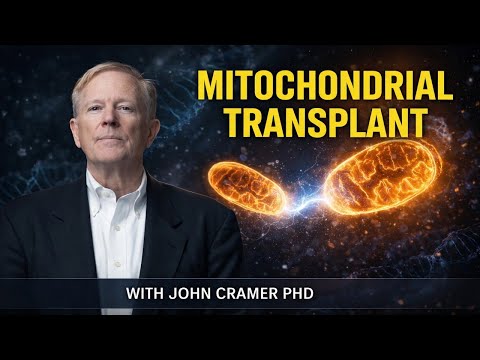
Cramer’s protocol involves Mitochondrial Transplantation, specifically the use of “Mitlets”—liposomes containing fresh, functional mitochondria harvested from young, healthy blood platelets. In May 2026, Cramer became the oldest human subject to receive an escalating dose of these transplants under a “Right-to-Try” clinical framework. The objective is to achieve systemic age reversal by increasing the “energy budget” of aged cells, thereby allowing them to clear senescent proteins and reset epigenetic programming. While early pediatric cardiac rescues by Dr. James McCully provide a proof of concept for acute tissue recovery, Cramer’s application for systemic longevity remains a pioneering, high-risk biological bet with significant translational gaps.
II. Insight Bullets
- Energy as the Master Variable: Aging is defined as the body’s inability to maintain its internal operating budget due to a diminishing energy supply from aging mitochondria.
- mtDNA Replication Errors: Contrary to the classic “Free Radical Theory,” most mitochondrial damage is caused by replication errors in the 16,569-base-pair mitochondrial genome, which has a 12-year “damage doubling time” that accelerates to 3–4 years in extreme old age.
- Rejection of Small-Molecule Primacy: Drugs like rapamycin and metformin are characterized as “delay” strategies; they optimize existing (damaged) machinery but do not replace the underlying energy source.
- CBC Restoration: True age reversal requires the physical replacement of “Complex Biological Components” (mitochondria, lysosomes, stem cells) that are lost or degraded over decades Cramer & Benson, 2025.
- Mitochondrial Transplant Origin: The technology stems from the work of Dr. James McCully, who successfully used autologous mitochondrial transfer to rescue cardiac tissue in pediatric patients.
- The Platelet Pathway: Platelets are naturally occurring “mitochondrial delivery trucks” in the blood; therapeutic “Mitlets” emulate this process using liposomal delivery.
- Epigenetics as a Downstream Effect: Epigenetic clocks (Horvath, etc.) are seen as the cell’s “software” response to failing “hardware” (mitochondria); restoring the hardware is hypothesized to reset the software.
- Damage Sequestration: The body compensates for energy loss by shutting down non-essential processes, leading to the clinical manifestations of the Hallmarks of Aging.
- The Physics of Error Bars: Cramer criticizes biological literature for lacking fundamental mechanistic models, often focusing on “cataloging” observations rather than root-cause derivation.
- Microbiome-Mitochondria Link: Emerging May 2026 data suggests that “youthful” fecal microbiota transplants (FMT) can partially reverse liver mitochondrial decline by suppressing the cancer-linked MDM2 gene.
- Right-to-Try Ethics: Cramer acknowledges the “Palestian bargain”—the systemic risk of experimental transplants in exchange for potential survival beyond current documented limits (126 years).
- Autologous vs. Heterologous: While early trials use a patient’s own (autologous) tissue, maximal reversal is hypothesized to require “young” external mitochondria.
IV. Actionable Protocol (Prioritized)
High Confidence Tier (Level A/B Evidence)
- Optimize Mitochondrial Biogenesis (Standard): Maintain mitochondrial density through high-intensity interval training (HIIT) and zone 2 cardio. While not “reversal,” this is the most validated method to maximize the current energy budget.
- Standard Geroprotectors (Delay Only): Use of rapamycin or metformin to modulate the mTOR and AMPK pathways. These remain the gold standard for delaying the onset of age-related disease, though they do not address mtDNA mutation accumulation.
Experimental Tier (Level C/D Evidence)
- Mitochondrial Transfer for Acute Ischemia: Use of autologous mitochondrial transplantation for cardiac or renal rescue during surgery or post-ischemic events. This has clinical precedent in pediatric cardiac care (McCully protocol).
- Microbiome-Induced Rejuvenation: Fecal Microbiota Transplantation (FMT) from young donors is emerging as a Level C method to suppress inflammatory genes (MDM2) and support hepatic mitochondrial function.
Red Flag Zone (Safety Data Absent)
- Systemic Mitochondrial Transplants (Longevity): High-volume systemic transplants (Mitlets) for the purpose of general “age reversal” in healthy adults lack Phase 3 RCT data. Potential risks include mitochondrial heteroplasmy (conflict between donor and host DNA), systemic inflammation, or unintended metabolic “overdrive.”
- Unregulated Longevity Clinics: Avoid “Right-to-Try” clinics for systemic mitochondrial therapy unless part of a monitored clinical trial (NCT registry). The long-term stability and integration of exogenous mitochondria into host cells are not yet understood in humans