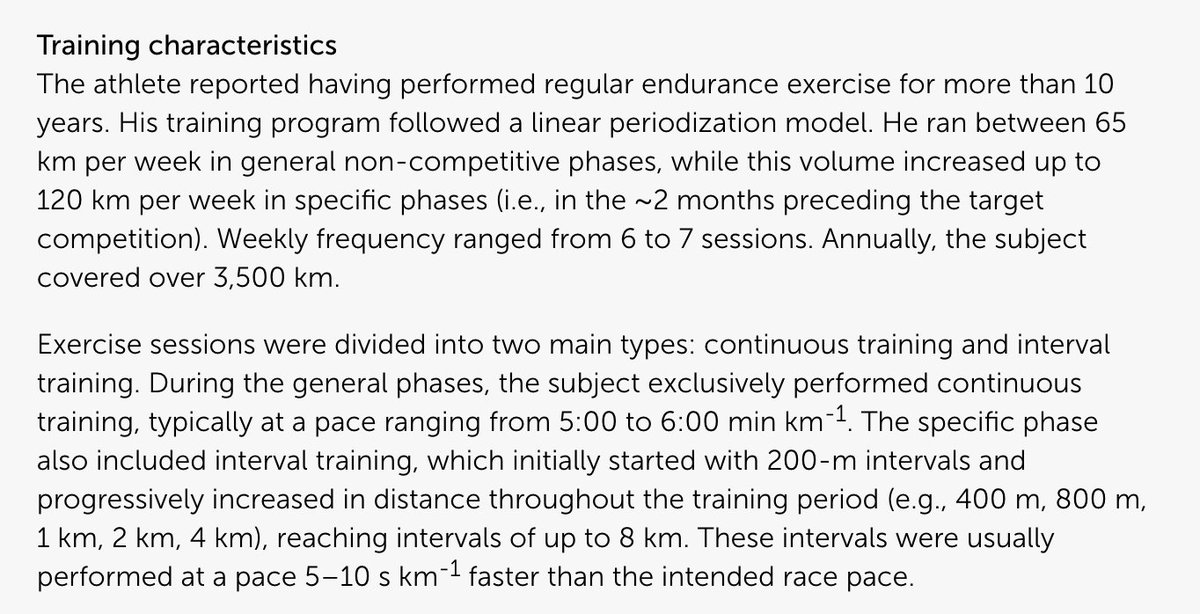
In a stunning demonstration of human plasticity, a new case study from the University of Pavia and Spanish researchers has shattered conventional wisdom about the inevitable decline of cardiovascular potency. Published in Frontiers in Physiology, this report dissects the physiology of an 81-year-old male who recently set the 50km world record for the 80+ age category (4 hours, 47 minutes). The “Big Idea” here is not just that he is fast, but that he started training at age 66—challenging the dogma that elite aerobic capacity requires a lifetime of conditioning.
The subject displayed a VO₂max of 52.8 mL/kg/min, a value typical of a healthy man in his 20s and unheard of for an octogenarian (where >25 mL/kg/min is considered good). Mechanistically, the study reveals that his performance engine is driven by a “Ferrari-like” ability to oxidize fat (0.55 g/min) and a cardiac output that defies the stiffening usually seen in aging hearts. While most aging research focuses on slowing decline, this case study suggests the human “physiological ceiling” is far higher than clinical textbooks admit. The implications are profound: the window for significant cardiovascular remodeling may remain open well into the seventh decade of life.
Source:
- Open Access Paper: Exploring the physiological limits of aging: a case study of the male 50-km world record in the 80+ age category
- Context: University of Pavia (Italy) & University of Castilla-La Mancha (Spain); Frontiers in Physiology.
- Impact Evaluation: The impact score of this journal is 3.4 (JIF 2024), evaluated against a typical high-end range of 0–60+ for top general science, therefore this is a Medium impact journal.
Mechanistic Deep Dive: The study identifies three critical pillars of this athlete’s longevity phenotype:
- Mitochondrial Flexibility (Fat Oxidation): The subject achieved a Maximal Fat Oxidation (MFO) of 0.55 g/min. In typical aging, mitochondrial density and efficiency (specifically Complex I/IV activity) plummet, shifting reliance to glycolytic pathways. This subject has preserved a “youthful” metabolic flexibility, likely driven by PGC-1α upregulation from high-volume Zone 2 training.
- Cardiac Compliance: Aging is usually characterized by left ventricular hypertrophy (stiffness) and reduced diastolic filling. This subject maintained a peak Cardiac Output (Q̇) of 15.3 L/min. This suggests a preservation of vascular elasticity (NO availability) and stroke volume, counteracting the typical age-related fibrosis.
- The “Oxygen Cascade” Integrity: The study utilized NIRS (Near-Infrared Spectroscopy) to verify that the limiting factor was not lung diffusion, but rather peripheral extraction, which remained highly efficient (75% extraction).
Novelty: The “Late Starter” Paradox. The subject began running at age 66. This contradicts the “use it or lose it” dogma which implies you must build the base early. It demonstrates that late-life initiation of high-volume endurance training can induce profound systemic remodeling.
Part 3: Claims & Verification
Claim 1: “VO₂max of 52.8 mL/kg/min is achievable in octogenarians.”
- Verification: True, but rare. Meta-analyses show trainability of VO₂max in elderly is possible (+16-25%), but absolute values >50 are statistically anomalous outliers ( >3 SD above mean).
- Hierarchy: Level C (Case Study).
- Support: [Confidence: High for existence, Low for reproducibility]. External data confirms elite masters athletes can reach 40-50s, but usually with lifelong training.
- External Source: PLOS ONE Meta-analysis (2013) confirms VO₂max trainability in elderly, though average gains are ~3.8 mL/kg/min.
Claim 2: “Starting training at age 66 can lead to world-record performance.”
- Verification: Supported by “Late Starter” cardiovascular studies.
- Hierarchy: Level C (Observational).
- Translational Gap: High. Success requires surviving the “orthopedic filter” of high-volume training without injury.
- Safety Check: Starting high-intensity endurance >60 carries risks of musculoskeletal injury and temporary immunosuppression.
- External Source: ScienceDaily / EuroPRevent 2014: “Endurance training at 40 and up” confirms cardiac remodeling is possible even with late starts.
Claim 3: “High Fat Oxidation (0.55 g/min) preserves endurance capacity.”
- Verification: Mechanistically sound. “Metabolic Inflexibility” is a hallmark of aging; reversing it is a known benefit of Zone 2 training.
- Hierarchy: Level B (Physiological Principle validated in RCTs of younger cohorts).
Claim 4: “No upper age limit for cardiovascular remodeling.”
- Verification: Controversial. While remodeling occurs, the risk of “Phidippides Cardiomyopathy” (fibrosis) increases.
- Safety Check: WARNING. External search for “Masters Athlete Fibrosis” confirms a significant risk.
- Data Absent: The paper does not mention an MRI scan for myocardial fibrosis (LGE-CMR), which is critical for safety context.
Part 4: Actionable Intelligence (The “Late-Starter” Protocol)
The Intervention: Polarized Endurance Training (Human Equivalent Protocol) Instead of a drug, the “molecule” here is Training Stress.
-
Dosing (HED):
- Volume: Estimated 8–12 hours/week based on 50km event prep.
-
Intensity: Polarized Model (80/20).
- 80% Zone 2: 60–70% of HRmax (Fat Oxidation Focus).
- 20% Zone 5: VO₂max Intervals (4x4 min or similar).
-
Pharmacokinetics (Adaptation Timeline):
- Half-life: detraining effects visible within 10-14 days.
- Steady State: 12–18 months of consistent loading required for cardiac remodeling seen in the subject.
Safety & Toxicity Check (The “Overdose” Risk):
-
Atrial Fibrillation (AF): [Risk: High]. Search confirms male masters athletes have a 2-10x increased risk of AF compared to sedentary controls (The “U-Shaped Curve”).
- Mechanism: Vagal tone increase + Atrial dilation.
- Myocardial Fibrosis: [Risk: Moderate]. Chronic excessive volume can lead to patchy fibrosis in the interventricular septum.
- Contraindications: Pre-existing cardiomyopathy, uncorrected hypertension, severe osteoarthritis.
Biomarker Verification Panel:
-
Efficacy Markers:
- VO₂max: Gold standard.
- Resting Heart Rate: Target <55 bpm (indicates stroke volume increase).
- Metabolic Cart: RER (Respiratory Exchange Ratio) < 0.85 at moderate intensity (proves fat oxidation).
-
Safety Monitoring:
- hs-Troponin T: Measure 24h post-long run. Chronically elevated levels indicate “cardiac leak.”
- Holter Monitor: Annual check for AF burden.
- NT-proBNP: To rule out strain-induced heart failure.
Feasibility & ROI:
- Cost: High (Time cost). 10+ hours/week.
- Equipment: Running shoes, Heart Rate Monitor, Lactate Meter ($300 upfront).
- Effect Size: Massive. VO₂max is the strongest predictor of all-cause mortality. The “ROI” on lifespan is likely highest of any known intervention, exceeding Rapamycin or Metformin in effect size for healthspan.
Part 5: The Strategic FAQ
Q1: Is this result purely genetic, or can I replicate it? A: There is a genetic ceiling. This subject likely has high “trainability” (high responder). However, directionally, the benefits (increased VO₂max, mitochondrial density) are replicable by anyone. You might not hit 52.8 mL/kg/min, but you can move from 25 to 35, which significantly reduces mortality risk.
Q2: Does this confirm the “Use it or Lose it” hypothesis? A: It actually refutes the “Lose it” part. It suggests “Use it Late and Regain it.” The plasticity of the 60+ heart is higher than previously thought.
Q3: What are the risks of Atrial Fibrillation (AF) with this protocol? A: [Risk: High]. Meta-analyses confirm a 5-fold risk of AF in veteran endurance athletes. You must monitor for palpitations. The benefit of stroke reduction generally outweighs the AF risk, but anticoagulation might be needed if AF develops.
Q4: What specific diet supports 0.55 g/min fat oxidation? A: Likely a periodized carbohydrate strategy (“Train Low, Race High”). To burn that much fat, the athlete likely trains in a glycogen-depleted state occasionally to upregulate PPARδ pathways.
Q5: Is the 50km distance safe for an 80-year-old? A: Biologically, yes (as proven). Orthopedically, it is high risk. Bone Mineral Density (BMD) must be monitored via DEXA to prevent stress fractures.
Q6: Why did the study use NIRS (Near-Infrared Spectroscopy)? A: To determine if the “bottleneck” was the heart or the muscle. Findings showed the muscle was extracting oxygen efficiently (high desaturation), implicating a well-functioning capillary network, often the first thing to fail in aging.
Q7: Does this apply to women (Menopause transition)? A: Unknown. This was a male subject. Estrogen loss accelerates sarcopenia and vascular stiffening in women. The timeline for trainability might differ post-menopause.
Q8: What is the “Minimum Effective Dose” if I don’t want to run 50km? A: Research suggests 150–300 minutes/week of Zone 2 + one session of VO₂max intervals (Norwegian 4x4 protocol) captures ~80% of the physiological benefits without the extreme orthopedic wear of ultramarathon training.