7 Likes
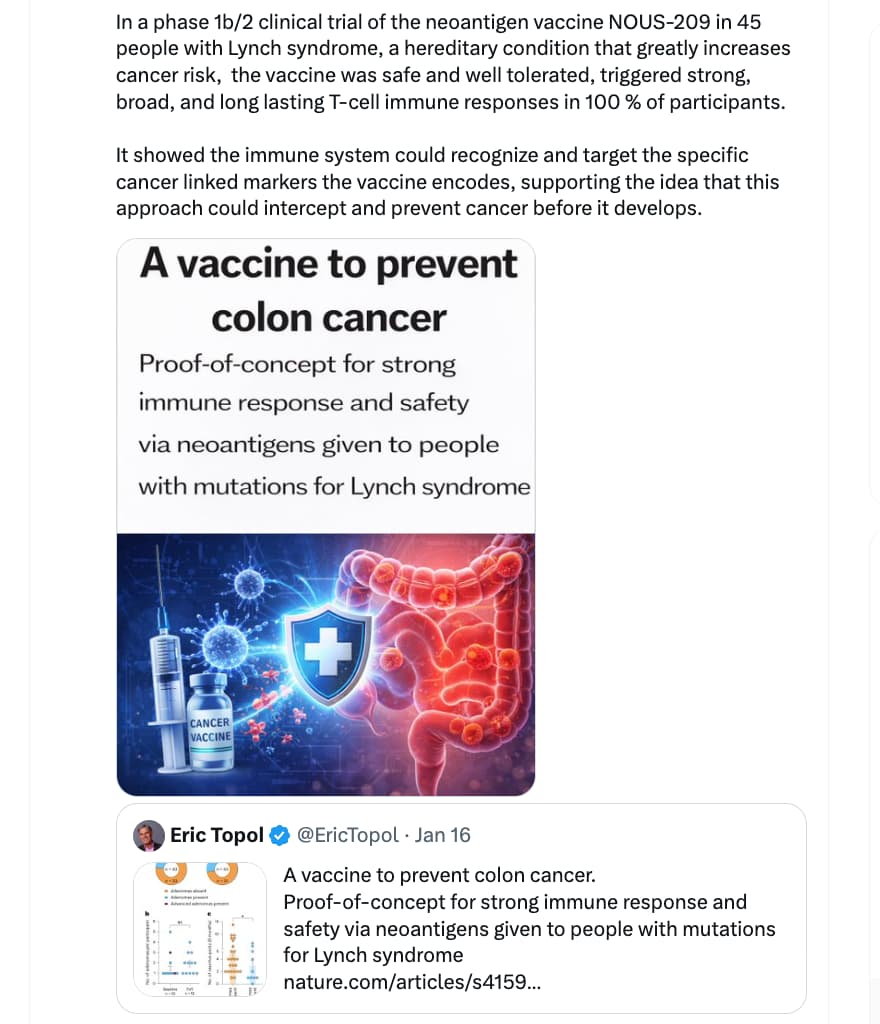
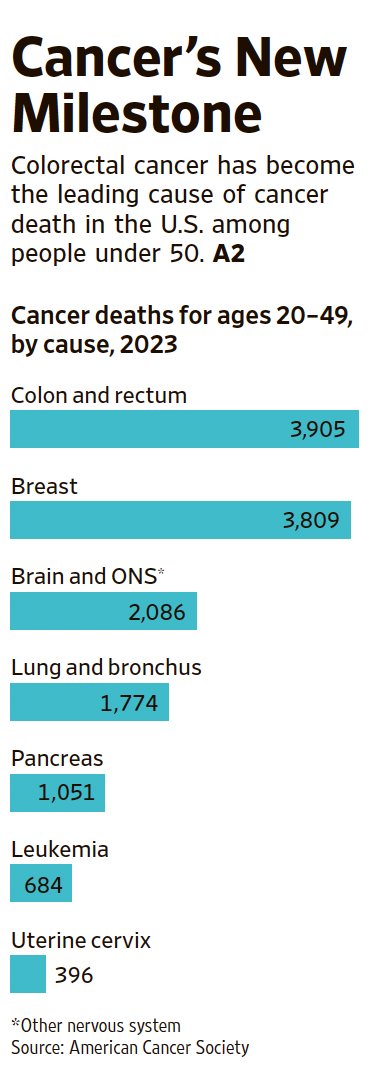
Colorectal cancer is on the rise among young people. Now it is the leading cause of cancer death in the U.S. for those under 50, according to a new analysis.
More than 1.2 million people under age 50 died of cancer in the U.S. from 1990 through 2023, American Cancer Society researchers reported Thursday.
Some 3,905 people ages 20 to 49 died of colorectal cancer in 2023, according to Cancer Society statistics, compared with 3,809 for breast cancer and 2,086 for brain and other nervous system cancers.
“This is absolutely disconcerting,” said Dr. Madappa Kundranda, division chief of cancer medicine at Banner MD Anderson Cancer Center in Phoenix, who wasn’t involved in the research.
Cancer has long been thought of as a disease of aging. Rising rates of some cancers among younger people, however, have upended the longtime stereotype, worrying health authorities and doctors and triggering research into possible causes and solutions. …
Colorectal Cancer Is Now the Top Cause of Cancer Death in Younger People - WSJ
4 Likes
3 Likes
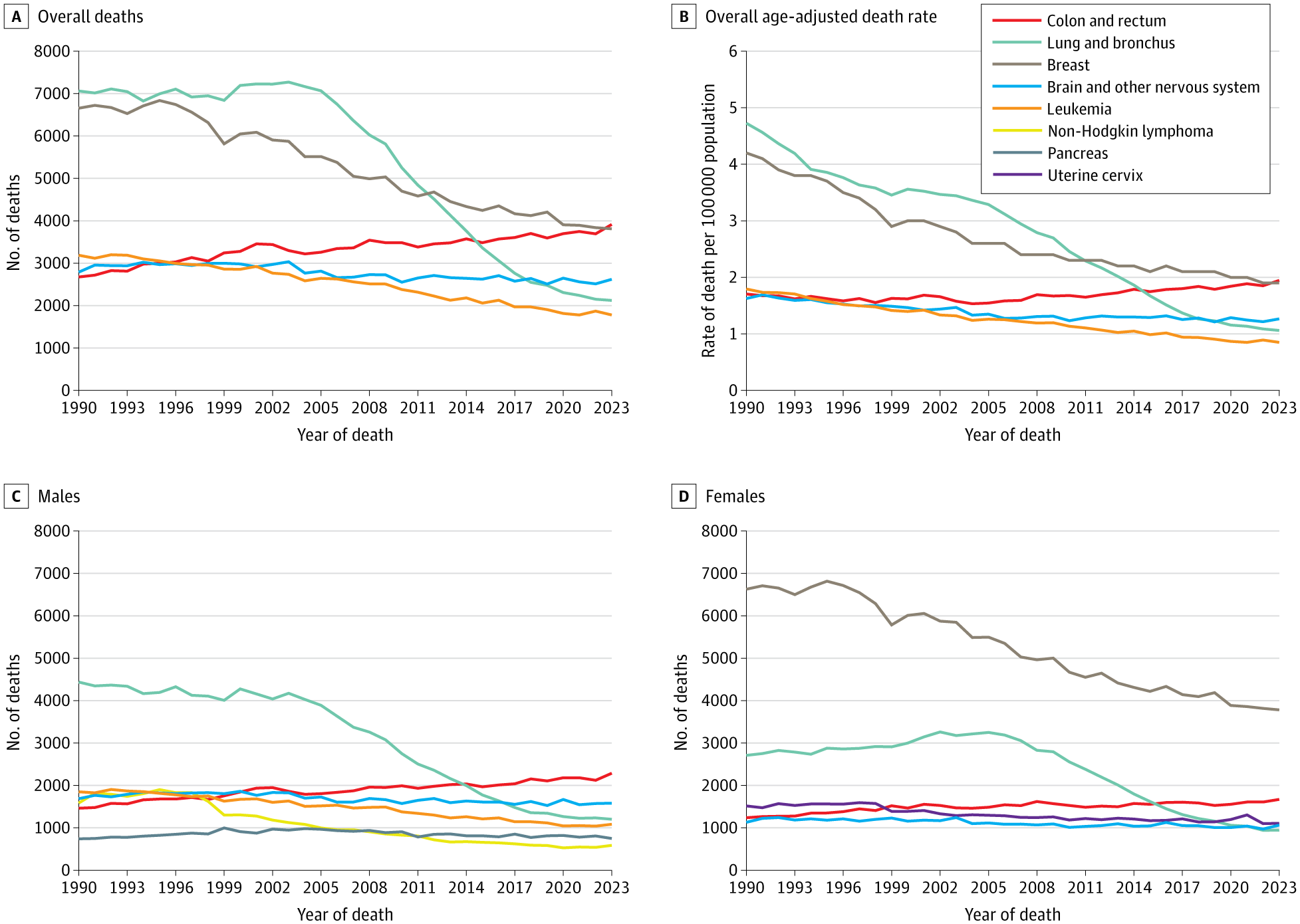
It’s worth noting that this is in substantial part the result of good news: that death from the other top cancers in young people have fallen, helping colorectal cancer rise to the top:
From 1990 through 2023, … the age-standardized death rate decreased by 44%, from 25.5 to 14.2 per 100 000. Among the 5 leading causes of cancer death, the mean annual decline from 2014 through 2023 was 0.3% (95% CI, −0.6% to −0.0%) for brain cancer, 1.4% (95% CI, −1.7% to −1.1%) for breast cancer, 2.3% (95% CI, −2.3% to −2.2%) for leukemia, and 5.7% (95% CI, −7.2% to −4.2%) for lung cancer (Table). Only colorectal cancer (CRC) mortality increased, by 1.1% (95% CI, 0.9% to 1.3%) annually since 2005, advancing it from fifth most common from 1990 through 1994 to the most common cancer death in 2023 (Figure). Conversely, lung cancer and leukemia dropped from ranking first to fourth and third to fifth, respectively,
9 Likes
New research has pinpointed exactly how many alcoholic drinks increase your risk of developing colorectal cancer.
People who drank an average of 14 drinks a week — or two per day — had a 25% higher chance of rectal cancer, and 95% higher chance of developing colon cancer, according to research published in the journal*Cancer.* Researchers used data from more than 88,000 adults who were enrolled in the Prostate, Lung, Colorectal, and Ovarian Cancer Screening Trial, and found that people who were consistent heavy drinkers had double the risk of developing colorectal cancer as their counterparts who only engaged in light drinking.
Paper: Association of alcohol intake over the lifetime with colorectal adenoma and colorectal cancer risk in the Prostate, Lung, Colorectal, and Ovarian Cancer Screening Trial
https://acsjournals.onlinelibrary.wiley.com/doi/full/10.1002/cncr.70201
2 Likes
Perspectives on Colon Aging and Decay, and how to prevent/slow it: The Colon’s Silent Decay: It’s Signaling, Not Mutations (And How to Stop it)
2 Likes
https://ergo-log.com/carotenoids-colon-rectal-cancer.html
Results
The group with the highest total carotenoid intake had a 38 percent lower risk of colon cancer and a 44 percent lower risk of rectal cancer than the group with the lowest intake. Beta-carotene, lutein, and zeaxanthin were particularly protective
5 Likes
Hey @DeStrider I am curious to know if there was any followup about this.
And based largely on your suggestions and strong recommendations, I will be having my first colonoscopy in 2 weeks’ time, just before my 40th birthday!
3 Likes
He has gone for additional tests but no cancer has been found. However he refuses to do a PET scan which would tell him exactly where any cancer would be. Due to the amount of weight loss he has, I’d say he’s in denial and will soon face the consequences of his inaction. You can lead a horse to water…
3 Likes
Well, CEA isn’t absolutely predictive - especially a small rise, so maybe it’s a false alarm? I assume he did have a colonoscopy etc, which was clear? Are the doctors recommending PET and he won’t do it? If he’s losing weight, that’s definitely something more concerning.
James Van Der Beek (Dawson’s Creek) actor just died from colon cancer, aged 48. He was diagnosed in late 2023 after noticing changes in his bowel habits. He was stage 3 at diagnosis, and so he’s survived around 2.5 years after diagnosis.
Very sad since a colonoscopy in his early 40s should have caught this and totally prevented his death. As a wealthy celebrity he should have had no problem accessing one.
One great thing is that he spent the last couple of years raising awareness of colon cancer screening, and I would suppose that his death should also cause more younger people (men particularly) to seek screening.
3 Likes
It wasn’t a small rise. It was 400% higher than the normal upper bound. That’s pretty significant. His doctors refused an MRI and told him to rerun the blood tests. I don’t know why they won’t let him do the MRI especially since he is expressing signs of cachexia. His colon and stomach are clean as he did do a colonoscopy.
1 Like
Ooh, yeah that sounds potentially nasty. Re-running the blood test isn’t a bad idea, but I’m surprised doctors are refusing to do anything though. And I’m surprised he isn’t strongly pushing to get something done. I sure as hell would be.
2 Likes
Aside from colonoscopies, which I do get, what is the best at home option to add to the mix.
This is not to delay a colonoscopy, but to have a look without waiting so many years.
And, would a whole body MRI negate the benefit of doing something like a cologuard?
Would a galleri blood test also do the trick instead?
(Again, not to replace an actual colonoscopy)
1 Like
Hi Beth, I can’t answer the specifics here, but what I do know is that colon cancer is very slow to develop and go bad. If it takes 8+ years from polyp to actual cancer, I am not sure whether adding a home testing option into the mix actually makes sense when you have colonoscopies available. It makes a lot of sense for people who don’t have access, or just don’t want to do, colonoscopies. So I would first consider whether a negative result would provide an enhanced sense of comfort. (For me, it wouldn’t, since I know colonoscopy is the gold standard and whatever test I did would be a second best option). Or, would a positive result spur us into some sort of different action that would be useful? I reckon a positive result would result in going to get a colonoscopy. So at that point, maybe it’s better just to stick with the colonoscopies?
Something like Galleri is definitely interesting, but I would think it’s more useful for cancers that don’t have good screening tests.
And FWIW, I don’t think a full body MRI has the resolution to detect pre-cancerous polyps, but I could be wrong.
1 Like
Great feedback, thank you. I didn’t know it takes that long to become cancer.
So, it sounds like if they want me to come back in ten years, if I just do it at year 6-7, I’ll be covered.
2 Likes
Exactly! I made a detailed post about this here: Prevent and cure cancer - #144 by relaxedmeatball
Colonoscopy is a case where the actual current guidelines are really quite good and would catch most cancers, with many being early stage. (The problem is that a lot of people don’t actually do the screening).
IMO, it looks like if you want to be pro-active then a first colonoscopy around 40, and then every 3-5 years afterwards should be almost failsafe. As I mentioned in that thread: " I took into account that colonoscopy isn’t perfect and it does miss some polyps and even tumours. Therefore, a scan every 3-5y is a reasonable middle ground where you’re very unlikely to miss something twice in a row, but you’re also unlikely to suddenly discover a stage 4 death sentence." (Obviously if polyps are found then you’d adjust screening frequency accordingly).
It just makes me think again that somebody like James Van Der Beek would have likely found an early-stage tumour at 40, and would definitely have found a tumour at 43. Unfortunately he was not tested until he was already symptomatic at age 46, and indeed discovered a stage 3, terminal, cancer.
3-5 years, got it! This is year 4 for me, so it sounds like I can just go 2027.
How are you personally making the decision between 3-5 years? Is it if you had a polyp or not?
I guess this means people who are dying from colon cancer are simply not being screened?
10 years just seemed to be a long time, so I had assumed something was happening within that time
1 Like
For me personally, I’ve never had a colonoscopy (yet). My first one will be next week actually - just before my 40th birthday!
If anything is found, I would go for every 3 years. If all clear, 5 should be fine. Really it’s just about the cost, and the potential adverse effects like bleeding, perforations etc. They’re pretty small though.
And yes, basically people dying from colon cancer are not having colonoscopies. They might be doing stool tests which catch later stage disease, allow some treatment and give them a few extra months. But basically, if everybody started at age 40 and did a colonoscopy every 3 years, we could have almost no deaths from colon cancer. (But at a population level this wouldn’t be a good return on investment. A huge amount of effort, expense etc).
10 years is a long time, but it’s quite well backed by the science I think. (Again, I’m not an oncologist or cancer researcher, and this is just my own opinion from reading the various guidelines and looking up the rates of tumour growth etc).
3 Likes
I don’t know if posted before or not:
New bacterial therapy destroys cancer without the immune system | ScienceDaily
1 Like