I thought this study was interesting, if we believe the fMRI data and it’s not like the dead fish fMRI experiment. Study published a few days ago in Cell (a top science journal).
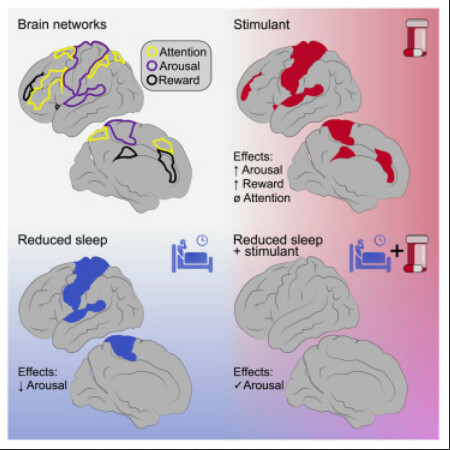
Stimulant medications light up in areas for arousal, reward, not attention. It matched patterns of “sleeping longer at night”
Bryan Johnson vindicated.
It’s interesting in one sense, people without ADHD choose to sleep less → cognitive deficits → take stimulant → activates in areas of “sleeping longer”. The downside might be less sleep the next night into a vicious cycle. The effects are also in a more wakeful and rewarded configuration, rather than improving attention.
Prescription stimulants (e.g., methylphenidate) are thought to improve attention, but evidence from prior fMRI studies is conflicted. We utilized resting-state fMRI data from the Adolescent Brain Cognitive Development Study (n = 11,875; 8–11 years old) and validated the functional connectivity findings in a precision imaging drug trial with highly sampled (n = 5, 165–210 min each) healthy adults (methylphenidate 40 mg). Stimulant-related connectivity differences in sensorimotor regions matched fMRI patterns of daytime arousal, sleeping longer at night, and norepinephrine transporter expression. Taking stimulants reversed the effects of sleep deprivation on connectivity and school grades. Connectivity was also changed in salience and parietal memory networks, which are important for dopamine-mediated, reward-motivated learning, but not the brain’s attention systems (e.g., dorsal attention network). The combined noradrenergic and dopaminergic effects of stimulants may drive brain organization towards a more wakeful and rewarded configuration, improving task effort and persistence without effects on attention networks.
Stimulants and sleep have similarly beneficial effects on performance
Stimulants34,35 and getting sufficient sleep148,149 are both thought to have beneficial effects on attention and working memory. The ABCD Study collected data on parent-reported school letter grade, out-of-scanner performance on the NIH Toolbox,150 and in-scanner performance on the n-back task. These cognitive measures were modeled against stimulants taken on the day of scanning and sleep duration with age, sex, and socioeconomic covariates (STAR Methods). ADHD was associated with significantly worse school grades, NIH Toolbox performance, and rate of correct responses on the n-back, while getting more sleep was associated with significant improvement in all of these measures (Table 2). Children with ADHD who took a stimulant had improved cognitive performance on all measures compared to those who did not take a stimulant (significant ADHD × stimulant interaction), and children with less sleep had better school grades if they took a stimulant (significant negative stimulant × sleep interaction). Children getting adequate sleep who did not have ADHD did not have better school grades, NIH Toolbox scores, or rate of correct responses on the n-back compared to those who did not take a stimulant. Taking a stimulant did significantly improve reaction time on the n-back by about 100 ms independent of other factors. Thus, overall, stimulants improved cognitive performance only for participants with ADHD or insufficient sleep (see p values in Table 2).
https://www.cell.com/cell/fulltext/S0092-8674(25)01373-X
Note: this is not about ADHD treatment, stimulant medications have massive benefits including on lifespan and mortality among other things. As said in the study:
“… Thus, overall, stimulants improved cognitive performance only for participants with ADHD or insufficient sleep (see p values in Table 2).” (in children).