How exactly would one take action on something like that?
I do encourage my kids to eat “real” food, like crunchy vegetables, chewier meat etc - not just mushy processed stuff. I’m vaguely aware of some ideas that eating soft food may adversely affect jaw development (and thus result in overcrowding of teeth etc), but I don’t know if that’s real science or pseudoscience.
Very important. This is something I’ll be doing if I have children.
@relaxedmeatball I’m no expert but I think when your children are young take them to an orthodontist/orthopedist who can keep an eye on development and intervene if necessary to correct problems with the airway. It’s much easier when you’re young to correct these things.
I’m seeing one right now and they told me this exact thing, now I have to do a more involved surgery to correct my nasal breathing and my jaw which controls overall breathing.
This is net negative for sure. What if it gets stuck in the airway. Lots of kids have died this way.
Psuedoscience often leads to suboptimal decisions. Just make sure to not create a habit out of breathing through the mouth (e.g after a cold).
When I say “kids” I mean like 5+, not infants or those learning to eat.
For example, I may encourage them to eat steak and a French baguette (chewing needed) rather than minced beef and soft sliced bread (almost no chewing needed). Or eating crunchy raw carrots rather than blended/pureed or cooked carrots. I’m not obsessed with it, but I am mindful that we don’t want to feed them nothing but mush all the time.
You’re right though that choking is definitely a very serious issue. We are careful and don’t allow things like marbles, hard candy, boiled sweets etc in the house at all. My wife and I have also both taken first aid courses on choking rescue, CPR etc back when she first got pregnant.
Research Paper:
Adverse Experiences, Protective Factors, and Obesity in Latinx and Hispanic Youths
Findings In this cross-sectional study of 5435 youths from the Adolescent Brain Cognitive Development (ABCD) study, ACEs were associated with increased BMI. Youth-reported self-coping skills and perceived caregiver support moderated the association of ACEs with BMI among Latinx and Hispanic youths, who had a greater number of ACEs and higher BMI than non-Hispanic youths.
Meaning These findings suggest that ACEs may increase youth obesity risk, but promotion of resiliency-focused skills may help improve pediatric weight trajectories among disproportionately impacted populations.
https://jamanetwork.com/journals/jamanetworkopen/fullarticle/2842300
Childhood Trauma Accelerates Aging. This Therapy Can Change That.
New UCSF research reveals that Child-Parent Psychotherapy doesn’t just heal emotional wounds — it repairs a biological process that could benefit kids for life.
“There is a very common misconception that at early ages, children are too young to understand when terrible things happen,” says Alicia Lieberman, PhD, director of UC San Francisco’s Child Trauma Research Program and the Irving B. Harris Professor of Infant Mental Health. “People think that at ages 5 and under, kids are too young to know when their parents are overwhelmed with grief and shame. They’re not too young. What they see, feel, and hear lives in them.”
It lives in them mentally and emotionally. And it lives in them physically.
A robust vein of research in stress biology has revealed that early childhood trauma is associated with a host of serious short- and long-term health issues, including diabetes, heart disease, asthma, cognitive decline, immune disorders, and cancer.
Scientists are working to explain exactly how this complex translation from mental to physical health occurs. In recent years, they’ve made enormous strides in understanding epigenetics — the study of the chemical processes that regulate gene activity and expression.
https://magazine.ucsf.edu/childhood-trauma-accelerates-aging-therapy-can-change
I recently finished a very nice book on the topic: “The Book You Wish Your Parents Had Read” by Phillipa Perry. I guess she was ahead of her time since all of these studies are coming out supporting her ideas.
From what I remember, the basics are:
-
Acknowledge their emotions, rather than downplaying them or telling them to suppress them. My kids fight over the most trivial unimportant things. If I downplay or ridicule it, they will feel like I don’t respect them, because those things are important to them.
-
Acknowledge your own emotions. Admit when you’re wrong. Apologise for doing bad/wrong things. We’ve all been sleep deprived, hungry, distracted etc and lashed out or carelessly said things we don’t mean. Apologising goes a long way and actually strengthens your bond.
-
Don’t go immediately for punishment, but consider why they are doing what they’re doing. They may be angling for attention, expressing frustration, displaying fear and trying to distract themselves etc. I recently had this where my youngest was starting a new class with a different teacher, and he was being an absolute little shit on the morning before class. Then I realised he’s probably worried, and as soon as I asked him about whether he was scared, the naughty behaviour switched off like magic.
-
Teach and connect, rather than coerce, to get the behaviours you want. So sure, I can force, manipulate or lie to them to quickly and conveniently get the outcome I want. However, there’s a cost to doing that because kids are extremely smart and soon they figure out that you can’t be trusted. That’s not a good foundation for a lifelong relationship.
-
Allow the child to explore for themselves and allow the child to safely experience failures. If you protect them from everything, they learn that mistakes are all catastrophic and it’s extremely stressful. And they also lack any sort of confidence for dealing with failure. As a professor, I see this in many of my high-achieving students who have gone through all sorts of exams etc with great scores. But now they’re suddenly in the lab, their experiments aren’t working and they are really upset by it. Some have even quit, or get depressed.
-
Think of a child not as a project to manage, but as a person with whom you are building a lifelong relationship. For me, this sort of long-term thinking has been really useful. We’re a longevity forum so I’d like to have 50+ years to spend with my kids, and to meet my great grand-kids.
The Canadian Paediatric Society is recommending cholesterol screening for all kids between two and 10 years old.
The position statement released Friday says atherosclerosis — or plaque buildup in the arteries, including cholesterol — starts in childhood and is a key driver of heart disease and stroke.
Lead author and pediatric cardiologist Dr. Michael Khoury says about one in 300 people have high cholesterol caused by a genetic condition passed down through families.
He says universal screening with a blood test will allow doctors to identify the condition early and begin treatment, including diet and physical activity.
Khoury says those lifestyle changes aren’t enough for many kids with severely high cholesterol and treatment with medications can begin at age eight.
He says treating the condition in childhood can prevent cardiovascular illness from appearing in adulthood.
“We’re working to treat the 20-, 30- and 40-year-old version of that child,” said Khoury, who specializes in preventive cardiology at the Stollery Children’s Hospital and the University of Alberta in Edmonton.
Dyslipidemia in children: Diagnosis, evaluation, and management | Canadian Paediatric Society
Dyslipidemia in children: Diagnosis, evaluation, and management
Weighing down the future: long-term effects of childhood obesity on intergenerational mobility
“We find that compared to their normal-weight peers, obese children experience substantially less upward income mobility, ending up approximately 20 percentile points lower than their parents in the adult income distribution and being less likely to live in higher-opportunity neighborhoods.”
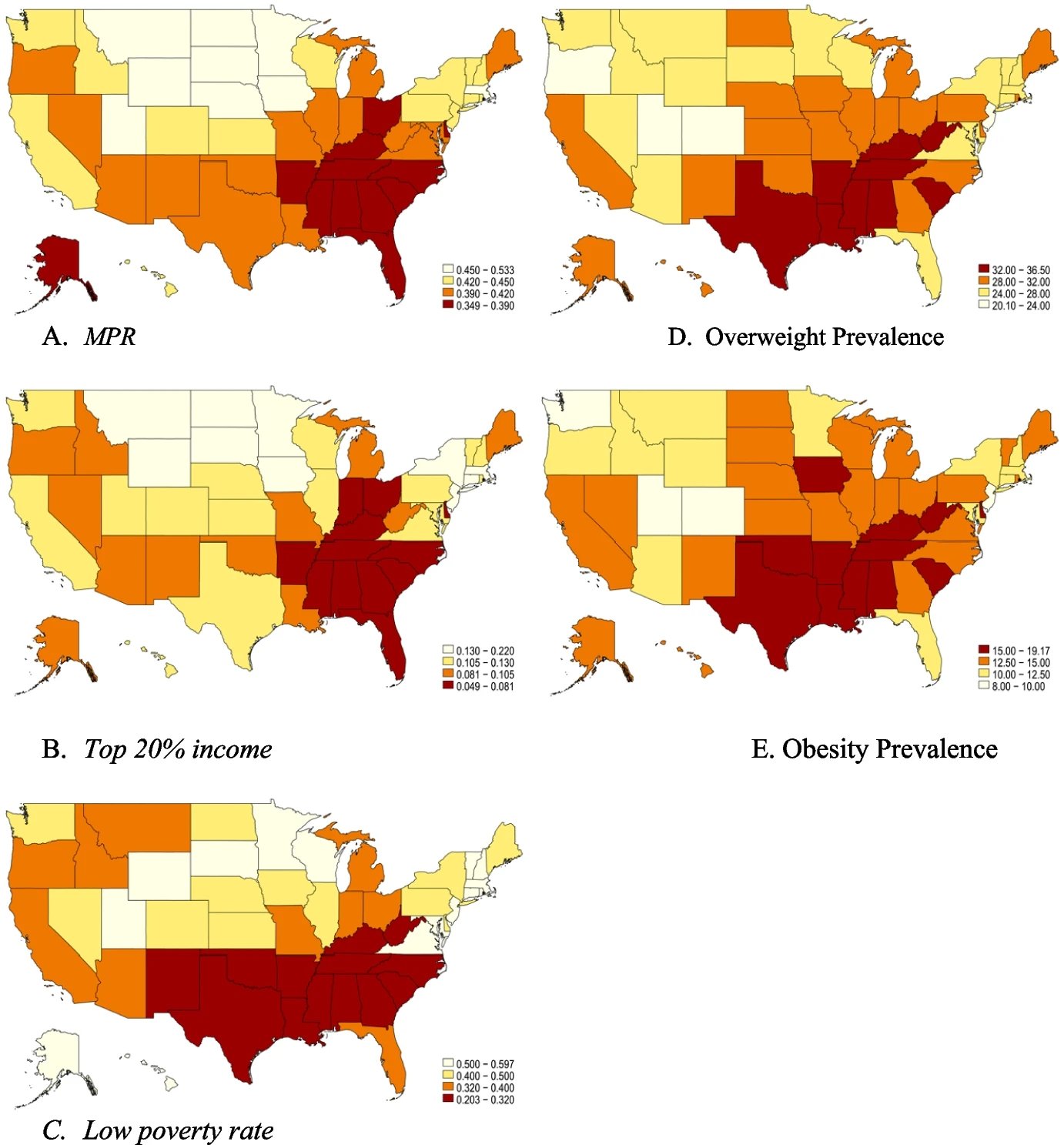
Maternal Obesity Decreases Offspring Lifespan
Data in mice, nonhuman primates, and in humans demonstrate that exposure to maternal obesity increases the risk of multiple diseases in offspring. However, little is known about the aging effects of maternal obesity on the offspring. This study shows that maternal obesity significantly reduced the lifespan of both male and female mice born to obese dams despite being weaned onto a healthy diet at three weeks of age.
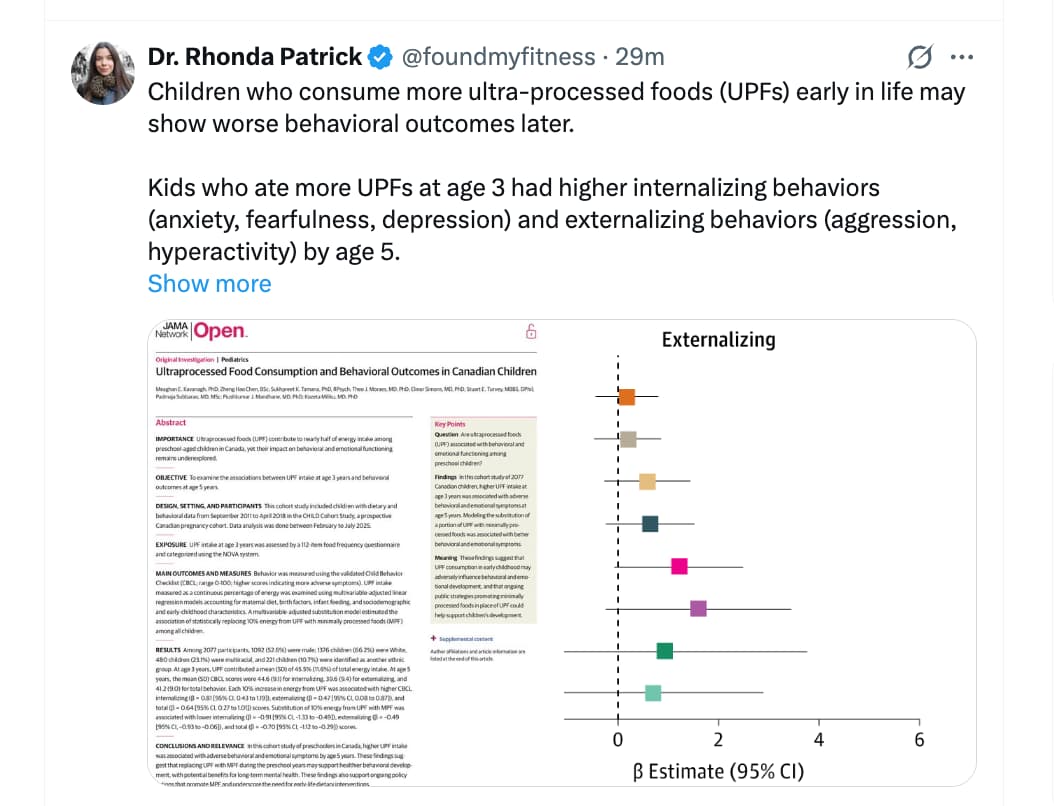
And all the CI’s cross 0 in the image, meaning they’re not statistically significant…
Classic Rhonda, haha.
The correlation also wouldn’t surprise me, since I’m sure that more caring parents who pay attention to nutrition and not feeding their kids junk is also correlated with less mental health issues.
It could be deliberate, Rhonda’s posted before that P-values are arbitrary. At least we know the concept of p-hacking might not be that valuable to her.
Wait till she remembers the threshold for statistical significance once you adjust for multiple comparisons with the Bonferroni correction, lol, as 0.05 is so arbitrary to her.
The Bonferroni correction compensates for that increase by testing each individual hypothesis at a significance level of α / m
, where α
is the desired overall alpha level and m
is the number of hypotheses.[2] For example, if a trial is testing m = 20
hypotheses with a desired overall α = 0.05
, then the Bonferroni correction would test each individual hypothesis at α = 0.05 / 20 = 0.0025
. The method is named for its use of the Bonferroni inequalities.[3]
Childhood oral health is associated with the incidence of atherosclerotic cardiovascular disease in adulthood
Highlights
• First nationwide cohort study linking childhood oral health to adult atherosclerotic cardiovascular disease (ASCVD) incidence.
• Utilizing registry data from over 568,000 individuals spanning more than two decades.
• Poor oral health in childhood is associated with increased risk of adulthood ischemic heart disease, myocardial infarction, and ischemic stroke.
• Declining or persistently poor oral health trajectories across childhood is associated with higher ASCVD risk incidence.
https://www.internationaljournalofcardiology.com/article/S0167-5273(25)01194-5/fulltext
Some early time sensitive experimental suggestions:
Whole genome sequencing at birth so early treatment can begin as soon as medically indicated.
Cord blood, cord and placental tissue storage at birth. Use a facility protected from floods, earthquakes, power outages, etc
Fecal matter storage before the baby is ever exposed to antibiotics
Early allergen exposure extrapolating LEAP study (Learning Early About Peanut Allergy) to other allergens
Begin introduction to multiple languages early to encourage fluency.
And of course the basics:
Follow all relevant breastfeeding, supplement, sleep, vaccine and (lack of) screen time recommendations.
Model healthy diet, exercise and relationships for your child