The Poly-Pill Era? Combinatorial Drug SRN-901 Outperforms Benchmarks in Late-Life Aging Study
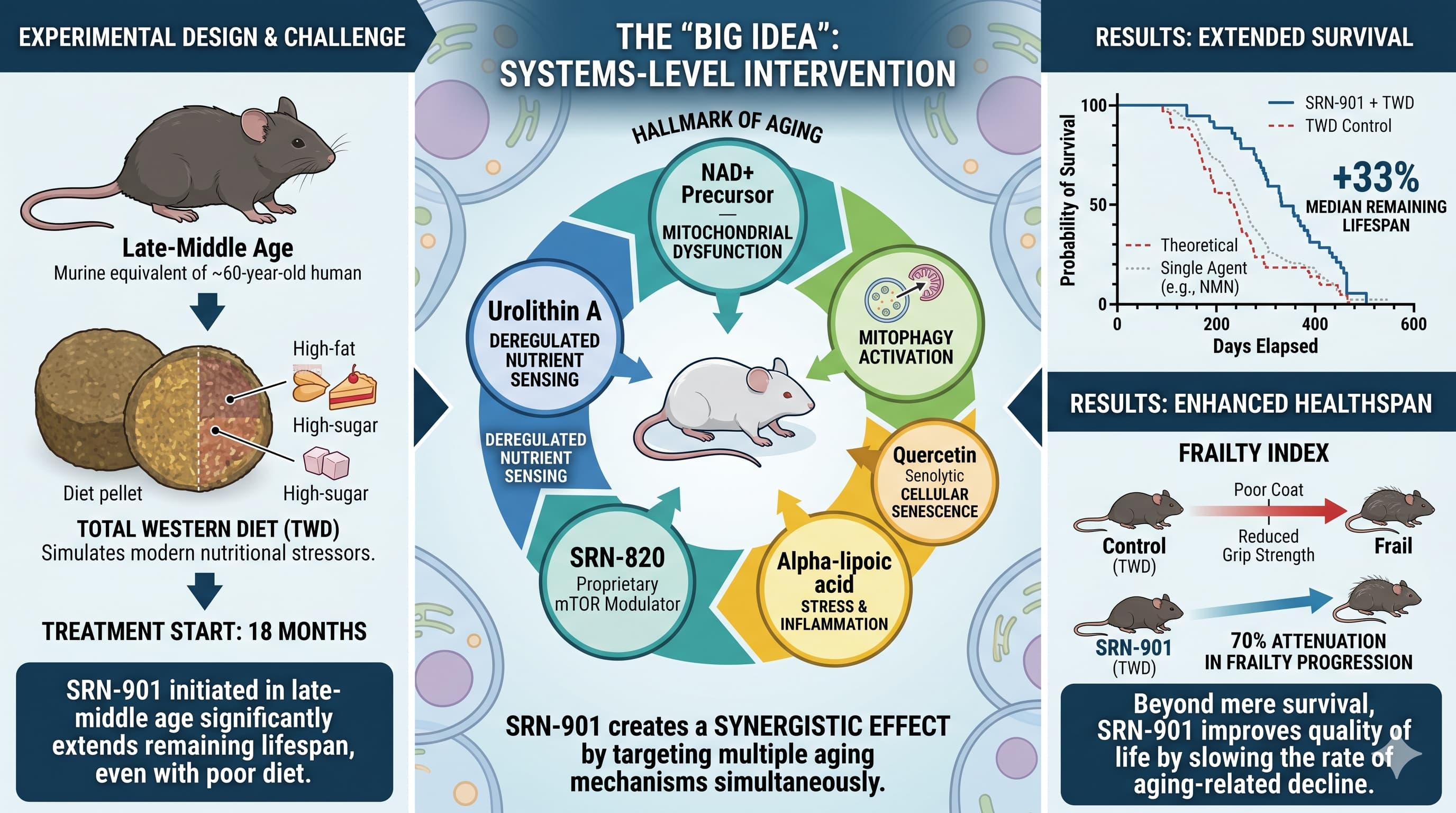
Recent research published in April 2026 marks a potential shift in geroprotective strategies, moving away from “magic bullet” single molecules toward complex, multi-target cocktails. The study investigates SRN-901 , a novel oral formulation that successfully extended the median remaining lifespan (not total lifespan) of 18-month-old mice by 33% (a 10.7% increase in median total lifespan). This is particularly significant as the treatment was initiated in late-middle age—the murine equivalent of a 60-year-old human—while the subjects were fed a “Total Western Diet” (TWD) to simulate modern human nutritional stressors.
The “Big Idea” behind SRN-901 is systems-level intervention. While individual compounds like NMN or NR have shown mixed results in late-life starts, SRN-901 combines an NAD+ precursor, a mitophagy activator (Urolithin A), a senolytic flavonoid (Quercetin), an antioxidant (Alpha-lipoic acid), and a proprietary mTOR modulator (SRN-820). By targeting five distinct hallmarks of aging simultaneously, the drug appears to create a synergistic effect that single agents struggle to replicate.
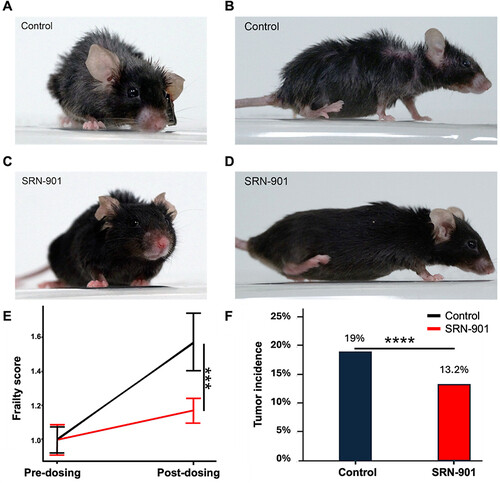
Beyond mere survival, SRN-901 demonstrated profound “healthspan” benefits. Treated mice showed a 70% attenuation in frailty progression. Visually, the treated cohorts maintained better grooming and posture, avoiding the kyphosis (hunching) typical of aging. Molecularly, the drug “re-tuned” the blood’s metabolic profile to resemble that of much younger animals, upregulating cellular repair and DNA-maintenance pathways while aggressively suppressing chronic inflammation and pathways associated with neurodegeneration and cancer. Most notably, tumor incidence dropped by approximately 30%.
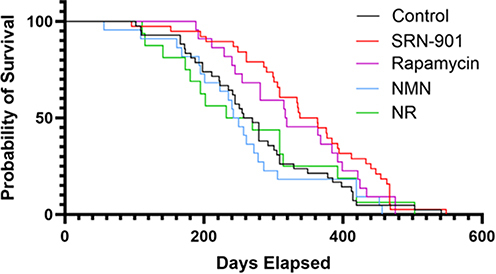
This study positions SRN-901 as a superior alternative to current benchmarks. In the same experimental conditions, while Rapamycin showed moderate benefits, individual NAD+ precursors (NMN and NR) failed to significantly extend median lifespan. The results reinforce the growing consensus in longevity science: aging is too complex for a single-target fix; the future of lifespan extension likely lies in carefully calibrated molecular “symphonies”.
Actionable Insights
The findings offer several practical takeaways for those interested in longevity optimization:
Prioritize Synergistic Cocktails Over Solo Agents: The failure of solo NMN and NR to extend lifespan in this late-onset, Western-diet model—contrasted with SRN-901’s success—suggests that “stacking” compounds targeting different pathways (e.g., NAD+ + Mitophagy + Senolytics) is more effective than high-dose monotherapy.
Late-Life Intervention is Viable: You do not necessarily need to start longevity protocols in your 20s to see results; SRN-901 was effective even when started in the murine equivalent of age 60.
Mitigate the “Western Diet” Penalty: The study used a high-fat, high-carb diet to mimic modern living. SRN-901’s ability to “rescue” the metabolic profile under these conditions suggests that specific compounds (Quercetin, ALA, Urolithin A) may help buffer the systemic damage caused by poor dietary choices.
Focus on Biomarkers of Frailty: Longevity is not just about time; it is about functional capacity. The use of a 24-parameter frailty index highlights that monitoring physical attributes (grip, coat quality, gait) is a valid way to track the biological “speed” of aging.
Note: It seems likely that the “proprietary mTOR modulator (SRN-820)” is doing the heavy lifting (i.e. is responsible for most of the lifespan/healthspan improvement) in this study… you have to wonder if they are just doing a combination with a generic rapalog (e.g. everolimus) so they can patent that “unique” combination.
Journal Name:Drug Design, Development and Therapy.
Impact Evaluation: The CiteScore of this journal is 8.2, evaluated against a typical high-end range of 0–60+ for top general science, therefore this is a Medium-to-High impact journal for specialized pharmacological research.
N-Number: SRN-901 (n=44); Control (n=44); Rapamycin, NMN, NR (n=24 per group).
Diet: Total Western Diet (TWD).
Lifespan Analysis
The control group (Placebo + Western Diet) showed a median remaining lifespan of 263.5 days starting from 18 months of age (~547 days), totaling a median lifespan of ~810.5 days.
Reference Comparison: Compared to the benchmark data in the provided reference (e.g., NIA Interventions Testing Program), where C57BL/6 mice often reach 850–900+ days on standard chow, these controls are slightly shorter-lived. However, this is expected and appropriate given the Total Western Diet (TWD) paradigm, which intentionally induces metabolic stress. The controls are not “pathologically” short-lived but represent a realistic model of a standard aging human [Confidence: High].
Lifespan Data
SRN-901 Extension: 33% increase in median remaining lifespan.
Absolute Time (Median): 350.5 days (Treated) vs. 263.5 days (Placebo).
Hazard Ratio: 0.54 (46% reduction in the hazard of death).
Max Lifespan: While median data is robust, the Kaplan-Meier curves suggest an increase in the “long-lived tail,” though maximum lifespan statistics were not explicitly isolated in the text beyond the curve visualization.
Mechanistic Deep Dive
SRN-901 functions as a multi-modal “metabolic re-programmer”:
Mitochondrial Dynamics: Urolithin A drives mitophagy, while Alpha-lipoic acid engages AMPK-dependent redox regulation.
Nutrient Sensing: The formula suppresses the PI3K/Akt/mTORC1 axis (via SRN-820 and Quercetin), mimicking the effects of caloric restriction despite the high-fat diet.
DNA Integrity: Transcriptomics showed a significant upregulation of DNA repair and the p53 pathway , which likely contributed to the 30% reduction in tumor incidence.
Metabolomics: Noteworthy “rescue” of niacinamide and glutathione metabolism, reducing oxidative stress markers like 11beta-PGE2 and pro-inflammatory ceramides.
Novelty
This is the first study to demonstrate that a specific five-component combination can significantly outperform Rapamycin and NAD+ precursors (NMN/NR) in a late-life intervention model under Western diet conditions. It provides empirical evidence that targeting multiple hallmarks of aging simultaneously can overcome the limitations of single-drug interventions.
Critical Limitations
Translational Uncertainty: While the TWD model is superior to standard chow for human modeling, mouse metabolism of NAD+ precursors and senolytics differs significantly from humans [Confidence: High].
Ablation Data Missing: The study does not show which of the five components is doing the “heavy lifting.” We cannot be certain if the effect is truly synergistic or if one or two components (e.g., the proprietary SRN-820) are responsible for the majority of the gain.
Proprietary Opacity: “SRN-820” is an internally established modulator. Without full disclosure of this compound’s structure, independent replication is impossible [Confidence: High].
Tissue-Specific Data: Transcriptomics and metabolomics were performed on whole blood. While indicative of systemic health, we lack direct data on organ-specific aging (e.g., cardiac or brain tissue).
This study investigates the effects of SRN-901—a novel oral combinatorial drug that consists of urolithin A, quercetin, nicotinamide riboside, alpha-lipoic acid, and Seragon’s SRN-820
SRN-901-treated mice showed a significant increase of 33% in median remaining lifespan compared to placebo-treated mice. Cox proportional hazards analysis revealed a hazard ratio of 0.54, indicating that SRN-901 treatment was associated with a 46% reduction in the hazard of death. While rapamycin increased lifespan in adult mice, nicotinamide mononucleotide (NMN), and nicotinamide riboside (NR) did not show significant differences in median lifespan compared to placebo. SRN-901 protected mice against increased frailty during aging, with baseline-normalized scores rising to 1.17 in treated mice and 1.57 in controls, corresponding to a 70% attenuation of frailty progression between pre-treatment (D-14) and post-treatment (D128; p < 0.001). Transcriptomic analyses revealed that SRN-901 modulates gene expression across pathways implicated in aging biology, including inflammation, apoptosis, and DNA repair, as well as gene sets associated with neurodegenerative disorders, including Alzheimer’s disease. Metabolic profiling revealed that SRN-901 was associated with attenuation of several age-related metabolic shifts, resulting in a blood metabolite profile that more closely resembled that of younger mice. The upregulation of glutathione metabolism and other longevity-related pathways underscores SRN-901’s role in enhancing cellular defenses against oxidative stress and maintaining metabolic health.
The 500 mg/kg/day SRN-901 dose was selected by combining nicotinamide riboside, quercetin, urolithin A, and alpha-lipoic acid in equimolar concentrations, consistent with doses previously reported in the literature to be well tolerated and to influence metabolic or aging-related pathways, together with Seragon’s SRN-820 at an internally established percentage that produced robust target engagement without gastrointestinal intolerance in prior exploratory studies. NMN (300mg/kg) and NR (300mg/kg) were purchased from Effepharm, and fed through oral gavage 6 days a week. Rapamycin was mixed in food with a concentration of 14.4 ppm. All groups (SRN-901, NMN, NR, Rapamycin, and Placebo), underwent an identical handling and gavage schedule (same frequency, time-of-day, and volume) by trained staff using a standardized procedure using either group-specific drug or vehicle (water) and no deviation events were recorded.
I wonder why they didn’t compare to urolithin A alone…
Just want to highlight one issue with this paper… it states a “33% increase in remaining lifespan”, which is a metric rarely used in the longevity research community because it is so misleading and deceptive. If you take a mouse (or person) that is near death (say 1 month from death), and give it a drug that makes it live 1 month extra, you’ve increased its remaining lifespan by 100%!! Wow - sounds great, but did you really slow down aging, or just keep them near death for a little longer.
The normal metric in mouse and other animal longevity studies is the increase median total lifespan… so if a mouse that typically lives to 30 months of age, and you give the drug to it at 29 months of age and it lives to 31 months of age, the life extension would be approx. 3.3%. Compared to 100% of remaining lifespan extension.
Keep this in mind as you read papers like this. Most labs do not publish a calculation based on “remaining lifespan” because it is so misleading…
“Remaining” vs. “Median total lifespan”
To calculate the increase in total median lifespan, we must add the age at which the intervention began to the median remaining lifespan reported in the study.
Baseline Data
The mice in this study were 18 months old when treatment with SRN-901 or the placebo began. In standard murine models, 18 months is approximately 548 days.
Placebo (Control) Median Remaining Lifespan: 263.5 days.
SRN-901 (Treated) Median Remaining Lifespan: 350.5 days.
Total Median Lifespan Calculation
By adding the starting age (548 days) to the remaining survival time, the total lifespan figures are as follows:
Control Total Median Lifespan: 548+263.5=811.5 days
SRN-901 Total Median Lifespan: 548+350.5=898.5 days
Resulting Increase
Comparing these total median values yields the following: