I am surprised that no one has discussed all-trans retinoic acid (ATRA) here. I’ve been looking into this medication and finding some interesting facts. Let’s start with
1. ATRA as a Senolytic — What the Evidence Says
This is genuinely nuanced, because ATRA has a dual and context-dependent relationship with senescence. It can either induce or clear senescent cells depending on the tissue context.
As a senescence inducer (pro-senescent): ATRA induces senescence via upregulation of p16 and p21 through promoter hypomethylation, achieved by downregulating DNA methyltransferases 1, 3a, and 3b. This facilitates binding of Ets1/2 to the p16 promoter and p53 to the p21 promoter — acting as an epigenetic drug. ScienceDirect In cancer cells this is desirable (forces malignant cells into terminal arrest), but in normal aging tissue, you would not want to induce more senescence.
As a senolytic (senescent cell clearer) — the more exciting angle: A 2024 study showed that ATRA effectively eliminated radiation-induced senescent astrocytes, and that removing these SASP-producing cells inhibited cancer cell proliferation. Furthermore, ATRA-mediated clearance improved survival in tumor-bearing mice and alleviated radiation-induced cognitive impairment. JCI Insight
RNA sequencing revealed that the AKT/mTOR/PPARγ/Plin4 signaling pathway is involved in this senescent cell clearance — suggesting ATRA could be considered a potential senolytic drug. JCI Insight
This is where the rapamycin parallel becomes clearer — both touch mTOR signaling, though via different entry points.
The NK cell angle (2024, Cancer Cell): RAR receptor activation via retinoids can reprogram the senescence response and enhance anti-tumor NK cell activity PubMed — meaning ATRA may not just clear senescent cells directly, but also revitalize immune surveillance of them, which is a more sophisticated and arguably more favorable mechanism than classical senolytics like dasatinib/quercetin.
Important caveat: The senolytic evidence so far is in cancer/radiation models. We don’t yet have clean data in physiological aging models equivalent to what exists for dasatinib+quercetin or fisetin. This is a significant gap.
2. Aortic / Vascular Remodeling — The Animal Data
This is where the evidence gets genuinely compelling.
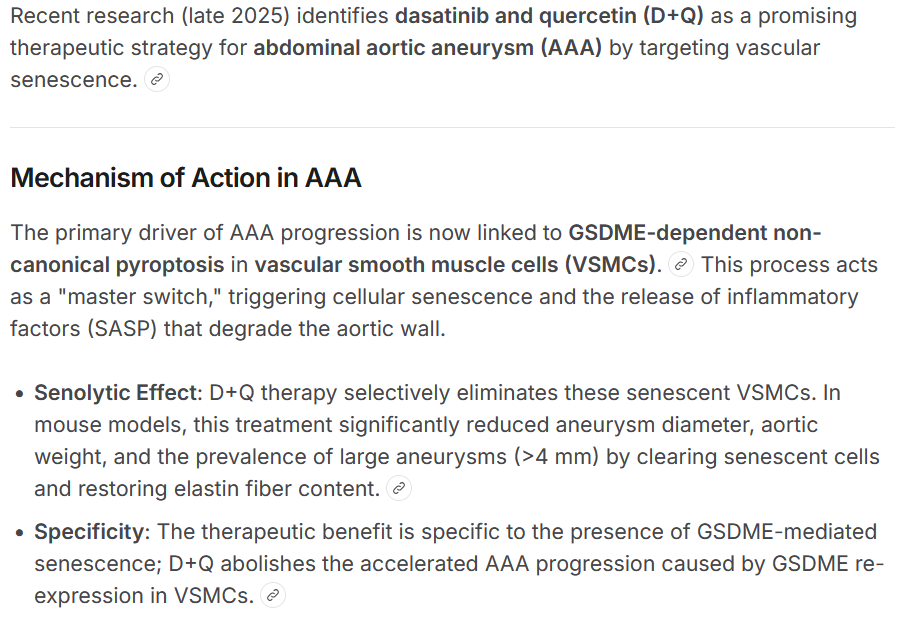
Abdominal Aortic Aneurysm (AAA) mouse model — direct and highly relevant: In ApoE-knockout mice with angiotensin II-induced AAA, ATRA treatment dramatically reduced aneurysm incidence from 75% to 25%. Elastic fiber integrity was preserved in the ATRA-treated group, while the untreated AAA group showed elastic fiber degradation and fracture. ATRA also protected smooth muscle cells and reduced MMP2 and MMP9 expression in the medial vessel. PubMed Central
This is a very significant finding — MMP2/MMP9 are the primary enzymes responsible for elastin degradation in aortic disease. ATRA appears to suppress their expression directly.
Carotid artery injury model (oral ATRA, rats): Rats given oral ATRA (30 mg/kg/day) before and after balloon withdrawal injury showed reduced neointimal formation and favorable geometric vascular remodeling. ATRA depressed peak DNA synthesis in the tunica media of injured vessels. AHA Journals The same study references earlier work showing ATRA stimulates elastin mRNA expression in vascular smooth muscle cells.
Tropoelastin and elastin synthesis: ATRA has been shown to stimulate tropoelastin mRNA expression, promoting elastin production in vascular smooth muscle cells. It also promotes SMC differentiation, restores SMC contractility in aortic rings, and inhibits calcification by increasing MGP (matrix Gla protein) and decreasing TNAP activity. PubMed Central
Atherosclerosis and aortic root — oral study in ApoE mice: Oral ATRA at 5 mg/kg/day for 8 weeks in ApoE-deficient mice reduced atherosclerotic lesion area in the aortic root by 53% compared to controls. PubMed Central This is a direct aortic root finding, which is particularly relevant to your question.
Anti-calcification effects: ATRA suppresses calcification in human arterial smooth muscle cells and aortic valvular interstitial cells via RARα, by increasing the calcification inhibitor MGP while decreasing the calcification-promoting enzyme TNAP. AHA Journals This means ATRA may address two distinct mechanisms of aortic root stiffening simultaneously — both elastin preservation and calcification prevention.
I’m going to try to order using @desertshores advice. Is this advice still relevant or is there a better route?
 Do we return to FOXO4-DRI?