"The placebo group exhibited significant reductions in total cholesterol, LDL-C, non-HDL-C, total LDL-P, large LDL-P, and ApoB, while the blueberry group exhibited significant reductions in total HDL-P and ApoA-I after 12 weeks compared to baseline."
Blueberry Intervention Mitigates Detrimental Microbial Metabolite Trimethylamine N-oxide By Modulating Gut Microbes
Blueberry supplementation (equivalent to 1.5 human servings) reduced circulating TMAO in CB vs C mice (~48%) without changing choline or TMA. This effect was not mediated through alterations in metabolic parameters. Dietary strawberries did not reduce choline, TMA or TMAO. Depleting gut microbes with antibiotics in these cohorts drastically reduced TMA and TMAO to not-quantified levels. Further, dietary blueberries increased the abundance of bacterial taxa that are negatively associated with circulating TMA/TMAO suggesting the role of gut microbes. Our phenolic profiling indicates that this effect could be due to chlorogenic acid and increased phenolic contents in blueberries. Our study provides evidence for considering dietary blueberries to reduce TMAO and prevent TMAO-induced complications.
Dietary phenolics and their microbial metabolites are poor inhibitors of trimethylamine oxidation to trimethylamine N-oxide by hepatic flavin monooxygenase 3
Quote:
“However, bioavailable chlorogenic acid metabolites did not generally inhibit FMO3 at physiological (1 µM) nor supra-physiological (50 µM) doses. Thus, the effects of chlorogenic acid in regulating TMAO levels in vivo are unlikely to occur through direct FMO3 enzyme inhibition. Potential effects on FMO3 expression remain unknown. Intestinal inhibition of TMA production and/or absorption are thus likely their primary mechanisms of action.”
Here is the high-resolution summary and analysis of the provided transcript.
A. Executive Summary
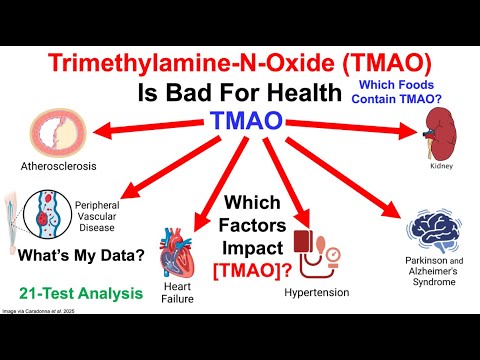
This video provides a deep dive into Trimethylamine N-oxide (TMAO), a gut-microbiome-derived metabolite associated with increased risk of heart failure, kidney disease, atherosclerosis, and all-cause mortality. The core thesis argues that while TMAO is dangerous, the dietary solution is nuanced. Although fish is the highest dietary source of pre-formed TMAO, data indicates fish intake is not associated with adverse outcomes (like Alzheimer’s), creating a “fish paradox.” Instead, the speaker identifies the primary driver of harmful TMAO levels as gut dysbiosis—specifically, an age-related increase in gut pH (alkalinity) that allows TMA-producing pathogenic bacteria to thrive.
The speaker presents rigorous n=1 data (21 blood tests over 3 years) showing that his TMAO levels correlate inversely with garlic intake. He proposes a protocol to keep TMAO levels below the optimal target of <2 µM by acidifying the gut lumen through high fiber intake and exercise (which produce short-chain fatty acids) and consuming garlic (specifically allicin) to inhibit bacterial TMA production.
B. Bullet Summary
TMAO Toxicity: High levels correlate with atherosclerosis, kidney disease, heart failure, and peripheral vascular disease.
Metabolic Pathway: Gut bacteria convert precursors (carnitine, choline, betaine) into TMA; the liver then oxidizes TMA into TMAO.
The Fish Paradox: Cod, lobster, and orange roughy have the highest TMAO content, yet fish intake is not associated with Alzheimer’s or mortality risk.
Farmed vs. Wild: Farm-raised salmon contains significantly less TMAO/TMA than wild-caught, though wild is still preferred for other health reasons.
Gut pH & Aging: Aging is associated with a 10-fold decrease in gut acidity (pH 7 in young vs. pH 8 in centenarians).
Mechanism of Harm: Alkaline gut environments promote pathogenic bacteria that produce TMA and other toxins (Indoxyl Sulfate).
Acidifying the Gut: Short-Chain Fatty Acids (SCFAs) like butyrate lower gut pH, inhibiting TMA producers.
SCFA Sources: Fiber intake and exercise training are the primary drivers of SCFA production.
Optimal Range: Mortality risk significantly increases when TMAO exceeds 4 µM. The optimal target is <2 µM (typical of healthy youth).
Speaker’s n=1 Data: Over 21 tests, the speaker’s average TMAO was ~6 µM (high), with only two tests reaching the <2 µM target.
Top Anti-TMAO Foods: Strongest inverse correlations in the speaker’s data were Garlic, Zinc, Avocado, and Olive Oil.
Pro-TMAO Foods: Strongest positive correlations (harmful) in the speaker’s data were Salt, Dates, and Bananas.
Garlic Protocol: The speaker is currently testing a protocol of ~3–6 grams of garlic per day to replicate his best TMAO results.
D. Claims & Evidence Table (Adversarial Peer Review)
Claim from Video
Speaker’s Evidence
Scientific Reality (Best Available Data)
Evidence Grade
Verdict
“TMAO causes heart failure & atherosclerosis”
Cites general associations/studies.
Supported by Meta-analyses. High TMAO is linked to >60% higher risk of mortality/MACE. Causality is strongly suggested by animal models, though human reverse causality (kidney function) is debated.
A (Meta-analysis)
Strong Support
“Fish raises TMAO but isn’t harmful”
Cites 11-study meta-analysis on Alzheimer’s risk.
The “Fish Paradox” is real. Fish acutely spikes TMAO >50x more than meat, yet fish intake is cardioprotective. The “harmful” TMAO likely requires the context of dysbiosis or meat-based precursors (choline/carnitine).
A (Cohort/Meta)
Strong Support
“Optimal TMAO level is <2 µM”
Cites mortality hazard ratios.
Accurate. Studies show risk stratification often begins >4–6 µM. Healthy controls typically range 2–3 µM. Heart failure patients often >5–10 µM.
B (Clinical Data)
Strong Support
“Garlic reduces TMAO levels”
Cites n=1 data; mentions correlations.
Plausible. Allicin (in garlic) acts as a non-lethal inhibitor of the bacterial enzyme (CutC/D) that produces TMA. Human trials are limited but animal data is robust.
C/D (Animal/n=1)
Plausible
“Aging causes gut alkalinity (high pH) which drives TMAO”
Cites comparison of young vs. centenarians.
Supported. Aging is linked to lower SCFA production and higher colonic pH, favoring proteolytic/TMA-producing bacteria (e.g., Proteobacteria).
C (Observational)
Plausible
“Salt intake raises TMAO”
Cites n=1 correlation.
Unclear/Speculative. High salt can alter gut microbiome composition (reducing Lactobacillus), potentially increasing inflammation, but direct TMAO link is not well-established in humans.
E (Anecdote)
Speculative
E. Actionable Insights (Pragmatic & Prioritized)
Top Tier (High Confidence & Safety)
Track TMAO: If possible, test plasma TMAO. Aim for <2 µM. If levels are >4–6 µM, intervention is required.
Increase Soluble Fiber: Consume high-fiber foods to feed gut bacteria that produce Short-Chain Fatty Acids (SCFAs). This naturally acidifies the gut lumen, inhibiting TMA-producing bacteria.
Exercise Training: Engage in regular aerobic and resistance training, which independently increases gut SCFA production and lowers gut pH.
Don’t Fear Fish: Despite high TMAO content, fish (especially wild-caught) remains net-beneficial. Do not restrict fish intake unless you have advanced Stage 3b/4 Kidney Disease.
Experimental (Risk/Reward)
Garlic Supplementation (The “Allicin Protocol”):
Based on the speaker’s data and mechanistic studies, consume 2–5 grams of raw garlic daily (approx. 1–2 cloves) or a high-allicin aged garlic extract.
Note: Allicin is the active compound. If cooking, crush the garlic and let it sit for 10 minutes before heating to maximize allicin production.
Foods to Prioritize: Avocado, Olive Oil, and Zinc-rich foods (Oysters, Pumpkin seeds) correlated with lower TMAO in the speaker’s dataset.
Foods to Moderate: If TMAO remains stubbornly high, consider reducing Salt, Bananas, and Dates (based on speaker’s negative correlations), though this is less validated than the garlic intervention.
2. Can I just eat blueberries, or do I need an extract? Answer: [Confidence: High] You can eat blueberries, but you need Wild Blueberries (smaller, darker) to reach the 200 mg+ therapeutic threshold without consuming excessive fructose. Extracts (Cyanidin-3-Glucoside) are superior for ketogenic/low-carb protocols.