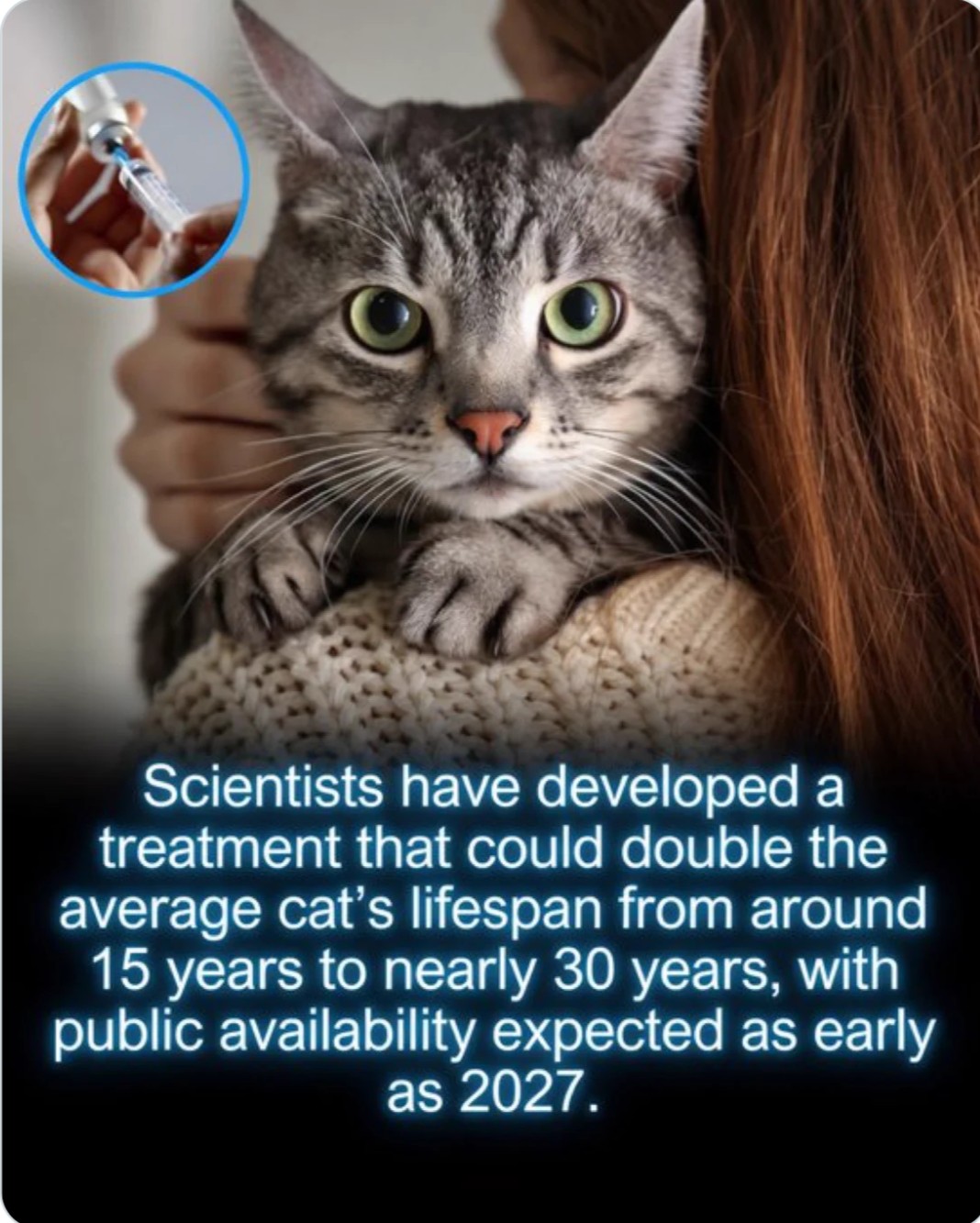
“Scientists in Japan have developed a groundbreaking treatment that could double the average lifespan of cats, extending it from around 15 years to nearly 30 years. The key lies in a protein called AIM (Apoptosis Inhibitor of Macrophage), discovered by Dr. Toru Miyazaki. While cats naturally produce AIM, they lack the ability to activate it effectively. This deficiency leads to the gradual buildup of waste in the kidneys, the leading cause of death in domestic cats. Dr. Miyazaki’s team created an injectable form of activated AIM that directly restores the kidneys’ natural cleaning function. In clinical trials, cats with advanced kidney disease showed dramatic improvement after treatment. The therapy works both as a preventive measure for healthy cats and as a treatment for those already ill. If approved, the treatment could revolutionize feline healthcare. Commercial rollout is expected to begin in Japan as early as 2025, with wider availability projected for 2027. The research has also sparked interest for its potential applications in human medicine, as the AIM protein plays a similar waste-clearing role across species.”
Fact checked by Google Gemini Pro Extended (Paid):
The provided text combines verified biological mechanisms with speculative timelines and extrapolated clinical outcomes. Below is a detailed evaluation of the claims.
Lifespan Extension to 30 Years
Verdict: Speculative.
Analysis: The 30-year figure originates from Dr. Toru Miyazaki’s book, The Day When Cats Can Live to 30. It is a theoretical extrapolation based on the premise that eliminating chronic kidney disease (CKD)—the primary limiting factor in feline longevity—could double the average lifespan. Current empirical data does not support this timeline. Confirming a doubling of lifespan requires multi-decade longitudinal studies.
Discovery and Mechanism of AIM (CD5L)
Verdict: Verified Fact.
Analysis: Dr. Miyazaki identified the Apoptosis Inhibitor of Macrophage (AIM), also categorized as CD5L, in the late 1990s. The claim that domestic cats produce AIM but cannot activate it is supported by a 2016 study published in Scientific Reports. In felines, AIM binds to the IgM pentamer with an affinity 1,000 times higher than in murine models. This structural anomaly prevents AIM from detaching to tag necrotic cellular debris during acute kidney injury. The accumulation of un-cleared cellular waste obstructs renal tubules, driving inflammation, tubulointerstitial fibrosis, and eventual CKD.
Injectable Recombinant AIM
Verdict: Verified Fact.
Analysis: Researchers have developed a recombinant feline AIM (rAIM) that bypasses the IgM binding limitation. Intravenous administration introduces free AIM that successfully tags necrotic debris, facilitating macrophage phagocytosis and restoring tubular patency.
Clinical Trial Efficacy
Verdict: Premature / Lacks Context.
Analysis: The assertion of “dramatic improvement” overstates the current clinical evidence. Data from an exploratory 2026 study involving 11 cats with advanced CKD reported a 360-day survival rate of 80–83% in the treatment group, compared to 20% in untreated controls. While this survival signal is significant and correlates with a reduction in uremic toxins, the study was non-pivotal and methodologically limited. Rigorous Phase III randomized controlled trials are required to establish safety and broad efficacy.
Preventative vs. Therapeutic Use
Verdict: Informed Speculation.
Analysis: The biological pathway suggests that early clearance of renal debris prevents the fibrotic cascade. However, clinical data currently centers on therapeutic administration in cats with existing CKD. The preventative efficacy in healthy cats represents a knowledge gap requiring distinct long-term preventative trials.
Approval and Commercial Rollout Timeline
Verdict: Inaccurate.
Analysis: Commercial rollout did not commence in 2025. As of April 2026, the drug candidate (FeliAIM) was submitted to Japan’s Ministry of Agriculture, Forestry and Fisheries for regulatory review. It remains an investigational drug. A 2027 commercial rollout is contingent upon imminent regulatory approval, and international availability will require separate filings in foreign jurisdictions.
Human Medicine Applications
Verdict: Verified Fact.
Analysis: AIM functions as a highly conserved debris-clearance protein across mammalian species. Its capacity to attenuate damage-associated molecular patterns (DAMPs) presents a viable pathway for extending human healthspan. Current academic literature investigates AIM’s application in treating human acute kidney injury, ischemic stroke, and metabolic dysfunction by enhancing the phagocytic clearance of toxic biological waste.
Implications for Human Longevity The hypothesis that an AIM therapeutic could “double” human lifespan is a false equivalency drawn from feline biology. In domestic cats, CKD is the predominant bottleneck to mortality; thus, eliminating renal failure disproportionately extends their average lifespan. In humans, mortality is driven by a diverse portfolio of age-related pathologies, including cardiovascular disease, oncology, and neurodegeneration.
However, the underlying mechanism—improving the clearance of necrotic cellular debris and mitigating DAMP-induced chronic inflammation (often termed “inflammaging”)—is highly relevant to extending human healthspan. Upregulating endogenous AIM or administering recombinant AIM could theoretically delay the onset of fibrotic diseases and improve tissue resilience across multiple organ systems.