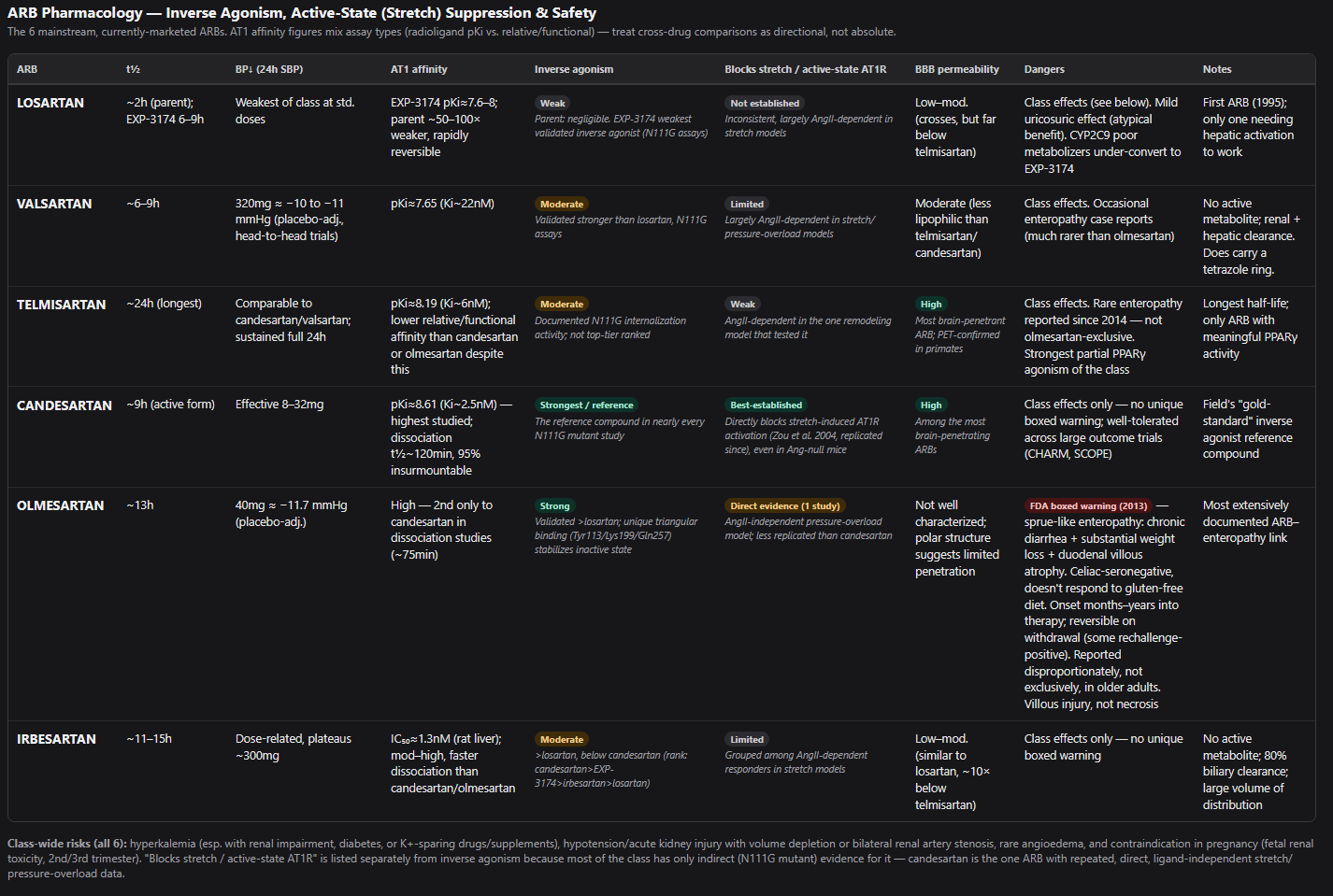
Rilmenidine vs Telmisartan or other BP meds for Longevity

I am on 160 mg Of Telemisartan for nearly a year now. I am taking it for the PPAR agonism. Monitored potassium - initially it went upto 5, now it has settled at 4.75. Pleased with it. I am experimenting to increase my insulin sensitivity but no clear cut outcome. I am also on Pioglitazone 7.5mg and the polypharmacy muddles the picture and now the peptides are muddling it more. There will be light at the end of the tunnel!

4 Likes

I have read that telmisartan is used to prevent kidney decline in those with CKD (chronic kidney disease) even with a normal BP. Based on graphs I’ve seen of kidney function over time, specifically Cystatin C with age, basically everyone gets CKD eventually without any intervention.

Activation of the renin-angiotensin-aldosterone system (RAAS), especially angiotensin-2 is involved in CKD pathogenesis and its cardiovascular complications.[10] Drugs interfering with the renin-angiotensin system, i.e. angiotensin converting enzyme (ACE) inhibitors and angiotensin II receptor antagonists (ARBs) are of choice as they have a blood pressure-independent antiproteinuric effect. During therapy with ACE inhibitors, angiotensin II escape prevents complete RAAS inhibition, due to alternative non-ACE pathways. However, ARBs overcome this limitation by selective blockade of the AT1 receptor and therefore angiotensin II escape observed with an ACEI do not occur with an ARB.[11,12] They are used to maximize RAAS inhibition and more effectively reduce proteinuria and decrease in GFR in diabetic and nondiabetic renal disease.[10] ARBs reduce protein excretion by approximately 35% to 40%, which is greater than other antihypertensive agents.[13] As CKD continues to rise, measures to prevent disease progression is an important goal. Among RAAS inhibitors, ARBs are preferred because of advantage discussed earlier and also because of the fact that ACE inhibitors are known to cause dry cough in a higher proportion of the Asian population. Literature search did not reveal specific study with telmisartan carried out in real-life setting in Indian patients. The aim of the present study was to examine the effects of telmisartan in patients with CKD.

Telmisartan is used to prevent kidney decline in CKD? But it can also cause renal injury? Does anyone know if a drug like this could be preventative to try and slow down kidney aging / EGFR decrease over time independent of BP effects? I know Peter Attia had trouble some while ago finding a nephrologist working in prevention.

2 Likes

Thanks. No sources provided by Gemini so hard to comment. Telmisartan is indeed a great drug, probably the best antihypertensive. I’m taking 80 mg.

2 Likes

That’s interesting. I am currently on 80mg/day of telmisartan and interested in 160mg. I was going to pair it with pioglitazone 7.5mg/day, but all my plans went out the window because of unexpected surgery coming up (ACDF) involving fusion of a couple vertebra in my neck with titanium plate and screws. The bone fusion is critical and can take up to 18 months. Since pioglitazone is a negative for bone health (suppresses osteoblasts, can enhance osteoclasts), I don’t want to risk poor bone fusion in my cervical spine. This means at least an 18 month delay of the pioglitazone for me.

Can you speak to your experiences/results of the 160mg telmisartan dose? Thx.

I too had a cervical fusion, except no Ti plates but bone graft from iliac crest. I had broken C5 and C6 at the age of 18! Anyways many moons ago!

I am afraid other than my potassium levels I cannot speak to anything. My BP did not change between 80 and 160 other than day to day fluctuations, nothing ascribable. Tell me what I should be looking for and I will respond. My Hba1c is around 7.2, had been as high as 12, but this decrease is due to Semaglutide and Tirzapetide. I am continuing with 160 because I did not experience anything negative and I can tolerate the added cost.

Among other good things, combining Telmisartan and an SGLT2 inhibitor creates a “bookend” geroprotective for aging kidneys. Telmisartan acts primarily at the efferent arteriole (glomerular exit), while SGLT2 inhibitors act at the proximal tubule and afferent arteriole (glomerular entrance). The two create synergistic hemodynamic and metabolic protection. It is a combination worth considering by older adults, including those whose BP is at least toward the middle of the normal range. My long term mean systolic BP was 118 before initiating telmisartan but the standard deviation was high. Adding 80 mg. Telmisartan lowered the mean to ~108 and significantly lowered the SD below the equivalence of the lower mean (another discussion but adding 250 mg. aged black garlic dropped my mean systolic further to ~104 – I’m leaving it there). Currently, I’m taking 5 mg. Canagliflozin but may increase that to 10 mg. at some point after re-assessing kidney function metrics.

3 Likes

Long-term risk of dementia with angiotensin receptor blockers versus angiotensin-converting enzyme inhibitors in hypertensive patients: A 15-year follow-up using the 45 and Up Study 2026

After controlling for major modifiable lifestyle factors such as diet and physical activity, ARB use was linked to a significantly reduced risk of dementia compared with ACEI use (hazard ratio [HR] = 0.72; 95% confidence interval [CI]: 0.65-0.80, p < 0.001). In exploratory agent-level analyses, compared with lisinopril, olmesartan (HR = 0.32; 95% CI: 0.16-0.62), candesartan (HR = 0.41; 95% CI: 0.24-0.69), telmisartan (HR = 0.42; 95% CI: 0.25-0.71), irbesartan (HR = 0.45; 95% CI: 0.27-0.75), and perindopril (HR = 0.52; 95% CI: 0.31-0.87) were associated with a significantly lower risk of dementia, while captopril showed a significantly increased risk (HR = 4.9; 95% CI: 1.04-23.4).

4 Likes

Thanks for that study - no paywall! this is an Australian 250k cohort followed for 11 years. Also in there is a statistically significant reduction in all cause mortality with ARB vs ACEi. And what seems to be a decent look at compliance - an issue since ACEi have more annoying side effects than ARB so there could be a significant compliance effect on outcome.

Does make you wonder why everyone hasn’t switched entirely to ARBs?

The Captopril number is based on only 36 events and the confidence interval is so wide. They mention that in the discussion.

Also, all the various ARB confidence intervals overlap quite a lot. So their overall interpretation is class effect rather than any particular drug which seems reasonable to me. But then so much for talmisartan being unique here although I know there are other studies.

1 Like

The olmesartan signal is pretty interesting. Not even for the dementia effect, but the much bigger and in my eyes more significant effect of ACM. From the paper:

“All-cause mortality risk

Results indicated a significant reduction in the risk of death for ARB users compared to ACEI users (HR = 0.77; 95% CI: 0.73–0.82, p < 0.001). In exploratory agent-level analyses, olmesartan showed the greatest risk reduction (HR = 0.64; 95% CI: 0.56–0.74), followed by telmisartan (HR = 0.91; 95% CI: 0.85–0.97) and candesartan (HR = 0.92; 95% CI: 0.86–0.98) compared with irbesartan (Table S9).

ARBs showed varied mortality risk compared to lisinopril. Olmesartan was associated with the greatest reduction in mortality risk (HR = 0.34; 95% CI, 0.24–0.48) (Table S9). Perindopril was linked to the lowest risk of death among ACEIs (HR = 0.70; 95% CI: 0.50–0.86) compared with lisinopril (Table S9). After excluding patients whose hypertension diagnosis was based solely on AHM records, ARBs were significantly associated with the reduction of all-cause mortality compared with users of ACEIs (HR = 0.80; 95% CI: 0.75–0.85) (Table S9).”

For dementia the HR difference between olmesartan and telmisartan is a more modest 0.32 vs 0.42, but look at that giant chasm in ACM - 0.64 vs 0.91! That is huge! And to me the most important aspect of this is not even the size of the difference, but the fact that in the case of the other ARBs like telmisartan the ACM lowering is barely there at 0.91, whereas the impact of olmesartan is a hefty, substantial, meaningful 0.64. You could almost say that olmesartan lowers ACM and telmisartan does not(of course we are talking comparatively here!). Again, all this is comparatively, important not to forget.

What good is it to natter on about ppar-gamma, glucose, lipid control and pleiotropic effects of telmisartan if it doesn’t lower ACM? Well, olmesartan may have no impact on ppar-gamma, but so what, it impacts what ultimately really matters, all cause mortality.

Of course, there’s a giant asterisk to all of this. The ACM effect here is observed in hypertensive subjects. Additionally, we don’t know if this is down to the BP lowering effect - and let us note, olmesartan is a more powerful BP lowering agent among ARBs than any other including telmisartan. And this - BP lowering size effect - was not controlled for in this study (Strengths and Limitations section):

“Finally, the lack of blood pressure (BP) measurements and longitudinal data prevented adjustment for differences in baseline BP, achieved targets, or treatment intensity. As BP management is central to vascular and brain ageing, class- or agent-specific dementia protection reported in this study should be interpreted cautiously without such data.”

Nonetheless olmesartan is an interesting drug, and deserves more attention from biohackers who mostly hyperfocus on telmisartan - ACM is what matters. I have posted about olmesartan before on this site, it has a different pleiotropic profile than telmisartan, and slightly more side effects (though that’s not saying much, seeing as telmisartan has virtually none!).

Obviously nobody should make decisions about picking a drug based on one observation study, but the study can still identify a drug worth further exploration, in this case olmesartan. YMMV.

1 Like

Angiotensin II–Stimulating Antihypertensive Medications and Dementia-Related Neuropathology

https://jamanetwork.com/journals/jamanetworkopen/fullarticle/2844919

“In this cohort study with 756 decedents, cumulative angiotensin II–stimulating exposure was associated with lower risk for some types of neuropathology relative to angiotensin II–inhibiting exposure. Long-term angiotensin II–stimulating exposure (≥15 years) was associated with a 24% lower risk for arteriolosclerosis.”

“In this community-based autopsy cohort study, angiotensin II–stimulating antihypertensive medications were associated with lower risk of neuropathological burden, supporting findings from epidemiologic dementia studies. Additional mechanistic research examining the effects of individual antihypertensive classes on Alzheimer disease–related biomarkers is warranted.”

Another win for ARBs.

3 Likes

For comparison some mortality and morbidity data for other HT med classes.

Mortality and Morbidity Among Individuals With Hypertension Receiving a Diuretic, ACE Inhibitor, or Calcium Channel Blocker

“A total of 32 804 participants (mean [SD] age, 66.9 [7.7] years; 17 411 men [53.1%]; and 11 772 Black participants [35.9%]) were followed up for all-cause mortality and a subgroup of 22 754 participants (mean [SD] age, 68.7 [7.2] years; 12 772 women [56.1%]; and 8199 Black participants [36.0%]) were followed up for fatal or nonfatal CVD through 2017 (mean [SD] follow-up, 13.7 [6.7] years; maximum follow-up, 23.9 years). Cardiovascular disease mortality rates per 100 persons were 23.7, 21.6, and 23.8 in the diuretic, CCB, and ACE inhibitor groups, respectively, at 23 years after randomization (adjusted hazard ratio [AHR], 0.97 [95% CI, 0.89-1.05] for CCB vs diuretic; AHR, 1.06 [95% CI, 0.97-1.15] for ACE inhibitor vs diuretic). The long-term risks of most secondary outcomes were similar among the 3 groups. Compared with the diuretic group, the ACE inhibitor group had a 19% increased risk of stroke mortality (AHR, 1.19 [95% CI, 1.03-1.37]) and an 11% increased risk of combined fatal and nonfatal hospitalized stroke (AHR, 1.11 [95% CI, 1.03-1.20]).”

I don’t know how to link, but table 3 is especially interesting, with ACM a big nothing in difference between these classes, which makes the ARB result in the other study quite interesting.

1 Like

Say more please… My BP was always between 105-110/65-75 until last year or so now it is usually 115-125/75-80 still good but I’d like to start a BP lowering drug. Did we establish which one of these drugs is best in terms of overall benefits (not just blood pressure lowering effects) with least side effects. I was thinking low doses of either Telmisartan, Captopril, or Nebivolol. Any insight is greatly appreciated.

1 Like

I’d prefer an ARB like telmisartan if I only needed one med to bring down BP by a relatively small amount. Not medical advice, just what I’d do personally.

3 Likes

Very interesting paper looking post-mortem which solves the issue of incorrect diagnosis: Association between angiotensin receptor blocker use and postmortem dementia pathology: analysis of the UK Brain Banks Network dataset 2026

The ARB group was less likely to have Alzheimer’s disease (AD) pathology compared with the ACEI group: Thal amyloid (adjusted OR (AOR) 0.59 (95% CI 0.36 to 0.97), p=0.038), Braak neurofibrillary tangle (AOR 0.61 (95% CI 0.38 to 0.98), p=0.041) and CERAD neuritic plaque (AOR 0.58 (95% CI 0.35 to 0.96), p=0.035). LB pathology did not differ significantly between ARB and ACEI groups, though use of either ACEI or ARB was associated with a lower likelihood of LB pathology (AOR 0.27 (95% CI 0.21 to 0.36), p<0.001).
ARB use is associated with a lower risk of AD pathology. The association between ARB/ACEI use and LB pathology requires further investigation.
LB pathology is associated with dementia with Lewy bodies (DLB) and Parkinson’s disease (with or without dementia). No studies have investigated the relationship between ARB use and postmortem LB pathology.
Notably, a significantly lower prevalence of LB pathology was observed in the combined ‘ACEI or ARB’ group compared with the ‘No ACEI or ARB’ group. This finding requires cautious interpretation. LB disease often presents with autonomic dysfunction and orthostatic hypotension, which may deter the prescription of antihypertensives. Despite the potential for reverse causality, these findings provide a strong rationale for further investigations into whether the RAS plays a neuroprotective role in LB pathology.

ARB look very good. Next step would be to conduct a similar paper with telmisartan vs olmesartan vs other ARBs…

2 Likes

But not everything may be roses. As I’ve been going through some bone issues recently, I’m rather interested in osteoarthritis.

This is in hypertensives. ARBs were the worst class of BP drugs vs OA, and among those, the worst was valsartan. Chinese paper:

Antihypertensive drug-associated adverse events in osteoarthritis: a study of a large real-world sample based on the FAERS database

“ARBs, especially valsartan, have significant positive signals for OA AEs. Therefore, ARB drugs, especially valsartan, should be used with caution when treating patients with OA combined with hypertension.”

1 Like

Effects of blood pressure and antihypertensive drugs on osteoarthritis: a mendelian randomized study 2023

We found no evidence that systolic and diastolic blood pressure significantly affected osteoarthritis. However, among antihypertensive drugs, we observed a significant positive correlation between potassium-preserving diuretics and aldosterone antagonists and all osteoarthritis (OR: 0.560, 95% CI 0.406–0.772, P = 0.0004).
Previous studies suggest that the homeostasis regulation of chondrocytes depends on the local renin–angiotensin system. Thus, angiotensin-converting enzyme (ACE) inhibitors or angiotensin-II receptor blockers may have therapeutic potential for knee OA [6].
Furthermore, a systemic review [23] on losartan and Angiotensin-II receptor blockers indicates that Angiotensin-II receptor blockers have beneficial effects on chondrocytes in animals, suggesting a potential protective effect against Osteoarthritis.

The effects of losartan or angiotensin II receptor antagonists on cartilage: a systematic review 2022

Both in vitro and in vivo studies provide evidence to demonstrate beneficial effects of Ang II receptor antagonists on osteoarthritis and cartilage defect models across animal species.

The effects of different antihypertensive drugs on pain and joint space width of knee osteoarthritis - A comparative study with data from Osteoarthritis Initiative 2021

At baseline, the CCBs group was with significantly higher pain score than the beta-blockers group (3.3 vs 1.3, p < .05), the angiotensin receptor blockers group (3.3 vs 1.4, p < .05), and the thiazide diuretics group (3.3 vs 1.6, p < .05) in male; the CCBs group was with significantly higher pain score than the beta-blockers group (3.8 vs 2.0, p < .01), and the angiotensin receptor blockers group (3.8 vs 2.2, p < .05) in female. The results of females at 36 months were similar to the baseline. Among the common antihypertensive drugs, CCBs were associated with high replacement rates, high pain scores, and less JSW in KOA patients.

None of those papers are great, but based on MR + models I would discard the FAERS article you sent @CronosTempi.

2 Likes

It’s been almost two years since you mentioned increasing your dose of telmisartan to 160mg. Are you still at that dose? What changes have you noticed with your blood pressure and potassium level? I have been taking 80mg for over a year. Also take nebivolol 5mg. Blood pressure around 125/65 resting heart rate around 55. Resting heart rate was low before starting nebivolol. I have good kidney function. My potassium is always in the middle of the reference range despite taking 3gm of potassium (Dr Berg electrolyte mix) almost everyday, I eat a banana about 5 days per week, and salmon (high in potassium) 2-3 meals per week. I’m considering dropping the nebivolol (I doubt it’s doing much for me) and bumping up the telmisartan to 160mg for the significant increase in PPARy activity. Obviously I’ll check labs a month of so after the change but curious how it worked out for you and your thoughts on how much this change could affect potassium levels. Sorry if you’ve already talked about this, this thread is very long…

2 Likes

I never needed to increase my dose to 160 mg. I do have higher range potassium - typically 5.0-5.4 with the 80 mg. I’m also on 5 mg of amlodipine. Central systolic BP using a Conneqt Pulse device is averaging ~102-105 mmHg; so I’m certainly optimal with this and haven’t seen a need to change.

I have a couple of patients on the 160 mg of telmisartan, both a diabetics, and both get regular monitoring of their potassium and renal function. I’ve not had a problem with this very limited group.

Another agent I have a couple of diabetics on is Saroglitazar which has predominant PPAR alpha effects, and moderate PPAR gamma effects.

4 Likes

I happened to find this topic very interesting, so I’m going to start a new thread to share the research progress from the past two years regarding ARBs and cancer risk.

No sure there’s a need, answer is here: