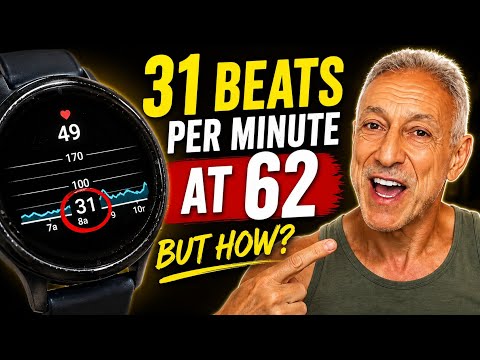
At 62 My Resting Heart Rate is 31 BPM: I Trained My Heart to Do This
I. Executive Summary
The presented video delivers a clinical case self-report and mechanistic rationale regarding exercise-induced extreme sinus bradycardia, wherein the speaker documents a resting heart rate (RHR) of 31 to 32 beats per minute (bpm) recorded via a wearable device. The presenter argues that resting heart rate is a critical biomarker of human healthspan and longevity, asserting that lowering RHR through cardiovascular conditioning is physiologically superior to lowering RHR through caloric restriction or weight reduction alone. The physiological premise relies on cardiac output homeostasis (Cardiac Output = Stroke Volume × Heart Rate): endurance and high-intensity interval training induce eccentric ventricular remodeling and augmented venous return, substantially increasing stroke volume so that systemic perfusion is maintained at significantly lower pulse rates.
The presentation cites epidemiological and physiological literature, including the 16-year follow-up of the Copenhagen Male Study (demonstrating a 16% increase in all-cause mortality per 10 bpm increase in resting heart rate) and 24-hour ambulatory monitoring data indicating that athletes average 11,520 fewer cardiac contraction cycles per day compared to sedentary controls. The speaker hypothesizes that this daily myocardial cycle conservation mitigates long-term cardiovascular wear and tear.
From an academic peer-review perspective, the speaker correctly identifies that cardiorespiratory fitness (CRF) and moderate resting bradycardia (50–60 bpm) strongly correlate with reduced all-cause and cardiovascular mortality. However, the implicit assumption that driving resting heart rate to extreme physiological nadirs (31–35 bpm) confers linear, incremental longevity benefits represents a clinical oversimplification. In exercise physiology and cardiology, profound athletic bradycardia is not mediated exclusively by autonomic vagal tone; it involves structural and electrophysiological remodeling of the sinoatrial node (SAN), specifically the transcriptional downregulation of Hyperpolarization-Activated Cyclic Nucleotide-Gated Channel 4 (HCN4) and the hyperpolarization-activated inward “funny” current (If).
While asymptomatic sinus bradycardia in conditioned athletes is largely benign, epidemiological meta-analyses reveal a J-shaped relationship between long-term high-volume endurance exercise, profound bradycardia, and arrhythmogenesis. Extreme endurance conditioning is associated with a 2- to 5-fold increased risk of lone atrial fibrillation, sinus pauses exceeding 3 seconds, and accelerated conduction system disease in aging populations.
II. Insight Bullets
- The presenter recorded a resting pulse rate of 31 to 32 beats per minute on a Garmin wearable device.
- The acute heart rate reached 136 beats per minute following high-intensity sprint training sessions.
- The speaker’s baseline resting heart rate had previously risen to 46–48 beats per minute prior to initiating a six-month intensive cardiovascular training protocol.
- The reduction in resting heart rate occurred while gaining 15 pounds of total body mass (progressing from 137 pounds to 152 pounds).
- The presenter previously reduced body fat to sub-5% levels before adjusting to a long-term target of 7% to 8% body fat.
- The video asserts that low resting heart rate creates functional physiological capacity for health rather than functioning as a deterministic lifespan predictor.
- Lowering resting heart rate via athletic conditioning is posited to confer superior longevity benefits compared to lowering it via caloric restriction or body mass loss.
- A 2019 review by Jensen (2019) reported that elevated resting heart rate is consistently associated with chronic disease and elevated mortality across populations.
- Systemic cardiac output is defined as the product of stroke volume and heart rate.
- Cardiovascular endurance training increases venous return and end-diastolic ventricular filling, directly elevating resting stroke volume.
- Elevated stroke volume enables the heart to sustain baseline cardiac output at markedly reduced contraction frequencies.
- Exercise-induced bradycardia involves enhanced parasympathetic vagal modulation, attenuated sympathetic outflow, and alterations in intrinsic sinoatrial node automaticity (Jensen, 2019).
- Identical resting heart rates (e.g., 35 bpm) achieved via athletic training versus caloric deprivation represent distinct physiological and functional states.
- Caloric restriction lowers basal resting heart rate without expanding left ventricular stroke volume or cardiorespiratory reserve.
- The Copenhagen Male Study monitored 2,798 healthy middle-aged men over a 16-year follow-up period (Jensen et al., 2013).
- In the Copenhagen Male Study, every additional 10 beats per minute increase in resting heart rate above 50 bpm was associated with a 16% higher all-cause mortality risk (Jensen et al., 2013).
- Higher baseline cardiorespiratory fitness strongly correlated with lower resting heart rates in the Copenhagen cohort (Jensen et al., 2013).
- Cardiorespiratory fitness serves as an independent predictor of survival and modulates the relationship between resting heart rate and mortality (Jensen et al., 2013).
- A continuous 24-hour monitoring study demonstrated that endurance athletes maintained an average 24-hour heart rate of 68 bpm compared to 76 bpm in sedentary controls.
- An average daily difference of 8 beats per minute equates to approximately 11,520 fewer myocardial contractions every 24 hours.
- The presenter cautions against evaluating resting heart rate as an isolated numeric metric without examining the underlying physiological mechanism.
- The video recommends combining sensible fat loss with structured cardiovascular training rather than relying exclusively on caloric deficit.
- Simultaneous optimization of body composition and cardiovascular stroke volume produces an additive protective effect.
- The presenter claims that progressive monthly training adaptations allowed the systematic reduction of resting heart rate down to 31 beats per minute.
- The speaker notes that reaching resting pulse rates in the low 30s is an extreme adaptation requiring substantial chronic training volume.
III. Adversarial Claims & Evidence Table
| Claim from Video |
Speaker’s Evidence |
Scientific Reality (Current Data) |
Evidence Grade (A-E) |
Verdict |
| 1. Higher resting heart rate linearly increases all-cause and cardiovascular mortality risk. |
2019 review and Copenhagen Male Study showing 16% mortality increase per 10 bpm elevation. |
Systematic reviews and large meta-analyses confirm that elevated RHR is independently associated with all-cause, cardiovascular, and cancer mortality, with relative risk increasing linearly above 60–70 bpm (Aune et al., 2017; Jensen et al., 2013). |
Level A (Human Meta-analysis of Prospective Cohorts) |
Strong Support |
| 2. Exercise-induced low RHR provides superior longevity protection compared to weight loss / caloric restriction. |
Mechanistic comparison of stroke volume, venous return, and cardiorespiratory functional reserve. |
While caloric restriction improves metabolic markers, high cardiorespiratory fitness (CRF/VO2 max) is an independent and stronger predictor of long-term all-cause survival than BMI or metabolic rate (Mandsager et al., 2018; Kokkinos et al., 2022). |
Level A (Human Cohort & Meta-Analytic Data) |
Strong Support |
| 3. Driving resting heart rate into the low 30s (31–35 bpm) confers linear, incremental longevity benefits. |
Anecdotal self-tracking (31 bpm) framed as the target adaptation for optimal health. |
Epidemiological data show a plateau in mortality reduction below 50–55 bpm. Extreme athletic bradycardia (<40 bpm) does not provide established survival advantages over moderate bradycardia (48–58 bpm) and elevates the risk of sinus pauses, chronotropic incompetence, and cardiac conduction disease (D’Souza et al., 2021). |
Level C (Human Observational / Electrophysiology) |
Speculative / Safety Warning |
| 4. The reduction in total daily heartbeats (~11,520 beats/day) directly explains extended lifespan via mechanical wear-and-tear sparing. |
24-hour ambulatory Holter monitoring study comparing athletes (68 bpm) to controls (76 bpm). |
The “rate of living” or “fixed heartbeat hypothesis” (~1 billion beats/lifespan) is an allometric observation across mammalian species based on mass-specific metabolic rate, not a verified causal intra-species aging mechanism in humans (Levine, 1997; Jensen, 2019). |
Level C(Comparative Physiology / Epidemiological Hypothesis) |
Speculative |
| 5. Athletic bradycardia is caused solely by increased vagal tone and higher stroke volume. |
Review of cardiac output, venous return, and autonomic balance. |
Athletic bradycardia is driven both by autonomic vagal modulation and intrinsic sinoatrial node (SAN) remodeling, specifically down-regulation of HCN4 channel expression and If current (Boyett et al., 2013; D’Souza et al., 2014). |
Level B/C(Human & Translational Electrophysiology) |
Plausible(Mechanistically incomplete) |
| 6. Gaining 15 lbs of muscle while dropping RHR from 48 to 31 bpm in 6 months occurs purely via training without safety trade-offs. |
Presenter’s personal body mass (137 to 152 lbs) and Garmin biometric timeline. |
High-intensity training in combination with substantial lean mass accrual can induce athletic cardiac remodeling. However, severe bradycardia (31 bpm) combined with heavy resistance/sprint loads increases left ventricular wall stress and atrial stretching, raising the hazard ratio for atrial fibrillation (O’Driscoll et al., 2021). |
Level E (Single-case Report) |
Safety Warning |
IV. Actionable Protocol (Prioritized)
│ EVIDENCE-BASED CARDIOVASCULAR PROTOCOL │
│ [HIGH CONFIDENCE TIER] (Level A/B) │
│ • Polarized Aerobic Base Conditioning (Zone 2 Endurance) │
│ - Intent: Expand left ventricular end-diastolic volume; lower resting RHR │
│ - Dose: 150-300 min/week at 60-70% HRmax or blood lactate 1.5-2.0 mmol/L │
│ • High-Intensity Interval Training (HIIT / 4x4 Protocols) │
│ - Intent: Maximize VO2 max, stroke volume, and peak cardiac output │
│ - Dose: 1-2 sessions/week (e.g., 4 x 4-min intervals at 85-95% HRmax) │
│ • Lean Mass Preservation & Body Composition Optimization │
│ - Intent: Prevent visceral adiposity while maintaining peripheral glucose sink│
│ - Dose: Progressive resistance training 2-4 days/week │
├──────────────────────────────────────────────
│ [EXPERIMENTAL TIER] (Level C/D) │
│ • Heart Rate Variability (HRV) Guided Autonomic Recovery Tracking │
│ - Intent: Prevent autonomic overreaching and maladaptive chronic fatigue │
│ - Dose: Daily resting rMSSD / SDNN tracking via validated ECG/PPG sensor │
│ • High-Volume Chronic Endurance Targeting RHR <45 BPM │
│ - Intent: Maximize athletic bradycardia and mitochondrial enzyme density │
│ - Caveat: Requires periodic 12-lead ECG and echocardiographic surveillance │
├────────────────────────────────────────────
│ [RED FLAG ZONE] (Lacks Efficacy / Safety Data Absent) │
│ • Deliberately Chasing Extreme Bradycardia (<35 BPM) as an Anti-Aging Target │
│ - Risk: Sinoatrial node fibrosis, symptomatic pauses (>3s), and lone AF │
│ • Unmonitored Bradycardia with Clinical Red Flags │
│ - Red Flags: Presyncope, syncope, exertional dyspnea, chronotropic lag │
└────────────────────────────────────────────────
High Confidence Tier (Supported by Level A/B Evidence)
-
Polarized Zone 2 Aerobic Base Training: The primary driver of physiological resting bradycardia and cardiac efficiency is eccentric ventricular remodeling (increased left ventricular internal diameter without pathological wall thickening). Maintaining 150 to 300 minutes per week of low-intensity steady-state (LISS) exercise below the first ventilatory threshold (VT1) optimizes mitochondrial density and capillary-to-fiber ratio while lowering resting heart rate into an optimal target range of 48–58 bpm (Aune et al., 2017).
-
High-Intensity Interval Training (HIIT): Incorporating 1 to 2 weekly sessions of aerobic interval training (e.g., Norwegian 4x4 protocol: 4 intervals of 4 minutes at 85–95% HRmax with 3 minutes active recovery) maximizes stroke volume and maximal oxygen uptake (VO2 max), which is among the strongest single modifiable predictors of all-cause mortality (Mandsager et al., 2018).
-
Concurrent Resistance Training: Combining cardiovascular conditioning with resistance training (2–4 days per week) optimizes body composition and lean muscle mass, mitigating sarcopenia without compromising vascular compliance.
Experimental Tier (Level C/D Evidence, High Safety Margin)
-
Continuous Autonomic Monitoring (HRV & 24-Hour Trends): Utilizing nocturnal root mean square of successive differences (rMSSD) and 24-hour ambulatory monitoring to track autonomic balance and prevent overtraining syndrome, which can paradoxically induce autonomic exhaustion or maladaptive sinus pauses.
-
High-Volume Aerobic Conditioning for Advanced Athletes: Undertaking high-volume training (>10 hours/week) to drive RHR into the 40–48 bpm range. If pursuing this level of adaptation, athletes should undergo baseline 12-lead ECG and transthoracic echocardiography to rule out structural cardiomyopathy, asymmetric septal hypertrophy, or pathological conduction delays.
Red Flag Zone (Debunked / Safety Data Absent)
-
Targeting Extreme Asymptomatic Bradycardia (<35 bpm) as an Isolated Goal: Driving resting pulse rates into the low 30s through extreme training volume is not supported by clinical evidence as superior to maintaining an RHR of 48–55 bpm. This practice increases the risk of acquired sinoatrial node disease, pathological sinus pauses, and ectopic atrial foci.
-
Ignoring Clinical Red Flags in the Setting of Bradycardia: Any resting pulse rate below 40 bpm accompanied by presyncope, dizziness, chronotropic incompetence (failure of heart rate to rise appropriately with exertion), or nocturnal pauses greater than 3 seconds requires immediate formal electrophysiological evaluation rather than being celebrated as a longevity victory.