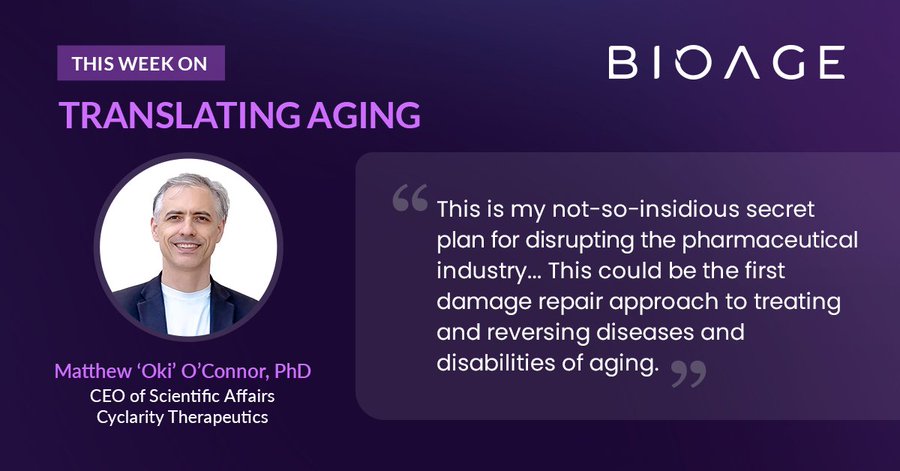
My guest today is Dr. Matthew ‘Oki’ O’Connor, Ph.D. - CEO and Co-Founder of Cyclarity Therapeutics ( https://cyclaritytx.com/ ), a biotech company developing engineered cyclodextrin molecules designed to bind and remove 7-ketocholesterol, or 7KC - a toxic oxidized cholesterol strongly implicated in atherosclerosis, inflammation, plaque instability, and even broader age-related diseases. Just recently, the company presented first-in-human clinical data at the American Heart Association Vascular Discovery Scientific Sessions showing dose-dependent urinary excretion of 7KC - potentially the first clinical evidence that this toxic molecule can be safely mobilized and removed from the human body. We’ll discuss what 7KC actually is, why oxidized cholesterol may be a root driver of cardiovascular disease, how engineered cyclodextrins work like molecular “sponges,” what the new human data really shows - and what it would mean if medicine could move from slowing plaque progression to truly reversing it.
I. Executive Summary
This interview features Dr. Matthew O’Connor, co-founder and CEO of Cyclarity Therapeutics, detailing a biotechnological framework aimed at the active removal—rather than the passive deceleration—of established atherosclerotic arterial plaque. Cardiovascular disease remains the leading global cause of mortality because conventional approaches (e.g., statins, PCSK9 inhibitors, RNA therapies) focus on lowering circulating LDL cholesterol or modulating systemic inflammation, leaving existing calcified and soft plaque intact. Cyclarity’s research targets the primary root cause of plaque instability: the accumulation of 7-ketocholesterol (7KC).
7KC is an oxysterol formed non-enzymatically when an oxygen free radical reacts with a native cholesterol molecule. In the vascular wall, macrophages migrate to early arterial shear-stress lesions to engulf accumulated lipids. While macrophages are highly efficient at processing regular cholesterol via reverse cholesterol transport (RCT), they lack the evolutionary enzymatic machinery required to metabolize 7KC. Consequently, 7KC builds up intracellularly, causing lysosomal dysfunction, shutting down RCT, and shifting the macrophage from an anti-inflammatory to a highly pro-inflammatory phenotype. These dysfunctional macrophages morph into “foam cells,” which aggregate to form the vulnerable soft plaque core, eventually undergoing apoptosis to create the necrotic core of the lesion.
To reverse this pathology, Cyclarity engineered custom macrocycles known as cyclodextrins. Leveraging an AI-driven computational chemistry platform optimized for carbohydrate simulations rather than standard protein modeling, they designed a flexible, dimeric “Pac-Man” molecule designated UDP-0003. By linking two beta-cyclodextrin rings together, they achieved a structural conformation that wraps around a single 7KC molecule. This dimeric layout increases binding affinity for 7KC by a thousand-fold over monomeric equivalents while ignoring native cholesterol, which is vital for cell membrane integrity.
Data presented at the American Heart Association (AHA) from Cyclarity’s 72-subject, first-in-human Phase 1 trial demonstrated that UDP-0003 is safe, exhibits a short three-hour half-life with zero accumulation, and successfully triggers a dose-dependent urinary excretion of 7KC. This confirms that a toxic, pathological lipid can be safely extracted from tissue and eliminated via the renal system. The company is transitioning into patient trials, utilizing advanced vascular imaging to measure plaque volume reductions in cahoots with active coronary artery disease.
II. Insight Bullets
- The Reversal Paradigm Deficit: Traditional cardiovascular pharmaceuticals act as risk-mitigation tools that lower circulating lipids but are entirely incapable of extracting or reducing pre-existing, embedded arterial plaque debris [[01:31]].
- The Regulatory/Pharma Translational Trap: Big pharma historically prioritizes incremental, copycat lipid-lowering drugs because surrogate biomarkers like LDL are easy to clear with regulators, avoiding the multi-hundred-million-dollar, multi-year Phase 3 endpoints required for clinical hard outcomes (heart attacks and strokes) [[07:41], [08:19]].
- The Paradoxical Immune Cascade: Atherosclerotic plaque is built from the inside out by the body’s own immune system; macrophages sent to clear sub-endothelial lipid pools become trapped, driving the soft plaque cascade [[06:35], [15:48]].
- Non-Enzymatic Oxysterol Generation: 7-ketocholesterol (7KC) is a highly toxic oxysterol created purely by accidental, non-enzymatic collisions between ambient oxygen free radicals and native cholesterol molecules within arterial tissue [[12:07]].
- Reverse Cholesterol Transport Paralysis: Macrophages possess no evolutionary enzymes to degrade 7KC; accumulation completely paralyzes their reverse cholesterol transport (RCT) pathway and phagocytic functions [[14:26], [15:07]].
- Foam Cell Morphogenesis: Intracellular 7KC toxicity alters the macrophage gene expression profile from anti-inflammatory to pro-inflammatory, forcing the cell to expand until it becomes a dysfunctional foam cell and ultimately dies, creating the plaque’s necrotic core [[15:15], [15:59]].
- Macrocycle Engineering Potential: Cyclodextrins are cyclic oligosaccharides possessing a hydrophilic exterior and a hydrophobic central cavity, rendering them uniquely engineerable due to having 21 distinct chemical reaction sites on a single monomer ring [[17:06], [20:18]].
- The Dimeric Binding Breakthrough: Connecting two cyclodextrin rings into a single dimeric molecule (UDP-0003) creates a flexible structure that increases the specific binding affinity for 7KC by a thousandfold compared to single-ring monomers [[21:31]].
- Essential Cholesterol Sparing Strategy: To guarantee clinical safety, UDP-0003 was deliberately engineered to bind 7KC while ignoring regular cholesterol, preventing the cell membrane disruption and lysis caused by non-specific lipid-extracting agents [[22:42]].
- Computational Carbohydrate Modeling Innovations: Standard AI drug-design software is calibrated for protein folding; Cyclarity had to modify existing tools to accurately simulate carbohydrate electrostatics, cavity geometries, and physical affinity metrics for cyclic sugars [[25:26]].
- Renal Plaque Elimination: Because lipids are not normally found in urine, detecting a dose-dependent urinary excretion of 7KC in Phase 1 trials proves that UDP-0003 successfully pulls the oxysterol from tissue into systemic circulation for renal clearance [[30:40], [31:20]].
- Ultra-Short Pharmacokinetic Optimization: UDP-0003 is designed to act within minutes and clear the body within three hours, ensuring rapid elimination via urine to prevent any drug bioaccumulation or off-target tissue damage [[32:02]].
- Systemic Oxysterol Pathologies: Beyond cardiology, 7KC accumulation is strongly linked to several major age-related diseases, including Alzheimer’s disease, age-related macular degeneration, non-alcoholic steatohepatitis (NASH), and renal failure [[02:16], [35:34]].
- The Hallmarks of Vascular Aging: Comprehensive cardiovascular rejuvenation requires moving past simple blood pressure and lipid control to target a newly defined matrix of 10 distinct vascular hallmarks, including arterial stiffening via glucose cross-linking, endothelial layer decay, micro-clots, fibrosis, and advanced medial calcification [[38:43], [39:24]].
- Environmental Bioaccumulation as an Aging Adjacent: Modern human vascular aging is increasingly aggravated by the lifetime accumulation of non-natural environmental toxins, such as nanoplastics, PCBs, and PFAS, which the body lacks evolutionary mechanisms to degrade [[44:54], [45:15]].
IV. Actionable Protocol
High Confidence Tier (Validated by Clinical Phase 1 Human Data)
- Acknowledge the Limitations of Conventional Lipid Therapy: Understand that while statins, ezetimibe, and PCSK9 inhibitors are critical for slowing down the progression of new vascular lesions by lowering circulating LDL, they do not actively dissolve or clear the toxic oxysterols (7KC) and necrotic debris embedded within existing plaques [[01:31]].
- Track the Clinical Development of Dimeric Cyclodextrins: Monitor upcoming Phase 2 clinical data for UDP-0003. This is currently the only clinically verified pharmacological class demonstrated to bind, mobilize, and safely eliminate 7KC from the human body via renal clearance [[31:20], [34:43]].
Experimental Tier (Translational Longevity Concepts with Emerging Data)
- Target Advanced Vascular Hallmarks Concurrently: When building a vascular longevity strategy, look beyond standard lipid panels. Address vascular stiffening, calcification, and endothelial senescence by tracking therapeutics in development that target advanced pathology markers, such as advanced glycation end-product (AGE) cross-link breakers and targeted calcification inhibitors [[39:24], [41:43]].
- Examine Environmental Toxin Bioaccumulation: Mitigate secondary drivers of vascular irritation by actively reducing exposure to nanoplastics, PFAS, and heavy industrial pollutants. These compounds accumulate over time within cardiovascular tissues and behave as modern, aging-adjacent pathomechanisms [[45:07]].
Red Flag Zone (Claims Lacking Safety Data or Mechanistically Refuted)
- Avoid Non-Specific Cyclodextrins for Plaque Reversal: Do not ingest standard, commercially available bulk cyclodextrin powders (such as alpha or beta-cyclodextrins sold as food stabilizers) expecting plaque reduction. Unengineered monomers lack the specific dimeric affinity required to extract 7KC and risk depleting essential unesterified cholesterol from healthy cell membranes, potentially triggering cellular lysis and ototoxicity [[22:42]].
- Reject Claims of Rapid Plaque Reversal from Dietary Changes Alone: Be highly skeptical of over-the-counter supplements or extreme diets claiming to quickly reverse calcified or soft plaques. Existing plaques are complex, fibrous, self-perpetuating immunological structures that require targeted macromolecular interventions to dismantle their core toxicity [[09:43], [15:48]].
V. Literature Verification & Methodological Context
A review of current cardiovascular and macrocyclic literature confirms the biological and engineering principles detailed by Dr. Matthew O’Connor, validating Cyclarity’s targeted approach to oxysterol removal.
- 7-Ketocholesterol (7KC) Toxicity and Atherogenesis: The focus on 7KC as a major driver of plaque vulnerability is supported by robust vascular biology data. Research demonstrates that 7KC is the most abundant oxysterol found in human atherosclerotic lesions, where it induces intensive smooth muscle cell and macrophage apoptosis, drives lysosomal membrane permeabilization, and generates the highly unstable necrotic core that triggers arterial rupture and subsequent thrombosis (Veiga et al., 2020).
- Dimeric Cyclodextrins and Affinity Engineering: The host’s description of engineering dimeric cyclodextrins to wrap around specific hydrophobic guests matches established supramolecular chemistry. Studies in Carbohydrate Research and Chemical Reviews detail that linking two cyclodextrin cavities via a flexible chemical bridge creates a cooperative binding effect. This alteration dramatically increases guest binding affinity constants (Ka) by orders of magnitude over monomeric equivalents, allowing the compound to differentiate between structurally similar steroids based on minor functional group variances (Janik et al., 2021).
- Vascular Hallmarks and Glucose Cross-Linking: Dr. O’Connor’s discussion of arterial stiffening caused by advanced glycation end-products (AGEs) cross-linking structural proteins aligns with current models of vascular aging. Accumulating AGEs on long-lived extracellular matrix proteins like collagen and elastin stiffens the central arterial wall, increases pulse wave velocity, and accelerates systolic hypertension independently of traditional lipid accumulation pathways (Saji et al., 2021).
Methodological Caveat: Although the presentation of Phase 1 human clinical trial data confirms that UDP-0003 safely mobilizes and triggers the urinary clearance of 7KC in a dose-dependent manner, its ability to decrease total plaque burden, stabilize cap thickness, or lower the incidence of major adverse cardiovascular events (MACE) in humans remains to be determined in upcoming Phase 2 imaging and outcome trials.