Reversal of Epigenetic Aging and Immunosenescent Trends in Humans: A Structured Technical Analysis
This is the original TRIIM paper from Fahy. There’s a lot of discussion around the results of the paper from videos and interviews from Fahy, but not a proper summary and analysis of the paper itself, which can be found here: https://onlinelibrary.wiley.com/doi/full/10.1111/acel.13028
Part 1: Narrative Summary & Impact Evaluation
The Big Idea
The scientific consensus has long held that biological aging is an inexorable, unidirectional trajectory governed by progressive cellular degradation and systemic functional decline. However, a groundbreaking clinical intervention has challenged this paradigm by demonstrating that systemic biological age—as measured by highly accurate multi-tissue epigenetic clocks—can be actively reversed in healthy human subjects.
The primary biological catalyst for this study was the historical challenge of immunosenescence driven by age-related thymic involution. The thymus degrades rapidly after puberty, leading to a profound collapse of the T-cell receptor (TCR) repertoire and a concomitant rise in all-cause mortality, cancer incidence, and systemic inflammation in elderly populations. To reverse this process, the investigators deployed a novel pharmacological triad consisting of recombinant human growth hormone (rhGH), dehydroepiandrosterone (DHEA), and metformin.
While rhGH was utilized as the primary tissue-regenerative mitogen to reconstitute thymic epithelial mass and bone marrow hematopoietic output, its well-documented “diabetogenic” side effect required mitigation. Hyperinsulinemia can promote oncogenesis and hinder immune restoration. Therefore, DHEA and metformin were co-administered specifically to optimize insulin sensitivity and limit glucose excursion, while simultaneously functioning as caloric restriction mimetics and anti-inflammatory agents.
The trial yielded definitive multi-systemic updates to our longevity priors. Magnetic resonance imaging (MRI) confirmed a significant restoration of functional, non-fatty thymic density. Concurrently, immune monitoring revealed a substantial rejuvenation of the white blood cell landscape, characterized by an increase in recent thymic emigrants and a sharp, persistent reduction in pro-inflammatory monocyte percentages. Most remarkably, evaluation across four discrete epigenetic clocks established that the protocol reversed biological age by an average of 1.5 years relative to baseline, and 2.5 years compared to no-treatment trajectories. Rather than merely slowing down the clock, this study provides the first human clinical trial evidence of an active, multi-systemic regression of biological age, altering our baseline assumptions regarding the plastic nature of human chronological decline.
Context
- Institution: Intervene Immune, Los Angeles, CA; UCLA Division of Plastic and Reconstructive Surgery, Los Angeles, CA; Stanford University School of Medicine (Human Immune Monitoring Center), Stanford, CA; and the University of British Columbia, Vancouver, Canada.
- Country: United States and Canada.
- Journal Name: Aging Cell.
- Original paper: https://onlinelibrary.wiley.com/doi/full/10.1111/acel.13028
Impact Evaluation
The impact score of this journal is 7.1 (2024/2025 Journal Citation Reports, Clarivate), evaluated against a typical high-end range of 0–60+ for top general science journals, therefore this is a High impact journal. It ranks 5th out of 73 journals in the primary category of Geriatrics & Gerontology, representing a premier, peer-reviewed authority for mechanistic aging biology.
Part 2: The Biohacker Analysis
Study Design Specifications
- Type: Human Clinical Trial (Phase I open-label pilot study, single-arm).
- Subjects: 10 healthy human male volunteers (9 completed the full analysis) aged 51 to 65 years. Baseline screening excluded individuals with severe metabolic disease, active malignancies, or pre-existing prostatic hyperplasia. There was no concurrent control group; subjects served as their own longitudinal controls relative to pre-treatment baselines.
- Lifespan Data: No true survival data was captured. Epigenetic modeling using the GrimAge clock—which acts as a validated predictor of human morbidity and all-cause mortality—projected a 2-year decrease in biological risk relative to chronological age, which persisted 6 months after treatment cessation.
                [ rhGH Administration ] ──> Thymic Epithelial Reconstitution
                           │
             (Side Effect: Insulin Resistance)
                           │
             ┌─────────────┴─────────────┐
             ▼                           ▼
      [ Metformin ]                  [ DHEA ]
             │                           │
             └─────────────┬─────────────┘
                           ▼
              Insulin Mitigation & Signaling
                           │
                           ▼
          [ Epigenetic Age Reversal (-1.5 yrs) ]
Mechanistic Deep Dive
The treatment complex altered fundamental cellular and tissue signaling networks across major regulatory axes:
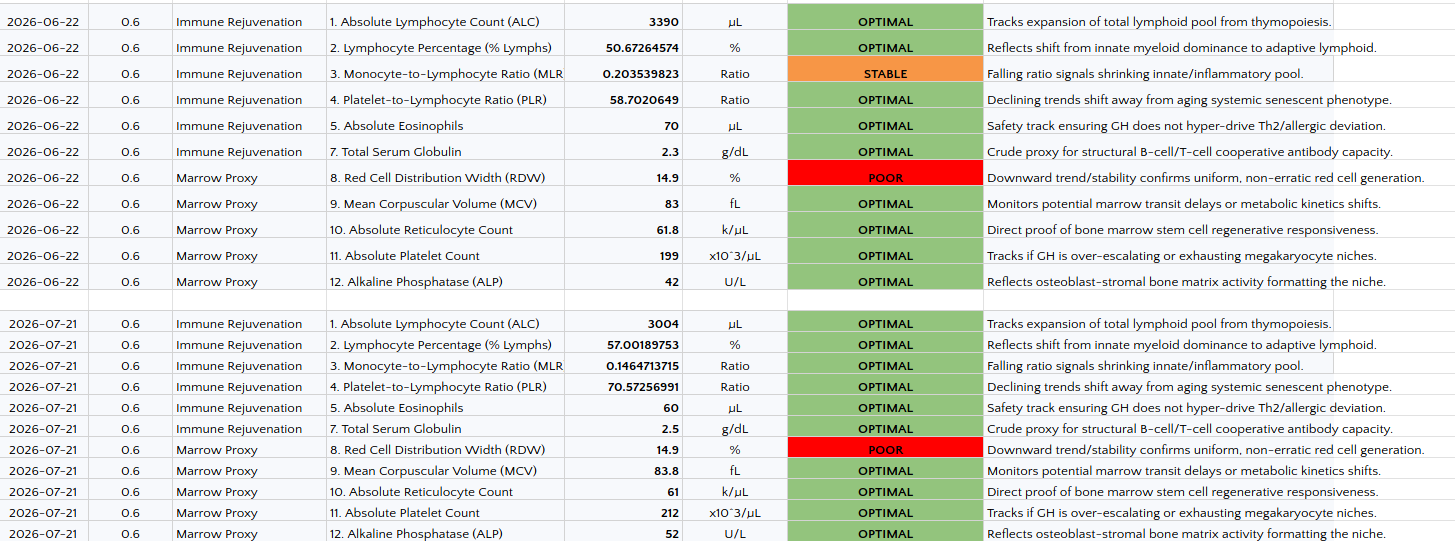
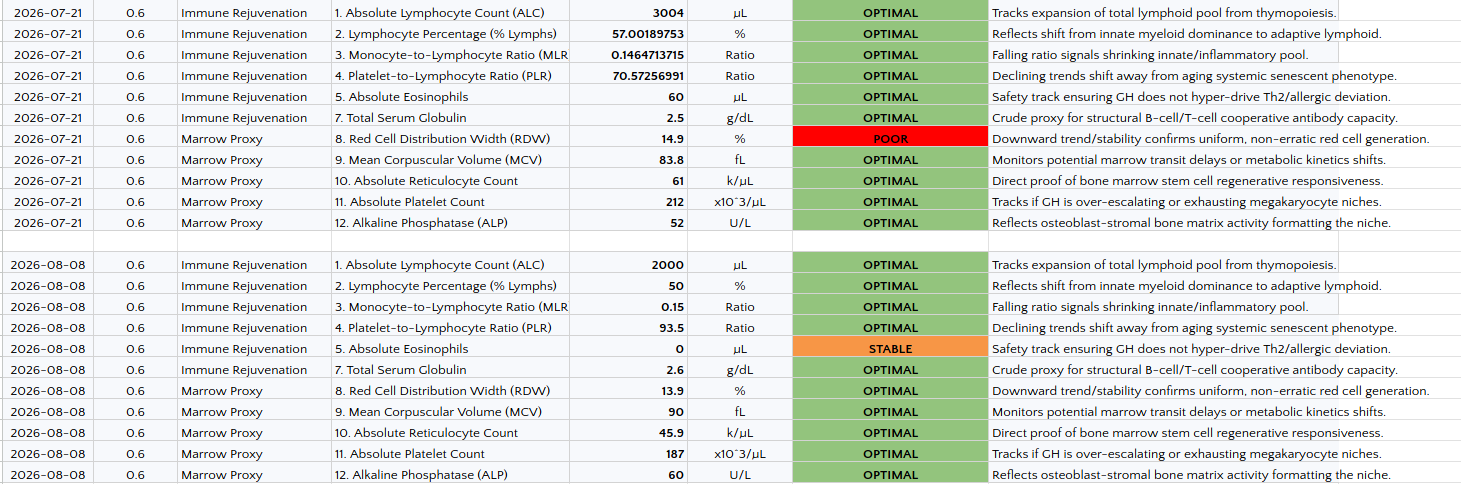
- Thymic and Bone Marrow Microenvironments (Vascular & Tissue Architecture): rhGH stimulated the expansion of thymic epithelial cells, shifting tissue composition away from fatty infiltration toward dense, functional cortical and medullary zones. This was accompanied by enhanced bone marrow lymphoid progenitor production.
- Insulin & Nutrient Sensing (mTOR/AMPK Axis): rhGH normally upregulates IGF-1, which strongly activates the growth-promoting mTOR pathway and suppresses insulin sensitivity. Metformin counteracted this by activating AMP-activated protein kinase (AMPK), downregulating hepatic gluconeogenesis, and dampening over-activation of downstream mTOR complex 1 (mTORC1) signaling to normalize peripheral glucose disposal.
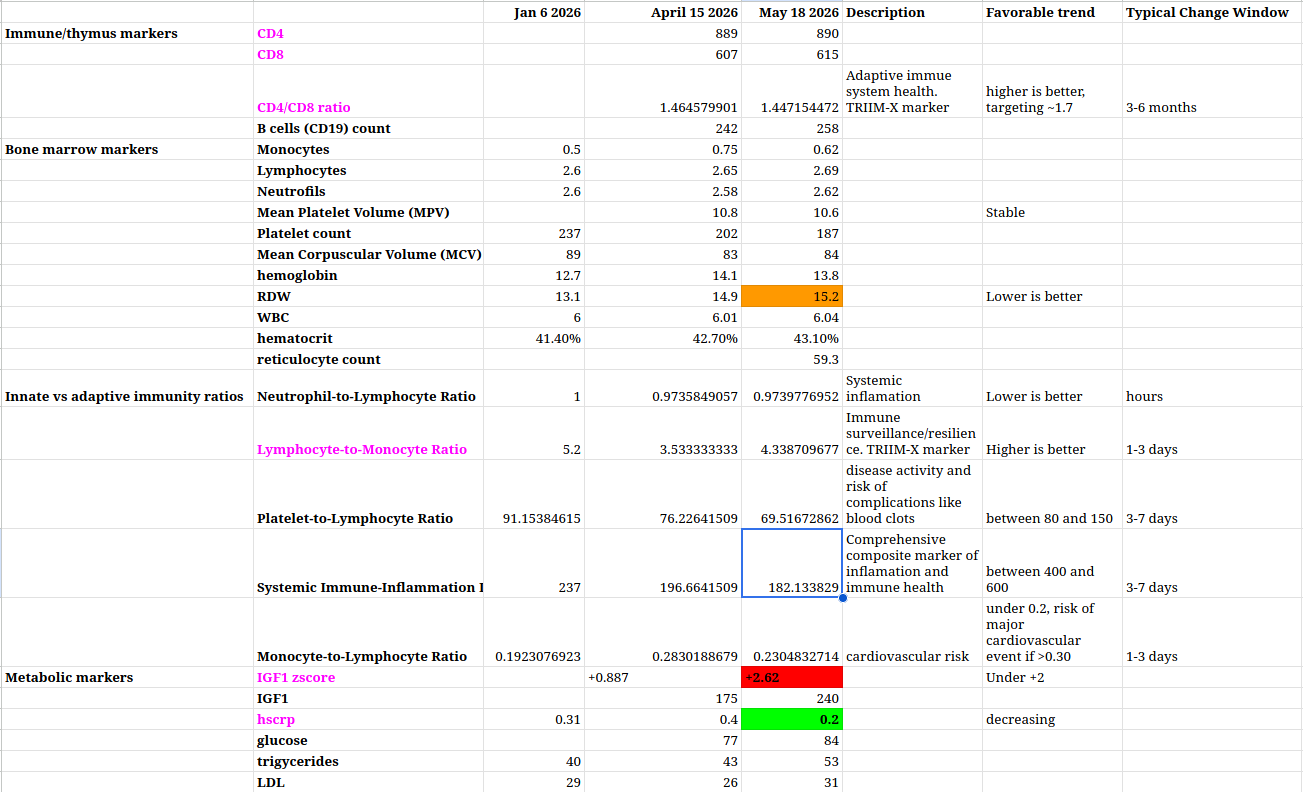
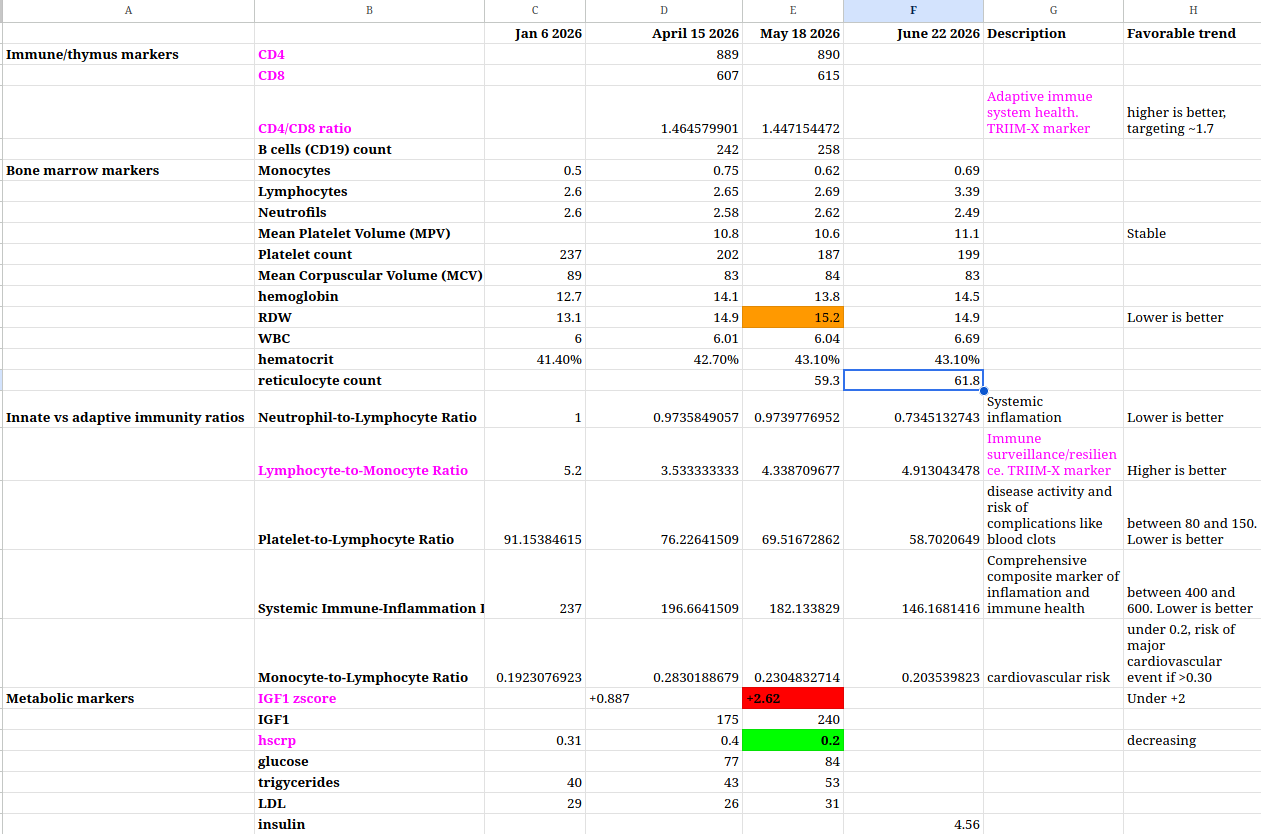
- Inflammation & Monocyte-to-Lymphocyte Rebalancing: Cellular monitoring verified a -35% reduction in circulating CD33/CD38 proinflammatory monocyte profiles. Concurrently, recent thymic emigrants ($CD31^+ CD45RA^+ CD4^+$ T-cells) increased, restoring a youthful, anti-inflammatory adaptive-to-innate immune equilibrium.
- Organ-Specific Priorities: The primary targets were the thymus (immune restoration) and liver/skeletal muscle (metabolic maintenance), with secondary protective markers noted in general vascular health via reductions in high-sensitivity C-reactive protein (hsCRP).
Novelty
Prior to this trial, no human intervention had demonstrated an absolute, longitudinal regression of biological age across multiple validated epigenetic clocks. This study proved that the human epigenetic clock is plastic, not fixed, and that targeted interventions can achieve a true systemic reversal of biological aging rates. Additionally, it demonstrated that the rate of epigenetic age reversal is not linear but can accelerate over time: accelerating from a rate of -1.6 years/year during the first 9 months to a remarkable -6.5 years/year between months 9 and 12.
Critical Limitations [Confidence Score: High]
- Sample Size and Design Demographics: Extremely low statistical footprint ($N=9$ completing the study) comprised entirely of white male volunteers. The complete absence of a randomized placebo control arm subjects all findings to potential selection biases or unmonitored lifestyle confounders.
- Intervention Complexity (Confounding Effects): Because three powerful compounds (rhGH, DHEA, metformin) were deployed concurrently, it is statistically impossible to isolate the individual therapeutic contribution or rule out unpredictable synergistic toxicities.
- Duration: The active treatment phase lasted only 12 months, which is insufficient to evaluate long-term genomic stability, risk of oncogenesis from sustained rhGH/IGF-1 elevation, or long-term permanence of the epigenetic reversal.
Part 3: Claims Verification and Hierarchy of Evidence
Claim 1: Administration of rhGH reverses age-related human thymic involution.
- External Verification & Context: MRI imaging in this trial demonstrated an expansion of functional thymic tissue volume and a corresponding reduction in thymic fat fraction. While animal models establish clear tissue regeneration, human data outside of HIV-induced immunodeficiency is limited.
- Hierarchy Level: Level C (Human Single-Arm Trial / Observational Cohort for healthy aging; though supported by Level D pre-clinical rodent and canine validation).
- Translational Certainty: High intra-study tracking via MRI, but lacks broad clinical validation in healthy unselected populations.
Claim 2: The TRIIM protocol induces an absolute reversal of systemic biological age across multiple epigenetic clocks.
- External Verification & Context: The investigators tracked age regression across the Horvath pan-tissue clock (-2.5 years), Levine PhenoAge (-3.73 years), Hannum clock (-2.76 years), and GrimAge (-2.16 years) at 12 months. Independent validation of these clocks confirms their high mathematical correlation with multi-tissue chronological and biological decline.
- Hierarchy Level: Level B/C (Direct longitudinal measurement within a controlled clinical trial cohort, but lacks a multi-center randomized, double-blind design).
- Translational Certainty: Strong analytical alignment; however, the lack of an untreated control group limits our ability to completely rule out assay or batch normalization variances.
Claim 3: Metformin and DHEA co-administration mitigates the hyperinsulinemic, diabetogenic effects of rhGH.
- External Verification & Context: Large-scale human data confirms that metformin lowers fasting insulin and HbA1c via AMPK activation and insulin receptor sensitization. DHEA replacement has also been demonstrated in separate clinical cohorts to decrease peripheral insulin resistance and downregulate inflammatory cytokines.
- Hierarchy Level: Level A (For metformin’s standalone insulin-sensitizing properties via comprehensive human meta-analyses); Level B (For the combinatory mitigation seen within this specific trial design).
- Translational Certainty: Robust. The biochemical properties of both compounds are well-mapped in human clinical endocrinology.
Claim 4: The combination protocol causes a significant, lasting reduction in systemic inflammatory monocyte percentages.
- External Verification & Context: CyTOF and blood panels showed a -35% reduction in CD33/CD38 monocyte fractions that persisted through month 18 (6 months post-trial).
- Hierarchy Level: Level B/C (Direct cellular measurement within the patient cohort).
- Translational Certainty: Confirmed within the boundaries of this specific protocol, but requires replication across larger cohorts to rule out individual immunological drift.
Part 4: Actionable Intelligence
The Translational Protocol (Rigorous Extrapolation)
-
Human Equivalent Dose (HED): Because the study was conducted directly in human subjects, direct dosing parameters are available without requiring body surface area (BSA) calculations or animal-to-human conversions. The dynamic dosing protocol used in the trial was adapted based on individual patient biomarker feedback (targeting specific IGF-1 and insulin thresholds):
-
rhGH: Scaled between 0.015 mg/kg and 0.030 mg/kg subcutaneously, administered 3–4 times per week (Equivalent to roughly 0.5 IU to 1.5 IU per injection day for a standard 75 kg adult).
-
DHEA: 50 mg orally, adjusted based on DHEAS serum level monitoring.
-
Metformin: 500 mg orally, titrated up to 1000 mg daily as required to fully suppress insulin excursions.
-
Pharmacokinetics (PK/PD): Subcutaneous rhGH displays a human elimination half-life of approximately 3 to 5 hours, generating a secondary surge in hepatic IGF-1 that peaks 12–24 hours post-injection. Metformin exhibits a half-life of 4.5 to 6.5 hours with an oral bioavailability of ~50-60%, requiring divided daily dosing. DHEA is rapidly metabolized into its sulfated form (DHEA-S), which features a prolonged human circulating half-life of 16 to 20 hours.
-
Safety & Toxicity Check: * rhGH: Long-term high doses can induce acromegaly, severe arthralgias, peripheral edema, and carpal tunnel syndrome.
-
Metformin: Carries a boxed warning for lactic acidosis (rare, typically occurring at 2,000mg/day or in individuals with pre-existing renal impairment). It is a mild inhibitor of mitochondrial complex I.
-
Interactions: Metformin relies on OCT1/2 organic cation transporters. rhGH may moderately induce CYP3A4, which can alter the clearance rates of co-administered steroid hormones.
Biomarker Verification Panel
To replicate or monitor this protocol safely, the following clinical biomarkers must be systematically tracked:
-
Efficacy Markers:
-
Target Engagement: Serum IGF-1 (target: elevation to upper-youthful quadrant) and DHEA-S.
-
Epigenetic Progression: Commercial multi-clock methylation sequencing panels (e.g., Horvath Pan-Tissue, GrimAge).
-
Immune Landscape: High-sensitivity C-reactive protein (hsCRP), absolute CD33/CD38 monocyte fractions, and naive $CD4^+$ / $CD8^+$ T-cell counts ($CD31^+ CD45RA^+$).
-
Safety Monitoring:
-
Metabolic Stability: Fasting Insulin, HbA1c, and continuous glucose monitoring (CGM).
-
Organ Function: Glycated hemoglobin, Serum Creatinine, Estimated Glomerular Filtration Rate (eGFR), and Cystatin C (renal safety for metformin).
-
Prostatic Safety: Total and Free Prostate-Specific Antigen (PSA) combined with digital rectal examinations to monitor rhGH-induced prostatic epithelial proliferation.
Part 5: The Strategic FAQ
- How can we differentiate true biological rejuvenation from transient fluid shifts or cell-composition alterations in the epigenetic clock data?
- Answer: Epigenetic clocks can be altered by acute shifts in blood cell lineages (e.g., shifts in myeloid-to-lymphoid ratios). However, the investigators used Horvath’s pan-tissue estimator, which is mathematically validated to be less sensitive to blood cell composition changes than earlier models. Furthermore, the sustained 2-year reduction in GrimAge scores observed 6 months after treatment withdrawal suggests long-term, stable alterations in the underlying DNA methylation landscapes.
- Does the elevation of IGF-1 pose an unacceptable long-term risk for accelerating occult malignancies?
- Answer: This remains the primary safety concern. While the investigators tracked PSA levels carefully and observed no adverse prostatic spikes during the 12-month period, a 1-year window is far too short to rule out the potential for accelerating micro-metastases or latent oncogenesis. Clinicians must balance the immunotrophic benefits against the oncogenic risks of sustained growth factor elevation.
- Why did the rate of epigenetic age reversal accelerate so drastically (-1.6 years/year to -6.5 years/year) in the final three months of the study?
- Answer: This non-linear acceleration suggests a threshold effect. Reconstituting the physical architecture of the thymus takes several months. It is highly probable that once the structural thymic epithelial mass crossed a critical operational threshold, the resulting wave of youthful naive T-cells and systemic anti-inflammatory signaling triggered a rapid, cascading reset of peripheral multi-tissue epigenetic markers.
- Will co-administering Rapamycin negate the thymic benefits of this protocol, given that rhGH upregulates mTOR and Rapamycin inhibits it?
- Answer: There is a clear mechanistic conflict. The TRIIM protocol relies on rhGH to drive tissue hypertrophy and cellular proliferation via the anabolic IGF-1/mTOR axis. Concurrent administration of a high-dose, continuous mTOR inhibitor like Rapamycin would likely blunt the thymotrophic and tissue-regenerative effects of rhGH. However, a pulsed, cyclical dosing schedule could theoretically allow for alternating phases of rhGH-driven regeneration and Rapamycin-driven cellular autophagy.
- Can Metformin be safely replaced with SGLT2 inhibitors or Berberine to achieve the same insulin-mitigating outcomes?
- Answer: Unknown, as this has not been clinically evaluated. SGLT2 inhibitors lower blood glucose through an independent renal mechanism (excreting glucose via urine) without directly inhibiting mitochondrial complex I or activating AMPK in the same manner as metformin. Berberine mimics metformin’s AMPK activation pathways but features poor human bioavailability and distinct pharmacokinetics. Replacing metformin would alter the specific mechanistic synergy validated in this trial.
- Are the immunotrophic benefits of this protocol reproducible in female subjects?
- Answer: This is a notable translational uncertainty. Because the trial exclusively enrolled male subjects to minimize hormonal variables and monitor prostate safety, we lack direct data on how this protocol interacts with female endocrine loops, ovarian aging, or female-specific epigenetic baselines.
- How does this protocol interact with common endogenous and exogenous androgens or 17-alpha estradiol?
- Answer: Exogenous androgens can accelerate thymic involution and increase prostate volumes, directly opposing the core goals of this protocol. Conversely, 17-alpha estradiol has been shown in animal models to extend lifespan and reduce systemic metabolic inflammation without classical feminization. However, its interactions with high-dose rhGH and human DHEA remain unmapped.
- What occurs to the newly generated naive T-cell pool after the protocol is discontinued? Do they undergo rapid senescence?
- Answer: The trial data showed that the reduction in pro-inflammatory monocytes remained stable 6 months post-treatment, and the GrimAge extensions persisted. This indicates that the immune cells generated during the active treatment phase remained functional over that timeframe. However, without ongoing thymotrophic support from rhGH, the thymus will eventually resume its normal trajectory of age-related involution.
- Could oral DHEA replacement alone, without rhGH, account for the observed reductions in systemic inflammation?
- Answer: While standalone DHEA replacement can improve insulin sensitivity and downregulate certain inflammatory cytokines in older adults, historical data shows it cannot reverse structural thymic atrophy or independently stimulate the dramatic multi-year epigenetic reversals demonstrated by the combined TRIIM triad.
- Is there an alternative explanation for the epigenetic age changes, such as a localized assay artifact or seasonal variations in blood draws?
- Answer: A potential confounding factor is that blood draws were taken at fixed seasonal intervals, and human immune profiles can exhibit minor seasonal oscillations. However, because the study tracked four distinct epigenetic clocks utilizing independent CpG site metrics and observed consistent, statistically significant downward trajectories across all of them, a localized assay artifact or simple seasonal variation is highly improbable.