I’d stop the Telmisartan. Seems like overkill. I was approaching some pretty low BP as well so I had to remove that.
3 Likes
It’s a bit sad to see such a negative reaction from the audience in the comments. People seem resistant to something that makes their lives easier.

- The video argues that powerful GLP‑1 drugs like semaglutide and tirzepatide (used in Ozempic, Mounjaro and similar medications) represent a breakthrough because they make people feel full sooner and eat less by amplifying a natural hormone signal that controls appetite and digestion, essentially fixing biology rather than willpower alone.
- Obesity has deep biological and evolutionary roots, and modern environments with cheap palatable food overwhelm normal appetite control, making dieting and behavior changes extremely difficult.
- GLP‑1 medications have led to much greater weight loss than traditional diets, often over 15–20% of initial body weight in a year, similar to results seen with bariatric surgery.
- In addition to weight loss, these drugs can reduce the risk of major health conditions such as heart attacks, strokes and type 2 diabetes, and also improve sleep apnoea, kidney and liver function and inflammatory markers. Some benefits might occur even independent of weight lost.
- There is intriguing early evidence these drugs may reduce cravings for substances like alcohol, nicotine and opioids, potentially becoming useful in addiction treatment.
- Side effects are mostly gastrointestinal (nausea, vomiting, diarrhea, constipation) and generally transient, but more serious issues like pancreatitis or gallbladder problems can occur in a small minority of people.
- Stopping GLP‑1 treatment usually results in partial or full weight regain unless lifestyle habits have changed; many individuals therefore stay on treatment long term, but long‑term safety data for the newest drugs are still limited.
- A modelling study suggests broad use of GLP‑1 drugs among overweight adults in the United States could cut millions of cases of diabetes and heart disease and reduce premature deaths, but high prices and supply issues remain barriers.
4 Likes
Semaglutide was depressive for me. Tirzepatide was good mentally, but made me very tired. Retatrutide, no mental side effects and the slight HR increase adds a bit of energy.
8 Likes
Absolutely true for me on the cravings. I was a light smoker (6-7 cigs a day) who became an even lighter smoker (3-4 and I could easily quit altogether if I didn’t enjoy the sensation out of choice) and it cut my sugar cravings down significantly - as someone who was “skinny fat” in part because I enjoyed my deserts
3 Likes
I’m a big fan of how GLP1RA drugs simplify our tastes. I can enjoy simpler meals and feel very satisfied with them. I don’t drink or smoke though I did in the past, and I could see how this applies to addictions.
I also wonder how this would work with ADHD in improving satisfaction with performing menial but necessary tasks.
2 Likes
N=1
ADD
I take small doses of TZ or RT and zero effect on getting me to do things I don’t want to do :).
Would it be different with larger doses, I dunno?
SS-31 did make a difference and I do all sorts of things I would usually put off.
@sunshine4 oddly, LDN did for me what glp1’s do for others… no real love for anything anymore (food/wine)… but, unfortunately, it actually inspires me to eat less healthy because I need more incentive to eat.
3 Likes
I think it is different with higher doses. What type of behavior modification effects are you noticing? Also, just for curiosity sake is your ADD already medicated?
1 Like
I didn’t know I had ADD until I was aprox 40 (almost 20 years ago). My sister in law had a hunch and handed me an adderall. The clouds parted and the angels sang. Everything became crystal clear (focus, no fog) and I could get things done.
I was on it for probably 60-90 days, an incredible 60-90 days. Then, at a cardiologist appointment, he said ‘do you know it’s speed and causes vasoconstriction and will increase your risk for a heart attack?’… I said, nope, no one told me. I never took it again.
Those glorious 60-90 days… that is exactly how I feel now.
I’d procrastinate and could never get myself do anything I didn’t want to (mostly admin things), but I could hyper focus on things that were in my wheelhouse.
I’m getting tons of things done all the time now. Nothing super human, but I’m just ‘normal’. I also notice it a lot here too. The health/science topic has never come easily for me, not that it’s easy now, but I used to torture myself trying read one of these threads in order to get it to register (and often would fail), but now I can focus on things and my mind won’t wander.
Speaking of feeling great, I had a long meeting with my doc today to go over everything I’ve been doing and to discuss my results… everything is so different now that we decided to do a trial of going off my T3 (staying on T4). I was always sluggish and foggy, but now that I’m not, we are seeing if I still need it (can be a net negative for bones and heart rate, so I thought I’d see).
It didn’t seem like this could be real, but it made sense after hearing @John_Hemming say ADD might be a mitochondrial issue… TA DA!
4 Likes
If I’m reading this correctly you’re not longer taking Adderall for your condition but you say you feel as if you are taking it. What is it you’re taking for this effect?
I’m going to be trialling a stimulant medication soon. I’ll have to keep track of blood pressure and other health markers.
2 Likes
Sorry, I rattled on, as I do, and was not clear…
Correct. I only took adderall for a couple of months, almost 20 years ago. I had not taken anything for ADD prior or since then.
I started taking the SS-31 peptide early January. I had no idea it could have this effect, but when I had so many productive/clear days in a row, I tried to figure out what was different… and then google said this was a real possibility.
If you have ADD, it would be interesting for you to try ss-31 to see if lightening strikes twice?
5 Likes
SS-31 is something I have been curious to try. I’m sure I’ll give it a go some time and I’ll report what happens.
1 Like
I don’t know why but i feel as if almost everyone has a bit of ADD so if SS-31 effects replicate to others (as it has been the case with you) then has got to be a no brainer. Been on the fence for so long but I have finally given in. I’ll be making a purchase in next couple days and hopefully I get same results as you.
2 Likes
Cross check with Aristotle
2 Likes
This looks/sounds like some kind of AI circle-jerk.
3 Likes
Wow, this is like a room filled with mostly AI garbage. Anyway, the Known Short-Term Adverse Effects are common to all GLP1s, so you could apply almost all the longer short term effects to all of them.
1 Like
Retatrutide monotherapy matches the effectiveness of anti-PD-1 immunotherapy in a preclinical model of pancreatic cancer
"Results: Low-dose RETA significantly reduced tumor volume by 3-fold compared to vehicle, demonstrating efficacy comparable to anti-PD-1 monotherapy, which achieved a 5-fold reduction in tumor volume. With a 4-fold reduction in tumor volume, RETA + anti-PD-1 combination therapy did not demonstrate significant additional benefit beyond either monotherapy. Importantly, body weight remained stable across all groups, while blood glucose levels were significantly lowered by RETA treatment, indicating RETA’s anti-tumor effects occurred independently of weight loss and may involve metabolic modulation.
Conclusions: Findings demonstrate that low-dose RETA exerted anti-tumor effects comparable to anti-PD-1 immunotherapy in a preclinical pancreatic cancer model, independent of weight loss. Ongoing studies in additional models aim to determine mechanisms mediating RETA’s potent anti-tumor function. RETA may have direct anti-tumor and/or anti-tumor immunity actions that contribute to improved tumor outcomes. Further exploration of RETA as a novel therapeutic strategy for obesity-associated cancers are warranted."
6 Likes
5 Likes
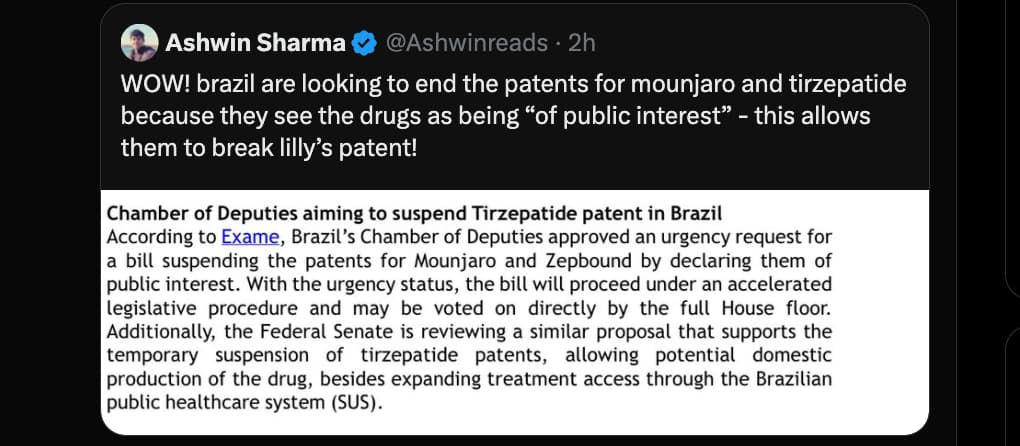
I feel similarly. My only concern is if this type of action stops the incentive of these companies inventing such great medicines.
What is the alternative? I don’t think having these medicines at their current price is fair.
4 Likes
More good news

-
Zydus plans to launch the drug under three brand names - SEMAGLYN, MASHEMA, ALTERME.
-
Unlike existing treatments that require multiple single-use pens, Zydus’ single adjustable pen will let patients select different doses, lowering costs, it says.
-
Zydus holds exclusive rights to its reusable pen with prefilled cartridges.
-
Patent protection for semaglutide expires in India late in March 2026, triggering a rush among Indian drugmakers to prepare lower-cost versions.
-
Semaglutide is the active ingredient in Danish drugmaker Novo Nordisk’s (NOVOb.CO), opens new tab blockbuster diabetes drug Ozempic and weight-loss drug Wegovy.
-
In January, Zydus received approval from India’s regulator to make and sell generic versions of the weight-loss drugs.
-
Larger peer Dr Reddy’s Laboratories (REDY.NS), opens new tab is likely to launch its generic semaglutide injection in the country in March under the brand name Obeda, Reuters reported earlier on Wednesday, citing two people familiar with the matter.
5 Likes