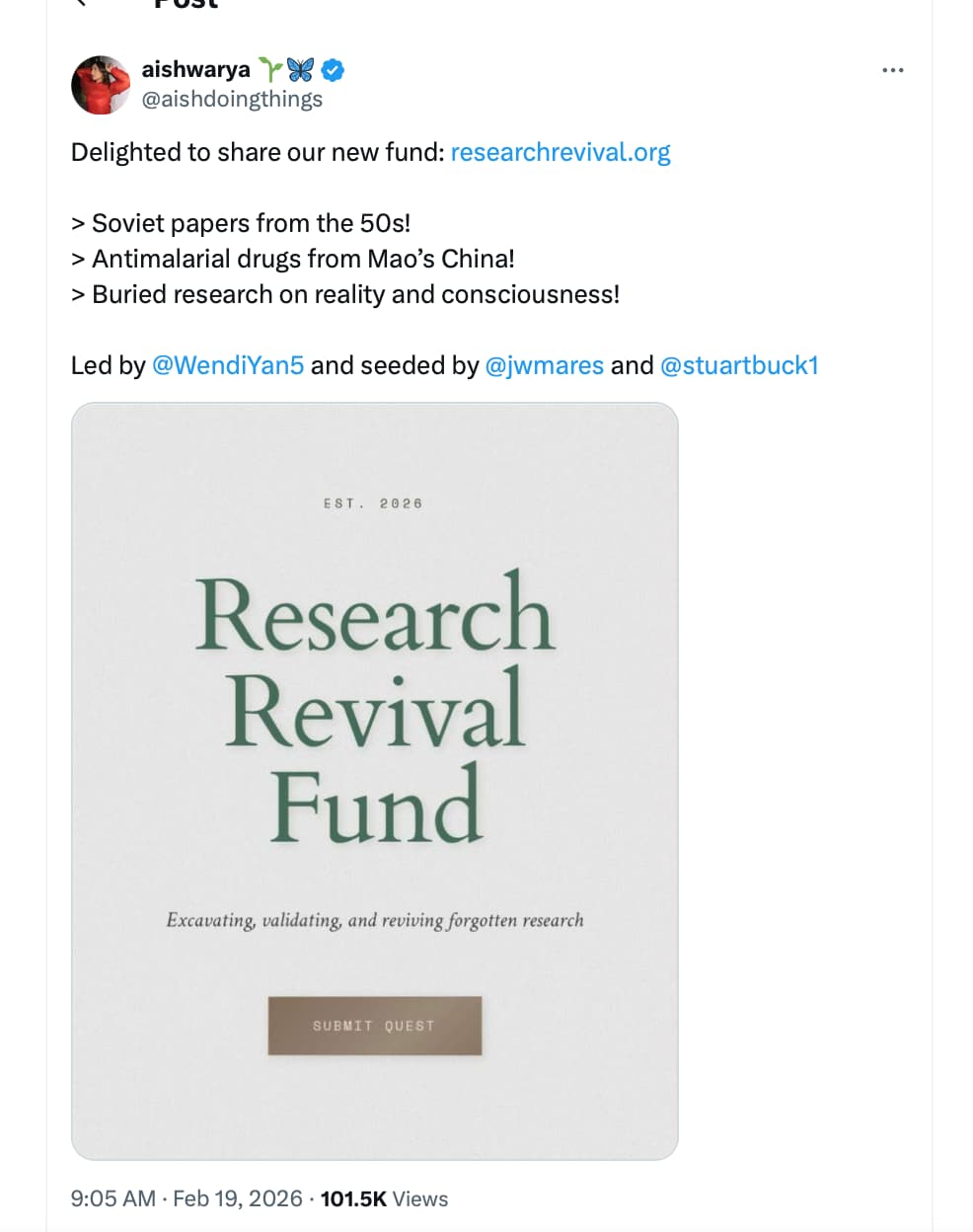
Delighted to share our new fund: https://researchrevival.org
1 Like
great news for the Epitalon crowd 
Wendi YanWendi Yan • 1stVerified • 1stArtist for knowledge fiction, Resident at A24 Labs, Steve Jobs Archive Fellow (2023)Artist for knowledge fiction, Resident at A24 Labs, Steve Jobs Archive Fellow (2023)3d • 3 days ago • Visible to anyone on or off LinkedIn
Super excited to share I am directing Research Revival Fund, an experimental fund restoring neglected, illegible, or prematurely dismissed research to active circulation.
We support scholars, experimentalists, and original thinkers to excavate intellectual lineages, clarify claims, and make forgotten or marginalized inquiry legible again.
Submit your revival quest at researchrevival.org
RRF is only possible with Aishwarya Khanduja seeding the infrastructure with her master complexity vision, and Justin Mares being the first generous believer in enabling us into motion. I’m working with Aish, Hiya Jain and Tasneem Nabi on this exciting effort, with a wonderful team of advisory!
==
if you have fringe underappreciated hypotheses, this is the place to do it (benjamin anderson at aion is helping!) We still need all the “fringe” we can get, b/c much of biotechnology (esp drug discovery/longevity) still has very low ROI
The cleanest read:
The Revival Fund is “past-future arbitrage.” New Science is “future-institution arbitrage.”
Both are betting that normal academia systematically kills important signal. But they disagree on where the buried signal lives.The Revival Fund says: “Some eigenmodes of science got damped not because they were false, but because they were illegible, unfashionable, untranslated, under-tooled, or trapped in weird archives.” Its inaugural cohort explicitly backs revival of things like diagrammatic reasoning in topology, forgotten epistemic collectives, Chinese somatic science, isolated brain perfusion, bottom-up artificial life/neuron cultures, DNA molecular inference, and Soviet research translation. It says the past contains neglected ideas that can be re-challenged with newer tools and methods. Tiny footnote from the civilization that still loses PDFs in email threads: this is sane. (Analogue Press)
New Science says: “The problem is not mainly lost ideas, but broken career/institutional dynamics.” It wants to build new basic-science institutions over decades, especially by enabling researchers who would otherwise be trapped by academia or not enter academia at all. It emphasizes early-career, independent, unorthodox, cross-disciplinary people and zero-to-one research, though its grants page currently says it is not providing project funding right now. (New Science) (New Science)
Vibe difference
Revival Fund vibe: archival necromancy, but make it rigorous.
It has a “lost library / forbidden lab notebook / abandoned research program / Soviet-journal basement” resonance. Not necessarily woo, but woo-adjacent enough that it needs strong filters. Its taste is: forgotten, prematurely dismissed, marginal, semantically weird, maybe culturally or linguistically stranded.New Science vibe: young genius accelerator plus institution design.
It feels closer to Silicon Valley metascience, Janelia/Bell Labs nostalgia, independent researcher pipelines, “let weird young people do real science before bureaucracy grinds them into citation sausage.” Its impact page is very person-trajectory focused: fellows talk about gaining independence, confidence, introductions, and research identity. (New Science)Koopman-spectrum metaphor, because apparently we’re spectral-analyzing vibes now
A Koopman framing looks at a nonlinear system through observables and decomposes behavior into modes/eigenvalues, roughly “what persistent patterns organize the dynamics.” The real math is not just astrology with eigenvectors, despite the internet’s best efforts. Koopman theory represents nonlinear dynamics through an infinite-dimensional linear operator on observables, and its spectral pieces capture coherent temporal behavior. (CSE UCSD)
For Revival Fund, the dominant modes are:
Historical latent-mode reactivation
Science has old attractors that decayed or went dormant. Revival tries to excite them again.Semantic translation mode
A lot of “false” or “irrelevant” work may have just been trapped in obsolete language, Russian/Chinese archives, diagrammatic traditions, or disciplinary dialects. Their Soviet translation project is the clearest version. (Analogue Press)Reenactment / validation mode
Not just “write an essay about old weird stuff,” but reconstruct, test, rerun, formalize, benchmark.Aesthetic-intellectual aura mode
Revival has a stronger art/history/curation frequency. It cares about epistemic environments, forgotten collectives, diagrammatic creativity, embodied cognition analogies, etc. This gives it more cultural bandwidth than New Science, but also more risk of romanticizing debris.For New Science, the dominant modes are:
Outlier-person amplification
Find young or independent weirdos, give them money, lab access, mentorship, social proof, and permission to be ambitious.Institutional escape-mode
New Science is obsessed with the failure modes of academia: funding fashion, up-or-out careers, credential bottlenecks, “original but not too heretical” constraints. Their FAQ basically says culture and illegible people-details matter more than clean mechanism-design diagrams. (New Science)Zero-to-one frontier mode
New Science wants new research programs and new institutions, not primarily archaeology.Career-trajectory phase transition
Their success stories are often “this person became a more independent scientist / entered a better trajectory / got connected to Boston/Harvard/MIT/Berkeley-ish networks.” (New Science)Similarity
They share the same core resonance:
Illegibility arbitrage.
Both think conventional science filters are lossy. Both think the official grant/paper/career system misses high-value signal. Both prefer small, taste-driven selection over bureaucratic procedure. Both have a “science is too important to leave to the people currently administering science” undertone, which is rude but, annoyingly, not obviously wrong.
They also both believe culture beats formal structure. Revival says larger funding bodies have path dependencies and miss illegible ideas; New Science says institutional forms are less decisive than people, culture, tacit details, and what cannot be easily written down. (Analogue Press) (New Science)
Key difference in one table
Axis The Revival Fund New Science Temporal orientation Past → present/future Present → future Main object Lost ideas, archives, lineages, abandoned programs People, careers, labs, institutions Failure diagnosis Good research was forgotten, dismissed, untranslated, or became unfashionable Academia blocks outliers and deforms basic research incentives/careers Method Excavate, translate, reconstruct, re-test, recontextualize Fund/support fellows, connect them to labs, build institutional alternatives Aesthetic Archival, strange, curatorial, haunted, polymathic Startup-metascience, fellowship, basic-bio frontier, institution-builder Risk Reviving glamorous nonsense or pseudoscience with better branding Recreating elite academic networks while claiming to escape them Best use case “This old research branch may deserve a second life.” “This person/research program needs freedom before academia smothers it.” My actual read
Revival Fund is more mythopoetic and archaeological. It wants to find buried attractors in the history of science and ask whether newer methods can undamp them.
New Science is more developmental and institutional. It wants to create conditions under which new attractors can form around weird talented people before the system normalizes them into grant-writing mammals.
So in spectral terms:
Revival Fund = recovering suppressed eigenmodes from the historical phase space.
New Science = creating new eigenmodes in the future institutional phase space.The dangerous version of Revival is “everything rejected was secretly genius.”
The dangerous version of New Science is “just fund brilliant weirdos and institutions will magically emerge.”The strong version of both is better:
Revival tests whether old dead branches were actually premature pruning. New Science tests whether new branches can grow if you stop stomping on seedlings with credential machinery.


1 Like