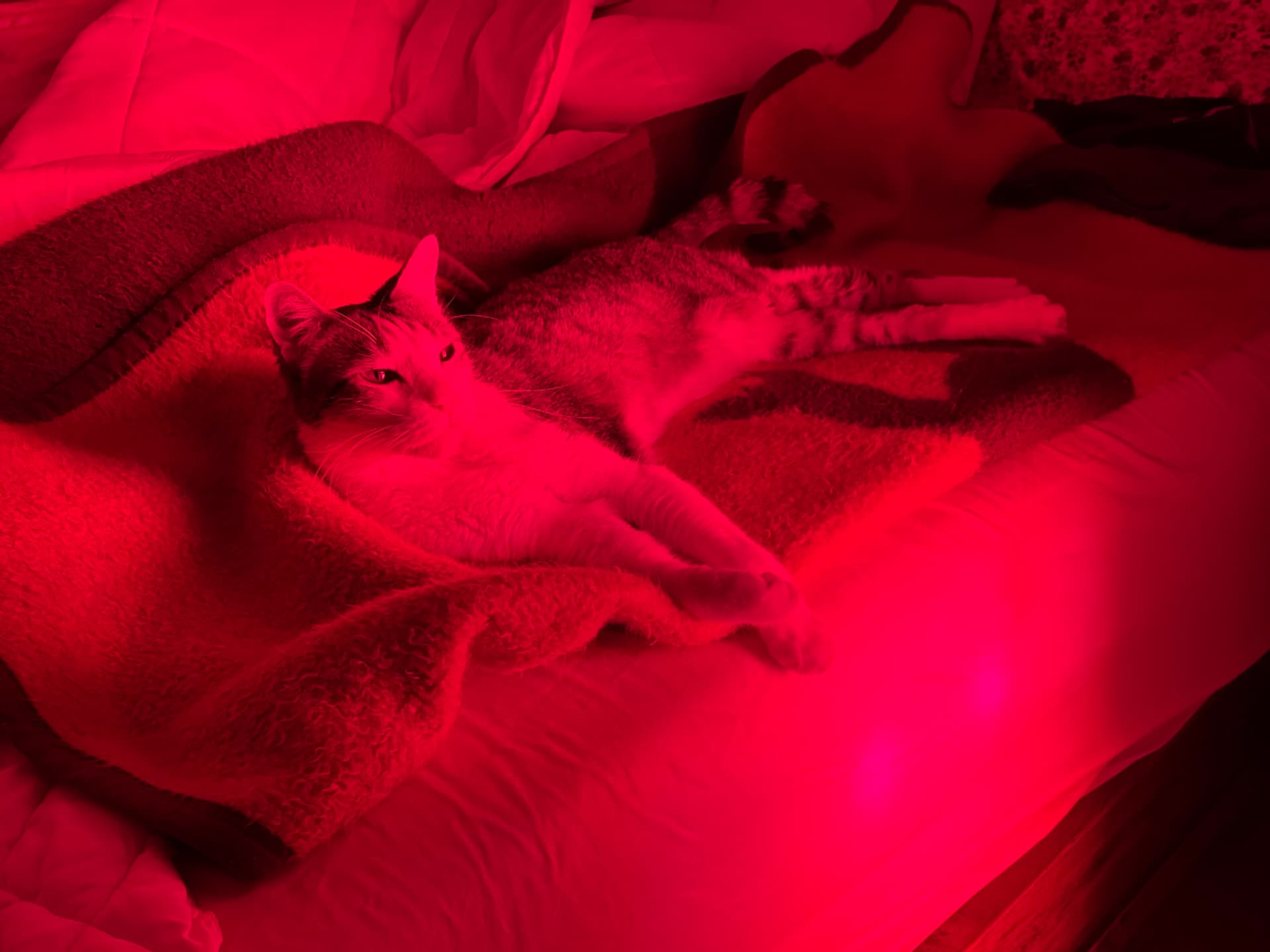
I also wondered about this, but they just did a poll in the facebook group and the overwhelming majority don’t use eye protection, including the red light guru, Alex Fergus.
I am glad you asked this though because I am still wondering if we should keep our eyes closed the entire time, or do we allow short bursts of eye exposure for potential eye benefits?
I’ll eventually ask them over there.
In addition to some people not being able to handle the NIR on their faces (pigmentation or red spots), for some, the panels are drying to their skin… and that also makes me hesitate with eye exposure as I have dry eyes. It’s apparently very individual… I’m still in info gathering mode
Thanks for answering. It sounds like the consensus is unprotected is fine.
Regarding dry eyes, depending on the cause of your dry eyes, there is data supporting the use of red light, near red infrared as well as blue light for demodex related dry eyes. I would definitely go easy on the blue light when it comes to the eyes regardless of why you’re using it.
I use goggles supplied with the panels I got, but I still see a significant amount of red light penetrating, which would be the 660 nm, as the 850 nm is invisible to the human eye. The 850 nm would penetrate the goggles even more.
I have been using the red light therapy for a few years now, and I get an extensive eye exam every year with a comprehensive retinal evaluation.
My eye health is more than excellent for an 85-year-old. I don’t know whether it is genes, rapamycin, or red light therapy, or a combination. But, at least the red light therapy has done no harm, and my eyes have been exposed to many hours of red light therapy.
My panel arrives on Tuesday and I have a question about a suggested brain protocol, if you can think of one.
I got a concussion a month ago from a minor incident, so minor that I never dreamed I’d still be dealing with it, but in fact, it’s considerably worse today… so it dawned on me the rl/nir might actually help heal my brain
If it were you, would you sit under it so it hits the top of your head… or just face and then flip, or all three?
Any ideas on time? All NIR or a mix of RL and NIR or?
In the facebook group, everyone suggests to go low and slow, and even begin at only a couple of minutes. I was on board but now that I feel so icky today, out of desperation, I imagine I’ll be significantly more aggressive unless I hear something to the contrary
I’ve been doing RLD consistently for five years and never use goggles. I don’t stare directly into the lights but my eyes are looking away while I stand in front of the panel. I haven’t had any issues at all.
It can damage the eyes in too high doses. Also they eyes don’t need as high of a dose as the skin. Therefore it is wise to either keep the eyes closed or use eye protective googles or even do both. That way your eyes will get a decent dose but less than the skin, which should work well and be safe. Granted, many people don’t use googles at all and even keep their eyes open without googles, and this seems to be fine and some even report benefits from using it like this. But I would still suggest using the googles or keeping the eyes closed or both since that’s safer and the eyes will usually get a high enough dose doing that.
For brain benefits I suggest using only the NIR light since the RL won’t penetrate deep enough at all. I would suggest using it very close to the head from different angles, like e.g. 5-10 minutes each on the front, back, each side of the head and the top of the head. Doing this would take a while but it’s hard to get a decent dose through the skull to the brain without a lot of light from different angles.
Thanks for that info. I hadn’t heard about that poll, but this matches with what I’ve read on various photobiomodulation groups. This adds to the evidence that keeping eyes open is relatively safe. However, I should mention that a lot of people (perhaps most) that use it for the eyes, don’t stare directly at the light the whole time but look in different directions. That is a good idea to get the light in different parts of the eyes and not overexpose the center of the macula.
You will get eye benefits with eyes closed, provided your device has NIR not just red light. If you don’t use googles, I would keep them closed the whole time. If you use googles, then maybe keep them open a part of the time is fine. Note that even with google and closed eyes you’ll still get a decent dose.
IMO: You may be doing more harm than good. Very little light will get through the fur, and there are no safety or efficacy benefits for cats. Though cats share more genes with humans than other animals, excluding primates.
As with rapamycin, NO ONE knows the correct dosage. Yes, I know that many gurus claim they do.
I have cats and would not dream of exposing them to red light therapy without protecting their eyes. Probably a short exposure would do no harm, but I do not know what a short exposure is to a cat’s eye. And I have several cats that lived to an old age, and none suffered any detectable eye problems.
So, the risk-benefit ratio for me is a reason not to give my cats red light therapy.
Basically, only the eyes would be benefited or harmed.
Cat (short-haired tabby/tuxedo): estimated effective penetration through skin + short fur"
Feline skin total thickness is roughly 0.4–2.0 mm depending on site, with a very thin epidermis (~0.3–0.5 mm cited for “top layer” in owner materials; most thickness is dermis). Short fur typically adds ~0.5–2 mm of fibrous, melanin-bearing shafts that scatter/absorb in the 650–900 nm range. ScienceDirect+1
Given melanin’s stronger absorption at 850 nm and its reduction near ~1060 nm, expect:
1060 nm: better net transmission through short fur and into skin; 1/e depth in skin on the order of a few mm.
850 nm: more power lost in pigmented fur and superficial skin; shallower effective reach than 1060 nm, especially in darker coats.
Practical estimate (order-of-magnitude, assuming short, well-groomed coat and average site such as lateral thorax): a sizable fraction of incident light is lost in fur. If fur is light/sparse, perhaps tens of percent of it reaches the skin; dark/dense fur can cut this dramatically. Once at the skin, expect millimeter-scale 1/e depths similar to those in human skin, with 1060 nm maintaining a modest advantage over 850 nm.
Ocular exposure must respect safety standards."
Define tissues and paths: scalp/skin, hair, skull (frontal vs parietal/crown), CSF, cortex; and ocular paths (eyelid, sclera/cornea/lens).
Pull wavelength-dependent optical properties (absorption/scattering) for 850 nm vs ~1060 nm in skin, hair/melanin, bone, blood, and water.
Account for anatomic variation: scalp and skull thickness by site; hair color/density; presence/absence of hair (forehead vs top).
Translate into practical “effective penetration” trends (greater 1/e depth or higher transmittance) by site and wavelength.
Note edge cases: eyes (higher NIR transmittance), very dark hair, very thick skull; and species difference (cat skin + short fur).
Direct comparison: 1060 nm vs 850 nm in the human head
General rule in the NIR “optical window” (650–1350 nm): absorption is dominated by hemoglobin at the short end and water at the long end; scattering weakly decreases with wavelength. That means moving from 850→1060 nm usually reduces melanin/hemoglobin losses and slightly reduces scattering before water absorption rises >~1100–1200 nm. Net effect: 1060 nm tends to penetrate deeper than 850 nm in many head tissues at equal power. Wikipedia+1
Through scalp/skin (no hair): in vivo human skin optical data around 823–850 nm show reduced absorption and modest scattering; 1064 nm typically experiences still lower melanin/hemoglobin absorption and comparable or slightly lower scattering, favoring deeper reach. Measurements across tissues also show 1064 nm outperforming 905–950 nm for deeper transmission in the first centimeters. PMC+1
Through skull: transmission inversely tracks skull thickness and varies widely by site; hydrated skull transmits more than dehydrated. Forehead is often preferred (hairless, relatively thinner bone), whereas the crown/parietal region shows lower cerebral sensitivity due to thicker bone/geometry. These effects dominate over modest wavelength differences, but at a given site 1060 nm generally transmits at least as well as 850 nm. PLOS+2opg.optica.org+2
Practical site comparison (same device, same power):
Forehead (glabella/frontal): best of the typical scalp sites (no hair, thinner bone). 1060 nm ≥ 850 nm. ScienceDirect
Top/crown (parietal/bregma): worse than forehead due to hair + thicker skull; both wavelengths attenuate more, but 1060 nm retains a small advantage. liebertpub.com
Occipital: often higher modeled NIRS sensitivity than inferior frontal regions if hair is parted/thin, but practical performance hinges on hair and individual skull thickness. 1060 nm ≥ 850 nm. PubMed
Absolute magnitudes vary with power/geometry; low-power LEDs show little/no transmission through combined scalp+skull in benchtop studies, underscoring that anatomy and irradiance dominate. (It’s a physics fact that even relatively low power 860 nm LEDs, and even the cheap panels have relatively higher power than average LEDs, will generate enough photons that some will penetrate the skull. It only means that you have to sit under your panel for a longer time.)
](Near-infrared photonic energy penetration: can infrared phototherapy effectively reach the human brain? - PMC)
Eyes (including “through the eyes”)
Ocular media (cornea, aqueous, lens, vitreous) transmit NIR well up to ~1,300–1,400 nm, with water absorption rising thereafter. Classic measurements show scleral transmission increasing from ~35% at ~804 nm to ~53% at 1064 nm (ex vivo), implying 1060 nm passes ocular coats more readily than ~850 nm. Safety limits still apply, but for pure physics, 1060 nm transmits more. bmo.uni-luebeck.de+2ec.europa.eu+2
Hair: how it affects results
Melanin strongly absorbs in the 650–850 nm range; hair (especially dark, dense hair) can absorb/reflect a large fraction of incident 850 nm, degrading delivery to scalp. Absorption by melanin falls at ~1000–1100 nm, giving 1060 nm a relative advantage on haired sites. This is why forehead (no hair) is routinely chosen for NIRS/tPBM and why deeper-penetrating lasers for darker phototypes favor ~1064 nm. biorxiv.org+2ScienceDirect+2
Clear, plain-English takeaways by site (equal conditions, human adult)
Forehead skin + frontal bone: 1060 nm penetrates slightly deeper than 850 nm; forehead outperforms crown due to no hair and often thinner bone. ScienceDirect
Top/crown (parietal): both wavelengths attenuate more; hair is the major loss term. If hair is dense/dark, 1060 nm’s relative advantage over 850 nm increases. biorxiv.org
Eyes (through eyelid or sclera): NIR transmittance increases with wavelength across this band; 1060 nm > 850 nm for pure transmission. (Note: ocular exposure must respect safety standards.) bmo.uni-luebeck.de+1
If you need rough numbers (order-of-magnitude, not device-specific)
Skin “effective penetration depth” (1/e) in the NIR is typically a few millimeters; skull adds orders of magnitude more loss, and inter-individual/site variation can be 10^2–10^5×. Expect only a small fraction of surface power to reach cortex without special optics/powers, with forehead best. 1060 nm tends to be ≥ 850 nm in net transmission when hair is controlled. PMC+1
Cat (short-haired tabby/tuxedo): estimated effective penetration through skin + short fur
Feline skin total thickness is roughly 0.4–2.0 mm depending on site, with a very thin epidermis (~0.3–0.5 mm cited for “top layer” in owner materials; most thickness is dermis). Short fur typically adds ~0.5–2 mm of fibrous, melanin-bearing shafts that scatter/absorb in the 650–900 nm range. ScienceDirect+1
Given melanin’s stronger absorption at 850 nm and its reduction near ~1060 nm, expect:
1060 nm: better net transmission through short fur and into skin; 1/e depth in skin on the order of a few mm.
850 nm: more power lost in pigmented fur and superficial skin; shallower effective reach than 1060 nm, especially in darker coats.
Practical estimate (order-of-magnitude, assuming short, well-groomed coat and average site such as lateral thorax): a sizable fraction of incident light is lost in fur. If fur is light/sparse, perhaps tens of percent reaches skin; dark/dense fur can cut this dramatically. Once at skin, expect millimeter-scale 1/e depths similar to human skin, with 1060 nm maintaining a modest advantage over 850 nm. PMC+1
Why forehead beats crown—and why 1060 nm often wins
Sensitivity maps and empirical work show higher brain-tissue sensitivity where scalp/skull are thinner and hair is absent; differences in skull thickness overwhelm small wavelength differences, but among common NIRs, 1060 nm benefits from lower melanin/hemoglobin absorption (vs 850 nm) and slightly reduced scattering, particularly on haired or darker-pigmented sites.
Key supporting references
NIR optical window and tissue absorbers (blood vs water): overview. Wikipedia
In vivo human skin optical properties around 661–850 nm; measurement set including 850 nm. PMC
1064 nm vs sub-1,000 nm penetration in tissue (upper cm): deeper reach at 1064 nm. MDPI
Skull/site effects (thickness, mapping, hydration): forehead vs crown differences. PLOS+1
Ocular media/sclera transmission rising from ~804 nm to 1064 nm. bmo.uni-luebeck.de
Large inter-individual skull translucency variability (10^2–10^5×). PMC
Feline skin thickness ranges and thin epidermis notes. ScienceDirect+1
Bottom line
For the human head, forehead > crown for penetration (hair + generally thinner bone), and 1060 nm ≥ 850 nm under comparable conditions—often noticeably better on haired/darker sites. Through the eyes/ocular coats, wavelength-dependent transmittance also favors ~1060 nm over ~850 nm (physics only; follow safety standards). Hair can be the single biggest practical barrier at 850 nm; its impact lessens at ~1060 nm. For a short-haired cat, expect substantial fur losses (color-dependent); once at skin, millimeter-scale penetration with 1060 nm again having a modest edge over 850 nm.
@Olafurpall and @desertshores this is fantastic information, thank you so very much!! I’m even slower than I usually am, so spoon feeding me the info was especially helpful! The 1060 nm bulbs can’t get here fast enough… I’ll let you know if I feel any differently. (I had been improving but regressed today… so odd).
For my cat, yeah, it’s just a Hail Mary for his spine/hip that is making it harder to walk with his singular back leg… he’s 18.5 with ckd, so there is little downside at this point. I will be giving him very short sessions because he won’t be able tell me if it’s bothering him. If he wants to look at the panel, I’ll then only hold him with his back facing it.
You know way more about cats than I do. He is 15+ and has lymphoma and I thought it might help with the inflammation and he seems to enjoy it. He pretty much sleeps through it.
Sorry about your cat. I appreciate that you are trying to help him and prolong his life. I am sure he appreciates the warmth he feels under the light. At his age I wouldn’t worry about how long he spends under the lamp. There have been no reports that I could find that any animals including humans that have been harmed by red light therapy. And, thinking about it, he probably has his eyes closed most of the time because of the brightness of the lights.
Best wishes and I hope you and your cat have many more years together.
I am very interested in RLT but haven’t yet committed to buying such a device. However, having done a lot of background reading, one thing stood out to me: the utterly minuscule amount of light that can reach the brain via the skin and skull. Unless very high powered lasers are used, the amount is negligible. There may be systemic effects that are able to affect the brain, but that is different.
There are nasally inserted red lights that might deliver more to the brain.
As for saying “you’ll just need more time to get a meaningful dose via the skull”…I would suggest that’s futile.
If you block IR light with a sheet of metal, how long must you stand behind it to obtain a benefit?
There is a question about the redistribution of mitochondria. Hence if mitochondria close to the skull are improved what effect does that have on the brain. It does appear that there is limited evidence that this can happen and if exercise improves cognition one would expect some of this to happen through somatic mitochondria passing the BBB rather than just improvements in mitochondria in the brain.