Actually, I found an excellent comparison of these two at:

Actually, I found an excellent comparison of these two at:
How would you use it on your eyes? I have been reading how it can halt eye diseases but dont know the method.
Use light on your eyes very carefully. I have tried to mimic what glen jeffery has done in his 670nm experiments which is a low power LED for 2-3 minutes a day. He says 2 minutes is enough and the effect lasts 5 days so every 5th day would work just as well if you can remember to do it. And he says that whenever they use a lower power LED they get the same benefit. Only morning treatment works.
His study said they used:
“The study eyes were treated daily in the morning with a 670 nm hand-held light source housed in a torch-like tube that emitted energy equivalent to 40 mW/cm2 or 4.8J/ cm2 for 2 min at the viewing aperture.”
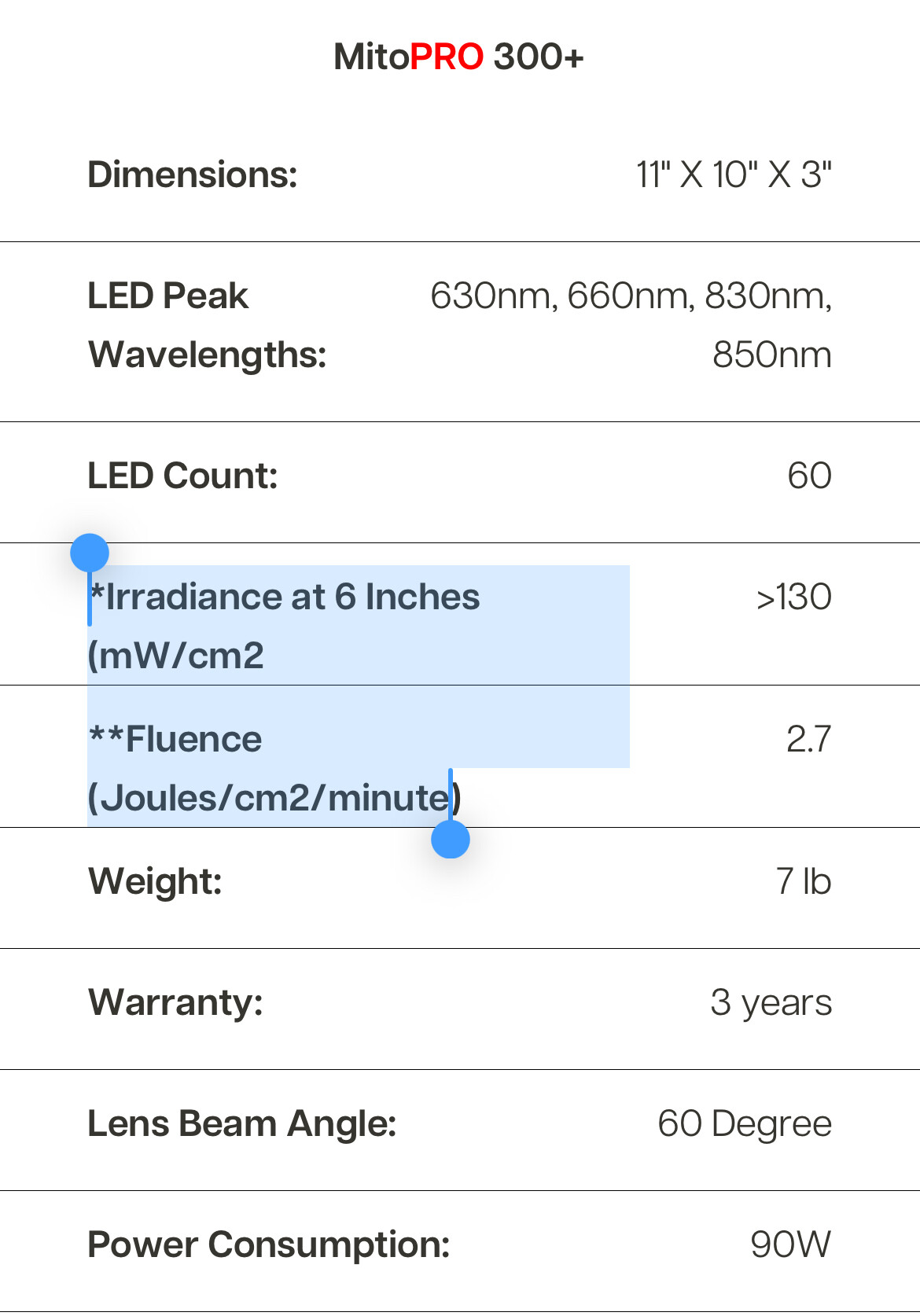
My light specs are in the screenshot. I put it on my face every few days for a few minutes. I get it in my eyes and into my skull. I only use the deep red (not NIR) for my eyes (my lamp allows to use red or NIR or both). When I do a daily brain (red and NIR) session I wear the blast goggles to reduce the penetration on my eyes (just to be safe).
So eyes closed or what?
I think most come with eye protectors.
Did you know that red light therapy before exercise can actually increase Vo2max?
An informative video about red light therapy by Nick Norwitz, PhD in Physiology, Oxford & MD student, Harvard,
He graduated Valedictorian from Dartmouth College in 2018, majoring in Cell Biology and Biochemistry. He then completed his PhD in Metabolism at the University of Oxford in 2021, before attending Harvard Medical School to complete his MD.

All of those fancy degrees must mean he’s right. 
As opposed to your fancy degrees?
More likely a rational investigator than you are, whose specialty seems to be trolling.
Rational investigator talking about untreated LDL’s of 250 mg/dl all the time (including his own):
Ok.
Hope his viewers enjoys the xanthomas, that cholesterol is going to be in other places as well, permanently.
Nick “Atherosclerosis Accelerator” Norwitz.
ISO opinions !!!
What started out as a search of a handheld device from Chewy to help my 18 yo cat’s leg has quickly morphed into me wanting a full body red light panel for my cat, my skin/hair, and for my husband’s aches and pains, too
(yes, I was thinking of my cat before my husband, there, I said it!!! 
I’m looking at a 36x12 single panel, and will get a horizontal stand. (I can commit to using anything if I can be lying down
Biomax 900
Biomox Pro
MitoAdapt 4.0
All similar-ish in price.
Biomax pro vs Biomax 900
Pro: The biomax pro is more powerful so you don’t need to use it quite as long
Con: My house is white so the biomax pro won’t look as good!!! and it’s more expensive.
Biomax 900 link
MitoAdapt 4.0
It’s brand new, as is the Biomax Pro
A YouTube video guy, who loves Biomax, said each bulb on the Mito (and some other brands) has multiple types of light coming out of the same light, and Biomax alternates which bulbs do what (no idea if this matters one way or another).
This new Mito supposedly has more types of light than any other on the market, but I also have no idea if that translates to anything useful.
The Biomax was highly recommended by one of you as a stand out brand, but having said that, if you think Mito is as good or close to it, I’d lean heavily towards Mito simply due to their superior return policy (free vs paying shipping and a restocking fee!).
So, if you have any, please offer up your opinions on the types of light waves they offer … and if one brand might have safer lights… or anything you can think of?
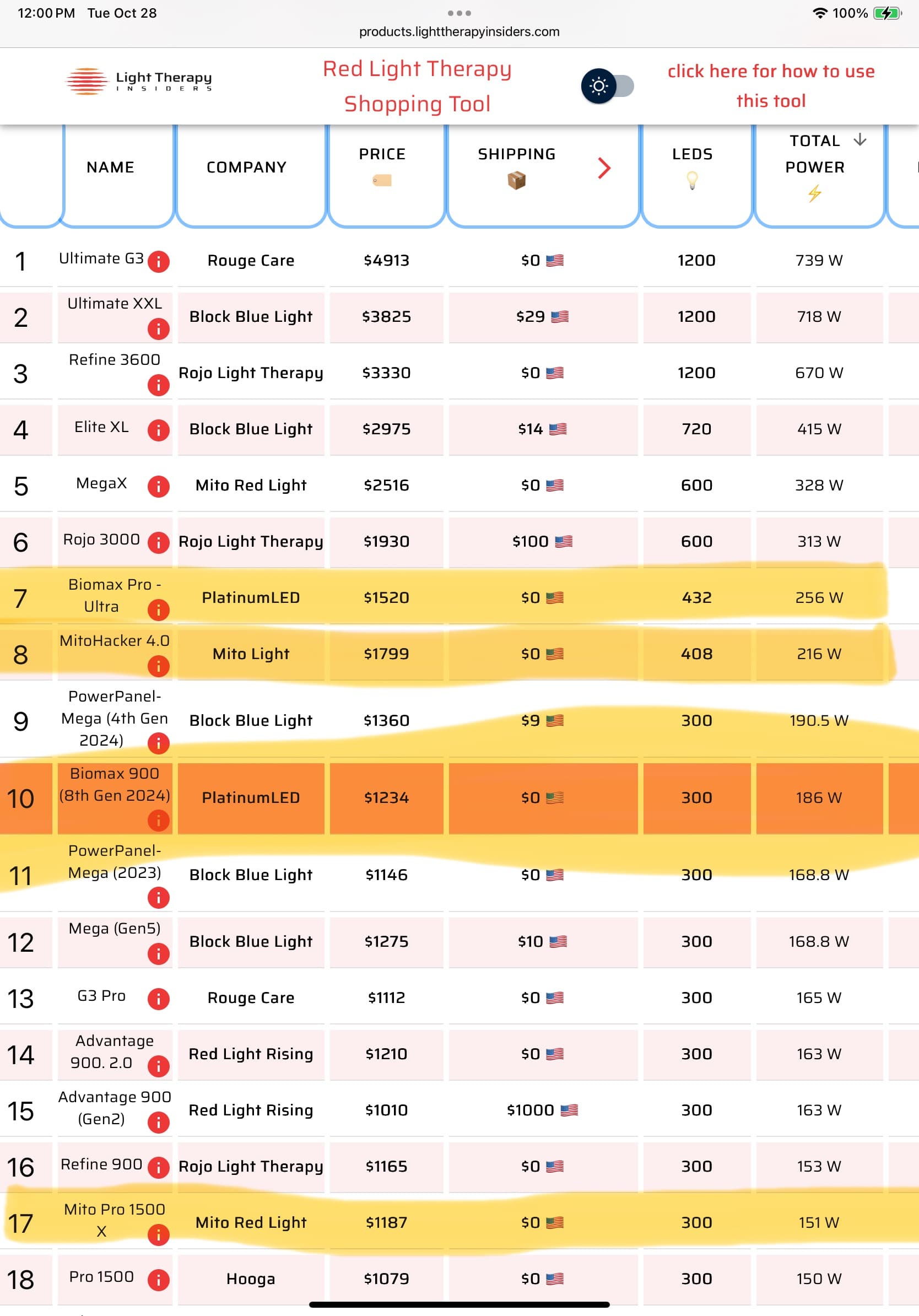
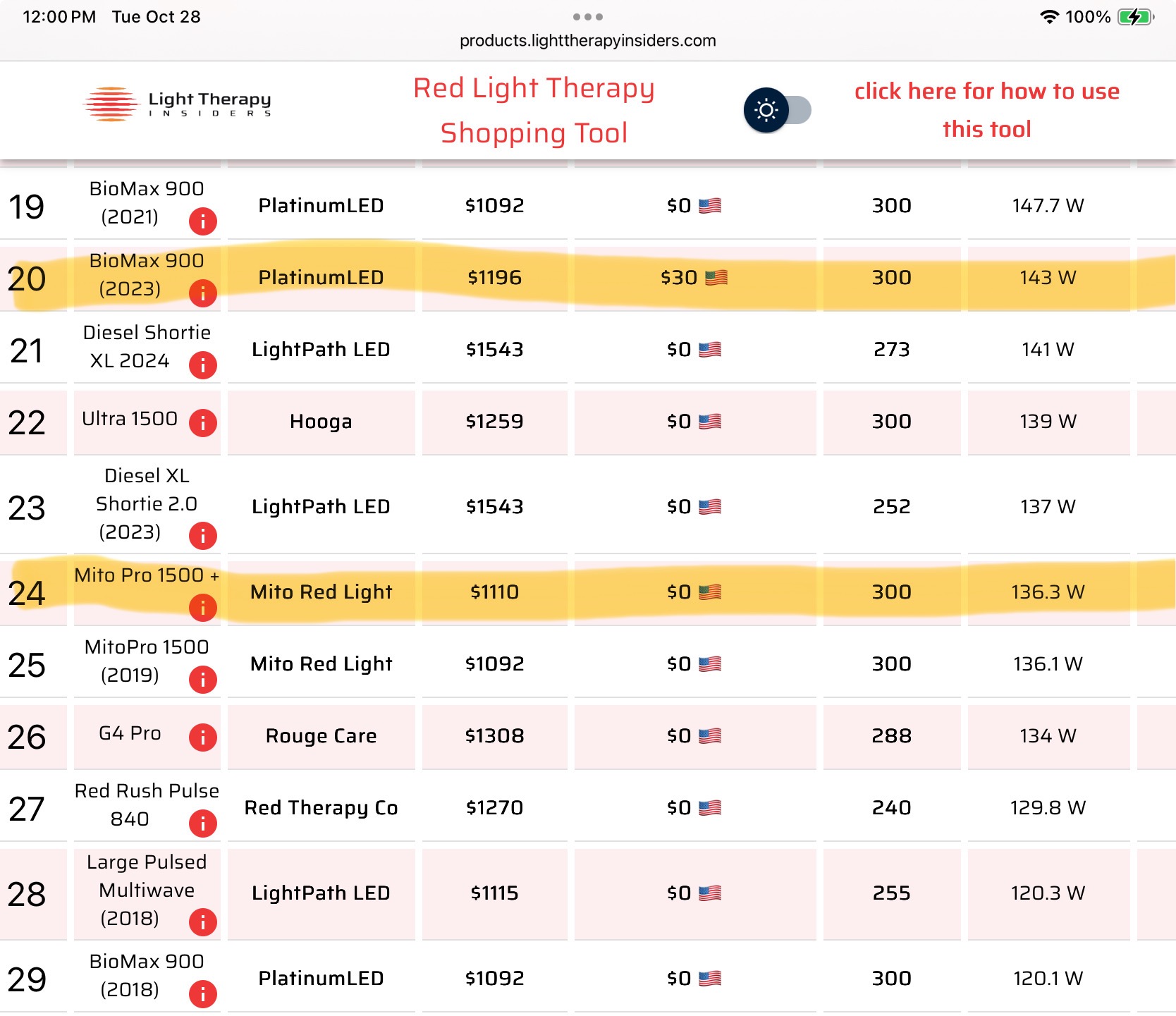
I suggest using this shopping tool when buying panels. https://products.lighttherapyinsiders.com/ It gives the power of the different panels measured independently by Alex Fergus, a guy that has tested dozens of red light devices. Thing is, you can’t trust the numbers the manufacturers give since they often exaggerate the power quite a bit. This tool gives you an idea of the real power of the panels.
Using the above tool you can see that the Biomax Pro ultra has around 2.5-times more power and the Biomax 900 almost 2.5-5imes more than the MitoAdapt Min panel. That’s a huge difference. Now the MitoAdapt Min panel is likely not the panel you would get from that brand, but it gives an idea of the power of their panels. Usually the different sizes from the same brand have very close to the same power per cm2 so I would expect the MitoAdapt 4.0 to also be a lot less powerful than the Biomax panels.
There is no Biomox Pro panel in the shopping tool so I don’t know how powerful that one is.
Given this, I would get either one of the Biomax panels. The reason I recommend them is because they are so powerful so even though they are expensive, you get good value for money if you buy them. Note that more power doesn’t just mean that you need shorter time to get the effecive dose. It also means that alternatively you could use the panel at a greater distance to cover a larger area while not taking longer than it would with a less powerful panel. So any way you look at it, more power is more bang for the buck.
All these extra frequencies and settings are mostly for show and don’t really have practical value or added benefits. I haven’t seen good evidence of more frequencies being clearly more beneficial than just few as long as the few are good. Basically, all you need is some one frequency in the effective part of the red spectrum and some in the effective part of the infrared spectrum and optimally they can be turned on or off separately (as an example sometimes it may be useful to only use infrared and to skip the red light). Most of the popular panels out there fulfil this requirement.
I watched no fewer than 1 million Alex Fergus videos yesterday!!! That is how I heard about the new Mito…
Thanks, now I’m more focused on my deep dive… I’ll be back!
@Olafurpall
I’ll go review his videos again, but when you mention power, is it max wattage that I’m looking for?
I don’t know if Mito hacker is the EU version of the adapt 4.0, but I’ll find out.
The Mito Pro 1500 appears to me to be a step down from the Adapt line, but I’m including it because the wattage is listed.
Sorry, I should have been more clear. It’s not max wattage that you should look for. That just tells you how much power the panel consumes. What’s important is the average irradiance. That’s the power you get from the light per square centimeter.
“It’s not max wattage that you should look for”
What’s important is the average irradiance."
I have examined and bought several 12" panels and spotlights from different brands. If the panels have the same number of LEDs per square foot and use similar parabolic reflectors, the red light output strongly correlates with max wattage.
If the panels have the same number of LEDs, the panel using the most power indicates more expensive LEDs were used. So, if they are similar in other respects, you can take it the bank that the ones consuming more power are putting out more light (irradiance).
This makes sense as a rough estimate of the irradiance the panels emit.
OMG I love this… I’m thinking your new avatar was born
And yes, incase the peanut gallery is curious, I spent my entire night watching more Alex Fergus Videos (he’s really great!)… . And joined his fb group… I’m a whack job at this point!
Also, I’m now seeing a lot of talk about 1060 wavelength and how it might be better for brain health and osteoporosis.
I’m taking everything I read with a grain of salt, but does anyone think having that in my panel is a big deal?