I stumbled upon this article in a Chinese community, I translated it into English to share here.
Rapamycin Shortens the Lifespan of Diabetic Mice
The db/db mouse is a murine model of diabetes. Unlike other mice, db/db mice exhibit numerous key features of human diabetes, such as an increase in Aldhla3 expression and a decrease in Nkx6.1 in islet cells [1]. Therefore, db/db mice serve as a nearly ideal model for simulating patients with type 2 diabetes.
A study [2] found that when 4-month-old db/db mice were placed on a rapamycin-containing diet, their mortality rate increased by 1.7-fold compared to the control group, indicating that rapamycin shortens the lifespan of db/db mice.
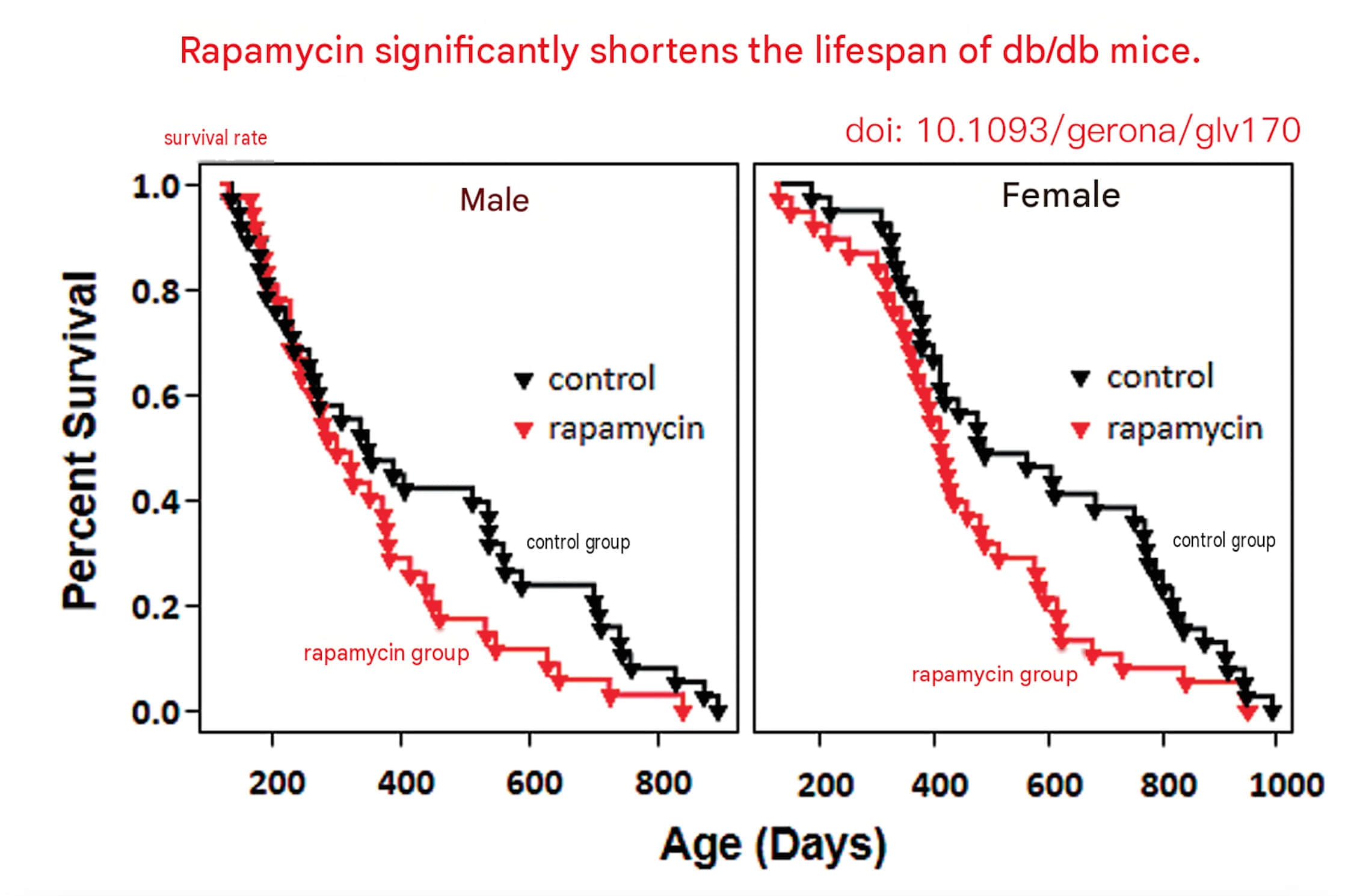
Autopsies of these mice revealed that purulent inflammation was the primary cause of death, which is consistent with a meta-analysis [3] incorporating 10 clinical studies, which found that patients taking rapamycin exhibited perifollicular purulent inflammation within a few weeks of administration.
So, will patients with insulin resistance who take rapamycin for anti-aging or suppress the mTOR pathway through other means kick the bucket earlier? Let us wait and see what answers the biohackers provide.
mTOR-Related Genes Are Unrelated to Human Longevity
A 48-year follow-up of 440 Japanese individuals aged 95 and older [4] (the HHP+HAAS study), published in 2015, found no significant differences in mTOR-related genes among these long-lived individuals compared to those who died before age 80. This suggests that the mTOR pathway is unrelated to human longevity.
However, a genetic analysis of 417 Dutch individuals aged 89 and older [5] (the LLS study), published in 2012, found differential expression of 7 mTOR genes compared to a middle-aged control group, which seemingly indicates that mTOR is associated with “longevity.”
Nevertheless, according to statistics [6], only 30% of 89-year-olds live to be 95 or older; therefore, hyping age 89 as longevity is misleading. Furthermore, the FOXO3 gene has been confirmed in numerous studies [7] [8] [9] [10] [11] [12] [13] to be associated with longevity, yet that study [5] failed to find any differences, further demonstrating that the “longevity” defined in that study has nothing to do with true longevity. In fact, existing research [7] has confirmed that differences in the FOXO3 gene increase by 42% from the 80s to the 90s.
Caloric Restriction, Associated with mTOR Inhibition, Promotes Human Aging
It is well known that caloric restriction typically induces the inhibition of mTOR, both in mice and humans [14].
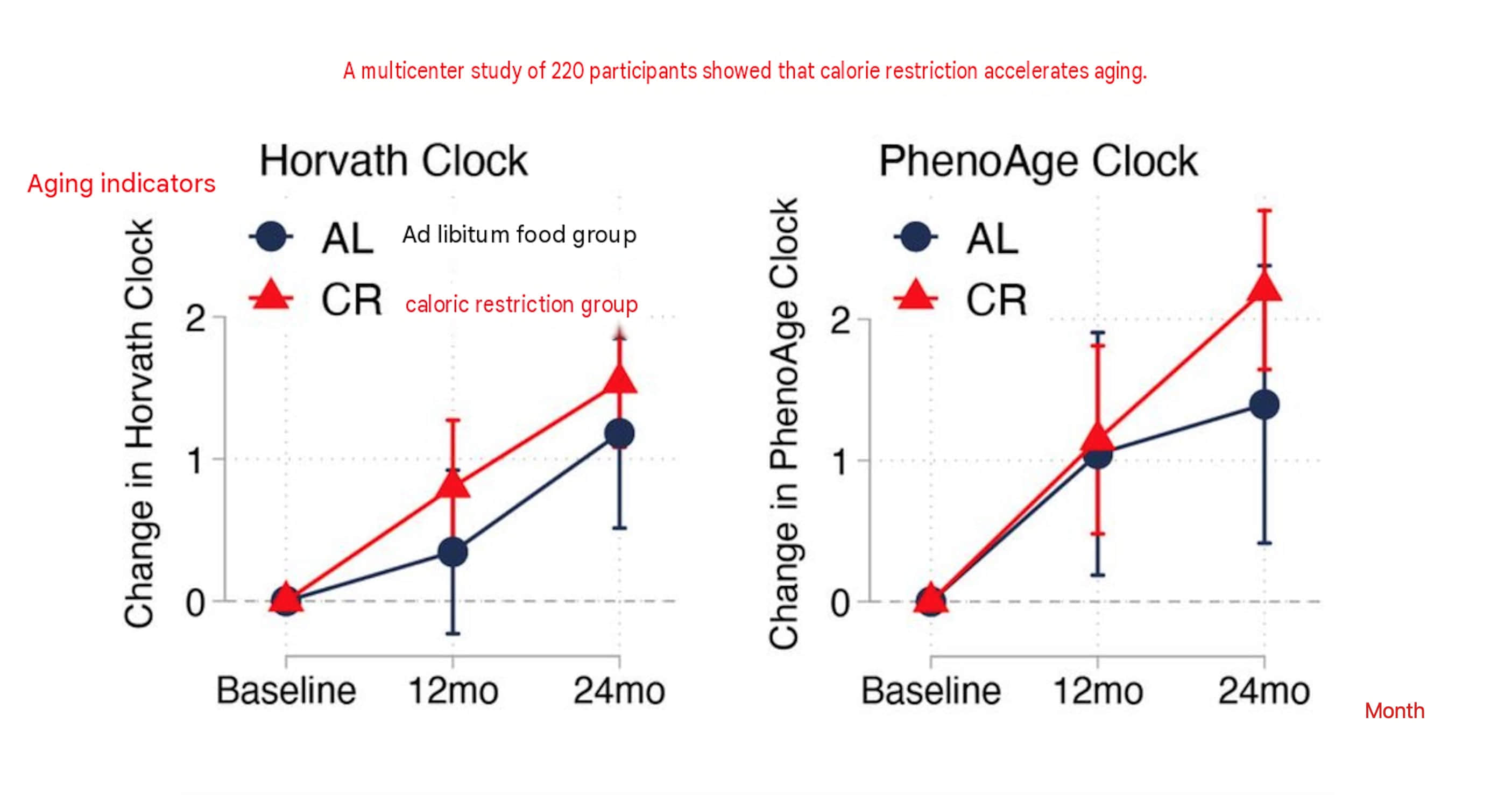
Epigenetic age is an indicator that simulates physiological age, where a higher epigenetic age represents a faster rate of aging. In a multicenter clinical study involving 220 participants [15] [16] (the CALERIE™ trial), two groups of subjects received caloric restriction and ad libitum diet interventions, respectively.
The results showed that, compared to the ad libitum group, the epigenetic age of the caloric restriction group increased significantly, indicating that caloric restriction promotes human aging.
Caloric Restriction, Associated with mTOR Inhibition, Shortens the Lifespan of Primates
Next, let us look at studies on rhesus macaques, which belong to the same primate order as humans.
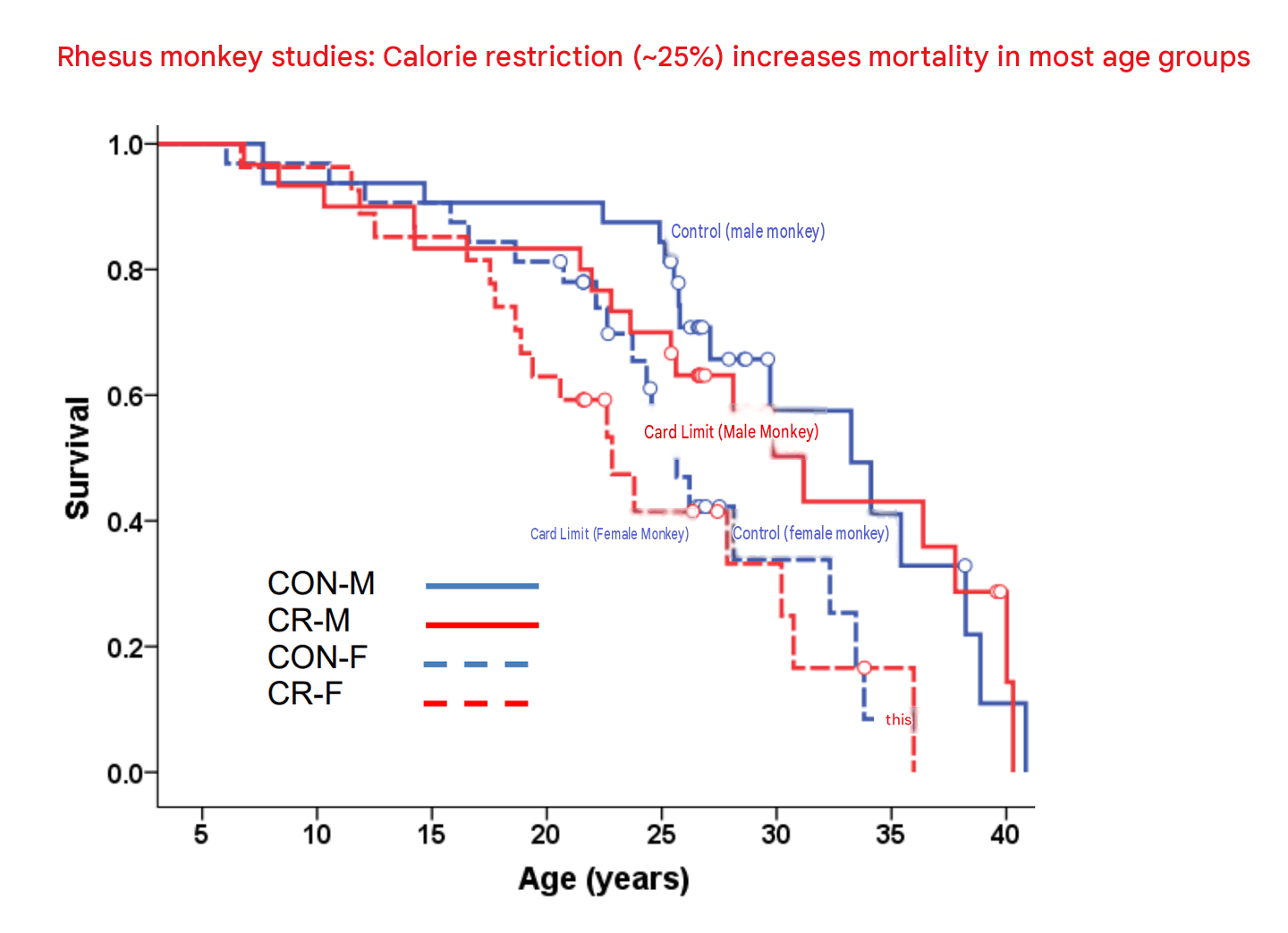
In a 23-year study involving 86 rhesus macaques [17] (the NIA+WNPRC study), the monkeys were divided into a caloric restriction group and an ad libitum group. The caloric restriction group began a calorie-restricted diet ranging from $-21.9%$ to $-25.9%$ at various ages. The results showed that caloric restriction failed to extend the lifespan of these rhesus macaques and, across most age groups, actually increased mortality rates.
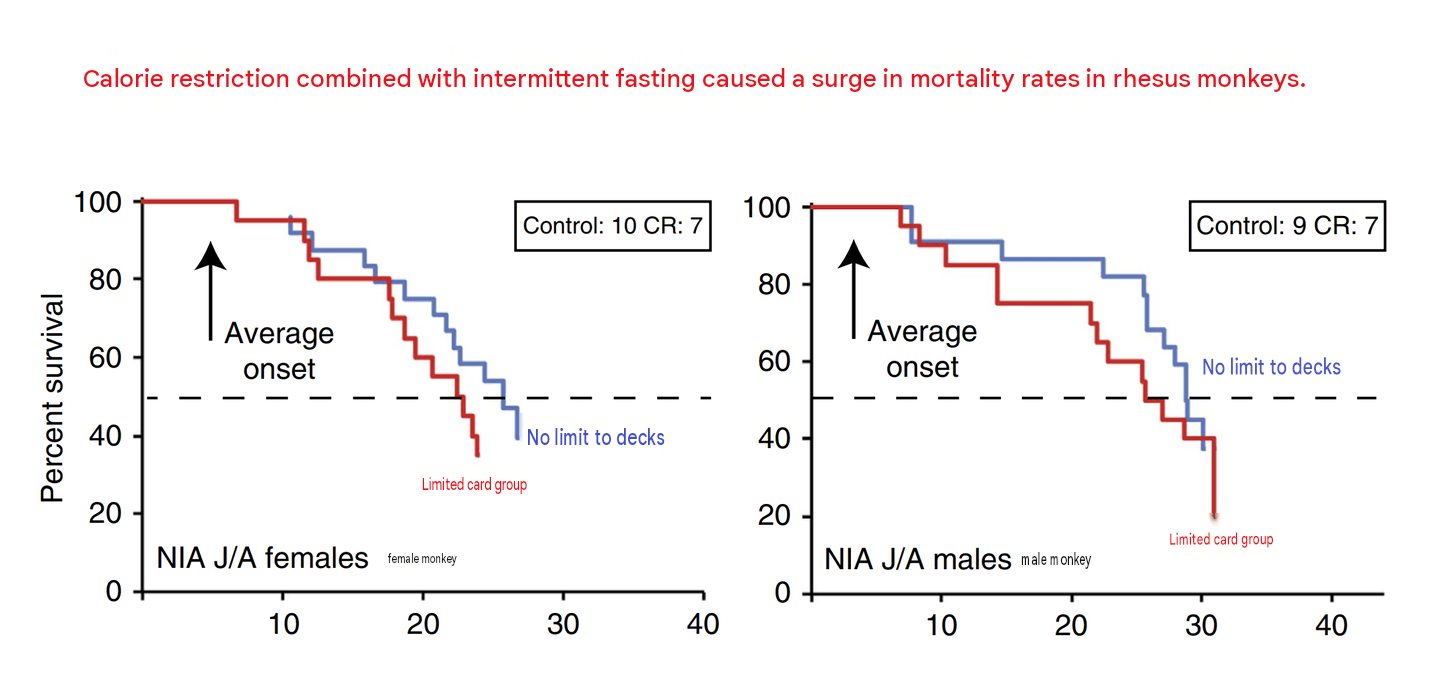
Among them, in the NIA J/A rhesus macaque study, these monkeys were fed using an intermittent fasting regimen: two meals per day at 6:30 and 13:00 [18]. The leftover food from the 13:00 meal was not removed, meaning the caloric restriction group likely finished their food during the second meal and had nothing to eat in the evening. The results showed that this intermittent fasting-based caloric restriction significantly increased the mortality rate of these rhesus macaques across all age groups.
Therefore, for rhesus macaques, although caloric restriction inhibits the mTOR pathway, it has no beneficial effect on mortality and may even shorten their lifespan. So, for humans—who are also primates—if we practice intermittent fasting combined with caloric restriction for health and wellness, might we also end up shortening our lifespans?
reference:
[1] Burke SJ, Batdorf HM, Burk DH, Noland RC, Eder AE, Boulos MS, Karlstad MD, Collier JJ. db/db Mice Exhibit Features of Human Type 2 Diabetes That Are Not Present in Weight-Matched C57BL/6J Mice Fed a Western Diet. J Diabetes Res. 2017;2017:8503754. doi: 10.1155/2017/8503754. Epub 2017 Sep 6. PMID: 29038790; PMCID: PMC5606106.
[2] Sataranatarajan K, Ikeno Y, Bokov A, Feliers D, Yalamanchili H, Lee HJ, Mariappan MM, Tabatabai-Mir H, Diaz V, Prasad S, Javors MA, Ghosh Choudhury G, Hubbard GB, Barnes JL, Richardson A, Kasinath BS. Rapamycin Increases Mortality in db/db Mice, a Mouse Model of Type 2 Diabetes. J Gerontol A Biol Sci Med Sci. 2016 Jul;71(7):850-7. doi: 10.1093/gerona/glv170. Epub 2015 Oct 5. PMID: 26442901; PMCID: PMC4906320.
[3] Gomez-Fernandez C, Garden BC, Wu S, Feldman DR, Lacouture ME. The risk of skin rash and stomatitis with the mammalian target of rapamycin inhibitor temsirolimus: a systematic review of the literature and meta-analysis. Eur J Cancer. 2012 Feb;48(3):340-6. doi: 10.1016/j.ejca.2011.11.028. Epub 2011 Dec 27. PMID: 22206873.
[4] Morris BJ, Donlon TA, He Q, Grove JS, Masaki KH, Elliott A, Willcox DC, Allsopp R, Willcox BJ. Genetic analysis of TOR complex gene variation with human longevity: a nested case-control study of American men of Japanese ancestry. J Gerontol A Biol Sci Med Sci. 2015 Feb;70(2):133-42. doi: 10.1093/gerona/glu021. Epub 2014 Mar 3. PMID: 24589862; PMCID: PMC4366598.
[5] Passtoors WM, Beekman M, Deelen J, van der Breggen R, Maier AB, Guigas B, Derhovanessian E, van Heemst D, de Craen AJ, Gunn DA, Pawelec G, Slagboom PE. Gene expression analysis of mTOR pathway: association with human longevity. Aging Cell. 2013 Feb;12(1):24-31. doi: 10.1111/acel.12015. Epub 2012 Nov 23. PMID: 23061800.
[6] Arias, E. (2011). United States life tables, 2007. National vital statistics reports. vol 59 no 9. Hyattsville, MD: National Center for Health Statistics.
[7] Willcox BJ, Donlon TA, He Q, Chen R, Grove JS, Yano K, Masaki KH, Willcox DC, Rodriguez B, Curb JD. FOXO3A genotype is strongly associated with human longevity. Proc Natl Acad Sci U S A. 2008 Sep 16;105(37):13987-92. doi: 10.1073/pnas.0801030105. Epub 2008 Sep 2. PMID: 18765803; PMCID: PMC2544566.
[8] Flachsbart F, Caliebe A, Kleindorp R, Blanché H, von Eller-Eberstein H, Nikolaus S, Schreiber S, Nebel A. Association of FOXO3A variation with human longevity confirmed in German centenarians. Proc Natl Acad Sci U S A. 2009 Feb 24;106(8):2700-5. doi: 10.1073/pnas.0809594106. Epub 2009 Feb 5. PMID: 19196970; PMCID: PMC2650329.
[9] Anselmi CV, Malovini A, Roncarati R, Novelli V, Villa F, Condorelli G, Bellazzi R, Puca AA. Association of the FOXO3A locus with extreme longevity in a southern Italian centenarian study. Rejuvenation Res. 2009 Apr;12(2):95-104. doi: 10.1089/rej.2008.0827. PMID: 19415983.
[10] Pawlikowska L, Hu D, Huntsman S, Sung A, Chu C, Chen J, Joyner AH, Schork NJ, Hsueh WC, Reiner AP, Psaty BM, Atzmon G, Barzilai N, Cummings SR, Browner WS, Kwok PY, Ziv E; Study of Osteoporotic Fractures. Association of common genetic variation in the insulin/IGF1 signaling pathway with human longevity. Aging Cell. 2009 Aug;8(4):460-72. doi: 10.1111/j.1474-9726.2009.00493.x. Epub 2009 May 31. PMID: 19489743; PMCID: PMC3652804.
[11] Pawlikowska L, Hu D, Huntsman S, Sung A, Chu C, Chen J, Joyner AH, Schork NJ, Hsueh WC, Reiner AP, Psaty BM, Atzmon G, Barzilai N, Cummings SR, Browner WS, Kwok PY, Ziv E; Study of Osteoporotic Fractures. Association of common genetic variation in the insulin/IGF1 signaling pathway with human longevity. Aging Cell. 2009 Aug;8(4):460-72. doi: 10.1111/j.1474-9726.2009.00493.x. Epub 2009 May 31. PMID: 19489743; PMCID: PMC3652804.
[12] Soerensen M, Dato S, Christensen K, McGue M, Stevnsner T, Bohr VA, Christiansen L. Replication of an association of variation in the FOXO3A gene with human longevity using both case-control and longitudinal data. Aging Cell. 2010 Dec;9(6):1010-7. doi: 10.1111/j.1474-9726.2010.00627.x. Epub 2010 Oct 21. PMID: 20849522; PMCID: PMC2992870.
[13] Soerensen M, Dato S, Christensen K, McGue M, Stevnsner T, Bohr VA, Christiansen L. Replication of an association of variation in the FOXO3A gene with human longevity using both case-control and longitudinal data. Aging Cell. 2010 Dec;9(6):1010-7. doi: 10.1111/j.1474-9726.2010.00627.x. Epub 2010 Oct 21. PMID: 20849522; PMCID: PMC2992870.
[14] Blagosklonny MV. Calorie restriction: decelerating mTOR-driven aging from cells to organisms (including humans). Cell Cycle. 2010 Feb 15;9(4):683-8. doi: 10.4161/cc.9.4.10766. Epub 2010 Mar 2. PMID: 20139716.
[15] Waziry, R., Corcoran, D. L., Huffman, K. M., Kobor, M. S., Kothari, M., Kraus, V. B., … & Belsky, D. W. (2021). Effect of long-term caloric restriction on DNA methylation measures of biological aging in healthy adults: CALERIE™ trial analysis. medRxiv.
[16] Ramaker ME, Corcoran DL, Apsley AT, Kobor MS, Kraus VB, Kraus WE, Lin DTS, Orenduff MC, Pieper CF, Waziry R, Huffman KM, Belsky DW. Epigenome-wide Association Study Analysis of Calorie Restriction in Humans, CALERIETM Trial Analysis. J Gerontol A Biol Sci Med Sci. 2022 Dec 29;77(12):2395-2401. doi: 10.1093/gerona/glac168. PMID: 35965483; PMCID: PMC9799188.
[17] Mattison JA, Roth GS, Beasley TM, Tilmont EM, Handy AM, Herbert RL, Longo DL, Allison DB, Young JE, Bryant M, Barnard D, Ward WF, Qi W, Ingram DK, de Cabo R. Impact of caloric restriction on health and survival in rhesus monkeys from the NIA study. Nature. 2012 Sep 13;489(7415):318-21. doi: 10.1038/nature11432. PMID: 22932268; PMCID: PMC3832985.
[18] Mattison JA, Colman RJ, Beasley TM, Allison DB, Kemnitz JW, Roth GS, Ingram DK, Weindruch R, de Cabo R, Anderson RM. Caloric restriction improves health and survival of rhesus monkeys. Nat Commun. 2017 Jan 17;8:14063. doi: 10.1038/ncomms14063. PMID: 28094793; PMCID: PMC5247583.
1 Like
Yes - don’t take rapamycin if you have uncontrolled diabetes.
Discussed previously here in this thread:
1 Like
LOL, this is getting weaker and weaker. I mean, what can one say. Studies referenced are either not applicable or misrepresented. I think this is bottom of the barrel stuff - and I say that as someone who has literally spent decades studying and years practicing CR. The monkey study I have discussed for years with top people in the field. Same with the CALERIE studies (original and follow ups). I have referenced both on this site repeatedly. These articles posted by the OP are trash not worth engaging with. Criticism is fine - in fact vital. But there must be minimum quality standards - these here fall far below.
4 Likes
I looked through many other articles this author wrote in their column, including ones on rapamycin, metformin, SGLT2 inhibitors, intermittent fasting, and more, and almost all of them list how these things are harmful to health, which contradicts mainstream views. Like “Healthy people taking metformin actually end up getting diabetes. Metformin promotes cancer. Metformin causes neurodegenerative diseases such as Parkinson’s and dementia.”
I was shocked when I first read them. Now I feel that all these articles can indeed be ignored.
1 Like