Rapamycin.news stats

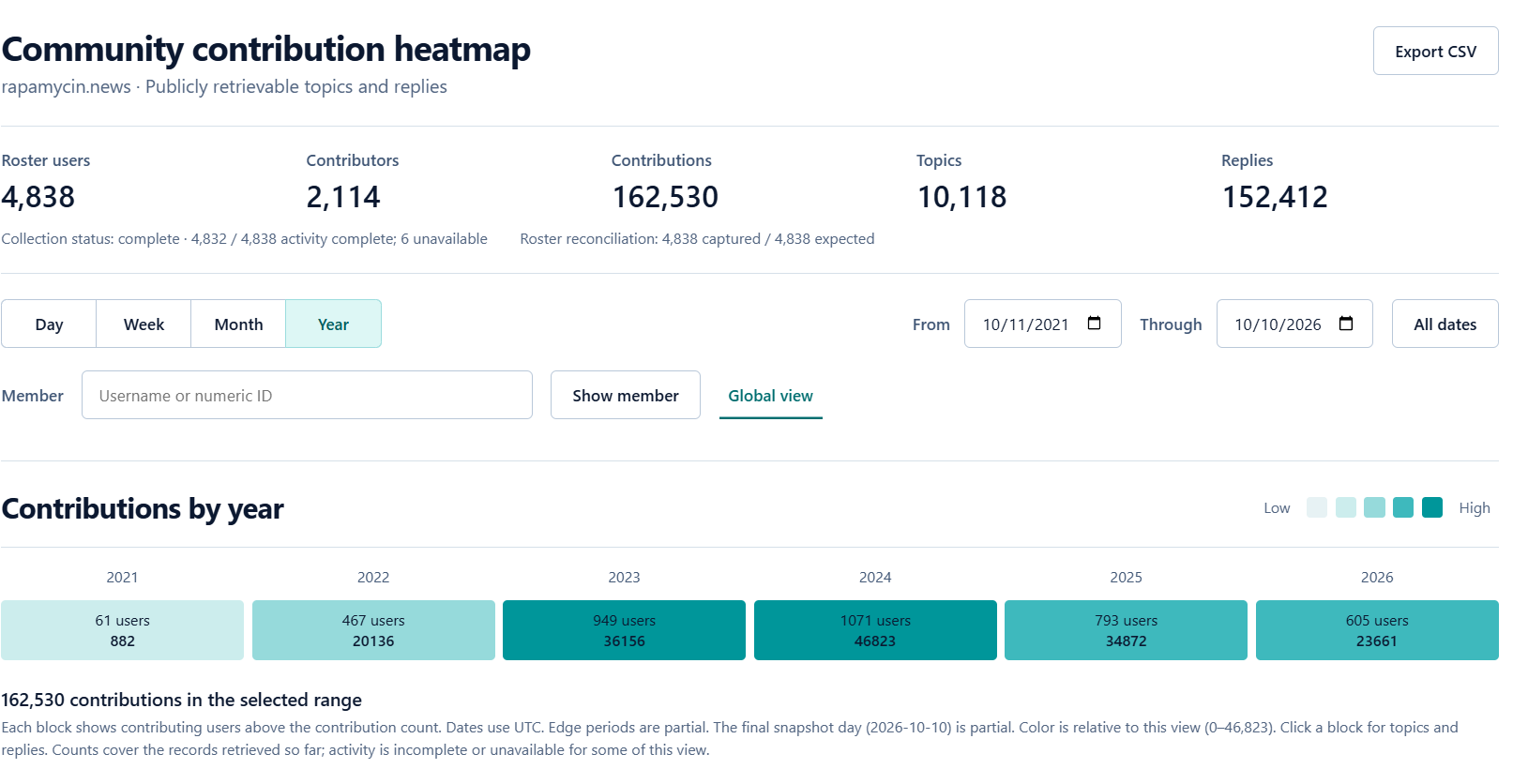
Statistics from its five year existence:

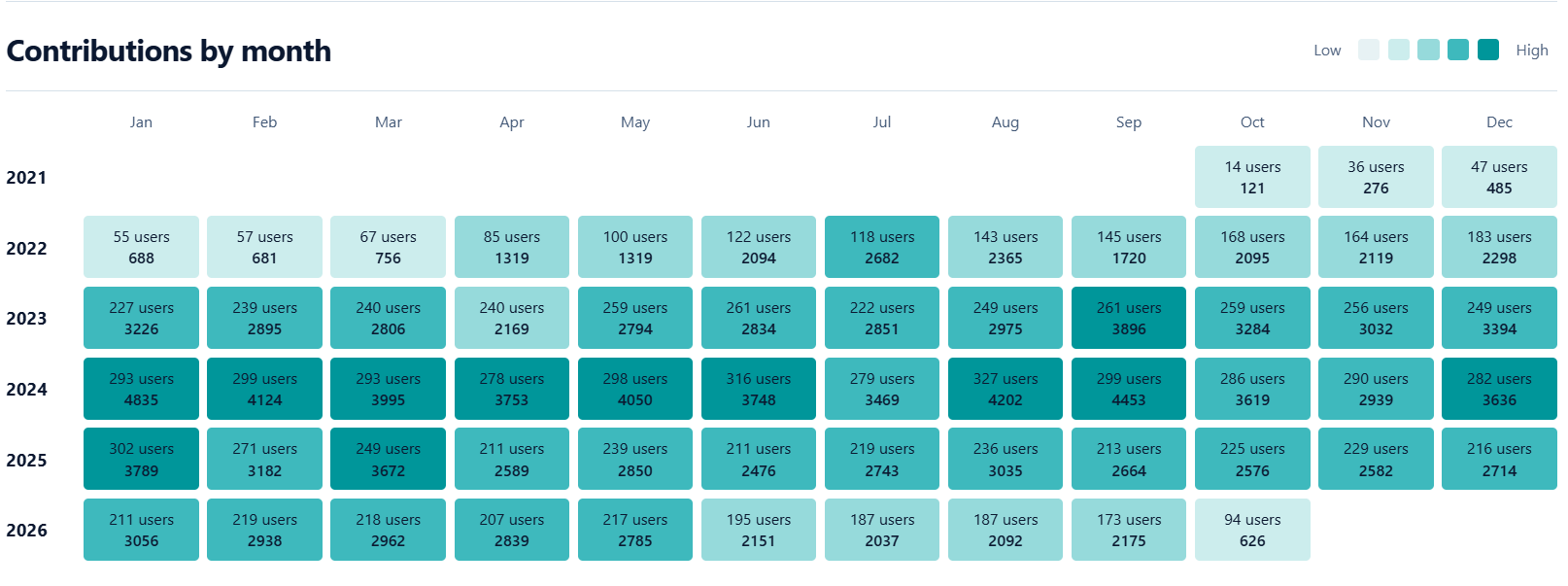
2024 was clearly peak rapa news. C’mon people, poast harder!

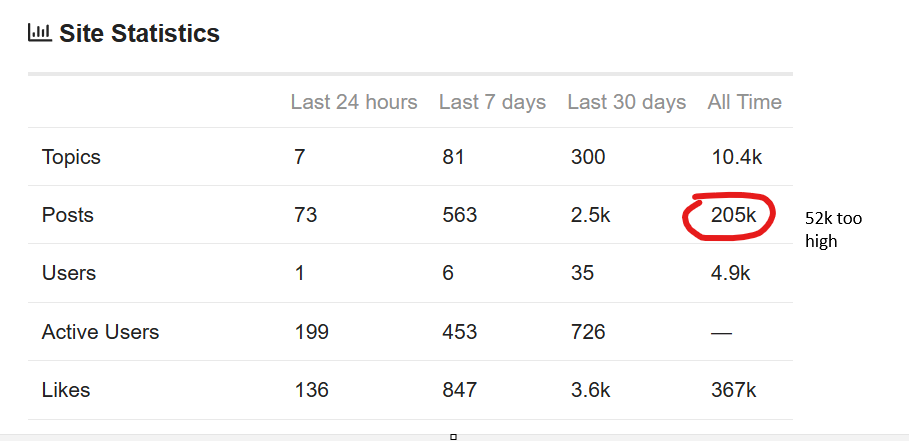
One caveat here: The About page reported 204k total posts, this process found 152K. A number for the last seven days is also reported, and retrieving the actual publicly retrievable posts for that period also produced a much lower number, which matched this process. Apparently DMs are included in the About total, maybe there is a thriving DM community.

3 Likes

What did you use (or where did you get) that summary? We have about 5,000 registered community members now.

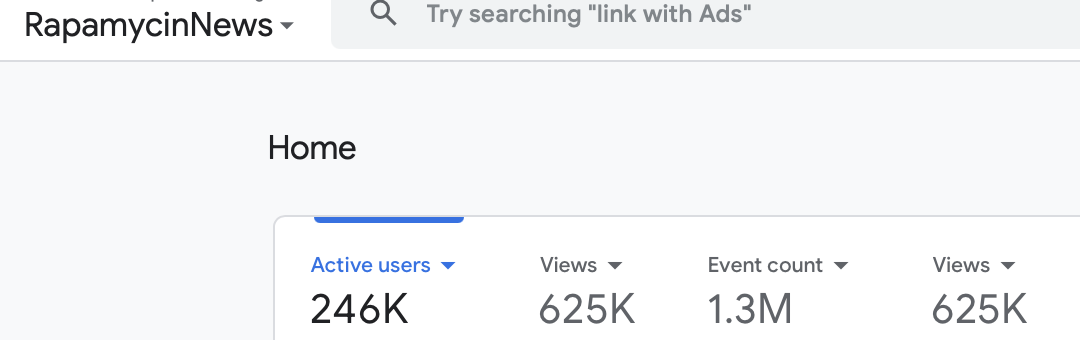
Here are my latest Google Analytics summary from the past month - lots of readers (that has ramped as I ramped up the news / science coverage), but only a small percent are posters. We typically see between 200K and 400K unique visitors per month. I would encourage people with a strong interest and background in science and medicine to get more involved.

I’m thinking of changing the name of the site so that it’s less suggestive of a focus only on rapamycin (to reflect its broader focus on longevity hacking of all types). The Press coverage on Rapamycin clearly peaked in 2025, and has fallen off, and it’s going to be a few years before the dog and human clinical studies finally release any data.

I suspect a lot of people think a “rapamycin” named website is just covering rapamycin… so the current name is very misleading. Rapamycin is only a small part of what we actually cover.

7 Likes

IMO, there are two primary reasons for the slowdown.

One, we have explored and posted results and opinions on most of the realistic life extension drugs and supplements. Some, like statins, we have thoroughly flogged and beaten into the ground. So, until some new discoveries that have a major impact, as rapamycin did, things have become a little boring. I am not interested in another opinion about statins, VO2max, the pros and cons of this and that questionable drug or supplement. Currently, one of the main topics of discussion is whether or not we can continue to get drugs from India, which is not advancing the science of longevity.

Two, the influx of more educated members who are doctors, whether MD or PhD. This leads to fewer postings from laymen like me, who can only parrot what they have read or post anecdotal results and opinions. This is a good thing. I am here to learn from those more knowledgeable than me. I am limited mainly to opinion piece postings.

Bottom line: Maybe fewer, but on the whole, more educated postings, which in IMO is a good thing. I am waiting for something new to get excited about.

15 Likes

Initially, I was attracted to the site by my alignment with the statement outline in the ‘About’ section.

We are a group of science-oriented professionals interested in longevity and healthspan . . . We are dedicated to healthier, longer lives through a good diet, regular exercise, and longevity medicines and therapies as they become identified and available. We are your “early adopters” of new longevity technologies and seek to help speed their validation and adoption.>

My interest and participation has grown over the past few years because of the depth and breadth of the conversations. I find value in the comments and analyses of experts and the questions of those just getting started in geroprotection. It can also be gratifying to be able to help a newcomer get started.

A broader, more inclusive, URL might increase first looks but I do not think the current URL has much to do with rather a first time visitor decides to stick around.

5 Likes

I agree. This seems like a period of incremental progress, waiting (or hoping) for the next jump forward. I believe we could change that if we were to conduct a deep, granular dive – more than a tabulation of how long we have taken along with perceived effects – on the specifics of our experience. The first step in this process would be developing a research protocol.

Taking the other side, I believe I see steady improvement in the application of scientific standards to gero studies. The group is becoming a more sophisticated consumer of the research. AI has been helpful in that and the most recent versions are themselves much better at it.

4 Likes

I’d just like to say I prefer quality over quantity. I wouldn’t want to see a load of inane slop just for the sake of getting numbers up.

Otherwise, the analysis of the situation by @desertshores is spot on.

4 Likes

The evolution of discussion and activity in the longevity community appears to follow a fairly predictable trajectory.

Hype > Experimentation > Mechanistic understanding > Recognition of limitations > Waiting for clinical human data.

I believe the recent decline in activity reflects this trajectory rather than a loss of interest. As fields mature, the number of discussions often decreases, while the quality and sophistication of those discussions increase.

The senolytic field provides an excellent example. Between 2018 and 2021, there was tremendous excitement surrounding cellular senescence and the idea of eliminating so-called “zombie cells.” Dasatinib plus Quercetin (D+Q) - Fisetin and other senolytic approaches were widely viewed as potential breakthroughs that could dramatically improve healthspan and perhaps even extend lifespan.

The period from 2022 to 2024 brought a more critical evaluation of the evidence. Researchers and enthusiasts began asking harder questions about reproducibility, the lack of reliable biomarkers, tissue-specific effects, and whether promising animal results would translate into meaningful clinical benefits in humans.

By 2025 and 2026, the conversation had become even more nuanced. Some were asking whether senolytics work at all, other discussions focused on the magnitude of their potential effects, the populations most likely to benefit, and whether there would be any gains in human healthspan and lifespan. This shift has been accompanied by a growing degree of skepticism, not because the biology is uninteresting, but because the complexity of the biology has become increasingly apparent.

Rapamycin has followed a remarkably similar path. Early discussions were dominated by enthusiasm and broad claims about mTOR inhibition as a master longevity intervention. Over time, however, the focus shifted toward questions of optimal dosing, treatment schedules, side effects, lipid metabolism, immune function, exercise interactions, and individual variability in response.

In many ways, this pattern is characteristic not only of rapamycin and senolytics but of the supplement and longevity fields more broadly. New interventions often begin with a period of intense optimism and hype fueled by promising mechanistic data and animal studies. Eventually, however, the hype encounters the realities of rigorous scientific investigation.

Biological systems turn out to be more complex than initially assumed, effects are often smaller than expected, and translation from animal models to humans proves challenging.

This transition should not be viewed negatively. On the contrary, it is often a sign that a field is maturing. The most interesting questions are no longer “Does it work?” but rather “For whom does it work, under what circumstances, at what dose, and to what extent?” When a field reaches that stage, it has moved beyond enthusiasm and entered a nuanced phase and the realm of genuine scientific inquiry.
2 Likes

Via AI, using the Discourse API to read JSON. Additionally, I also had AI manually scroll through all the ‘activity’ for you and John Hemming, the top two posters. Around 27-28,000 posts. Manual vs. API counts matched perfectly. In fact, your profile count is three too high, vs. what’s in the activity list.

As previously mentioned, the About stats show more than 200K posts, whereas actually counting all the posts came up with 152K. I could have AI manually scroll every last activity record, but since counts were confirmed 100% accurate by two different methods, I’m pretty sure the AI counts are correct. Trivial, but an explanation would be interesting.

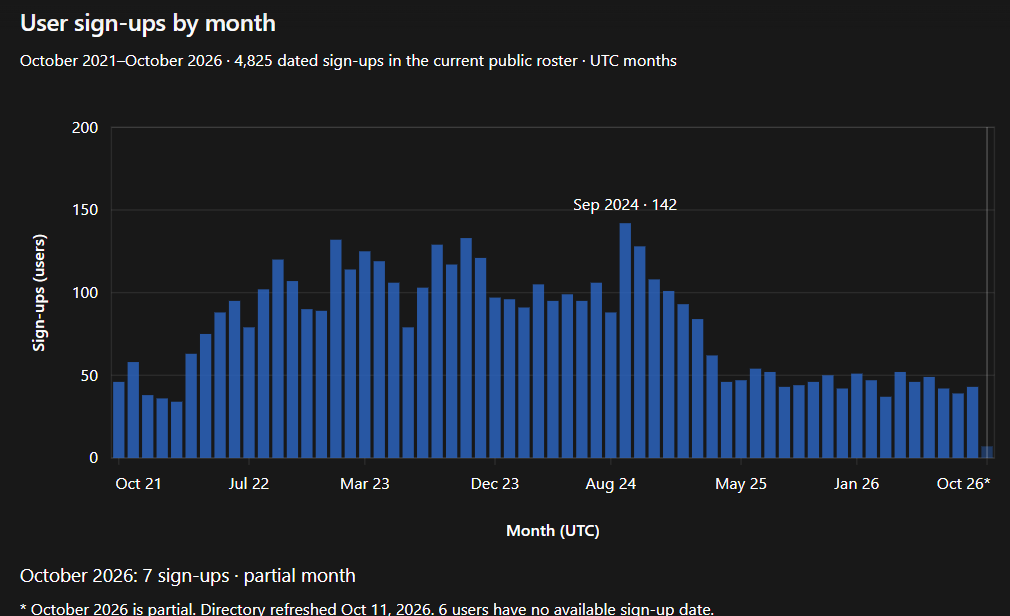
Here’s some more data - sign-ups by month:

On September 24, 2024, the New York Times ran an article mentioning rapa.news. Hence the spike. Followed by a waterfall decline to rates well below the preceding couple of years. Remarkably stable at low levels.

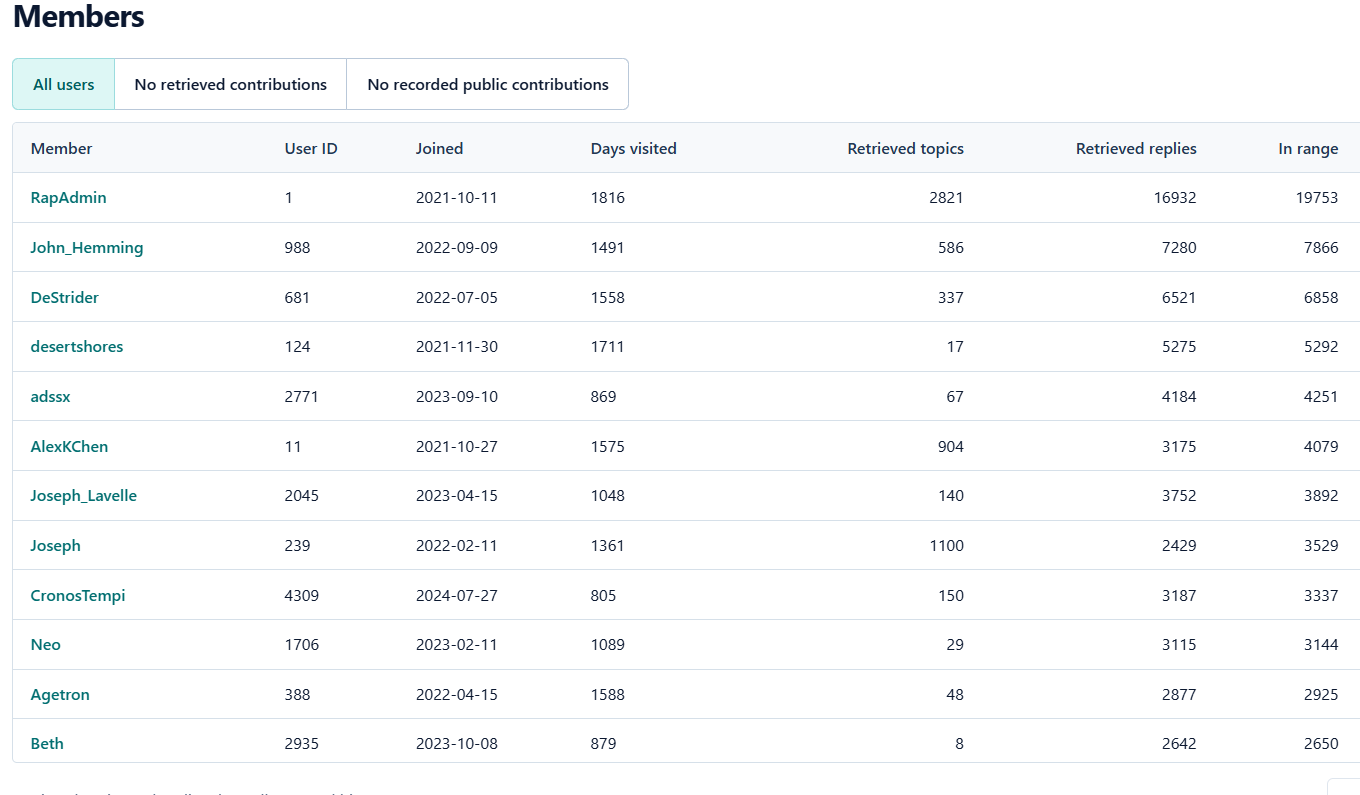
And here’s the leader board for individual posters (‘in range’ basically new topics + replies).

No doubt readership is booming. And perhaps Mr. Shores is correct, that there’s an extreme Lake Woebegone High School Effect - that despite the wide popularity, most all are too intimidated to participate by the fact that those who do so are so far above average.

3 Likes

I also find the n=1 posts to be interesting as well as the links to journal articles and the more technical posts.

2 Likes

Funny to see that after RapAdmin… and Desert Shores I am the 3rd most frequent visitor for number of total days.

Desert Shores… beat me. But he started as a member earlier. Hahaha :laughing:

1 Like

Thankyou to this site, members and rapadmin!

From my perspective and recent experience, when I started my first dosing of rapa, I can’tt remember exactly, 7yr ago, 5yr ago? I guess I could find my membership here for a date. Long time ago in new chemicals perspective. Then it was OTCs, sleep, excersize and … rapamycin. Thank god even back then it was cheap enough that the barrier was not cost nor access given india and my first rapa was 99% pure 2 oz +/- from china.

Just in the last 12 mo the advanced health coaching group I’m in its a new chemical every few days!!! Admitadly few of the new chemicals target longevity. They are usually mitochondrial enhancing, mitophogy or of all things an energy short circuit thus creating a thermogenic effect accelerating energy burning. In this sphere; SLU-PP-332 and 915, BAM-15, MVD-1/sana, mitochonic acid 5…

Also new/newis are the myostatin inhibitors that have fewer side effects and actually work, MID-15, the longer life IGF-1 called IGF-LR3 6hr half life, grows muscle! So many new BDNF/brain/nootrophics, once exotic Caribean Island only compounds now can be bought from within private health groups and shipped to ones home. Personally received; Cell Factors, Exosomes (injected not topical), SMS stem cells, MUSE stem cells… Sadly the days of $0.70/mg rapamycin are but a dream. In this last group I’ve got >>$15k into a small number of injections. No my hair i still thinning grey and I can’t lift 200# with one hand. ;-( Like taking rapa, how do I know I’m benefiting?

From my vantagepoint there’s 100x new things coming at me and nearly zero rapa news. Rapa has matured and new things are crowding out the channels.

Hope all are well and make it to 120 with Bryan Johnson. Which btw if I’m not mistaken has had bits and pieces of odd sounding news leak from his camp. Another thread for sure.

Take care, curt